Duas for every hour, exactly as narrated
Arabic, translation and source for every dua — nothing printed that a verified source does not carry.
Short answer: Dua is asking Allah directly — and this page gathers the duas the Qur’an and the Prophet ﷺ taught, for the morning, the evening, after prayer, anxiety, debt, decisions and your parents. Every dua carries its Arabic copied from its source, a translation with the translator named, and its reference. Nothing here is sold with a count or a promise.
Translations on this page: Qur’an — Dr. Mustafa Khattab (via quran.com); hadith — the translations printed at sunnah.com. Arabic is copied from those pages, never typed from memory. ImanAtlas presents sources, not fatwas; for a ruling on your situation, ask a qualified scholar.
The one dua that asks for everything
If you learn a single dua, the Qur’an itself gives one that asks for good in both worlds:
رَبَّنَآ ءَاتِنَا فِي ٱلدُّنْيَا حَسَنَةً وَفِي ٱلْأٓخِرَةِ حَسَنَةً وَقِنَا عَذَابَ ٱلنَّارِ
Rabbana atina fid-dunya hasanah, wa fil-akhirati hasanah, wa qina ‘adhaban-nar.
“Our Lord! Grant us the good of this world and the Hereafter, and protect us from the torment of the Fire.”
Qur’an 2:201 — quran.com/2/201
Start your day — morning azkar
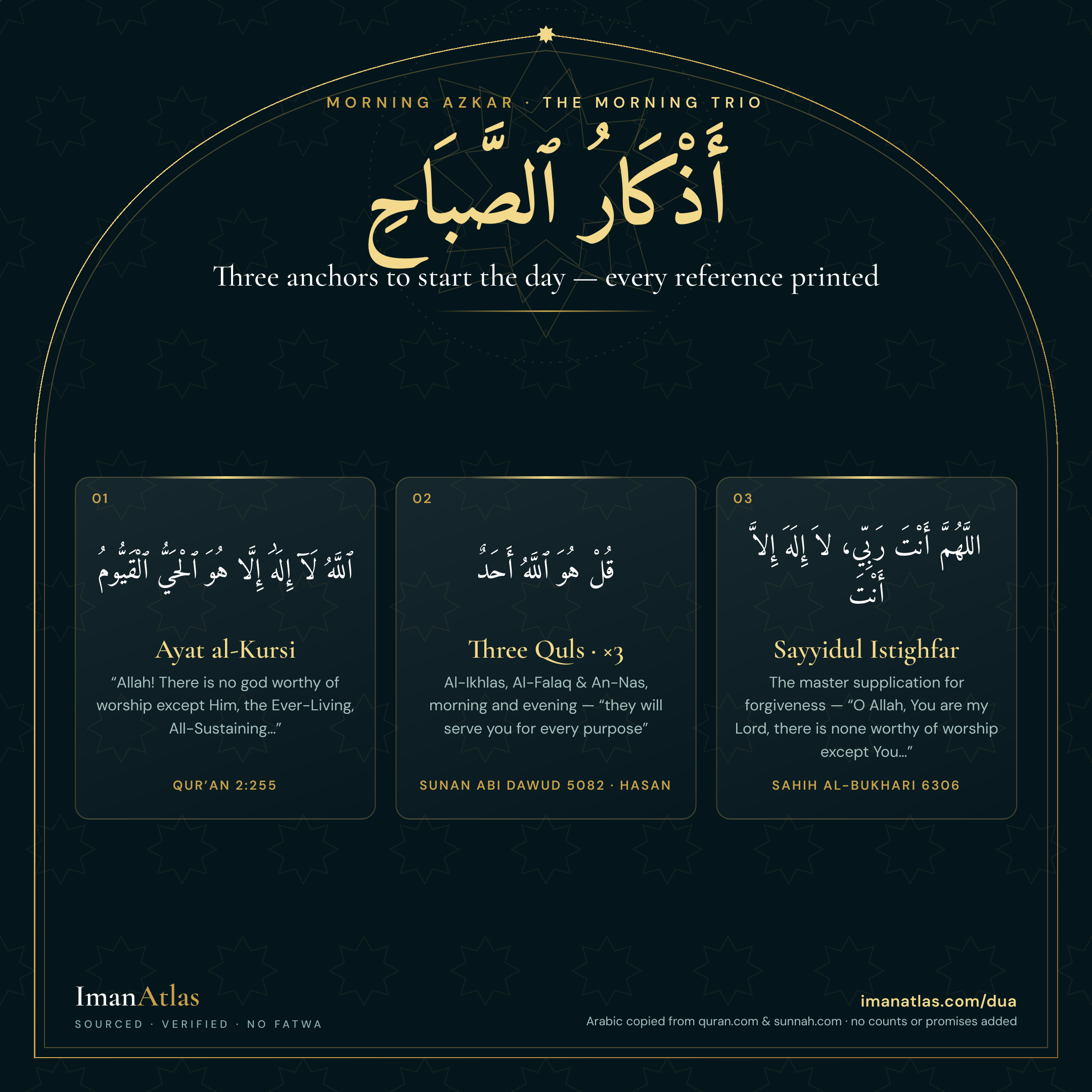
Three anchors carry the morning: the master supplication for forgiveness, the three short surahs, and the greatest verse of the Qur’an.
Sayyidul Istighfar — the master supplication for forgiveness
اللَّهُمَّ أَنْتَ رَبِّي، لاَ إِلَهَ إِلاَّ أَنْتَ، خَلَقْتَنِي وَأَنَا عَبْدُكَ، وَأَنَا عَلَى عَهْدِكَ وَوَعْدِكَ مَا اسْتَطَعْتُ، أَعُوذُ بِكَ مِنْ شَرِّ مَا صَنَعْتُ، أَبُوءُ لَكَ بِنِعْمَتِكَ عَلَىَّ وَأَبُوءُ لَكَ بِذَنْبِي، فَاغْفِرْ لِي، فَإِنَّهُ لاَ يَغْفِرُ الذُّنُوبَ إِلاَّ أَنْتَ
Allahumma anta Rabbi, la ilaha illa anta, khalaqtani wa ana ‘abduk, wa ana ‘ala ‘ahdika wa wa’dika mastata’t, a’udhu bika min sharri ma sana’t, abu’u laka bi-ni’matika ‘alayya wa abu’u laka bi-dhanbi, faghfir li, fa-innahu la yaghfirudh-dhunuba illa anta.
“O Allah, You are my Lord, there is none worthy of worship except You. You have created me, and I am Your servant, and I am faithful to Your covenant and promise as much as I can. I seek refuge in You from the evil of what I have done. I acknowledge Your blessings upon me, and I admit my sins. So forgive me, for none forgives sins except You.” The hadith adds: “If somebody recites it during the day with firm faith in it, and dies on the same day before the evening, he will be from the people of Paradise; and if somebody recites it at night with firm faith in it, and dies before the morning, he will be from the people of Paradise.”
Sahih al-Bukhari 6306 — sunnah.com/bukhari:6306
Ayat al-Kursi — the Verse of the Throne
ٱللَّهُ لَآ إِلَٰهَ إِلَّا هُوَ ٱلْحَيُّ ٱلْقَيُّومُ ۚ لَا تَأْخُذُهُۥ سِنَةٌ وَلَا نَوْمٌ ۚ لَّهُۥ مَا فِي ٱلسَّمَٰوَٰتِ وَمَا فِي ٱلْأَرْضِ ۗ مَن ذَا ٱلَّذِي يَشْفَعُ عِندَهُۥٓ إِلَّا بِإِذْنِهِۦ ۚ يَعْلَمُ مَا بَيْنَ أَيْدِيهِمْ وَمَا خَلْفَهُمْ ۖ وَلَا يُحِيطُونَ بِشَيْءٍ مِّنْ عِلْمِهِۦٓ إِلَّا بِمَا شَآءَ ۚ وَسِعَ كُرْسِيُّهُ ٱلسَّمَٰوَٰتِ وَٱلْأَرْضَ ۖ وَلَا يَـُٔودُهُۥ حِفْظُهُمَا ۚ وَهُوَ ٱلْعَلِيُّ ٱلْعَظِيمُ
Allahu la ilaha illa Huwal-Hayyul-Qayyum. La ta’khudhuhu sinatun wa la nawm. Lahu ma fis-samawati wa ma fil-ard. Man dhal-ladhi yashfa’u ‘indahu illa bi-idhnih. Ya’lamu ma bayna aydihim wa ma khalfahum, wa la yuhituna bi-shay’im-min ‘ilmihi illa bima sha’. Wasi’a kursiyyuhus-samawati wal-ard, wa la ya’uduhu hifzuhuma, wa Huwal-‘Aliyyul-‘Azim.
“Allah! There is no god worthy of worship except Him, the Ever-Living, All-Sustaining. Neither drowsiness nor sleep overtakes Him. To Him belongs whatever is in the heavens and whatever is on the earth. Who could possibly intercede with Him without His permission? He fully knows what is ahead of them and what is behind them, but no one can grasp any of His knowledge — except what He wills to reveal. His Seat encompasses the heavens and the earth, and the preservation of both does not tire Him. For He is the Most High, the Greatest.”
Qur’an 2:255 — quran.com/2/255
The three Quls, three times
The Prophet ﷺ said: “Say: ‘Say, He is Allah, One’ [Surah Al-Ikhlas], and al-Mu’awwadhatan [Surah Al-Falaq and Surah An-Nas] three times in the morning and evening; they will serve you for every purpose.”
Sunan Abi Dawud 5082 (graded Hasan) — sunnah.com/abudawud:5082
Close your day — evening azkar and sleep
The evening mirrors the morning: Sayyidul Istighfar (above) is taught for the night as well, and the three Quls are repeated three times. Before sleep, one more anchor: the Prophet ﷺ confirmed the teaching given in the story of Abu Hurairah — “Whenever you go to bed, recite Ayat-al-Kursi… Allah will appoint a guard for you who will stay with you and no satan will come near you till morning.”
Sahih al-Bukhari 2311 — sunnah.com/bukhari:2311
After every prayer
Two sourced anchors. First, the same verse: “Whoever reads Ayat al-Kursi at the end of each mandatory prayer, nothing prevents him from entering Paradise except death.”
Sunan an-Nasa’i al-Kubra 9848 (graded Sahih by Ibn Hibban and al-Albani; numbering varies by edition) — the narration and its grading (quran.com).
Second, the dua Abu Bakr asked the Prophet ﷺ to teach him for inside his prayer, before the tasleem:
اللَّهُمَّ إِنِّي ظَلَمْتُ نَفْسِي ظُلْمًا كَثِيرًا وَلاَ يَغْفِرُ الذُّنُوبَ إِلاَّ أَنْتَ، فَاغْفِرْ لِي مَغْفِرَةً مِنْ عِنْدِكَ، وَارْحَمْنِي إِنَّكَ أَنْتَ الْغَفُورُ الرَّحِيمُ
Allahumma inni zalamtu nafsi zulman kathira, wa la yaghfirudh-dhunuba illa anta, faghfir li maghfiratan min ‘indik, warhamni, innaka Antal-Ghafurur-Rahim.
“O Allah! I have done great injustice to myself and none except You forgives sins, so bestow on me a forgiveness from You, and Have Mercy on me, You are the Forgiver, the Merciful.”
Sahih al-Bukhari 834 — sunnah.com/bukhari:834
When the heart is heavy — anxiety and sorrow
Anas ibn Malik reports that the Prophet ﷺ used to say:
اللَّهُمَّ إِنِّي أَعُوذُ بِكَ مِنَ الْهَمِّ وَالْحَزَنِ، وَالْعَجْزِ وَالْكَسَلِ، وَالْجُبْنِ وَالْبُخْلِ، وَضَلَعِ الدَّيْنِ، وَغَلَبَةِ الرِّجَالِ
Allahumma inni a’udhu bika minal-hammi wal-hazan, wal-‘ajzi wal-kasal, wal-jubni wal-bukhl, wa dala’id-dayn, wa ghalabatir-rijal.
“O Allah! I seek refuge with You from worry and grief, from incapacity and laziness, from cowardice and miserliness, from being heavily in debt and from being overpowered by (other) men.”
Sahih al-Bukhari 6369 — sunnah.com/bukhari:6369
Notice what this one dua covers together: the mind (worry, grief), the will (incapacity, laziness), the character (cowardice, miserliness) and the circumstances (heavy debt, being overpowered). The full anxiety collection — including the dua of Yunus, once verified at its primary sources — is being prepared as its own page.
Asking for forgiveness
The Prophet ﷺ called Sayyidul Istighfar (in the morning section above) the most superior way of asking forgiveness — it is the anchor of this collection too, joined by Abu Bakr’s dua (in after prayer), which is a confession and a plea in one: “I have done great injustice to myself… so bestow on me a forgiveness from You.”
Protection
The protection anchors are already on this page: the three Quls morning and evening (Abu Dawud 5082, above) and Ayat al-Kursi — after prayer, before sleep, and as the day’s guard. ImanAtlas prints the virtues the sources themselves state, with their references — and adds none of its own.
For your parents
رَّبِّ ٱرْحَمْهُمَا كَمَا رَبَّيَانِي صَغِيرًا
Rabbir-hamhuma kama rabbayani saghira.
“My Lord! Be merciful to them as they raised me when I was young.”
Qur’an 17:24 — quran.com/17/24
The verse places this dua inside how we treat them: “And be humble with them out of mercy, and pray…” Duas for parents who have passed away will join this collection after their sources are verified for the parents page.
Decisions — Istikhara
Jabir ibn Abdullah reports that the Prophet ﷺ used to teach them Istikhara in all matters, as he taught them the surahs of the Qur’an: pray two rak’ahs other than the obligatory prayer, then say this dua, naming your need where the text says “this matter”:
اللَّهُمَّ إِنِّي أَسْتَخِيرُكَ بِعِلْمِكَ وَأَسْتَقْدِرُكَ بِقُدْرَتِكَ، وَأَسْأَلُكَ مِنْ فَضْلِكَ الْعَظِيمِ، فَإِنَّكَ تَقْدِرُ وَلاَ أَقْدِرُ وَتَعْلَمُ وَلاَ أَعْلَمُ وَأَنْتَ عَلاَّمُ الْغُيُوبِ، اللَّهُمَّ إِنْ كُنْتَ تَعْلَمُ أَنَّ هَذَا الأَمْرَ خَيْرٌ لِي فِي دِينِي وَمَعَاشِي وَعَاقِبَةِ أَمْرِي ـ أَوْ قَالَ عَاجِلِ أَمْرِي وَآجِلِهِ ـ فَاقْدُرْهُ لِي وَيَسِّرْهُ لِي ثُمَّ بَارِكْ لِي فِيهِ، وَإِنْ كُنْتَ تَعْلَمُ أَنَّ هَذَا الأَمْرَ شَرٌّ لِي فِي دِينِي وَمَعَاشِي وَعَاقِبَةِ أَمْرِي ـ أَوْ قَالَ فِي عَاجِلِ أَمْرِي وَآجِلِهِ ـ فَاصْرِفْهُ عَنِّي وَاصْرِفْنِي عَنْهُ، وَاقْدُرْ لِي الْخَيْرَ حَيْثُ كَانَ ثُمَّ أَرْضِنِي بِهِ
Allahumma inni astakhiruka bi-‘ilmik, wa astaqdiruka bi-qudratik, wa as’aluka min fadlikal-‘azim. Fa-innaka taqdiru wa la aqdir, wa ta’lamu wa la a’lam, wa anta ‘Allamul-ghuyub. Allahumma in kunta ta’lamu anna hadhal-amra khayrun li fi dini wa ma’ashi wa ‘aqibati amri — aw qala ‘ajili amri wa ajilih — faqdurhu li wa yassirhu li thumma barik li fih. Wa in kunta ta’lamu anna hadhal-amra sharrun li fi dini wa ma’ashi wa ‘aqibati amri — aw qala fi ‘ajili amri wa ajilih — fasrifhu ‘anni wasrifni ‘anh, waqdir liyal-khayra haythu kan, thummar-dini bih.
“O Allah! I ask guidance from Your knowledge, and Power from Your Might, and I ask for Your great blessings. You are capable and I am not. You know and I do not, and You know the unseen. O Allah! If You know that this job is good for my religion and my subsistence and in my Hereafter — (or said: if it is better for my present and later needs) — then You ordain it for me and make it easy for me to get, and then bless me in it. And if You know that this job is harmful to me in my religion and subsistence and in the Hereafter — (or said: if it is worse for my present and later needs) — then keep it away from me and let me be away from it. And ordain for me whatever is good for me, and make me satisfied with it.” Then the person names his need.
Sahih al-Bukhari 1166 — sunnah.com/bukhari:1166
The hadith describes the prayer and the dua — it does not mention seeing a dream. Istikhara is for every serious decision, not only marriage; the Prophet ﷺ taught it “in all matters”.
Rizq and debt — an honest note
Search “dua for rizq” and much of what you find promises an outcome for a count: recite a name 308 times, a phrase 1,060 times, a wazifa 313 times for 21 days and a job is guaranteed. None of those counts or promises come from the Qur’an or the hadith collections, so you will not find them here. What the sources do give you: the Prophet’s ﷺ own dua above seeks refuge from being heavily in debt (Bukhari 6369), and the Qur’an’s most complete dua asks Allah for good in this world as well as the next (2:201). The full rizq and debt collection is being prepared from the primary sources, the same way.
Collections in preparation
Health and healing
The shifa duas — including the dua the Prophet ﷺ taught for the sick — will appear here only after each is verified at its primary source (Bukhari and Muslim), the same standard as every dua above.
Marriage and family
Duas for a spouse and family, including the Qur’anic dua of 25:74, are being verified at the primary sources before any of them is printed.
Travel and daily occasions
Duas for leaving home, riding, travelling and returning — a corner almost no dua site covers with references. Each one will be checked against the collections before it appears.
Questions people ask
What is the dua for anxiety and stress?
The Prophet’s ﷺ own dua, reported by Anas ibn Malik: “O Allah! I seek refuge with You from worry and grief, from incapacity and laziness, from cowardice and miserliness, from being heavily in debt and from being overpowered by (other) men” (Sahih al-Bukhari 6369). Its Arabic and full text are in the anxiety section above.
What are the morning adhkar, and when should they be recited?
The morning anchors on this page are Sayyidul Istighfar (Bukhari 6306), Ayat al-Kursi (Qur’an 2:255) and the three Quls three times (Abu Dawud 5082) — the sources describe them as morning recitations.
What is Sayyidul Istighfar, and when should it be said?
It is the supplication the Prophet ﷺ called the most superior way of asking forgiveness, taught for both morning and evening (Sahih al-Bukhari 6306). The full Arabic, transliteration and translation are in the morning section.
What should I recite after every obligatory prayer?
Ayat al-Kursi — “Whoever reads Ayat al-Kursi at the end of each mandatory prayer, nothing prevents him from entering Paradise except death” (Sunan an-Nasa’i al-Kubra 9848, graded Sahih). Inside the prayer, before the tasleem, Abu Bakr’s dua (Bukhari 834) is the taught anchor.
How do I pray Istikhara, step by step?
From the hadith (Sahih al-Bukhari 1166): pray two rak’ahs other than the obligatory prayer, then say the Istikhara dua in full, naming your need where it says “this matter”. The complete Arabic and translation are in the Istikhara section.
Do I need to see a dream after Istikhara?
The hadith of Istikhara (Bukhari 1166) describes the two rak’ahs and the dua — it does not mention a dream. We present what the source says; questions of practice beyond the text belong to a scholar, not a website.
Is Istikhara only for marriage?
No. Jabir reports the Prophet ﷺ taught Istikhara “in all matters, as he taught us the surahs of the Qur’an” (Bukhari 1166) — marriage, work, travel, any serious decision.
What is the best dua for parents?
The Qur’an’s own words: “My Lord! Be merciful to them as they raised me when I was young” (Qur’an 17:24) — printed in full in the parents section.
Is there a fixed number of times to recite a dua for rizq?
Not in the sources we can verify. The counts sold online (308 times, 1,060 times, 21 days) carry no Qur’an or hadith reference — see the honest note above. Where a hadith itself gives a count — the three Quls three times — we print it with its reference.
Why is Ayat al-Kursi recited after prayer and before sleeping?
Because the sources attach it to both moments: after each obligatory prayer (an-Nasa’i al-Kubra 9848) and at bedtime, with a guard appointed until morning (Sahih al-Bukhari 2311). Both references are printed with the verse in the morning section.
Sources
Every dua on this page was copied from its primary source on 27 November 2026:
- Qur’an 2:255 — Ayat al-Kursi (quran.com)
- Qur’an 2:201 — Rabbana atina (quran.com)
- Qur’an 17:24 — dua for parents (quran.com)
- Sahih al-Bukhari 6306 — Sayyidul Istighfar (sunnah.com)
- Sahih al-Bukhari 6369 — refuge from anxiety and debt (sunnah.com)
- Sahih al-Bukhari 834 — Abu Bakr’s dua (sunnah.com)
- Sahih al-Bukhari 1166 — Istikhara (sunnah.com)
- Sahih al-Bukhari 2311 — Ayat al-Kursi before sleep (sunnah.com)
- Sunan Abi Dawud 5082 — the three Quls (sunnah.com)
- Ayat al-Kursi after prayer — an-Nasa’i al-Kubra 9848 and its grading (quran.com)
How we verify: Sources & Method · Accuracy & Correction Policy · No-Fatwa Disclaimer. Spotted an error? Our correction policy explains how we fix it within 24 hours.