Family life, quoted — not ruled
The Qur’an and hadith in their own words, general information labelled as such — and your own situation routed to a scholar, never answered here.
Short answer: Islamic family life, as the Qur’an and sahih hadith describe it: marriage built on tranquillity, affection and mercy (30:21), parents honoured next after Allah Himself (17:23), and families guarded by teaching and example (66:6). This hub quotes those sources word for word — it explains; it does not give fatwas.
The no-fatwa frame — how this category works
Family questions are where websites most often stop quoting and start ruling. ImanAtlas does the opposite, under a frame printed here and binding on every family page. Every sentence in this category belongs to exactly one of three layers:
Layer A — What the Qur’an and sahih hadith state
The text itself, quoted — verses on marriage, parents, children and kinship; sahih hadith on family conduct. The page adds nothing to the text: no application to your situation, no “so you must…”. Cited as Surah:verse or collection + number, translation named.
Layer B — General information
What a term means (nikah, mahr, wali, aqiqah); what a civil process generally involves, dated; and the existence of a scholarly difference, stated neutrally — positions named, none adopted, no winner declared.
Layer C — Your own situation: not answered here
Anything that applies the sources to a named person’s case. ImanAtlas does not give fatwas. For your own situation, ask a qualified scholar you trust.
Never printed, in any layer
A ruling on a reader’s situation · divorce procedure or custody/maintenance outcomes · inheritance disputes (the Qur’an’s inheritance text lives on the Tools hub, under its own disclaimer) · medical or pregnancy rulings · “your husband must…” / “a wife should never…” in our voice · a hadith report converted into an instruction · gender polemics from either direction · sectarian framings — one tradition’s fiqh presented as unmarked Islam, or any school declared wrong · relationship guarantees.
And the frame, working — three famous items run through it:
“Two sheep for a boy, one for a girl” — the aqiqah count
The report behind this count exists in at-Tirmidhi and Abu Dawud — but it was not opened and verified for this hub, so the hub prints nothing about aqiqah numbers. When the Pregnancy & Aqiqah page’s own research verifies it word for word, that page may print it as a quoted report with its reference — never as “you must”, which would be a ruling wearing a report’s clothes.
“Teach them to pray at seven, discipline them at ten”
This report (Abu Dawud 495) was likewise not opened in this pass, so it is held back entirely. Note what other sites do with it: at least one fatwa desk converts the report into a direct instruction to parents, escalating to physical discipline. Even once verified, on ImanAtlas it may only ever appear as a quoted report with its context. This site will never publish a sentence instructing a parent to hit a child.
“Is it haram to disown my child?” — the personal case
Real readers bring exactly this question to family content. It asks for a ruling on a named case — Layer C by definition. The hub’s answer is the frame itself: the sources it has verified, printed above, and the routing line. The more personal the question, the more our job is to show the sources and step back.
What the sources themselves say
Eight texts — six verses and two narrations — verified word for word against their primary sources. Nothing else is quoted on this hub.
وَمِنْ ءَايَٰتِهِۦٓ أَنْ خَلَقَ لَكُم مِّنْ أَنفُسِكُمْ أَزْوَٰجًا لِّتَسْكُنُوٓا۟ إِلَيْهَا وَجَعَلَ بَيْنَكُم مَّوَدَّةً وَرَحْمَةً إِنَّ فِى ذَٰلِكَ لَـَٔايَٰتٍ لِّقَوْمٍ يَتَفَكَّرُونَ
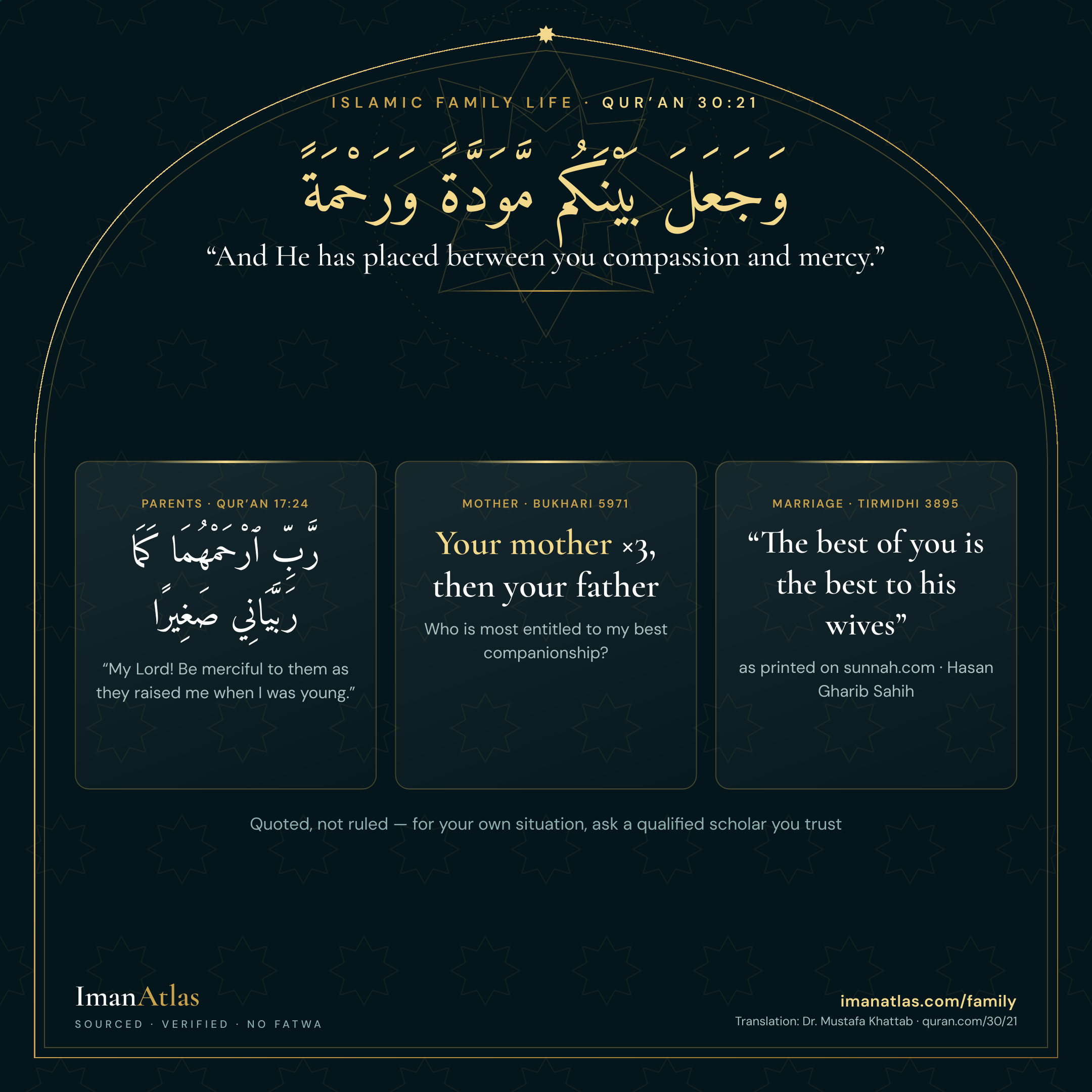
“And one of His signs is that He created for you spouses from among yourselves so that you may find comfort in them. And He has placed between you compassion and mercy. Surely in this are signs for people who reflect.”
Qur’an 30:21 — marriage as the Qur’an describes it: comfort, compassion, mercy. A description of marriage’s God-given character — printed as description, not as a ruling. quran.com/30/21 (translation: Dr. Mustafa Khattab; Arabic: Tanzil)
“For your Lord has decreed that you worship none but Him. And honour your parents. If one or both of them reach old age in your care, never say to them ˹even˺ ‘ugh,’ nor yell at them. Rather, address them respectfully.”
Qur’an 17:23 — quran.com/17/23 (translation: Dr. Mustafa Khattab)
“And be humble with them out of mercy, and pray, “My Lord! Be merciful to them as they raised me when I was young.””
Qur’an 17:24 — the verse carries its own dua for parents; the Dua hub carries the dua pages. quran.com/17/24 (translation: Dr. Mustafa Khattab)
“And We have commanded people to ˹honour˺ their parents. Their mothers bore them through hardship upon hardship, and their weaning takes two years. So be grateful to Me and your parents. To Me is the final return.”
Qur’an 31:14 — printed exactly as it stands: the “two years” is the verse’s own wording about weaning, not a breastfeeding ruling, and this site never presents it as one. quran.com/31/14 (translation: Dr. Mustafa Khattab)
“O humanity! Be mindful of your Lord Who created you from a single soul, and from it He created its mate, and through both He spread countless men and women. And be mindful of Allah—in Whose Name you appeal to one another—and ˹honour˺ family ties. Surely Allah is ever Watchful over you.”
Qur’an 4:1 — quran.com/4/1 (translation: Dr. Mustafa Khattab)
“O believers! Protect yourselves and your families from a Fire whose fuel is people and stones, overseen by formidable and severe angels, who never disobey whatever Allah orders—always doing as commanded.”
Qur’an 66:6 — the charter verse of the Parenting and Deen-at-Home shelves below. What “protect” requires in a specific home is application — and application to a reader’s case is Layer C. quran.com/66/6 (translation: Dr. Mustafa Khattab)
Narrated Abu Huraira: A man came to Allah’s Messenger ﷺ and said, “O Allah’s Messenger ﷺ! Who is more entitled to be treated with the best companionship by me?” The Prophet ﷺ said, “Your mother.” The man said. “Who is next?” The Prophet said, “Your mother.” The man further said, “Who is next?” The Prophet ﷺ said, “Your mother.” The man asked for the fourth time, “Who is next?” The Prophet ﷺ said, “Your father.”
Sahih al-Bukhari 5971 — sunnah.com/bukhari:5971. Printed as narrated; the popular gloss “the mother has three times the right” is an interpretation added by others, not part of the narration.
‘Aishah narrated that the Messenger of Allah ﷺ said: “The best of you is the best to his wives, and I am the best of you to my wives, and when your companion dies, leave him alone.”
Jami’ at-Tirmidhi 3895 — sunnah.com/tirmidhi:3895, graded Hasan Gharib Sahih as printed. One precision note: the Arabic word is ahl (لِأَهْلِهِ — family/household); sunnah.com’s printed English renders it “his wives”, and we quote the translation exactly as printed rather than silently re-translating it — the popular paraphrase “best to his family” is not quoted here as if it were the text.
The family shelves — each opens only after its own research
Nikah Guide — choosing a spouse, wali, mahr & the Nikahnama in India
In preparation. Where a question is one the schools answer differently, the guide will set out each position with its sources — and adopt none.
Rights & Kindness in Marriage
In preparation. Built from the verified texts outward — 30:21 and Tirmidhi 3895 are its foundation stones, both printed in full above.
Pregnancy, Newborn, Aqiqah & Naming
In preparation. The aqiqah reports arrive here only after quote-the-line verification — and naming links onward to the Baby Names hub.
Islamic Parenting by Age — toddlers to teens
In preparation. Qur’an 66:6 is its charter; reports are quoted as reports, never converted into instructions.
Family Money, Home & In-Laws
In preparation. General information and the sources’ own words — no household’s specific situation is ruled on here.
Ramadan, Eid & Daily Deen at Home with Children
In preparation. The family’s year and the family’s day, from the sources — with duas carried by the Dua hub.
Marriage as the Qur’an itself describes it — compassion and mercy, quoted, not ruled. Save it, share it.
Questions people ask
What does Islam say about keeping ties with relatives?
The Qur’an joins the two in one verse: “be mindful of Allah—in Whose Name you appeal to one another—and ˹honour˺ family ties” (4:1). That is the text, quoted in full above. How it applies inside a particular family’s dispute is a scholar’s question — Layer C of the frame.
What are the rights of parents in Islam?
As the sources state them: honour commanded immediately after the worship of Allah alone (17:23) — no word of contempt in their old age, respectful address, humility out of mercy, and the prayer the verse itself teaches (17:24); gratitude to Allah and to parents joined in a single command (31:14). Those texts are printed word for word on this page; rulings built on them belong to scholars, not to this summary.
Who is most entitled to a child’s good companionship — mother or father?
The Prophet ﷺ answered the question directly, and the narration is printed in full above: “Your mother” — three times — then “Your father” (Sahih al-Bukhari 5971). We print the narration as narrated, without the interpretive glosses others add to it.
What does the Qur’an say about marriage?
Its most-quoted description is 30:21: spouses created from among yourselves, “so that you may find comfort in them. And He has placed between you compassion and mercy.” The verse describes marriage’s God-given character; this hub prints it as the description it is. The contract’s terms and conditions are the Nikah Guide’s subject, researched separately.
What does the Qur’an say about raising and protecting children?
One verse anchors the subject: “O believers! Protect yourselves and your families from a Fire…” (66:6), printed in full above. What protection requires in a specific home — schools, screens, discipline — is application, and application to a reader’s case is Layer C: a scholar’s and a parent’s judgement, not a website’s ruling.
Is a wali required for a nikah?
This is a point on which the schools of law genuinely differ, and this hub does not answer it. The Nikah Guide — in preparation — will set out each position with its sources and adopt none. For a specific marriage, ask a qualified scholar you trust.
Does kindness to parents continue if the parents are not Muslim?
The verses verified for this page command honouring parents in unqualified words (17:23; 31:14), and they are printed in full above. The further texts that discuss parents who oppose one’s faith were not part of this hub’s verified set, so the hub prints what it has and routes the rest: it is a scholar’s question, and we will not improvise an answer the research has not earned.
Can parents disown their child in Islam?
That is a fatwa question about a specific family’s case, and this site does not give fatwas — the frame at the top of this page exists for exactly such questions. What the sources state about parents, children and family ties is printed above, word for word. For your own situation, ask a qualified scholar you trust.
Sources
Every load-bearing claim on this page was checked against its primary source on 27 November 2026. Family is outside this site’s scholar-review scope (which covers calculators and the core dua pages only) — no review is claimed here.
- Qur’an 30:21 — marriage: comfort, compassion, mercy (quran.com) · Arabic text: Tanzil (Uthmani script)
- Qur’an 17:23 · 17:24 — honouring parents (quran.com)
- Qur’an 31:14 — gratitude to Allah and to parents (quran.com)
- Qur’an 4:1 — one soul, its mate, family ties (quran.com)
- Qur’an 66:6 — protect yourselves and your families (quran.com)
- Sahih al-Bukhari 5971 — “Your mother” three times, then “Your father” (sunnah.com)
- Jami’ at-Tirmidhi 3895 — the best to his wives, as printed (Arabic word: ahl), grade as printed (sunnah.com)
How we verify: Sources & Method · Accuracy & Correction Policy · No-Fatwa Disclaimer. Spotted an error? Our correction policy explains how we fix it within 24 hours.