Ramadan 1448, with the moon kept in the dates
Expected dates for 2027, the disagreements printed rather than hidden, and fasting times calculated city by city.
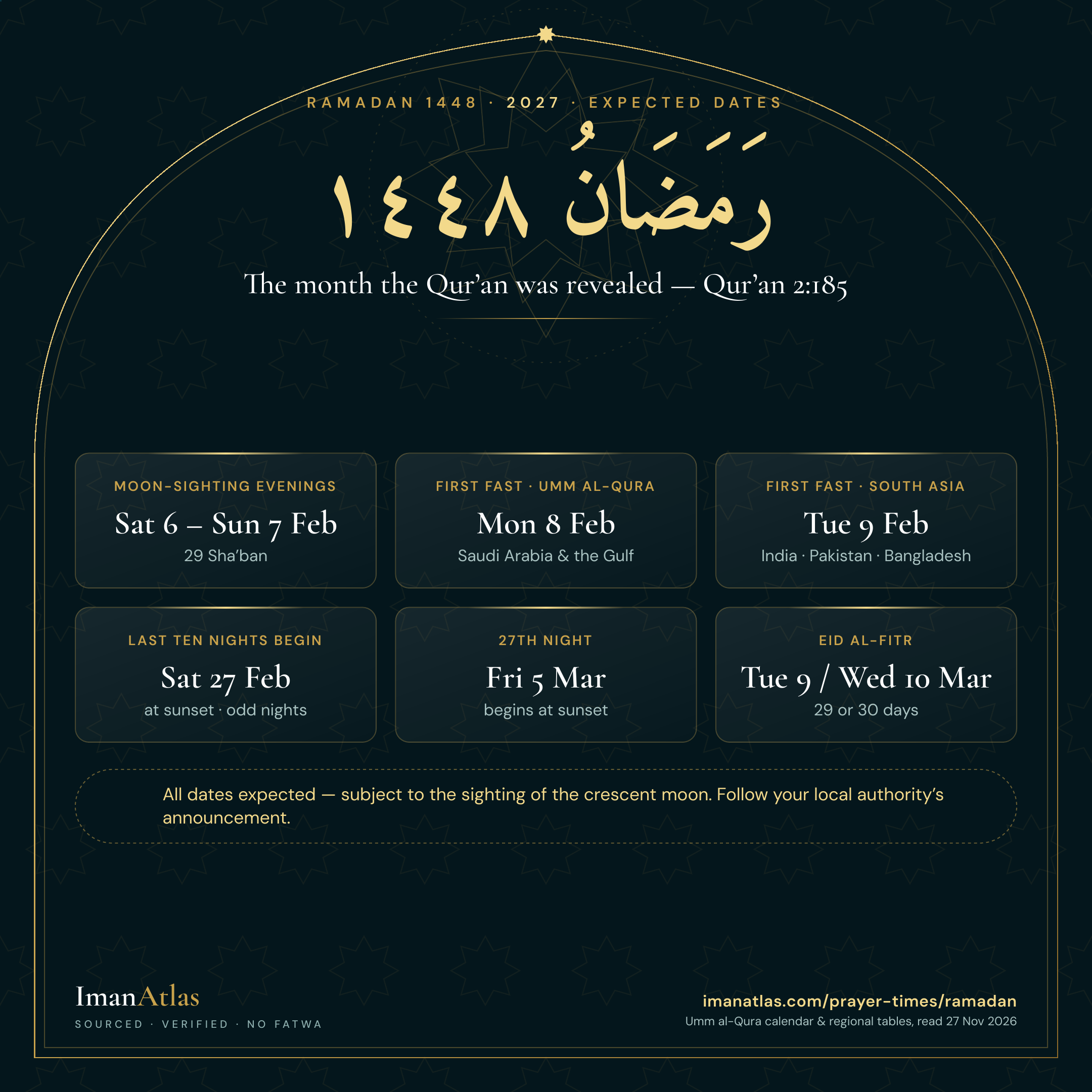
Short answer: Ramadan is the month of fasting Allah prescribed in the Qur’an (2:185). Ramadan 1448 is expected to begin on Monday 8 February 2027 on the Umm al-Qura calendar, and on Tuesday 9 February in much of South Asia — every date on this page is expected, subject to the sighting of the moon.
ImanAtlas prints Ramadan the way the sources themselves print it: the expected dates from the calculated calendar, the variants where sources disagree, the authority that will actually announce the start where you live, and the Qur’an and hadith the month is built on. Nothing here is a fatwa, and no date here is a promise — the crescent decides.
The expected dates for Ramadan 1448 (2027)
| Event | Expected date | What decides it |
|---|---|---|
| Moon-sighting evening (29 Sha’ban) | Evenings of Saturday 6 – Sunday 7 February 2027 | Committees look for the crescent; announcements are expected across these two evenings — sources differ by a day, so both are printed. |
| First night of Ramadan (first taraweeh) | Evening of Sunday 7 February 2027 | The night comes before the first fast; if the crescent is sighted that evening, taraweeh begins. |
| First fast — on the Umm al-Qura calendar (Saudi Arabia and the Gulf) | Monday 8 February 2027 | The calculated Umm al-Qura calendar; the Saudi Supreme Court’s sighting call confirms it. |
| First fast — India, Pakistan, Bangladesh | Tuesday 9 February 2027 expected | Local sighting usually falls a day later here. Some calendar tables print 8 February for these countries; the local announcement decides — the variant is printed, not hidden. |
| Last fast | Monday 8 March 2027 expected | If the month completes 29 days on the calculated calendar. |
| Eid al-Fitr (1 Shawwal) | Tuesday 9 March 2027 expected — Wednesday 10 March if Ramadan completes 30 days | The Shawwal crescent, announced the same way Ramadan was. 10 March is also the expected Eid date across South Asia and in Malaysia and Singapore in most published tables. |
All dates are expected, subject to the sighting of the crescent moon. The confirmed date is announced by your local authority — follow its announcement.
Why the dates are announced, not just calculated
The month itself is prescribed in the Qur’an:
يَٰٓأَيُّهَا ٱلَّذِينَ ءَامَنُواْ كُتِبَ عَلَيۡكُمُ ٱلصِّيَامُ كَمَا كُتِبَ عَلَى ٱلَّذِينَ مِن قَبۡلِكُمۡ لَعَلَّكُمۡ تَتَّقُونَ
“O believers! Fasting is prescribed for you—as it was for those before you—so perhaps you will become mindful ˹of Allah˺.”
Qur’an 2:183 — quran.com/2/183 (translation: Dr. Mustafa Khattab)
شَهۡرُ رَمَضَانَ ٱلَّذِيٓ أُنزِلَ فِيهِ ٱلۡقُرۡءَانُ هُدٗى لِّلنَّاسِ وَبَيِّنَٰتٖ مِّنَ ٱلۡهُدَىٰ وَٱلۡفُرۡقَانِۚ فَمَن شَهِدَ مِنكُمُ ٱلشَّهۡرَ فَلۡيَصُمۡهُۖ وَمَن كَانَ مَرِيضًا أَوۡ عَلَىٰ سَفَرٖ فَعِدَّةٞ مِّنۡ أَيَّامٍ أُخَرَۗ يُرِيدُ ٱللَّهُ بِكُمُ ٱلۡيُسۡرَ وَلَا يُرِيدُ بِكُمُ ٱلۡعُسۡرَ
“Ramaḍân is the month in which the Quran was revealed as a guide for humanity with clear proofs of guidance and the decisive authority. So whoever is present this month, let them fast. But whoever is ill or on a journey, then ˹let them fast˺ an equal number of days ˹after Ramaḍân˺. Allah intends ease for you, not hardship…” (the verse continues)
Qur’an 2:185 — quran.com/2/185 (translation: Dr. Mustafa Khattab)
And its start is tied to sighting the crescent. The Prophet ﷺ said: “Start fasting on seeing the crescent (of Ramadan), and give up fasting on seeing the crescent (of Shawwal), and if the sky is overcast (and you cannot see it), complete thirty days of Sha’ban.” (Sahih al-Bukhari 1909 — sunnah.com/bukhari:1909). Sahih Muslim records the same ruling: “Whenever you sight the new moon (of the month of Ramadan) observe fast, and when you sight it (the new moon of Shawwal) break it, and if the sky is cloudy for you, then observe fast for thirty days.” (Sahih Muslim 1081a — sunnah.com/muslim:1081).
That is why two honest systems sit side by side: some authorities announce by local sighting, some follow a shared sighting, and some — like Saudi Arabia’s Umm al-Qura calendar or the Fiqh Council of North America — use a calendar calculated in advance. Communities follow different ones; ImanAtlas names which authority decides in each region below and never calls one of them wrong. It is also why Ramadan moves about eleven days earlier each solar year: the Islamic year of twelve lunar months (Qur’an 9:36) runs about 354 days against the solar year’s 365, so the month crosses every season over a cycle of about 33 years.
Ramadan in your region
India
First fast expected Tuesday 9 February 2027; Eid al-Fitr expected Wednesday 10 March. Announced by the local sighting committees after the crescent is looked for on the evenings of 6–7 February. City timetables for sehri and iftar are being prepared on the India region page; today’s prayer times for the metros are live in the widget on our Prayer Times hub.
Pakistan
First fast expected Tuesday 9 February 2027; Eid expected Wednesday 10 March. Announced by the Central Ruet-e-Hilal Committee. Karachi and Lahore times are live in the Prayer Times widget.
Bangladesh
First fast expected Tuesday 9 February 2027 (one calculated table prints 8 February — the National Moon Sighting Committee’s announcement decides); Eid expected Wednesday 10 March. Dhaka times are live in the Prayer Times widget.
The Gulf
First fast expected Monday 8 February 2027 on the Umm al-Qura calendar; Eid expected Tuesday 9 March. Saudi Arabia’s Supreme Court issues the sighting call; the Emirates, Qatar, Kuwait and Dubai keep their own official calendars and committees. Makkah, Dubai, Doha and Kuwait City are live in the Prayer Times widget.
The West — UK, US, Canada
First fast expected Monday 8 February 2027 for communities following the calculated calendars (such as the Fiqh Council of North America’s) or the Saudi announcement; communities that sight locally — including many UK groups — may begin a day later. Eid expected Tuesday 9 March, or Wednesday 10 March where the month completes 30 days. Follow the announcement of the mosque or council you pray with. London, New York and Toronto are live in the Prayer Times widget.
Southeast Asia
Malaysia’s dates are proclaimed by the Keeper of the Rulers’ Seal on the work of JAKIM; Indonesia’s are set at the Ministry of Religious Affairs’ isbat session; Singapore’s by MUIS. First fast expected Monday 8 or Tuesday 9 February 2027 by each country’s announcement; Eid in Malaysia and Singapore is expected Wednesday 10 March in most published tables. Kuala Lumpur, Singapore and Jakarta are live in the Prayer Times widget.
All dates are expected, subject to the sighting of the crescent moon. The confirmed date is announced by your local authority — follow its announcement.
A day in Ramadan — from suhoor to iftar
The fast begins at true dawn (Fajr) and ends at sunset (Maghrib) — the same two signs the prayer times are calculated from. Before dawn comes suhoor, the pre-fast meal the Prophet ﷺ blessed: “Take Suhur as there is a blessing in it.” (Sahih al-Bukhari 1923 — sunnah.com/bukhari:1923). Sehri ends at Fajr — your city’s exact time today is in the Prayer Times widget.
At sunset, the dua the Prophet ﷺ himself said when he broke his fast:
ذَهَبَ الظَّمَأُ وَابْتَلَّتِ الْعُرُوقُ وَثَبَتَ الأَجْرُ إِنْ شَاءَ اللَّهُ
Dhahaba adh-dhama’u wabtallatil-‘urooqu wa thabatal-ajru in shaa Allah.
“Thirst has gone, the arteries are moist, and the reward is sure, if Allah wills.”
Sunan Abi Dawud 2357 — sunnah.com/abudawud:2357 · Grade as printed on sunnah.com: Hasan (Al-Albani)
And the moment itself carries a promise in the sources’ own words: “There are three whose supplication is not rejected: the fasting person when he breaks his fast, the just leader, and the supplication of the oppressed person…” (Jami` at-Tirmidhi 3598 — sunnah.com/tirmidhi:3598; at-Tirmidhi himself called the hadith hasan). We quote the hadith; we add no guarantee of our own to it. More duas — for the morning, for anxiety, for your parents — live on the Duas & Azkar hub.
How long is the fast?
A day’s fast is simply Maghrib minus Fajr for your city, computed by the same named engine as this site’s prayer times (the Aladhan API, with each city’s own method). On Wednesday 10 February 2027 — the third day of the month on the Umm al-Qura reckoning — the fast runs:
| City | Fajr (sehri ends) | Maghrib (iftar) | Length of fast | Method |
|---|---|---|---|---|
| London | 05:31 | 17:06 | 11 h 35 min | Muslim World League |
| Delhi | 05:44 | 18:07 | 12 h 23 min | Karachi · Hanafi Asr |
| Karachi | 05:52 | 18:23 | 12 h 31 min | Karachi · Hanafi Asr |
| Dhaka | 05:18 | 17:51 | 12 h 33 min | Karachi · Hanafi Asr |
| Makkah | 05:37 | 18:16 | 12 h 39 min | Umm al-Qura |
| Kuala Lumpur | 06:08 | 19:28 | 13 h 20 min | JAKIM |
Computed 27 November 2026 from the Aladhan API for 10 February 2027, each city with its own method — the same figures the region and city pages will carry. Ramadan 1448 falls in late northern winter, so northern fasts start short and lengthen a little every day through the month; near the equator, like Kuala Lumpur, the length barely changes. Where twilight lasts all night at extreme latitudes, communities apply an adjustment rule on top of their method — the three sourced rules are explained on the Prayer Times hub.
Laylatul Qadr and the last ten nights
إِنَّآ أَنزَلۡنَٰهُ فِي لَيۡلَةِ ٱلۡقَدۡرِ وَمَآ أَدۡرَىٰكَ مَا لَيۡلَةُ ٱلۡقَدۡرِ لَيۡلَةُ ٱلۡقَدۡرِ خَيۡرٞ مِّنۡ أَلۡفِ شَهۡرٖ
“Indeed, ˹it is˺ We ˹Who˺ sent this ˹Quran˺ down on the Night of Glory. And what will make you realize what the Night of Glory is? The Night of Glory is better than a thousand months.”
Qur’an 97:1–3 — quran.com/97/1-3 (translation: Dr. Mustafa Khattab)
The sources place this night in the last ten nights of Ramadan, and the teaching is to seek it on the odd nights among them — no source we can verify fixes it to one night with certainty, and ImanAtlas will not pretend otherwise. On the Umm al-Qura reckoning, the last ten nights are expected to begin with the night starting at sunset on Saturday 27 February 2027 (some tables date the same point by its daytime, Sunday 28 February — the same nights, two labelling conventions). The odd nights, each named by the evening it begins:
| Night | Begins at sunset on (expected) |
|---|---|
| 21st night | Saturday 27 February 2027 |
| 23rd night | Monday 1 March 2027 |
| 25th night | Wednesday 3 March 2027 |
| 27th night | Friday 5 March 2027 |
| 29th night | Sunday 7 March 2027 |
Many families and mosques give the 27th night special attention — it is the most widely observed of the odd nights — but the sourced position is the one above: it is sought among the odd nights of the last ten, and its exact night is not announced in advance by any authority. If your community begins Ramadan a day later, every night in this table shifts a day later with it.
Taraweeh — the night prayer of Ramadan
Taraweeh is the congregational night prayer of Ramadan, prayed after Isha in units of two, and closed with witr. Walk into two mosques on the same street and you may find one praying eight rak’ahs and the other twenty, each followed by witr — both are established congregational practices with their own sourced histories, and the difference is one of school and tradition. ImanAtlas presents the variation as the sources present it; how many rak’ahs to pray is a question of practice to take from your mosque and your scholars, not a ruling this website issues. The first taraweeh of 1448 is expected on the evening of Sunday 7 February 2027 — the night before the first fast.
Eid al-Fitr — the door out of the month
Ramadan ends the way it began: with a crescent. When the Shawwal moon is sighted — or the month completes thirty days — the fast ends and Eid al-Fitr begins: expected Tuesday 9 March 2027 on the calculated calendar, Wednesday 10 March if Ramadan completes 30 days, and the expected date across South Asia in most published tables. Eid prayer falls in the morning after sunrise, and its congregation time is each mosque’s own — we never print a mosque’s time it has not published itself. How Eid and Jumu’ah times work is explained on the Prayer Times hub; region Eid pages will be updated from the authorities’ actual announcements when they come.
Ramadan 1448 — the expected dates, with the moon-sighting condition printed on the card itself. Save it, share it.
Questions people ask
When does Ramadan start in 2027?
Expected Monday 8 February 2027 on the Umm al-Qura calendar, and expected Tuesday 9 February in India, Pakistan and Bangladesh, where local sighting usually falls a day later. Every date is expected, subject to the sighting of the crescent moon — your local authority announces the confirmed start.
When is Eid al-Fitr 2027?
Expected Tuesday 9 March 2027 if Ramadan completes 29 days, and Wednesday 10 March if it completes 30 — 10 March is also the expected date across South Asia and in Malaysia and Singapore in most published tables. The Shawwal crescent decides, exactly as the Ramadan crescent did.
How many days is Ramadan 2027 — 29 or 30?
The calculated Umm al-Qura calendar gives 29 days (expected 8 February to 8 March on that calendar). Whether the observed month runs 29 or 30 is settled by the Shawwal sighting: if the crescent is seen on the 29th evening, the month ends at 29; if not, it completes 30, as the hadith of Bukhari 1909 itself directs.
Why do countries start Ramadan on different days?
Because their authorities use different sourced methods: some announce by local sighting of the crescent, some accept a sighting shared from elsewhere, and some follow a calendar calculated in advance (Umm al-Qura in Saudi Arabia, the Fiqh Council’s calendar in North America). Geography plays a part too — a crescent visible in one horizon may not be visible in another on the same evening. The hub names each region’s method; it does not rank them.
Why does Ramadan move about 11 days earlier every year?
The Islamic calendar is purely lunar: twelve months of 29 or 30 days make a year of about 354 days, roughly eleven days shorter than the solar year. Ramadan therefore steps back through the solar calendar by about eleven days annually and passes through every season over a cycle of about 33 years.
What time does sehri (suhoor) end?
At Fajr — true dawn — in your city. Suhoor is eaten before it; the Prophet ﷺ said, “Take Suhur as there is a blessing in it” (Sahih al-Bukhari 1923). Your city’s Fajr today is in the live widget on our Prayer Times hub, and the Ramadan timetable pages for each region are in preparation.
What is the dua for breaking the fast?
The dua the Prophet ﷺ said when he broke his fast: “Thirst has gone, the arteries are moist, and the reward is sure, if Allah wills” (Sunan Abi Dawud 2357, graded Hasan by Al-Albani as printed on sunnah.com). Its Arabic and transliteration are in the day-in-Ramadan section above.
When is Laylatul Qadr in 2027?
It is sought in the odd nights of the last ten nights of Ramadan — expected, on the Umm al-Qura reckoning, on the nights beginning at sunset on 27 February, 1, 3, 5 and 7 March 2027, with the 27th night (beginning Friday 5 March) the most widely observed. No source fixes it to one night with certainty; if your community starts a day later, the nights shift with it.
How many rak’ahs is taraweeh — 8 or 20?
Both are established congregational practices: mosques pray eight rak’ahs in one tradition and twenty in another, each followed by witr, and each with its own sourced history. ImanAtlas presents the variation and rules on neither — follow the practice of your mosque and your scholars.
What breaks the fast?
The Qur’an’s own frame is that the fast runs from dawn to nightfall, with eating and drinking within the night hours (Qur’an 2:185 states the month and its exemptions for the ill and the traveller). Which specific acts break the fast — medicines, injections, and the like — are rulings scholars give on the sources; ImanAtlas presents the sources and does not issue rulings. For your situation, ask a qualified scholar.
Sources
Every load-bearing claim on this page was checked against its primary source on 27 November 2026; the expected dates were read across nine published calendars and tables the same day, and disagreements between them are printed on the page rather than resolved silently.
- Qur’an 2:183 — fasting is prescribed (quran.com)
- Qur’an 2:185 — the month of Ramadan (quran.com)
- Qur’an 97:1–3 — the Night of Glory (quran.com)
- Sahih al-Bukhari 1909 — fast on seeing the crescent (sunnah.com)
- Sahih Muslim 1081a — sight the new moon and fast (sunnah.com)
- Sahih al-Bukhari 1923 — the blessing in suhoor (sunnah.com)
- Sunan Abi Dawud 2357 — the iftar dua, graded Hasan (sunnah.com)
- Jami` at-Tirmidhi 3598 — the fasting person’s dua (sunnah.com)
- Aladhan API — the fasting-hour computations and method registry
How we verify: Sources & Method · Accuracy & Correction Policy · No-Fatwa Disclaimer. Spotted an error? Our correction policy explains how we fix it within 24 hours.