The 99 Names, with the list’s own story
The number from Bukhari and Muslim; the list from Tirmidhi — with its grade printed on the page, not hidden.
Short answer: Asma ul Husna — the Most Beautiful Names — is the Qur’an’s own phrase for Allah’s names (7:180). The number ninety-nine comes from hadith in Bukhari and Muslim, which give no list; the famous list itself is narrated in Jami’ at-Tirmidhi 3507, printed here exactly as narrated, with its source and grade.
Where the names — and the list — come from
Three different things are usually blurred into one on pages like this. We keep them separate, because the sources do.
First, the Qur’an. Allah names the phrase Himself and commands that He be called by His names:
وَلِلَّهِ ٱلْأَسْمَآءُ ٱلْحُسْنَىٰ فَٱدْعُوهُ بِهَا وَذَرُوا۟ ٱلَّذِينَ يُلْحِدُونَ فِىٓ أَسْمَٰٓئِهِۦ سَيُجْزَوْنَ مَا كَانُوا۟ يَعْمَلُونَ
“Allah has the Most Beautiful Names. So call upon Him by them, and keep away from those who abuse His Names. They will be punished for what they used to do.”
Qur’an 7:180 — quran.com/7/180 (translation: Dr. Mustafa Khattab; Arabic text: Tanzil, Uthmani script)
The phrase “the Most Beautiful Names” is the Qur’an’s own, used of Allah in four places: 7:180, 17:110, 20:8 and 59:24. The Qur’an gives the names in many places — one sequence of them is printed in full further down this page — but it nowhere prints a numbered list of ninety-nine.
Second, the number. The Prophet ﷺ said: “Allah has ninety-nine names, i.e. one-hundred minus one, and whoever knows them will go to Paradise.” (Sahih al-Bukhari 2736 — sunnah.com/bukhari:2736). Bukhari carries the same statement in his Book of Tawhid, adding his own gloss that to count the names means to know them by heart (Sahih al-Bukhari 7392 — sunnah.com/bukhari:7392), and Muslim’s version adds that Allah is Odd and loves the odd (Sahih Muslim 2677a — sunnah.com/muslim:2677a). None of these narrations contains a list. The number is certain; it arrives without names attached.
Third, the list. The enumeration the whole world copies is narrated in Jami’ at-Tirmidhi 3507 (sunnah.com/tirmidhi:3507), where the hadith of the number continues into the names themselves. Two facts about that narration are printed on the same page, and we print them too, in the open: sunnah.com grades the narration Da’if (Darussalam), and at-Tirmidhi himself, in his own comment on it, calls it gharib and says (as rendered in the Darussalam translation): “we do not know of many narrations (with Sahih chains) in which there is mention of the Names, except in this Hadith” — adding that the other route which mentions the names “does not have a Sahih chain.” A second, different enumeration also exists, in Sunan Ibn Majah 3861 (sunnah.com/ibnmajah:3861) — it begins differently and includes names Tirmidhi’s list does not — which is why scholars have discussed exactly which names make up the ninety-nine, and why websites quietly differ. ImanAtlas reproduces one narration exactly, names it, and never merges lists to make the page look tidier than the sources are.
The 99 names — as narrated in Jami’ at-Tirmidhi 3507
The table below is reproduced exactly as printed on sunnah.com for Jami’ at-Tirmidhi 3507: the Arabic, the transliteration, and the meanings as translated in the narration itself. Read the meanings as what they are — the narration’s own terse translated glosses, not a commentary. You may notice two that run against most websites: the narration’s translation renders Ar-Rahman “the Most Merciful (to the creation)” and Ar-Rahim “the Most Beneficent (to the believers)”. We print the narration as it stands; fuller, source-checked meanings belong to each name’s own page, where they can be verified one by one.
| # | Arabic | Name | Meaning — as translated in the narration (sunnah.com) |
|---|---|---|---|
| 1 | اللَّهُ | Allah | The narration’s opening: “He is Allah, the one whom there is none worthy of worship except for Him” |
| 2 | الرَّحْمَنُ | Ar-Raḥmān | the Most Merciful (to the creation) |
| 3 | الرَّحِيمُ | Ar-Raḥīm | the Most Beneficent (to the believers) |
| 4 | الْمَلِكُ | Al-Malik | the King |
| 5 | الْقُدُّوسُ | Al-Quddūs | the Free of Deficiencies |
| 6 | السَّلاَمُ | As-Salām | the Granter of Safety |
| 7 | الْمُؤْمِنُ | Al-Mu’min | the Granter of Security |
| 8 | الْمُهَيْمِنُ | Al-Muhaimin | the Watcher |
| 9 | الْعَزِيزُ | Al-‘Azīz | the Mighty |
| 10 | الْجَبَّارُ | Al-Jabbār | the Compeller |
| 11 | الْمُتَكَبِّرُ | Al-Mutakabbir | the Supreme |
| 12 | الْخَالِقُ | Al-Khāliq | the Creator |
| 13 | الْبَارِئُ | Al-Bāri’ | the Originator |
| 14 | الْمُصَوِّرُ | Al-Muṣawwir | the Fashioner |
| 15 | الْغَفَّارُ | Al-Ghaffār | the Pardoner |
| 16 | الْقَهَّارُ | Al-Qahhār | the Overwhelming |
| 17 | الْوَهَّابُ | Al-Wahhāb | the Giving |
| 18 | الرَّزَّاقُ | Ar-Razzāq | the Provider |
| 19 | الْفَتَّاحُ | Al-Fattāḥ | the Opener |
| 20 | الْعَلِيمُ | Al-‘Alīm | the Knowing |
| 21 | الْقَابِضُ | Al-Qābiḍ | the Taker |
| 22 | الْبَاسِطُ | Al-Bāsiṭ | the Giver |
| 23 | الْخَافِضُ | Al-Khāfiḍ | the Abaser |
| 24 | الرَّافِعُ | Ar-Rāfi’ | the Exalter |
| 25 | الْمُعِزُّ | Al-Mu’izz | the One who grants honor |
| 26 | الْمُذِلُّ | Al-Mudhil | the One who humiliates |
| 27 | السَّمِيعُ | As-Samī’ | the Hearing |
| 28 | الْبَصِيرُ | Al-Baṣīr | the Seeing |
| 29 | الْحَكَمُ | Al-Ḥakam | the Judge |
| 30 | الْعَدْلُ | Al-‘Adl | the Just |
| 31 | اللَّطِيفُ | Al-Laṭīf | the Kind |
| 32 | الْخَبِيرُ | Al-Khabīr | the Aware |
| 33 | الْحَلِيمُ | Al-Ḥalīm | the Forbearing |
| 34 | الْعَظِيمُ | Al-‘Aẓīm | the Magnificent |
| 35 | الْغَفُورُ | Al-Ghafūr | the Oft-Forgiving |
| 36 | الشَّكُورُ | Ash-Shakūr | the Grateful |
| 37 | الْعَلِيُّ | Al-‘Aliyy | the Most High |
| 38 | الْكَبِيرُ | Al-Kabīr | the Great |
| 39 | الْحَفِيظُ | Al-Ḥafīẓ | the Guardian |
| 40 | الْمُقِيتُ | Al-Muqīt | the Powerful |
| 41 | الْحَسِيبُ | Al-Ḥasīb | the Reckoner |
| 42 | الْجَلِيلُ | Al-Jalīl | the Glorious |
| 43 | الْكَرِيمُ | Al-Karīm | the Generous |
| 44 | الرَّقِيبُ | Ar-Raqīb | the Watcher |
| 45 | الْمُجِيبُ | Al-Mujīb | the Responder |
| 46 | الْوَاسِعُ | Al-Wāsi’ | the Liberal Giver |
| 47 | الْحَكِيمُ | Al-Ḥakīm | the Wise |
| 48 | الْوَدُودُ | Al-Wadūd | the Loving |
| 49 | الْمَجِيدُ | Al-Majīd | the Majestic |
| 50 | الْبَاعِثُ | Al-Bā’ith | the Reviver |
| 51 | الشَّهِيدُ | Ash-Shahīd | the Witness |
| 52 | الْحَقُّ | Al-Ḥaqq | the Truth |
| 53 | الْوَكِيلُ | Al-Wakīl | the Guarantor |
| 54 | الْقَوِيُّ | Al-Qawiyy | the Strong |
| 55 | الْمَتِينُ | Al-Matīn | the Firm |
| 56 | الْوَلِيُّ | Al-Waliyy | the One Who Aids |
| 57 | الْحَمِيدُ | Al-Ḥamīd | the Praiseworthy |
| 58 | الْمُحْصِي | Al-Muḥṣi | the Encompasser |
| 59 | الْمُبْدِئُ | Al-Mubdi’ | the One Who Begins things |
| 60 | الْمُعِيدُ | Al-Mu’īd | the One Who brings things back |
| 61 | الْمُحْيِي | Al-Muḥyi | the One Who gives life |
| 62 | الْمُمِيتُ | Al-Mumīt | the One Who causes death |
| 63 | الْحَىُّ | Al-Ḥayyu | the Living |
| 64 | الْقَيُّومُ | Al-Qayyūm | the Self-Sufficient |
| 65 | الْوَاجِدُ | Al-Wājid | the One Who brings into existence |
| 66 | الْمَاجِدُ | Al-Mājid | the Illustrious |
| 67 | الْوَاحِدُ | Al-Wāḥid | the One |
| 68 | الصَّمَدُ | Aṣ-Ṣamad | the Master |
| 69 | الْقَادِرُ | Al-Qādir | the Able |
| 70 | الْمُقْتَدِرُ | Al-Muqtadir | the Powerful |
| 71 | الْمُقَدِّمُ | Al-Muqaddim | the One who hastens |
| 72 | الْمُؤَخِّرُ | Al-Mu’akhkhir | the One who delays |
| 73 | الأَوَّلُ | Al-Awwal | the First |
| 74 | الآخِرُ | Al-Ākhir | the Last |
| 75 | الظَّاهِرُ | Aẓ-Ẓāhir | the Apparent |
| 76 | الْبَاطِنُ | Al-Bāṭin | the Inner |
| 77 | الْوَالِي | Al-Wāli | the Owner |
| 78 | الْمُتَعَالِي | Al-Muta’āli | the Exalted |
| 79 | الْبَرُّ | Al-Barr | the Doer of Good |
| 80 | التَّوَّابُ | At-Tawwāb | the Acceptor of repentance |
| 81 | الْمُنْتَقِمُ | Al-Muntaqim | the Avenger |
| 82 | الْعَفُوُّ | Al-‘Afuww | the Pardoning |
| 83 | الرَّءُوفُ | Ar-Ra’ūf | the Kind |
| 84 | مَالِكُ الْمُلْكِ | Mālikul-Mulk | the Owner of Dominion |
| 85 | ذُو الْجَلاَلِ وَالإِكْرَامِ | Dhul Jalāli wal Ikrām | the Possessor of Glory and Generosity |
| 86 | الْمُقْسِطُ | Al-Muqsiṭ | the One who does justice |
| 87 | الْجَامِعُ | Al-Jāmi’ | the Gatherer |
| 88 | الْغَنِيُّ | Al-Ghaniyy | the Rich |
| 89 | الْمُغْنِي | Al-Mughni | the Enricher |
| 90 | الْمَانِعُ | Al-Māni’ | the Preventer |
| 91 | الضَّارُّ | Aḍ-Ḍār | the Harmer |
| 92 | النَّافِعُ | An-Nāfi’ | the One who benefits |
| 93 | النُّورُ | An-Nūr | the Light |
| 94 | الْهَادِي | Al-Hādi | the Guide |
| 95 | الْبَدِيعُ | Al-Badī’ | the Originator |
| 96 | الْبَاقِي | Al-Bāqi | the Lasting |
| 97 | الْوَارِثُ | Al-Wārith | the Inheritor |
| 98 | الرَّشِيدُ | Ar-Rashīd | the Guide |
| 99 | الصَّبُورُ | Aṣ-Ṣabūr | the Tolerant |
How the count works — printed, not hidden: after the narration’s opening statement (“He is Allah, the one whom there is none worthy of worship except for Him”), the names that follow number ninety-eight. The ninety-nine is reached counting Allah — the opening statement’s own name — as the first, which is how the table above is numbered. Tables elsewhere that number Ar-Rahman as 1 and As-Sabur as 99 contain at least one entry beyond this narration’s printed text; we do not add it silently.
The Qur’an’s own sequence — Surah Al-Hashr 59:23–24
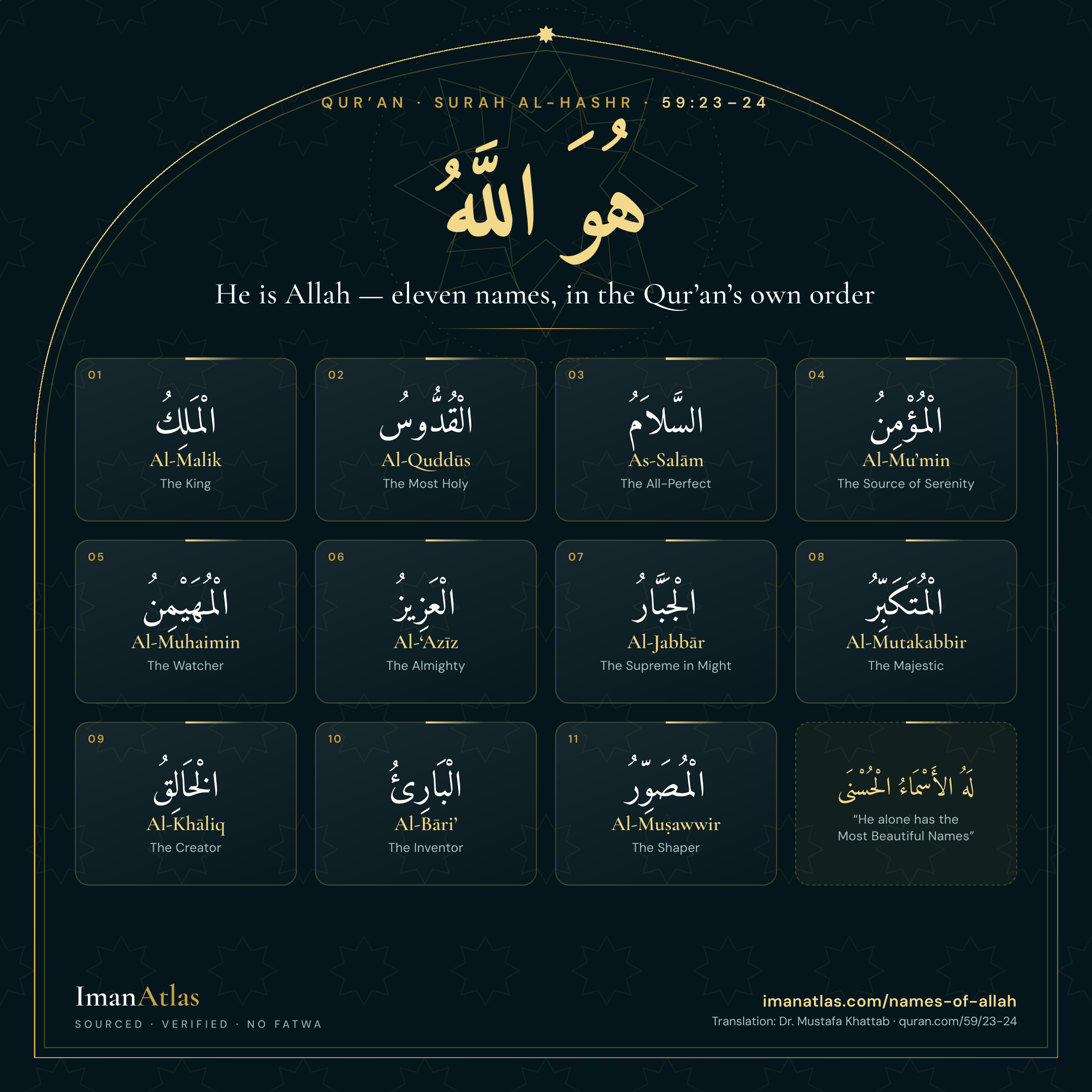
One place in the Qur’an strings the names together in a single breath — the closing verses of Surah Al-Hashr, naming eleven of them across two verses:
هُوَ ٱللَّهُ ٱلَّذِى لَآ إِلَـٰهَ إِلَّا هُوَ ٱلْمَلِكُ ٱلْقُدُّوسُ ٱلسَّلَـٰمُ ٱلْمُؤْمِنُ ٱلْمُهَيْمِنُ ٱلْعَزِيزُ ٱلْجَبَّارُ ٱلْمُتَكَبِّرُ ۚ سُبْحَـٰنَ ٱللَّهِ عَمَّا يُشْرِكُونَ ٢٣
“He is Allah—there is no god except Him: the King, the Most Holy, the All-Perfect, the Source of Serenity, the Watcher ˹of all˺, the Almighty, the Supreme in Might, the Majestic. Glorified is Allah far above what they associate with Him ˹in worship˺!”
Qur’an 59:23 — quran.com/59/23-24 (translation: Dr. Mustafa Khattab)
هُوَ ٱللَّهُ ٱلْخَـٰلِقُ ٱلْبَارِئُ ٱلْمُصَوِّرُ ۖ لَهُ ٱلْأَسْمَآءُ ٱلْحُسْنَىٰ ۚ يُسَبِّحُ لَهُۥ مَا فِى ٱلسَّمَـٰوَٰتِ وَٱلْأَرْضِ ۖ وَهُوَ ٱلْعَزِيزُ ٱلْحَكِيمُ ٢٤
“He is Allah: the Creator, the Inventor, the Shaper. He ˹alone˺ has the Most Beautiful Names. Whatever is in the heavens and the earth ˹constantly˺ glorifies Him. And He is the Almighty, All-Wise.”
Qur’an 59:24 — quran.com/59/23-24 (translation: Dr. Mustafa Khattab)
The eight names of verse 23 — Al-Malik, Al-Quddūs, As-Salām, Al-Mu’min, Al-Muhaimin, Al-‘Azīz, Al-Jabbār, Al-Mutakabbir — and the three of verse 24 — Al-Khāliq, Al-Bāri’, Al-Muṣawwir — all appear in the table above, in the Qur’an’s words and in the narration’s list alike. The verses are printed here as they stand, unranked: the Qur’an presents them; it does not call them the most important.
Learning them by heart
The promise in the Sahih narrations attaches to knowing the names — Bukhari’s own gloss on “counting” them is knowing them by heart, and Muslim’s wording is committing them to memory. Two honest tools for that work: the table above, and a printable version that carries the same source line, grade note and counting note onto paper — because a printout is exactly what gets forwarded and pinned up, and the honesty has to travel with it.
Download the printable 99 Names (PDF) — the full table with its sources printed on it.
Learning the names in themes
A grouping of the table’s own rows, made by this site purely as a learning aid — it comes from no hadith and no scholar, and it is labelled as ours so it is never mistaken for one.
Mercy & Forgiveness
Ar-Raḥmān · Ar-Raḥīm · Al-Ghaffār · Al-Ghafūr · At-Tawwāb · Al-‘Afuww · Ar-Ra’ūf · Al-Ḥalīm — its own page is in preparation.
Power, Kingship & Majesty
Al-Malik · Mālikul-Mulk · Al-‘Azīz · Al-Jabbār · Al-Mutakabbir · Al-Qawiyy · Al-Matīn · Al-Kabīr · Al-‘Aẓīm · Al-Jalīl · Dhul Jalāli wal Ikrām — in preparation.
Knowledge, Guidance & Light
Al-‘Alīm · Al-Khabīr · Al-Ḥakīm · Al-Hādi · Ar-Rashīd · An-Nūr · Ash-Shahīd · Al-Baṣīr · As-Samī’ — in preparation.
Provision, Peace & Protection
Ar-Razzāq · Al-Wahhāb · Al-Fattāḥ · As-Salām · Al-Mu’min · Al-Muhaimin · Al-Ḥafīẓ · Al-Wakīl · Al-Waliyy — in preparation.
The Surah hub
The Qur’an’s chapters, surah by surah — beginning with the ones read most. Open the Surah hub — the full index of all 114 surahs; the Al-Hashr verses above are the bridge between the names and the surahs.
The eleven names of Surah Al-Hashr, in the Qur’an’s own order. Save it, share it.
Questions people ask
Where does the list of 99 names come from?
From a narration in Jami’ at-Tirmidhi (3507), where the hadith of the number continues into the names. The number itself — ninety-nine, with Paradise promised to whoever learns them — is stated in Sahih al-Bukhari (2736) and Sahih Muslim (2677a), but those narrations carry no list. This page prints the Tirmidhi narration’s list with its printed grade, Da’if (Darussalam), and at-Tirmidhi’s own caution beside it.
Why do different websites show slightly different lists?
Because the enumeration was narrated more than once, and not identically: Sunan Ibn Majah 3861 carries a second, different list, and scholars have discussed which names make up the ninety-nine. Sites that silently merge versions hide that discussion. ImanAtlas reproduces one named narration exactly — Jami’ at-Tirmidhi 3507 as printed on sunnah.com — and says so on the page.
What does “whoever counts them” mean?
The Arabic word is ahsaha. Bukhari himself glosses it in his Book of Tawhid: to count the names means to know them by heart (Sahih al-Bukhari 7392), and Muslim’s version says “he who commits them to memory” (Sahih Muslim 2677a).
Can I call on Allah by these names in my dua?
The Qur’an itself commands it: “Allah has the Most Beautiful Names. So call upon Him by them…” (Qur’an 7:180). Which name suits which need is a question this page leaves to the sources and to scholars — it prints the command, and the names, and rules on nothing beyond them.
Does Allah have only ninety-nine names?
The narrations promise Paradise to whoever learns the ninety-nine; they are presented here as a number given to learn, not as a fence around Allah’s names. The Qur’an names Allah in many places beyond any single list — Surah Al-Hashr alone strings eleven names across two verses (59:23–24), printed in full above.
What are the benefits of reciting each name a certain number of times?
No source we could verify states an outcome for reciting an individual name a set number of times, so this site prints none — a count tied to a promised result would be a claim without a source. The virtue the verified sources do state is the one attached to the ninety-nine themselves: whoever learns them by heart enters Paradise (Bukhari 2736; Muslim 2677a).
Which name is the Greatest Name (Ism-e-A’zam)?
Its narrations deserve their own researched page, and until that research is done this site names no candidate and quotes no narration about it. The question is real; an unsourced answer would not be.
Why does this page print a “Da’if” grade next to the list?
Because the source prints it, and hiding it would mislead you about what kind of text the list is. The number ninety-nine rests on the two most authentic collections; the enumeration rests on a narration its own collector flagged. Both facts belong on the page — that honesty is this hub’s whole reason to exist.
Sources
Every load-bearing claim on this page was checked against its primary source on 27 November 2026. The table is one narration, reproduced exactly — never merged with any other list.
- Qur’an 7:180 — the Most Beautiful Names; call upon Him by them (quran.com) · Arabic text: Tanzil (Uthmani script)
- Qur’an 17:110 · Qur’an 20:8 — the phrase in its other places (quran.com)
- Qur’an 59:23–24 — the Al-Hashr name sequence (quran.com)
- Sahih al-Bukhari 2736 — ninety-nine names, no list (sunnah.com)
- Sahih al-Bukhari 7392 — counting means knowing by heart (sunnah.com)
- Sahih Muslim 2677a — commits them to memory; Allah is Odd (sunnah.com)
- Jami’ at-Tirmidhi 3507 — the enumeration itself, its grade, and at-Tirmidhi’s comment (sunnah.com)
- Sunan Ibn Majah 3861 — the second, different enumeration (sunnah.com)
- Encyclopaedia Britannica — the 99 names of God (secondary corroboration)
How we verify: Sources & Method · Accuracy & Correction Policy · No-Fatwa Disclaimer. Spotted an error? Our correction policy explains how we fix it within 24 hours.