Stories, labelled by their sources
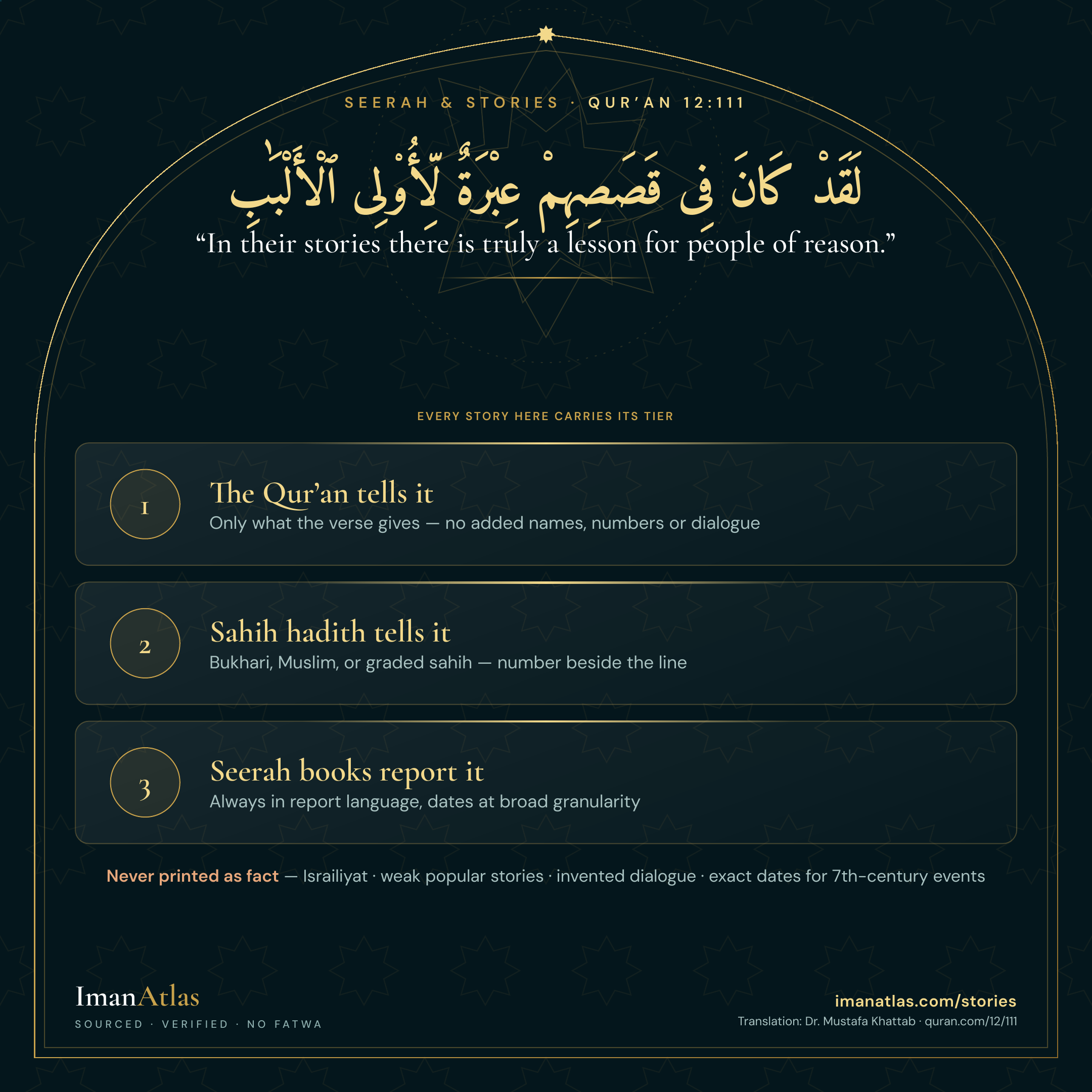
Every story carries its tier: what the Qur’an tells, what sahih hadith tells, and what the seerah books report.
Short answer: Islamic stories come in three kinds, and this hub never mixes them silently: what the Qur’an itself narrates, what sahih hadith adds, and what the seerah books report. Every story here is labelled by its source — and details no sound source gives, however famous, are left out.
Why the Qur’an tells stories at all
The Qur’an states its own purpose for its stories, twice, in words this whole category is built on:
لَقَدْ كَانَ فِى قَصَصِهِمْ عِبْرَةٌ لِّأُو۟لِى ٱلْأَلْبَٰبِ مَا كَانَ حَدِيثًا يُفْتَرَىٰ وَلَٰكِن تَصْدِيقَ ٱلَّذِى بَيْنَ يَدَيْهِ وَتَفْصِيلَ كُلِّ شَىْءٍ وَهُدًى وَرَحْمَةً لِّقَوْمٍ يُؤْمِنُونَ
“In their stories there is truly a lesson for people of reason. This message cannot be a fabrication, rather ˹it is˺ a confirmation of previous revelation, a detailed explanation of all things, a guide, and a mercy for people of faith.”
Qur’an 12:111 — quran.com/12/111 (translation: Dr. Mustafa Khattab; Arabic: Tanzil)
“And We relate to you ˹O Prophet˺ the stories of the messengers to reassure your heart. And there has come to you in this ˹sûrah˺ the truth, a warning ˹to the disbelievers˺, and a reminder to the believers.”
Qur’an 11:120 — quran.com/11/120 (translation: Dr. Mustafa Khattab)
A lesson for people of reason — and a reassurance to the Prophet’s ﷺ own heart. So on ImanAtlas a lesson may be drawn from a story and labelled as our reflection; it is never dressed up as something Allah or His Messenger ﷺ said when they did not. And a story is only ever as strong as its source — which is why every story on this site carries one of these labels:
The sourcing ladder — printed on every story
Tier 1 — The Qur’an tells it
The event or detail is stated in a verse. A retelling may use only what the verse gives — no added names, numbers, places or dialogue. Cited as Surah:verse, translation named, Arabic copied from Tanzil.
Tier 2 — Sahih hadith tells it
Narrated in Sahih al-Bukhari or Sahih Muslim, or graded sahih as printed on sunnah.com. Quoted or closely paraphrased, with the collection and number beside the line.
Tier 3 — The seerah books report it
From the seerah literature — Ibn Hisham’s Sirah, Ibn Kathir, and modern compilations such as Ar-Raheeq Al-Makhtum. Always in report language (“the seerah books report…”, “it is commonly reported…”), never with Tier 1–2 certainty, and dates only at the broad granularity the sources support.
Never printed as fact
Israiliyat details the Qur’an and sahih hadith do not confirm · weak or fabricated popular stories, however famous · invented dialogue and scene detail · exact dates presented as certain for seventh-century events · “the moral is…” dressed as revelation.
The ladder is not a promise — here it is, working, on three famous items:
The People of the Cave — the Qur’an models the restraint
The Qur’an gives the story’s spine (18:9–26) — and then refuses the head-count: the guesses are “guessing blindly”, and “My Lord knows best their number” (18:22). What it withholds, later reports filled in — the sleepers’ names, their dog’s name — and those stay off this site. What the Qur’an does give, we print exactly:
وَلَبِثُوا۟ فِى كَهْفِهِمْ ثَلَٰثَ مِا۟ئَةٍ سِنِينَ وَٱزْدَادُوا۟ تِسْعًا
“They had remained in their cave for three hundred years, adding nine.” (Qur’an 18:25 — quran.com/18/25)
The Prophet’s ﷺ birth — three tiers on one event
Tier 1: Surah Al-Fil attests the Elephant event — no year, no date. Tier 2: he was born on a Monday — his own words in Sahih Muslim 1162b: “It was the day on which I was born. on which I was commissioned with prophethood or revelation was sent to me,” Tier 3: the seerah books place the birth in the Year of the Elephant, about 570 CE — and dispute the day themselves (the 12th of Rabi’ al-Awwal is the best-known view; the 9th is also given). Sites that print “born 12 Rabi’ al-Awwal 571 CE” as flat fact are printing Tier 3 material in Tier 1 language. We do not.
Idris’s pen — a famous “fact” that fails Tier 1
Popular story hubs state that Idris was the first to write with a pen and the first to sew. The Qur’an’s whole portrait of him is one verse: “And mention in the Book ˹O Prophet, the story of˺ Enoch. He was surely a man of truth and a prophet.” (19:56 — quran.com/19/56; Khattab renders Idris as “Enoch”), with 19:57 adding only that Allah raised him to a high station. No pen, no sewing, no firsts — those details travel through later report literature. On ImanAtlas they are dropped, or labelled as the unsourced reports they are.
The Seerah timeline — at the granularity the sources support
The frame is anchored in hadith, not in a modern chronology: Ibn ‘Abbas narrated that the Messenger of Allah ﷺ “was inspired Divinely at the age of forty. Then he stayed in Mecca for thirteen years, and then was ordered to migrate, and he migrated to Medina and stayed there for ten years and then died.” (Sahih al-Bukhari 3851 — sunnah.com/bukhari:3851). Madani events below carry AH years as the commonly reported seerah chronology; no day-level dates appear anywhere on this page.
| Period | What the sources support | Source tier |
|---|---|---|
| Before prophethood | Born in the Year of the Elephant, about 570 CE; the day of the month is disputed in the seerah books themselves (9th or 12th of Rabi’ al-Awwal) | Tier 3 — seerah books report |
| Before prophethood | Born on a Monday — “It was the day on which I was born” | Tier 2 — Sahih Muslim 1162b |
| Age forty | First revelation; the opening of Surah Al-‘Alaq (its story is told on the Surah hub) | Tier 2 — Bukhari 3851 & 3 |
| The Makkah years | Thirteen years of preaching in Makkah after revelation began | Tier 2 — Bukhari 3851 |
| The Hijrah | Driven out of Makkah; the cave moment is in the Qur’an itself — “he was only one of two. While they both were in the cave, he reassured his companion, ‘Do not worry; Allah is certainly with us.’” (9:40). The verse names neither the companion nor the cave — those details belong to the Madani seerah page’s own research | Tier 1 — Qur’an 9:40 |
| The calendar | The second caliph ʿUmar later made the Hijrah the starting point of the Muslim calendar; the histories date his decision to about 17 AH / 639 CE | Tier 3 — as the histories report |
| The Madinah years | Badr 2 AH · Uhud 3 AH · the Trench 5 AH · Hudaybiyyah 6 AH · the Conquest of Makkah 8 AH · the Farewell Hajj 10 AH · his death 11 AH | Tier 3 — commonly reported chronology |
The story shelves — each opens only after its own research
Seerah of the Prophet ﷺ — the Makki Life
In preparation. Birth, upbringing, marriage, the first revelation, the thirteen Makkah years — every episode tiered before it is told.
Seerah — the Madani Life, Battles & Farewell
In preparation. The Hijrah, the Madinah decade, and the events of the timeline above at their own research depth.
Stories of the 25 Prophets (Qasas ul Anbiya)
In preparation. The prophets the Qur’an names — told, wherever possible, from the Qur’an’s own telling first.
Stories of Sahaba & Great Women of Islam
In preparation. The companions and the women of the first generation — narrations first, reports labelled.
Quranic Waqiat
In preparation. The Cave sleepers, Yusuf, Musa and Khidr, the People of the Elephant — the stories the Qur’an itself narrates, verse by verse.
Islamic Stories for Kids
In preparation. The same ladder, in a child’s language — a story does not become truer by being told at bedtime, so the sourcing stays.
Why the Qur’an tells its stories — in its own words. Save it, share it.
Questions people ask
Why does the Qur’an tell stories at all?
It says so itself: “In their stories there is truly a lesson for people of reason” (12:111), and the stories of the messengers were related to the Prophet ﷺ “to reassure your heart” (11:120). Those two verses are this category’s charter — the stories carry lessons and reassurance, sourced as carefully as they were given.
What is the Hijrah, and why does the Islamic calendar start there?
The Hijrah is the Prophet’s ﷺ migration from Makkah to Madinah, driven out by the disbelievers — the Qur’an itself records its cave moment (9:40). The calendar starts there because the second caliph ʿUmar later chose the Hijrah as the era’s starting point; the histories date his decision to about 17 AH / 639 CE.
Who started the Hijri calendar?
The second caliph, ʿUmar ibn al-Khattab — as the histories report it (the decision is dated to about 17 AH / 639 CE, and the reference literature varies slightly on the year). It is a reported historical decision, not a verse or a hadith, and this page prints it at exactly that strength.
How many people were in the Cave with their dog?
The Qur’an deliberately does not fix the number. It records the guesses — three, five, seven — calls them “guessing blindly”, and answers: “My Lord knows best their number” (18:22). What it does fix is the sleep’s length: “three hundred years, adding nine” (18:25).
What were the names of the People of the Cave — and their dog’s name?
Not given — not in the Qur’an, and not in sahih hadith. The names in circulation (and the dog’s name, Qitmir) come from later report literature. On ImanAtlas they are not printed as fact; the Qur’an’s own restraint on this story is the point of it.
Was Idris the first person to write with a pen?
The Qur’an does not say so. Its entire portrait of Idris is that he was “a man of truth and a prophet” whom Allah “raised to a high station” (19:56–57). The pen and sewing “firsts” travel through later reports without a sound source — popular hubs print them as fact; this one does not.
Is the story of the woman who threw garbage in the Prophet’s ﷺ path authentic?
No sound chain supports it. It is among the most retold stories in the world — in children’s books, sermons and social posts — and fame is not a source. ImanAtlas names it only as the worked example of a story it will not print as fact; the Prophet’s ﷺ documented kindness to those who harmed him stands on narrations that do carry chains, and those are the ones this site tells.
What are Israiliyat?
Reports that entered Muslim literature from earlier communities’ traditions — Jewish and Christian lore carried by early storytellers and some commentaries. They are neither Qur’an nor sahih hadith. Some may be true, some are not, and the Qur’an itself often withholds exactly the details they supply. ImanAtlas never prints an Israiliyat detail as fact.
Are all stories in seerah books authentic?
No — and the seerah books were never the same kind of text as the Qur’an or the sahih collections. They gather reports of varying strength, which is why this site prints them in report language (“the seerah books report…”), at the dates’ broad granularity, and never lets a Tier 3 report wear Tier 1 certainty. The ladder at the top of this page is the whole method.
Sources
Every load-bearing claim on this page was checked against its primary source on 27 November 2026. The conditional claim (the Monday birth) was re-verified on the live sunnah.com page at build time before it was printed.
- Qur’an 12:111 — a lesson for people of reason (quran.com) · Arabic text: Tanzil (Uthmani script)
- Qur’an 11:120 — to reassure your heart (quran.com)
- Qur’an 9:40 — the cave moment of the Hijrah (quran.com)
- Qur’an 18:22 · 18:25 — the Cave: number withheld, duration given (quran.com)
- Qur’an 19:56 — the whole Qur’anic portrait of Idris (quran.com)
- Sahih al-Bukhari 3851 — the timeline’s frame: forty, thirteen, ten (sunnah.com)
- Sahih Muslim 1162b — “It was the day on which I was born” (sunnah.com)
- Encyclopaedia Britannica — “Hijrah” (ʿUmar and the calendar’s epoch; Tier 3 framing)
How we verify: Sources & Method · Accuracy & Correction Policy · No-Fatwa Disclaimer. Spotted an error? Our correction policy explains how we fix it within 24 hours.