Prayer times, calculated live for your city
Pick your city — the times are calculated when you open the page, with the method named. Never a printed timetable gone stale.
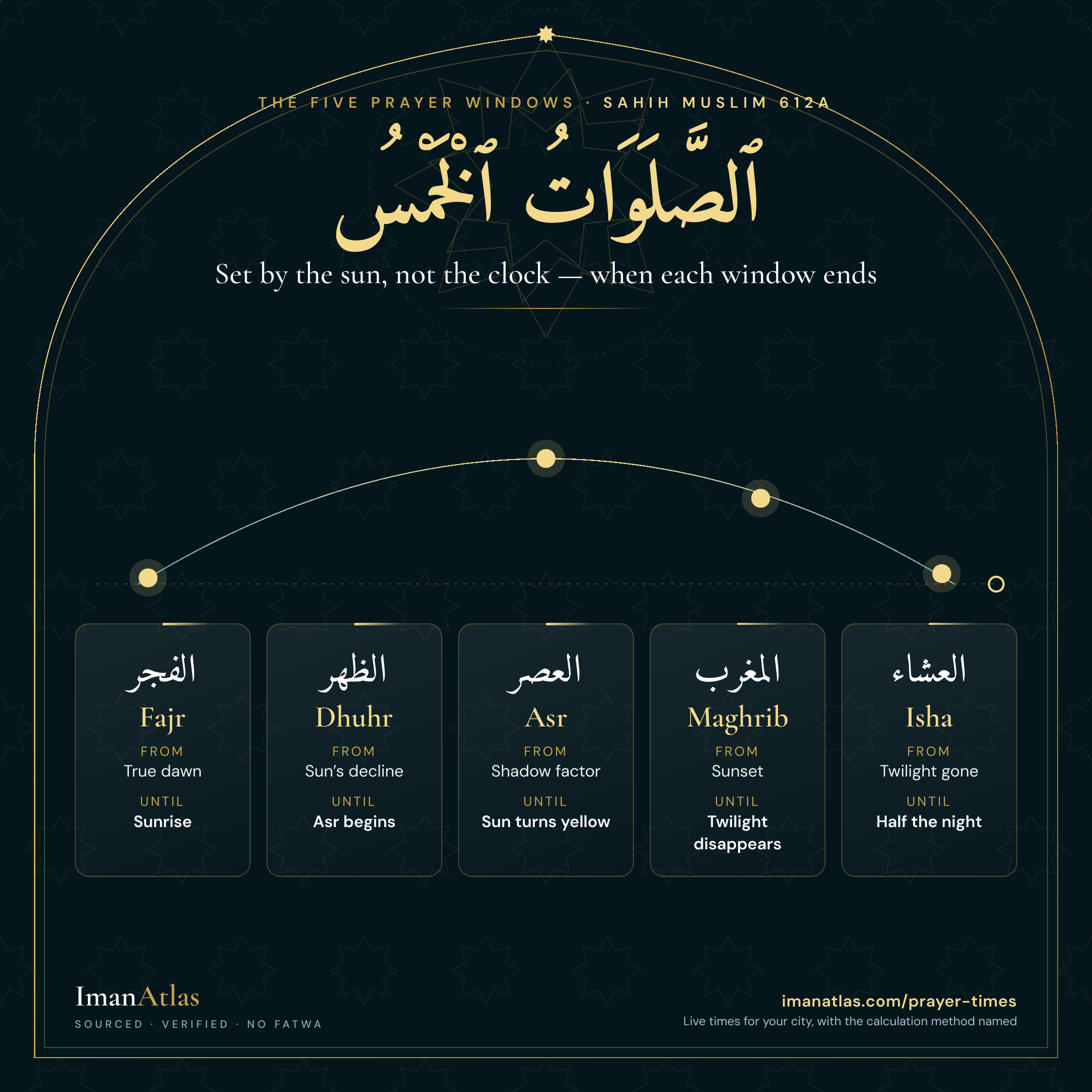
Short answer: Prayer times are windows set by the sun, not the clock — Fajr at dawn, Dhuhr after the sun’s decline, Asr by shadow length, Maghrib at sunset, Isha when twilight leaves. This hub explains each window from the Qur’an and Hadith, shows today’s live times for major cities, and names the calculation method behind every time.
The basis: what the Qur’an prescribes
وَأَقِمِ ٱلصَّلَوٰةَ طَرَفَيِ ٱلنَّهَارِ وَزُلَفًا مِّنَ ٱلَّيْلِ ۚ إِنَّ ٱلْحَسَنَٰتِ يُذْهِبْنَ ٱلسَّيِّـَٔاتِ ۚ ذَٰلِكَ ذِكْرَىٰ لِلذَّٰكِرِينَ
“Establish prayer (O Prophet) at both ends of the day and in the early part of the night. Surely good deeds wipe out evil deeds. That is a reminder for the mindful.”
Qur’an 11:114 — quran.com/11/114 (translation: Dr. Mustafa Khattab)
أَقِمِ ٱلصَّلَوٰةَ لِدُلُوكِ ٱلشَّمْسِ إِلَىٰ غَسَقِ ٱلَّيْلِ وَقُرْءَانَ ٱلْفَجْرِ ۖ إِنَّ قُرْءَانَ ٱلْفَجْرِ كَانَ مَشْهُودًا
“Observe the prayer from the decline of the sun until the darkness of the night and the dawn prayer, for certainly the dawn prayer is witnessed by angels.”
Qur’an 17:78 — quran.com/17/78
The five windows
The Prophet ﷺ stated the end of each window in one narration: “When you pray Fajr, its time is until the first part of the sun appears. When you pray Zuhr, its time is until ‘Asr comes. When you pray ‘Asr, its time is until the sun turns yellow. When you pray Maghrib, its time is until the twilight has disappeared. When you pray ‘Isha, its time is until half of the night has passed.”
Sahih Muslim 612a — sunnah.com/muslim:612a
| Prayer | Window begins | Window ends |
|---|---|---|
| Fajr | True dawn | Sunrise (the sun’s first part appears) |
| Dhuhr (Zuhr) | After the sun’s decline from its peak | When Asr begins |
| Asr | When an object’s shadow reaches the set factor (see below) | When the sun turns yellow (and finally, sunset) |
| Maghrib | Sunset | When the twilight disappears |
| Isha | When the twilight disappears | Half of the night has passed (per Muslim 612a) |
Jibril fixed the outer limits in person: he led the Prophet ﷺ in prayer over two days — the first day at each window’s earliest sign, the second at its latest — and said: “These are the times of the Prophets before you, and the (best) time is what is between these two times.”
Jami` at-Tirmidhi 149 — sunnah.com/tirmidhi:149
Why Asr has two times — and why both are printed
Asr begins by shadow: “the moment when the length of an object’s shadow equals a specific factor (commonly 1 or 2) of the object’s height, plus its noon shadow length.” The majority of schools — Shafi’i, Maliki, Ja’fari and Hanbali — take the factor as 1; the Hanafi school takes it as 2, so Hanafi Asr begins later. The Jibril narration itself contains both signs: Asr at shadow ×1 on the first day, at ×2 on the second. ImanAtlas prints the region’s conventional Asr as the main time and never calls either reading wrong — they are two sourced readings of the same evidence.
PrayTimes calculation reference — praytimes.org/calculation; Jami` at-Tirmidhi 149 above.
Calculation methods — the named conventions
Methods differ only in the sun angles used for Fajr and Isha (or a fixed Isha interval after Maghrib). These are the conventions in use, exactly as the Aladhan API’s official method registry lists them — the same registry this site’s live times use:
| Method | Authority | Fajr / Isha | Conventionally used in |
|---|---|---|---|
| Karachi | University of Islamic Sciences, Karachi | 18° / 18° | Pakistan, India, Bangladesh |
| Umm al-Qura | Umm Al-Qura University, Makkah | 18.5° / 90 min after Maghrib (120 min in Ramadan) | Saudi Arabia |
| MWL | Muslim World League | 18° / 17° | Common calculator default; much of Europe |
| ISNA | Islamic Society of North America | 15° / 15° | USA and Canada |
| Egypt | Egyptian General Authority of Survey | 19.5° / 17.5° | Egypt |
| Diyanet | Diyanet İşleri Başkanlığı, Turkey | 18° / 17° | Turkey and the Turkish diaspora |
| JAKIM | Jabatan Kemajuan Islam Malaysia | 20° / 18° | Malaysia |
| MUIS | Majlis Ugama Islam Singapura | 20° / 18° | Singapore |
| KEMENAG | Kementerian Agama Republik Indonesia | 20° / 18° | Indonesia |
| Gulf / Qatar / Kuwait | Regional official calendars | Gulf 19.5°/90 min · Qatar 18°/90 min · Kuwait 18°/17.5° | The Gulf states, each with its own |
Full registry (24 methods) and the complete angle table live on the Calculation Methods page, in preparation. Registry source: api.aladhan.com/v1/methods.
Find your region
India
Karachi method, Hanafi Asr — the usual choice across India. State and city pages are in preparation; the live widget above already covers the major metros.
Pakistan
Karachi method, Hanafi Asr. City pages in preparation; Karachi and Lahore are live in the widget above.
Bangladesh
Karachi method, Hanafi Asr. Dhaka is live in the widget above.
The Gulf
Each state keeps its own official calendar — Umm al-Qura in Saudi Arabia, and separate Gulf, Qatar, Kuwait and Dubai methods. Makkah, Dubai, Doha and Kuwait City are live in the widget above.
West Diaspora — UK, US, Canada
ISNA is the North American convention. The UK has no single national method: MWL is the common calculator default and many mosques publish their own timetables — London in the widget uses MWL.
Southeast Asia
JAKIM in Malaysia, MUIS in Singapore, KEMENAG in Indonesia — all three capitals are live in the widget above.
High-latitude readers
Near the poles, summer twilight can last all night, so the usual Fajr and Isha formulas cannot be applied directly. Calculation references describe three adjustment rules that communities use on top of their method: Middle of the Night (the sunset-to-sunrise period is halved; Fajr and Isha sit at midnight), One-Seventh of the Night (the night is divided into seven; Isha after the first seventh, Fajr at the last), and the Angle-Based Method (the night is divided in proportion to the twilight angle). ImanAtlas presents these as the sourced options they are — which one your community follows is a question for your local scholars, not for a website to rule on.
PrayTimes calculation reference — praytimes.org/calculation
Jumu’ah and Eid
يَٰٓأَيُّهَا ٱلَّذِينَ ءَامَنُوٓاْ إِذَا نُودِيَ لِلصَّلَوٰةِ مِن يَوْمِ ٱلْجُمُعَةِ فَٱسْعَوْاْ إِلَىٰ ذِكْرِ ٱللَّهِ وَذَرُواْ ٱلْبَيْعَ ۚ ذَٰلِكُمْ خَيْرٌ لَّكُمْ إِن كُنتُمْ تَعْلَمُونَ
“O believers! When the call to prayer is made on Friday, then proceed diligently to the remembrance of Allah and leave off your business. That is best for you, if only you knew.”
Qur’an 62:9 — quran.com/62/9
Jumu’ah is prayed in place of Dhuhr and falls inside Dhuhr’s window — but the khutbah and congregation time are set by each mosque, so check your mosque for the exact time. The same applies to Eid prayer: its window is the morning after sunrise, and the congregation time is each mosque’s own. ImanAtlas never prints a mosque’s time unless the mosque itself published it.
Ramadan
Ramadan runs on this same engine: sehri ends at Fajr, iftar is at Maghrib, and the month’s timetable is the daily table stretched over a month. The Ramadan Worldwide hub — expected dates by region, fasting durations and the moon-sighting notes every date needs — is live as this hub’s sibling.
Our honesty line, on every times page: calculated times are an estimate for the named city using the named method. Your local mosque’s times may differ by a few minutes; the mosque’s adhan is the final reference for congregation. A time printed without its method, coordinates and timezone is a claim without a source — you will not find one here.
Questions people ask
Why do prayer times change every day?
Because they follow the sun, not the clock. The sun’s path shifts a little daily — its rising and setting points, and how high it climbs — so dawn, solar noon, sunset and twilight all move with it, by seconds on some days and minutes on others.
Why are prayer times different in my city from another city?
Longitude moves every time east or west — a city further east sees dawn and sunset earlier — and latitude changes how long twilight lasts. Even inside one timezone the spread is large: on the same date, Gujarat and Kolkata can sit more than an hour apart.
Which calculation method should I use for my country?
Use the convention your region follows — it is named in the methods table above: Karachi for Pakistan, India and Bangladesh; Umm al-Qura for Saudi Arabia; ISNA for the USA and Canada; JAKIM, MUIS and KEMENAG in Southeast Asia; Diyanet for Turkey. The widget on this page already applies each city’s own convention.
Why is Asr time different for Hanafi and Shafi’i?
Both read the same shadow sign differently: Asr begins when an object’s shadow equals its height plus the noon shadow (factor 1 — Shafi’i, Maliki, Hanbali) or twice its height plus the noon shadow (factor 2 — Hanafi). The Jibril narration (Tirmidhi 149) shows Asr prayed at both points on successive days, which is why this site presents both readings and rules on neither.
When does Fajr end?
At sunrise. The Prophet ﷺ said Fajr’s time lasts “until the first part of the sun appears” (Sahih Muslim 612a). Sunrise itself is not a prayer — it is the marker that Fajr’s window has closed, and the point before which suhoor must end.
Is Jumu’ah at the same time as Dhuhr?
Jumu’ah is prayed in place of Dhuhr, inside Dhuhr’s window — but the khutbah and congregation time are set by each mosque, so the clock time differs from mosque to mosque. Check your mosque for its time.
Why do two prayer apps disagree by several minutes?
Almost always the settings: a different calculation method (different Fajr/Isha angles), a different Asr factor, or different coordinates. A time without a named method is a claim without a source — compare the methods first.
Should I follow the app or my local mosque?
Calculated times are estimates; mosques set congregation times deliberately, sometimes a few minutes after the window opens. For praying in congregation, the mosque’s adhan is the final reference — that is the honesty line printed under every timetable on this site.
What are the prayer times where the sun barely sets?
Where twilight lasts all night, the standard formulas have nothing to attach to, so communities apply an adjustment rule on top of their method — Middle of the Night, One-Seventh of the Night, or the Angle-Based Method. The three rules are explained in the high-latitude section above; which one to follow is a question for local scholars.
Until when can I pray Isha?
The Prophet ﷺ set Isha’s time as lasting “until half of the night has passed” (Sahih Muslim 612a).
Sources
Every load-bearing claim on this page was checked against its primary source on 27 November 2026:
- Qur’an 11:114 — prayer at both ends of the day (quran.com)
- Qur’an 17:78 — from the sun’s decline to the darkness of night (quran.com)
- Qur’an 62:9 — the Friday call (quran.com)
- Sahih Muslim 612a — the end of each window (sunnah.com)
- Jami` at-Tirmidhi 149 — Jibril fixes the times (sunnah.com)
- PrayTimes — calculation methods, Asr factors, high-latitude rules
- Aladhan API — official method registry (the live-times engine)
How we verify: Sources & Method · Accuracy & Correction Policy · Calculation Methods. Spotted an error? Our correction policy explains how we fix it within 24 hours.