Zakat, calculated in the open
Your figures and your prices — the formula and its sources printed next to the result, and nothing you enter is stored.
Short answer: ImanAtlas tools begin with zakat: the Qur’an commands it (9:103) and names who receives it (9:60). Our calculator prints its formula, both nisab conventions and the hadith lines beside the form; prices are only ever your own, and every result is an estimate — confirm your case with a qualified mufti.
Zakat calculator
Zakat is the obligatory charity on wealth that reaches the nisab and is held for a full lunar year. Allah says:
خُذۡ مِنۡ أَمۡوَٰلِهِمۡ صَدَقَةٗ تُطَهِّرُهُمۡ وَتُزَكِّيهِم بِهَا وَصَلِّ عَلَيۡهِمۡۖ إِنَّ صَلَوٰتَكَ سَكَنٞ لَّهُمۡۗ وَٱللَّهُ سَمِيعٌ عَلِيمٌ
“Take from their wealth ˹O Prophet˺ charity to purify and bless them, and pray for them—surely your prayer is a source of comfort for them. And Allah is All-Hearing, All-Knowing.”
Qur’an 9:103 — quran.com/9/103 (translation: Dr. Mustafa Khattab)
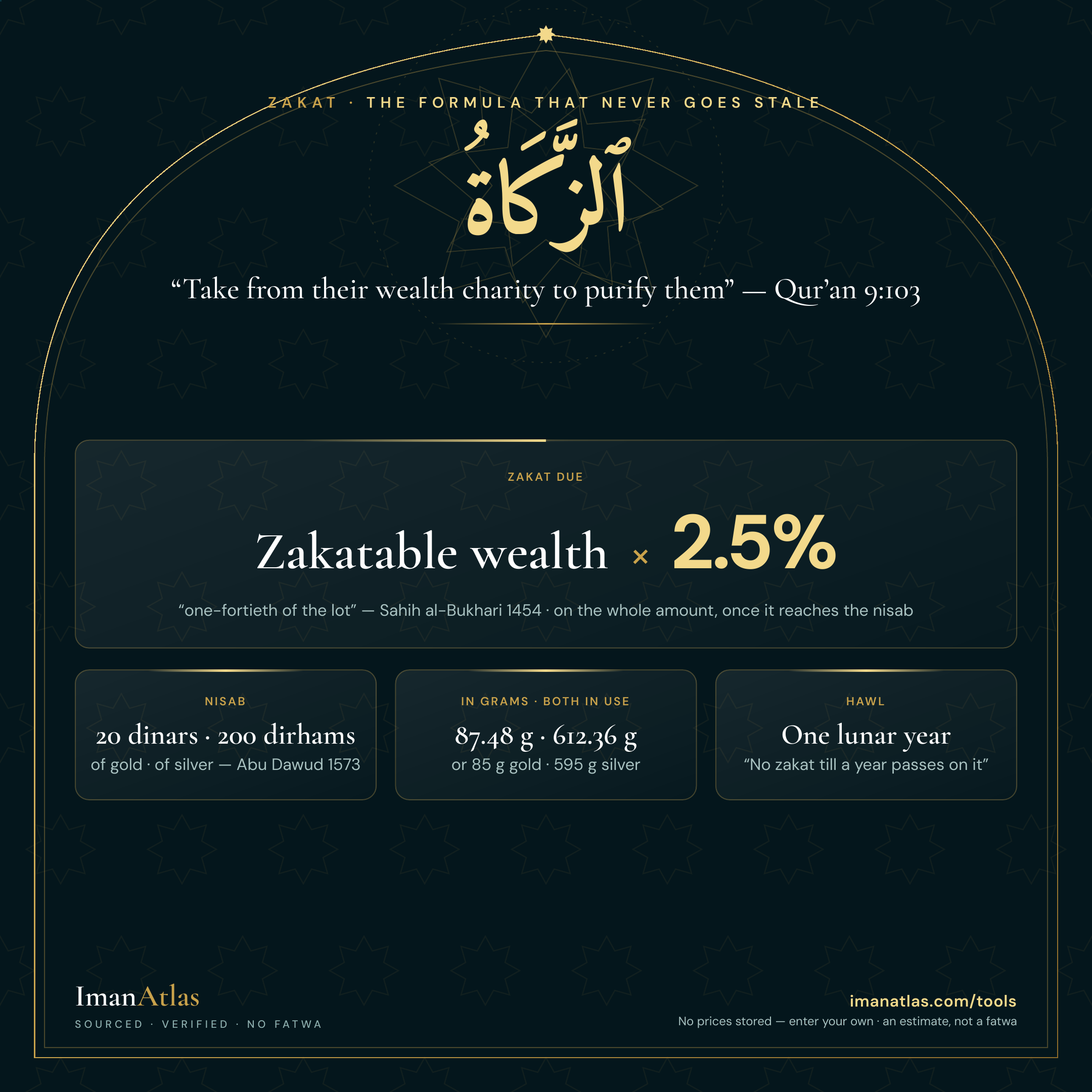
The formula this calculator performs, printed before it runs: Zakatable wealth = gold + silver + cash + bank + business stock + investments + money owed to you − debts due now. If that wealth is at or above the nisab on the basis you select, zakat due = zakatable wealth × 2.5% — the “quarter of a tenth” of the sources below. Enter your own local gold and silver prices; this page stores no price and calls none “today’s”. Everything is calculated in your browser — nothing you type is sent or stored.
Calculate your zakat — an estimate
This calculator is an estimate for learning, built on the sources printed on this page. It is not a fatwa. Confirm your own case with a qualified mufti or lawyer. Schools differ on some inputs (for example, jewellery worn for personal use, and which debts are deductible) — include an item if you follow the view that it is counted, and ask a scholar about your situation.
A worked example (with invented, round prices — never today’s rates)
Suppose gold is ₹5,000 a gram and silver ₹60 a gram — round numbers chosen only to show the arithmetic. A person holds ₹80,000 in cash and bank, 50 g of 24k gold (₹2,50,000), 200 g of silver (₹12,000), business stock worth ₹40,000, is owed ₹10,000, and owes ₹30,000 due now. Zakatable wealth = 80,000 + 2,50,000 + 12,000 + 40,000 + 10,000 − 30,000 = ₹3,62,000. The silver nisab at these prices is 612.36 g × ₹60 = ₹36,741.60 — the wealth is above it, so zakat = ₹3,62,000 × 2.5% = ₹9,050. Change any price and every figure moves; that is why this page will never print a nisab in rupees as a standing fact.
The nisab, from the sources
The nisab is the minimum wealth on which zakat falls. The Prophet ﷺ fixed it in weights, not currencies: “There is no Zakat on less than five camels and also there is no Zakat on less than five Awaq (of silver)… And there is no Zakat on less than five Awsuq.” (Sahih al-Bukhari 1447 — sunnah.com/bukhari:1447; the page’s own gloss equates five awaq with 200 dirhams — the equivalences printed there are the translator’s glosses, and we present them as such.) Abu Bakr’s written schedule, transmitting the Prophet’s ﷺ orders, sets the rate: “For silver the Zakat is one-fortieth of the lot (i.e. 2.5%), and if its value is less than two-hundred Dirhams, Zakat is not required, but if the owner wants to pay he can.” (Sahih al-Bukhari 1454 — sunnah.com/bukhari:1454). And ‘Ali ibn Abi Talib reports the Prophet ﷺ saying: “When you possess two hundred dirhams and one year passes on them, five dirhams are payable. Nothing is incumbent on you, that is, on gold, till it reaches twenty dinars. When you possess twenty dinars and one year passes on them, half a dinar is payable. Whatever exceeds, that will be reckoned properly… No zakat is payable on property till a year passes on it.” (Sunan Abi Dawud 1573 — sunnah.com/abudawud:1573 · grade as printed on sunnah.com: Sahih (Al-Albani)).
In today’s weights, scholars convert twenty dinars (mithqal) and two hundred dirhams two ways, and both conventions are in current use: 87.48 g of gold and 612.36 g of silver (20 × 4.374 g; 200 × 3.0618 g — also stated as 7.5 and 52.5 tola), and 85 g of gold and 595 g of silver (20 × 4.25 g). Neither figure in grams is in the Qur’an or hadith — they are scholarly conventions for the same weights, so the calculator above lets you choose, and shows which one produced your nisab. Which basis — gold or silver — a person follows is likewise a matter the schools discuss; because the silver nisab is far lower in money today, more wealth falls under it. ImanAtlas presents both and rules on neither: for readers in India, Pakistan and Bangladesh the silver basis is the usual presentation, and the difference is noted, as our method states.
Who receives zakat — the eight categories
إِنَّمَا ٱلصَّدَقَٰتُ لِلۡفُقَرَآءِ وَٱلۡمَسَٰكِينِ وَٱلۡعَٰمِلِينَ عَلَيۡهَا وَٱلۡمُؤَلَّفَةِ قُلُوبُهُمۡ وَفِي ٱلرِّقَابِ وَٱلۡغَٰرِمِينَ وَفِي سَبِيلِ ٱللَّهِ وَٱبۡنِ ٱلسَّبِيلِۖ فَرِيضَةٗ مِّنَ ٱللَّهِۗ وَٱللَّهُ عَلِيمٌ حَكِيمٞ
“Alms-tax is only for the poor and the needy, for those employed to administer it, for those whose hearts are attracted ˹to the faith˺, for ˹freeing˺ slaves, for those in debt, for Allah’s cause, and for ˹needy˺ travellers. ˹This is˺ an obligation from Allah. And Allah is All-Knowing, All-Wise.”
Qur’an 9:60 — quran.com/9/60 (translation: Dr. Mustafa Khattab)
| Category (the verse’s word) | In plain words |
|---|---|
| The poor (al-fuqara’) | Those who do not have enough for their needs. |
| The needy (al-masakin) | Those in hardship, short of sufficiency. |
| Its administrators (al-‘amilina ‘alayha) | Those employed to collect and administer the zakat itself. |
| Those whose hearts are attracted (al-mu’allafati qulubuhum) | People whose hearts are being drawn toward the faith. |
| Freeing slaves (fi’l-riqab) | To free those in bondage. |
| The debt-bound (al-gharimin) | Those weighed down by debt. |
| In Allah’s cause (fi sabilillah) | For the cause of Allah, as the scholars explain its scope. |
| The stranded traveller (ibn as-sabil) | A traveller cut off from their means, though they may have wealth at home. |
Whether a specific person or organisation qualifies under a category is a question for a qualified scholar — this page prints the verse; it does not rule on cases.
Inheritance (meerath) — the shares, explained
There is deliberately no automatic inheritance calculator on this page. A family’s estate divided wrongly is the gravest error a site like this can make, and real cases turn on details — who exactly survives, which school, which country’s law — that a form cannot weigh. What we can do faithfully is print what the Qur’an itself prescribes, in full, and show one carefully checked example. For an actual estate, take this page to a qualified mufti and a lawyer in your country.
يُوصِيكُمُ ٱللَّهُ فِيٓ أَوۡلَٰدِكُمۡۖ لِلذَّكَرِ مِثۡلُ حَظِّ ٱلۡأُنثَيَيۡنِۚ فَإِن كُنَّ نِسَآءٗ فَوۡقَ ٱثۡنَتَيۡنِ فَلَهُنَّ ثُلُثَا مَا تَرَكَۖ وَإِن كَانَتۡ وَٰحِدَةٗ فَلَهَا ٱلنِّصۡفُۚ وَلِأَبَوَيۡهِ لِكُلِّ وَٰحِدٖ مِّنۡهُمَا ٱلسُّدُسُ مِمَّا تَرَكَ إِن كَانَ لَهُۥ وَلَدٞۚ فَإِن لَّمۡ يَكُن لَّهُۥ وَلَدٞ وَوَرِثَهُۥٓ أَبَوَاهُ فَلِأُمِّهِ ٱلثُّلُثُۚ فَإِن كَانَ لَهُۥٓ إِخۡوَةٞ فَلِأُمِّهِ ٱلسُّدُسُۚ مِنۢ بَعۡدِ وَصِيَّةٖ يُوصِي بِهَآ أَوۡ دَيۡنٍۗ ءَابَآؤُكُمۡ وَأَبۡنَآؤُكُمۡ لَا تَدۡرُونَ أَيُّهُمۡ أَقۡرَبُ لَكُمۡ نَفۡعٗاۚ فَرِيضَةٗ مِّنَ ٱللَّهِۗ إِنَّ ٱللَّهَ كَانَ عَلِيمًا حَكِيمٗا
“Allah commands you regarding your children: the share of the male will be twice that of the female. If you leave only two ˹or more˺ females, their share is two-thirds of the estate. But if there is only one female, her share will be one-half. Each parent is entitled to one-sixth if you leave offspring. But if you are childless and your parents are the only heirs, then your mother will receive one-third. But if you leave siblings, then your mother will receive one-sixth—after the fulfilment of bequests and debts. ˹Be fair to˺ your parents and children, as you do not ˹fully˺ know who is more beneficial to you. ˹This is˺ an obligation from Allah. Surely Allah is All-Knowing, All-Wise.”
Qur’an 4:11 — quran.com/4/11 (translation: Dr. Mustafa Khattab)
وَلَكُمۡ نِصۡفُ مَا تَرَكَ أَزۡوَٰجُكُمۡ إِن لَّمۡ يَكُن لَّهُنَّ وَلَدٞۚ فَإِن كَانَ لَهُنَّ وَلَدٞ فَلَكُمُ ٱلرُّبُعُ مِمَّا تَرَكۡنَۚ مِنۢ بَعۡدِ وَصِيَّةٖ يُوصِينَ بِهَآ أَوۡ دَيۡنٖۚ وَلَهُنَّ ٱلرُّبُعُ مِمَّا تَرَكۡتُمۡ إِن لَّمۡ يَكُن لَّكُمۡ وَلَدٞۚ فَإِن كَانَ لَكُمۡ وَلَدٞ فَلَهُنَّ ٱلثُّمُنُ مِمَّا تَرَكۡتُمۚ مِّنۢ بَعۡدِ وَصِيَّةٖ تُوصُونَ بِهَآ أَوۡ دَيۡنٖۗ وَإِن كَانَ رَجُلٞ يُورَثُ كَلَٰلَةً أَوِ ٱمۡرَأَةٞ وَلَهُۥٓ أَخٌ أَوۡ أُخۡتٞ فَلِكُلِّ وَٰحِدٖ مِّنۡهُمَا ٱلسُّدُسُۚ فَإِن كَانُوٓاْ أَكۡثَرَ مِن ذَٰلِكَ فَهُمۡ شُرَكَآءُ فِي ٱلثُّلُثِۚ مِنۢ بَعۡدِ وَصِيَّةٖ يُوصَىٰ بِهَآ أَوۡ دَيۡنٍ غَيۡرَ مُضَآرٍّۚ وَصِيَّةٗ مِّنَ ٱللَّهِۗ وَٱللَّهُ عَلِيمٌ حَلِيمٞ
“You will inherit half of what your wives leave if they are childless. But if they have children, then ˹your share is˺ one-fourth of the estate—after the fulfilment of bequests and debts. And your wives will inherit one-fourth of what you leave if you are childless. But if you have children, then your wives will receive one-eighth of your estate—after the fulfilment of bequests and debts. And if a man or a woman leaves neither parents nor children but only a brother or a sister ˹from their mother’s side˺, they will each inherit one-sixth, but if they are more than one, they ˹all˺ will share one-third of the estate—after the fulfilment of bequests and debts without harm ˹to the heirs˺. ˹This is˺ a commandment from Allah. And Allah is All-Knowing, Most Forbearing.”
Qur’an 4:12 — quran.com/4/12 (translation: Dr. Mustafa Khattab)
يَسۡتَفۡتُونَكَ قُلِ ٱللَّهُ يُفۡتِيكُمۡ فِي ٱلۡكَلَٰلَةِۚ إِنِ ٱمۡرُؤٌاْ هَلَكَ لَيۡسَ لَهُۥ وَلَدٞ وَلَهُۥٓ أُخۡتٞ فَلَهَا نِصۡفُ مَا تَرَكَۚ وَهُوَ يَرِثُهَآ إِن لَّمۡ يَكُن لَّهَا وَلَدٞۚ فَإِن كَانَتَا ٱثۡنَتَيۡنِ فَلَهُمَا ٱلثُّلُثَانِ مِمَّا تَرَكَۚ وَإِن كَانُوٓاْ إِخۡوَةٗ رِّجَالٗا وَنِسَآءٗ فَلِلذَّكَرِ مِثۡلُ حَظِّ ٱلۡأُنثَيَيۡنِۗ يُبَيِّنُ ٱللَّهُ لَكُمۡ أَن تَضِلُّواْۗ وَٱللَّهُ بِكُلِّ شَيۡءٍ عَلِيمُۢ
“They ask you ˹for a ruling, O Prophet˺. Say, “Allah gives you a ruling regarding those who die without children or parents.” If a man dies childless and leaves behind a sister, she will inherit one-half of his estate, whereas her brother will inherit all of her estate if she dies childless. If this person leaves behind two sisters, they together will inherit two-thirds of the estate. But if the deceased leaves male and female siblings, a male’s share will be equal to that of two females. Allah makes ˹this˺ clear to you so you do not go astray. And Allah has ˹perfect˺ knowledge of all things.”
Qur’an 4:176 — quran.com/4/176 (translation: Dr. Mustafa Khattab)
The order of settlement
Before any heir receives anything, the estate settles in this order — the verses repeat “after the fulfilment of bequests and debts” at every step: funeral costs first, then debts, then bequests (a wasiyyah — the sources universally cap a bequest at one-third of what remains after debts), then the heirs’ shares. The Prophet ﷺ fixed the shares’ order: “Give the Fara’id (the shares of the inheritance that are prescribed in the Qur’an) to those who are entitled to receive it. Then whatever remains, should be given to the closest male relative of the deceased.” (Sahih al-Bukhari 6732 — sunnah.com/bukhari:6732).
The fixed shares, from the verses
| Share | Who receives it, and when | Source |
|---|---|---|
| 1/2 | One daughter, when there is no son · a husband whose wife left no offspring · one sister in kalalah (no parents or children) | 4:11 · 4:12 · 4:176 |
| 1/4 | A husband, when his wife left offspring · a wife (or wives together), when her husband left no offspring | 4:12 |
| 1/8 | A wife (or wives together), when her husband left offspring | 4:12 |
| 2/3 | Two or more daughters, when there is no son · two sisters in kalalah | 4:11 · 4:176 |
| 1/3 | The mother, when there are no offspring and no siblings · two or more maternal siblings, shared between them | 4:11 · 4:12 |
| 1/6 | Each parent, when there are offspring · the mother, when there are siblings · one maternal brother or sister | 4:11 · 4:12 |
Alongside the fixed shares, children and full siblings also take as residuaries — what remains after the fixed shares — with a male receiving the portion of two females (4:11, 4:176). Two adjustments complete the picture, as concepts: ‘awl — when the fixed shares add up to more than the whole estate, every share is reduced proportionally (the denominator rises); radd — when the fixed shares leave a surplus and there is no residuary, the surplus returns to the fixed-share heirs in proportion to their shares, a point whose details the schools discuss. A worked illustration of ‘awl: a husband (1/2) and two full sisters (2/3) claim 3/6 + 4/6 = 7/6 of an estate — the estate is divided into sevenths instead of sixths, so each receives 3/7 and 4/7 respectively.
One worked example (an illustration, checked by hand — not a ruling on any family)
A man dies leaving a wife, his mother, two sons and one daughter, and — after funeral costs, debts and any bequest — an estate of ₹9,60,000. The wife takes her fixed 1/8 (offspring exist, 4:12) = ₹1,20,000. The mother takes her fixed 1/6 (offspring exist, 4:11) = ₹1,60,000. The fixed shares use 7/24 of the estate; the remaining 17/24 goes to the children as residuaries, a son taking two daughters’ portions — five units in all (2 + 2 + 1), so each son takes 17/60 = ₹2,72,000 and the daughter 17/120 = ₹1,36,000. Total: 1,20,000 + 1,60,000 + 2,72,000 + 2,72,000 + 1,36,000 = ₹9,60,000 — the whole estate, nothing left over. Real estates add grandparents, siblings, exclusion rules and national law on top of this skeleton; that is exactly why this site explains the shares instead of automating them.
More tools, in preparation
Fitrana (zakat al-fitr)
The per-person charity of Eid al-Fitr, measured by your staple food. Its narration and amounts must be verified at their primary sources before any figure appears here — this door opens when that research is done, in time for Ramadan.
Fidya
Feeding a poor person for each missed fast, for those the Qur’an excuses from fasting. Its verse and measures get their own verified page before any calculator appears.
Qibla direction
Your Qibla bearing is computed from your own coordinates by the same engine layer as our prayer times — it lives with the Prayer Times hub, where the method is stated. We print no city’s bearing as a stored fact.
Hijri date converter
Conversion between Gregorian and Hijri dates is arithmetic on the calculated calendar — with one honest caveat that travels with every converted religious date: the observed date can differ by a day with the sighting of the moon, as the Ramadan hub explains. The converter ships only after its outputs are checked against known dates.
The zakat formula and the nisab weights — the facts that never go stale, because they carry no prices. Save it, share it.
Questions people ask
What is the nisab?
The minimum wealth on which zakat becomes due: twenty dinars of gold or two hundred dirhams of silver in the Prophet’s ﷺ words (Sunan Abi Dawud 1573), held for a full lunar year. In grams, scholars print two conventions — 87.48 g of gold and 612.36 g of silver, or 85 g and 595 g — both shown in the calculator above.
Gold nisab or silver nisab — which one should I use?
Both are in use, and the schools discuss the choice; because metal prices have diverged since the Prophet’s ﷺ time, the silver nisab is far lower in money today, so more people’s wealth crosses it. For readers in India, Pakistan and Bangladesh the silver basis is the usual presentation. ImanAtlas shows both, names the difference, and rules on neither — a scholar who knows your situation can advise you.
Do I pay 2.5% on all my wealth, or only on the amount above the nisab?
On the whole zakatable amount, once it reaches the nisab — that is how the sources’ own schedule reads: “When you possess two hundred dirhams and one year passes on them, five dirhams are payable” (Sunan Abi Dawud 1573) — five dirhams is 2.5% of the full two hundred, not of an excess. Below the nisab, nothing is due.
Must I hold the wealth for a full lunar year?
Yes — the hawl is part of the narration itself: “No zakat is payable on property till a year passes on it” (Sunan Abi Dawud 1573, graded Sahih by Al-Albani as printed on sunnah.com). The calculator asks you to confirm it; without a completed hawl, a figure is only what the estimate would be.
Is zakat due on gold jewellery that I wear?
The schools differ on jewellery kept for personal use — some hold it zakatable like any gold, others exempt jewellery in regular use. ImanAtlas presents the difference and rules on neither: include your jewellery in the calculator if you follow the view that it is counted, and ask a scholar about your own case.
Do I pay zakat on my salary every month?
The frame the primary sources give is wealth-based, not income-based: zakat falls on what you hold at or above the nisab when your zakat year completes — salary enters as the savings present on that date. Some contemporary scholars give rulings on monthly salary zakat; those are attributed fatwa positions, and this page presents the sourced frame rather than ruling between them.
Who can receive zakat?
The eight categories of Qur’an 9:60 — the poor, the needy, zakat’s administrators, those whose hearts are attracted to the faith, freeing slaves, the debt-bound, Allah’s cause, and the stranded traveller — printed in full in the section above. Whether a specific recipient qualifies is a scholar’s question.
How is Islamic inheritance calculated?
In the order the Qur’an sets: funeral costs, then debts, then bequests, then the fixed shares of verses 4:11, 4:12 and 4:176, with any remainder to the residuaries — “Give the Fara’id to those who are entitled to receive it; then whatever remains to the closest male relative” (Sahih al-Bukhari 6732). The shares table and a worked example are in the inheritance section above.
Do daughters inherit in Islam?
Yes — the Qur’an assigns daughters their shares in its own words: one daughter takes half the estate when there is no son, and two or more daughters share two-thirds (Qur’an 4:11). Alongside sons, daughters take as residuaries with a son receiving two daughters’ portions — the verse is printed in full above.
Why is there no inheritance calculator on this page?
Because a wrong share divides a real family’s estate wrongly, and real cases turn on exclusion rules, schools and national law that a form cannot weigh. We publish the Qur’an’s own shares, the settlement order and a hand-checked example instead — and for an actual estate, the honest advice is a qualified mufti and a lawyer, not a web form. An educational calculator, naming one school at a time with its limits printed, is planned as its own researched page.
Sources
Every load-bearing claim on this page was checked against its primary source on 27 November 2026. Metal prices are never sourced here — they are yours to enter.
- Qur’an 9:103 — charity taken from their wealth (quran.com)
- Qur’an 9:60 — the eight categories (quran.com)
- Sahih al-Bukhari 1447 — no zakat below five awaq (sunnah.com)
- Sahih al-Bukhari 1454 — a quarter of a tenth on silver (sunnah.com)
- Sunan Abi Dawud 1573 — twenty dinars, two hundred dirhams, the hawl (sunnah.com)
- Qur’an 4:11 — the children’s and parents’ shares (quran.com)
- Qur’an 4:12 — the spouses’ and maternal siblings’ shares (quran.com)
- Qur’an 4:176 — kalalah completed (quran.com)
- Sahih al-Bukhari 6732 — give the shares to those entitled (sunnah.com)
- Nisab weight conventions in current use, as printed by zakat organisations: Dexaloop (NZF figures) · Codanics · FinEst India
How we verify: Sources & Method · Accuracy & Correction Policy · No-Fatwa Disclaimer. Spotted an error? Our correction policy explains how we fix it within 24 hours.