The Dua After Completing Wudu — The Shahada, and the Addition the Critics Dispute
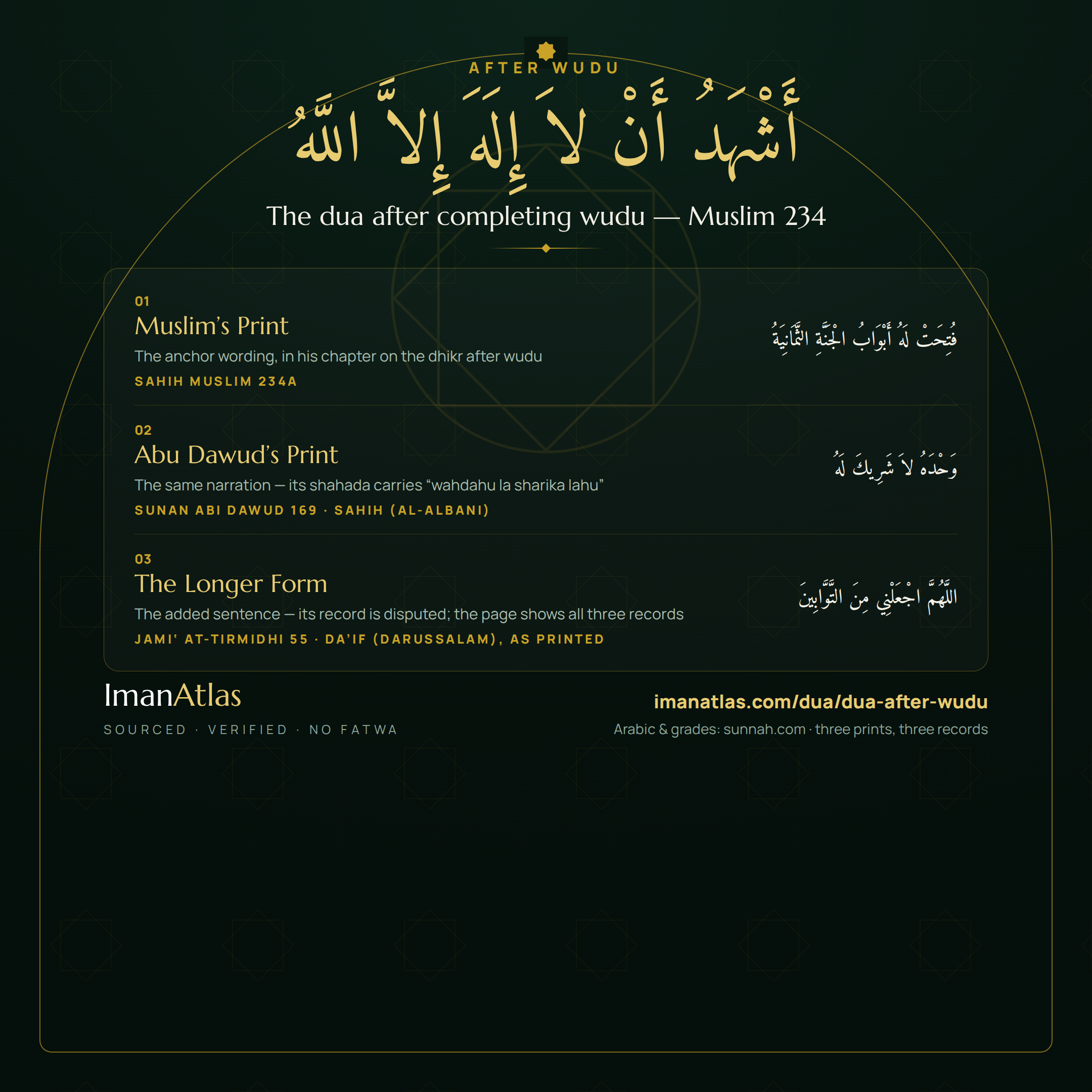
Ask what is said after wudu and most pages print one long text, as if the sources gave one text. They give three prints: a short anchor in Sahih Muslim, the same narration again in Abu Dawud with its own small differences, and a longer form in at-Tirmidhi that adds a sentence about repentance — a sentence whose record the critics dispute three ways. This page prints each print as it stands, and all three records beside the addition.
Short answer: After finishing wudu, the narration in Sahih Muslim 234 gives one set of words: the shahada — ‘I testify that there is no god but Allah, and that Muhammad is the servant of Allah and His Messenger.’ A longer form adding ‘O Allah, make me among the repentant’ comes through at-Tirmidhi 55, whose chain the hadith critics dispute.
ImanAtlas does not give fatwas. For your own situation, ask a qualified scholar you trust.
The words after wudu are among the most repeated words in a Muslim’s day, and among the least examined. The form most people carry — the shahada followed by “O Allah, make me among the repentant” — is a joining of two prints. The shahada stands in Sahih Muslim. The sentence about repentance stands in one print of the same hadith, in at-Tirmidhi, and its chain has been disputed since at-Tirmidhi himself wrote about it. This page prints the anchor first, then the second print of the same narration, then the longer form — and then sets out the three records for the added sentence, each under its own name.
The words in Sahih Muslim 234
Muslim gives this dhikr a chapter of its own in his Book of Purification: “Adh-Dhikr (the remembrance) which is recommended following wudu’.” The narration is ‘Uqba ibn ‘Amir’s. He tells of the companions taking turns tending the camels, of coming back one evening to find the Prophet ﷺ addressing the people, and of hearing first the words about two rak‘ahs prayed with heart and face turned to them. Then ‘Umar, standing before him, told him the words spoken just before he arrived were finer still: the words for the one who completes the ablution well and then says the shahada. The outcome the narration itself attaches to those words — the eight gates of Paradise opened, entry by whichever gate he wishes — stands inside the narration below, in the Prophet’s ﷺ words as Muslim prints them, and nowhere on this page in the site’s own voice.
أَشْهَدُ أَنْ لاَ إِلَهَ إِلاَّ اللَّهُ وَأَنَّ مُحَمَّدًا عَبْدُ اللَّهِ وَرَسُولُهُ
Ashhadu an la ilaha illallah, wa anna Muhammadan ‘abdullahi wa rasuluh.
“’Uqba b. ‘Amir reported: We were entrusted with the task of tending the camels. On my turn when I came back in the evening after grazing them in the pastures, I found Allah’s Messenger (ﷺ) stand and address the people. I heard these words of his: If any Muslim performs ablution well, then stands and prays two rak’ahs setting about them with his heart as well as his face, Paradise would be guaranteed to him. I said: What a fine thing is this! And a narrator who was before me said: The first was better than even this. When I cast a glance, I saw that it was ‘Umar who said: I see that you have just come and observed: If anyone amongst you performs the ablution, and then completes the ablution well and then says: I testify that there is no god but Allah and that Muhammad is the servant of Allah and His Messenger, the eight gates of Paradise would be opened for him and he may enter by whichever of them he wishes.”
Sahih Muslim 234a · The Book of Purification, chapter “Adh-Dhikr (the remembrance) which is recommended following wudu’” · in-book Book 2, Hadith 20 · narrated by ‘Uqba ibn ‘Amir — Sahih Muslim prints no per-hadith grade field at sunnah.com · sunnah.com prints no transliteration for this narration; the line above is a derivation from the Arabic, checked word for word against it
Note what Muslim’s print of the shahada does and does not carry. It names Muhammad as “the servant of Allah and His Messenger” — ‘abdullahi, with the name of Allah inside the phrase — and it carries no “wahdahu la sharika lahu” clause. Both of those small things change in the next print.
The same narration in Abu Dawud 169
Abu Dawud prints the same narration in his Book of Purification, in the chapter he names “What Should One Say After Finishing Wudu’.” Same narrator, same camels, same exchange with ‘Umar — it is one narration standing in two books, not two narrations. But his print words the shahada differently in two places: it carries “wahdahu la sharika lahu” — “He has no associate” — inside the testimony, and it reads ‘abduhu, “His Servant”, where Muslim’s print reads ‘abdullahi. Neither print has been corrected from the other on this page; each stands as its book gives it, under its own reference and its own printed grade.
أَشْهَدُ أَنْ لاَ إِلَهَ إِلاَّ اللَّهُ وَحْدَهُ لاَ شَرِيكَ لَهُ وَأَنَّ مُحَمَّدًا عَبْدُهُ وَرَسُولُهُ
Ashhadu an la ilaha illallah, wahdahu la sharika lah, wa anna Muhammadan ‘abduhu wa rasuluh.
“’Uqbah b. ‘Amir said: We served ourselves in the company of Messenger of Allah (ﷺ). We tended our camels by turn. One day I had my turn to tend the camels, and I drove them in the afternoon. I found the Messenger of Allah (ﷺ) addressing the people. I heard him say: Anyone amongst you who performs ablution, and does it well, then he stands and offers two rak’ahs of prayer, concentrating on it with his heart and body, Paradise will be his lot by all means. I said: Ha-ha! How fine it is! A man in front of me said: The action (mentioned by the Prophet) earlier, O ‘Uqbah, is finer that this one. I looked at him and found him to be ‘Umar b. al-Khattab. I asked him: What is that, O Abu Hafs? He replied: He (the Prophet) had said before you came: If any one of you performs ablution, and does it well, and when he finishes the ablution, he utters the words : I bear witness that there is no deity except Allah, He has no associate, and I bear witness that Muhammad is His Servant and His Messenger, all the eight doors of Paradise will be opened for him; he may enter (through) any of them. Mu’awiyah said: Rabi’ah b. Yazid narrated this tradition to me from Abu Idris and the authority of ‘Uqbah b.’Amir.”
Sunan Abi Dawud 169 · Purification (Kitab Al-Taharah), chapter “What Should One Say After Finishing Wudu’” · in-book Book 1, Hadith 169 · narrated by ‘Uqba ibn ‘Amir — Grade: Sahih (Al-Albani), as printed at sunnah.com · its shahada is worded differently from Muslim’s print, so it carries its own transliteration line — a derivation from its Arabic, checked word for word against it
The longer form: at-Tirmidhi 55
At-Tirmidhi prints the hadith a third time, in his Book on Purification, from ‘Umar directly. His print carries the shahada in the Abu Dawud wording — with the wahdahu clause — and then one sentence more, the sentence this page exists to handle honestly: “Allahumma-j’alni minat-tawwabin, waj’alni minal-mutatahhirin” — “O Allah, make me among the repentant, and make me among those who purify themselves.” This is the sentence printed in the dua books after the shahada — Hisnul Muslim’s chapter on what follows wudu prints the long form — and the sentence many people learn as a child without ever hearing that its record is disputed.
أَشْهَدُ أَنْ لاَ إِلَهَ إِلاَّ اللَّهُ وَحْدَهُ لاَ شَرِيكَ لَهُ وَأَشْهَدُ أَنَّ مُحَمَّدًا عَبْدُهُ وَرَسُولُهُ اللَّهُمَّ اجْعَلْنِي مِنَ التَّوَّابِينَ وَاجْعَلْنِي مِنَ الْمُتَطَهِّرِينَ
Ashhadu an la ilaha illallah, wahdahu la sharika lahu, wa ashhadu anna Muhammadan-abduhu wa rasuluhu, Allahummajalni minat tawwabin, waj’alni minal mutatahhirin
“Umar bin Al-Khattab narrated that : Allah’s Messenger said: ‘Whoever performs Wudu, making Wudu well, then says: (Ashhadu an la ilaha illallah, wahdahu la sharika lahu, wa ashhadu anna Muhammadan-abduhu wa rasuluhu, Allahummajalni minat tawwabin, waj’alni minal mutatahhirin) ‘I testify that none has the right to be worshipped but Allah Alone, there are no partners for Him. And I testify that Muhammad is His servant and Messenger. O Allah! Make me among the repentant, and make me among those who purify themselves.’ Then eight gates of Paradise are opened for him, that may enter by whichever of them wishes."”
Jami‘ at-Tirmidhi 55 · The Book on Purification, chapter “[About] What Is Said After Wudu” · in-book Book 1, Hadith 55 · English translation Vol. 1, Book 1, Hadith 55 · narrated by ‘Umar ibn al-Khattab — Grade: Da’if (Darussalam), as printed at sunnah.com · its printed translation carries the words in Roman letters inside itself; the line above is that printed form, judged against the Arabic word for word · the records for its added sentence stand in the section below
Three records for one addition
The added sentence carries three records, and they do not agree. This page sets them side by side, each under the name of the one who left it, and adds no verdict of its own.
The first record is the grade field printed at sunnah.com today for Jami‘ at-Tirmidhi 55: Da’if (Darussalam). That is the grade a reader of the source itself meets first.
The second record is older, and it is at-Tirmidhi’s own. After the narration, in the tail of his own print, he writes of this hadith:
At-Tirmidhi, in his tail: وَهَذَا حَدِيثٌ فِي إِسْنَادِهِ اضْطِرَابٌ وَلاَ يَصِحُّ عَنِ النَّبِيِّ صلى الله عليه وسلم فِي هَذَا الْبَابِ كَبِيرُ شَيْءٍ
— “this is a hadith in whose isnad there is idtirab”, confusion in its chain, “and nothing in this chapter is sahih from the Prophet ﷺ in any major way.” The tail goes on to trace the disagreement inside the chain — Zayd ibn Hubab was contradicted in this hadith — and it preserves a remark of Muhammad ibn Isma‘il al-Bukhari on one of its links:
The tail, recording al-Bukhari: قَالَ مُحَمَّدٌ وَأَبُو إِدْرِيسَ لَمْ يَسْمَعْ مِنْ عُمَرَ شَيْئًا
— “Abu Idris did not hear anything from ‘Umar.”
The third record runs the other way. IslamQA’s answer on the duas of wudu (answer 45730) records that al-Albani classed this addition as sahih, in his Sahih al-Tirmidhi, and that Ibn al-Qayyim held it proven from the Prophet ﷺ. The same answer also records the contrary view of al-Hafiz ibn Hajar: that the addition is da’if and not proven as part of this hadith. Both of those are reported here as what they are — records carried by that answer, attributed to it by name — not as lines from sunnah.com, which prints neither.
So the sentence stands with a weak grade on its own source page, a note of chain-confusion from its own collector, and a sahih verdict from a later critic, recorded by name. Readers who follow different scholarship will land in different places, and that is where the sources leave it. Whether to say the longer form is a question for the scholarship a person trusts; this page prints the wording and the records, and the line at the head of this page applies.
What the sources do not give
Two things often attached to these words are not in the narrations printed here, and this page says so plainly rather than supplying them. The first is a count. No narration on this page says the words are said once, or three times, or any number of times; the words stand without a number, and a number added to them would not be from these sources. The second is a set of duas for the limbs during wudu. Some books print a dua for each limb as it is washed; none of the narrations captured for this page carries any such words — the sources here give words for after the wudu is complete, and this page prints only what they give. What is said before wudu stands in a different narration — the basmalah narration, Abu Dawud 101 — and belongs to that narration’s own page, not this one; nothing from it is printed here. And how wudu itself is performed is a method, taught by teachers and books of fiqh; this page prints no method, only the words that follow it.
Beyond what these texts themselves say, this page adds nothing — no method, no ruling, and no words the sources do not give.
This page stands under the hub page, Duas & Azkar, where the library’s duas are gathered. In the book’s own order, this dhikr belongs to chapter 9 of Hisnul Muslim, on what is said after completing wudu — the book whose complete chapter index stands on this site’s Hisnul Muslim index page.
ImanAtlas does not give fatwas. For your own situation, ask a qualified scholar you trust.
Frequently asked questions
What dua do you say after wudu?
The narration in Sahih Muslim 234a gives the shahada: ‘I testify that there is no god but Allah and that Muhammad is the servant of Allah and His Messenger.’ Abu Dawud 169 prints the same narration with its own small wording differences, and at-Tirmidhi 55 prints a longer form that adds a sentence about repentance. This page prints all three prints, each as its book gives it.
Is ‘Allahumma-j’alni minat-tawwabin’ part of the dua after wudu?
It stands in at-Tirmidhi 55’s print of the hadith, as the added sentence after the shahada. Its record is disputed, and this page prints the dispute rather than settling it: the grade field at sunnah.com for at-Tirmidhi 55 is Da’if (Darussalam); at-Tirmidhi himself records confusion — idtirab — in the chain; and IslamQA’s answer 45730 records that al-Albani classed the addition as sahih in his Sahih al-Tirmidhi. Which record a reader follows is a question for the scholarship they trust.
Is the dua after wudu obligatory?
That is a ruling, and this page gives no rulings. The sources printed here record the words and the narration’s own outcome wording; whether saying them is obligatory, recommended, or neither is a question for a qualified scholar — the line at the head of this page applies.
Is there a dua during wudu for each limb?
None of the narrations captured for this page gives duas for the limbs. The sources printed here give words for after the wudu is complete, and nothing for the washing itself. Limb-by-limb duas are printed in some books, but they are not in these narrations, and this page does not print what its sources do not carry.
How many times is the dua after wudu said?
The narrations give no count. Muslim 234a, Abu Dawud 169 and at-Tirmidhi 55 all print the words without a number — no “once” and no “three times” stands in any of them. A count attached to these words would not be from these sources.
Sources
Every text and claim on this page comes from these pages. The three prints are printed from this page’s own captures of their sources. Al-Albani’s verdict on the added sentence is not a sunnah.com line; it is listed with the answer that records it, and is attributed to that answer wherever this page mentions it.
- The anchor narration — Sahih Muslim 234a — sunnah.com
- The same narration, Abu Dawud’s print — Sunan Abi Dawud 169 — sunnah.com
- The longer form, with at-Tirmidhi’s own tail — Jami‘ at-Tirmidhi 55 — sunnah.com
- The record of al-Albani’s Sahih verdict on the addition (and of Ibn Hajar’s contrary view) — IslamQA, answer 45730 — islamqa.info
- The hub this page belongs to — Duas & Azkar
- The book whose chapter 9 this dhikr is — Hisnul Muslim — The Complete Chapter Index
Found an error? We correct mistakes within 24 hours, with a note on the page — write to us through the website.