The Iftar Dua — What Is Actually Narrated at Breaking the Fast
Ask for the dua of iftar and one famous line comes back, usually with the word “hasan” attached to it. The sources give two wordings, side by side in a single chapter of Abu Dawud — and the hasan belongs to the other one. This page prints both narrations whole, each with its own record, and then the narration that speaks of the moment itself.
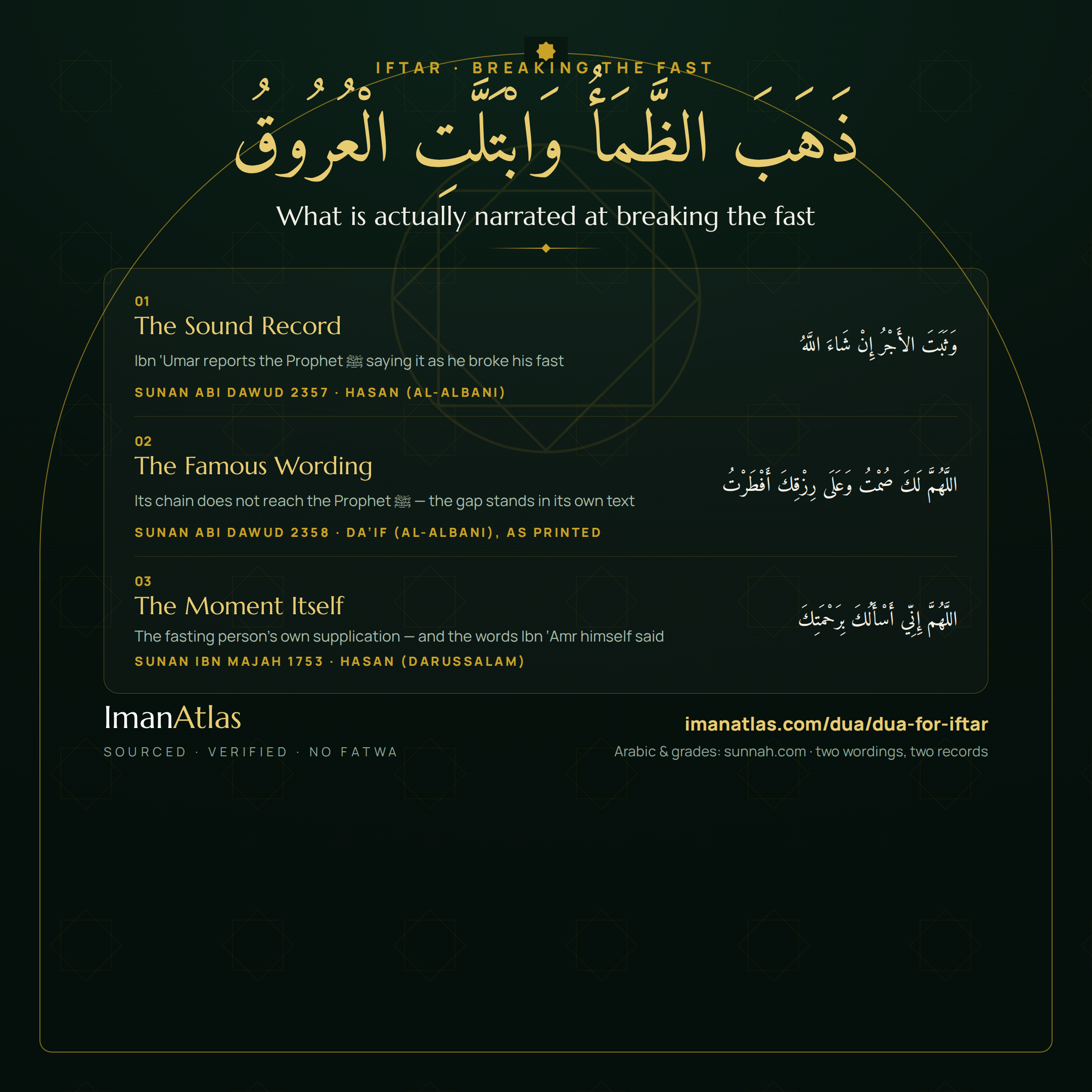
Short answer: Two wordings for breaking the fast stand in the same chapter of Abu Dawud, one after the other. Ibn ‘Umar reports the Prophet ﷺ saying ‘Dhahaba al-zama’ — thirst has gone (2357, Hasan). The famous ‘Allahumma laka sumtu’ comes through a narration whose chain does not reach the Prophet ﷺ, and its printed grade is Da’if (2358).
ImanAtlas does not give fatwas. For your own situation, ask a qualified scholar you trust.
The two wordings stand one narration apart. Abu Dawud gathers them in his Book of Fasting, in a chapter he names “The Saying At The Time Of Breaking The Fast”: first the words Ibn ‘Umar reports, then the famous words through Mu‘adh ibn Zuhrah. Between them they carry two different grades, and the difference between those grades is where most retellings go wrong — the record of the first is quietly borrowed for the second. This page keeps each wording with its own narration, its own chain and its own printed grade, and adds the third narration the chapter does not hold: Ibn Majah’s, about the moment itself.
The wording with the sound record
The chapter’s first narration comes through Marwan ibn Salim al-Muqaffa‘. He begins with something he saw, not something he heard: Ibn ‘Umar holding his beard in his hand and cutting what grew beyond the handful. The frame is part of the narration as Abu Dawud prints it, so it is printed whole here, beard and all — this page does not trim a narration down to the line people search for. Inside that frame, Ibn ‘Umar reports what the Prophet ﷺ said when he broke his fast. The words are not a request; they are a statement about the moment — the thirst gone, the veins moistened, the reward sure, if Allah wills. The grade on the source page today is al-Albani’s: Hasan.
ذَهَبَ الظَّمَأُ وَابْتَلَّتِ الْعُرُوقُ وَثَبَتَ الأَجْرُ إِنْ شَاءَ اللَّهُ
Dhahaba az-zama’u, wabtallatil-‘urooqu, wa thabatal-ajru, in sha Allah.
“Marwan ibn Salim al-Muqaffa’ said: I saw Ibn Umar holding his beard with his hand and cutting what exceeded the handful of it. He (Ibn Umar) said that the Prophet (ﷺ) said when he broke his fast: Thirst has gone, the arteries are moist, and the reward is sure, if Allah wills.”
Sunan Abi Dawud 2357 · Fasting (Kitab Al-Siyam), chapter “The Saying At The Time Of Breaking The Fast” · in-book Book 14, Hadith 45 · narrated by Ibn ‘Umar, via Marwan ibn Salim al-Muqaffa‘ — Grade: Hasan (Al-Albani), as printed at sunnah.com · sunnah.com prints no transliteration for this narration; the line above is a derivation from the Arabic, checked word for word against it
Hold on to this narration’s grade. It is the one that travels — the next narration is routinely introduced with it.
The famous wording: Allahumma laka sumtu
The very next narration in the chapter is the one many people learn as a child: “Allahumma laka sumtu wa ‘ala rizqika aftartu” — “O Allah, for Thee I have fasted, and with Thy provision I have broken my fast.” It comes through Mu‘adh ibn Zuhrah. What his narration does not have is a chain that reaches the Prophet ﷺ. Its own Arabic says so, in the middle of the isnad:
The chain, in Abu Dawud’s own print: عَنْ مُعَاذِ بْنِ زُهْرَةَ، أَنَّهُ بَلَغَهُ — “from Mu‘adh ibn Zuhrah: it reached him that the Prophet ﷺ used to say, when he broke his fast…”
The report came to him; from whom, the print does not say. A narration shaped like this — a man of the generation after the Companions reporting from the Prophet ﷺ with the connecting Companion unnamed — is what the hadith critics call mursal. That is a description of the chain’s shape, stated here as the critics use the term. The grade printed for this narration at sunnah.com is Da’if (Al-Albani).
اللَّهُمَّ لَكَ صُمْتُ وَعَلَى رِزْقِكَ أَفْطَرْتُ
Allahumma laka sumtu, wa ‘ala rizqika aftart.
“Narrated Mu’adh ibn Zuhrah: The Prophet of Allah (ﷺ) used to say when he broke his fast: O Allah, for Thee I have fasted, and with Thy provision I have broken my fast.”
Sunan Abi Dawud 2358 · the same chapter · in-book Book 14, Hadith 46 · from Mu‘adh ibn Zuhrah — Grade: Da’if (Al-Albani), as printed at sunnah.com · the chain as printed names no route from Mu‘adh up to the Prophet ﷺ; it says the report reached him · sunnah.com prints no transliteration for this narration either; the line above is a derivation from its own Arabic — the two wordings are different texts, and neither line is borrowed from the other
Yet across the web this wording is introduced with the grade of its neighbour. One dua site, islamful.com, prints it with the line “Source: Narrated by Abu Dawud, 2358. Graded hasan” (checked 29 November 2026) — and describes both wordings as hasan. The hasan is real, but it belongs one narration earlier, to 2357. The two narrations sit side by side in a single chapter, and somewhere in the copying their records were crossed. This page uncrosses them: 2357 keeps its Hasan, 2358 keeps its Da’if, and neither grade is moved.
The moment itself: Ibn Majah 1753
Ibn Majah gives the moment a chapter of its own, and names the chapter for the Prophet’s ﷺ words in it: “The supplication of the fasting person is not turned back.” The narration he prints carries two things. First, the Prophet’s ﷺ statement about the fasting person at the moment of breaking the fast — a statement about the moment, not a wording taught for it; it stands below inside its narration, and this page adds no promise of its own beside it. Second, inside the same narration, the words of a Companion at his own iftar. Ibn Abi Mulaikah heard ‘Abdullah ibn ‘Amr say, when he broke his fast: “O Allah! I ask You by Your mercy, which encompasses all things, to forgive me.” Those are Ibn ‘Amr’s own words — a Companion’s supplication, reported as his — and they are printed under that label, not as a dua the Prophet ﷺ taught.
إِنَّ لِلصَّائِمِ عِنْدَ فِطْرِهِ لَدَعْوَةً مَا تُرَدُّ قَالَ ابْنُ أَبِي مُلَيْكَةَ سَمِعْتُ عَبْدَ اللَّهِ بْنَ عَمْرٍو يَقُولُ إِذَا أَفْطَرَ اللَّهُمَّ إِنِّي أَسْأَلُكَ بِرَحْمَتِكَ الَّتِي وَسِعَتْ كُلَّ شَىْءٍ أَنْ تَغْفِرَ لِي
Allahumma inni as’aluka bi-rahmatikal-lati wasi’at kulla shay’in an taghfira li.
“It was narrated from ‘Abdullah bin ‘Amr bin ‘As that the Messenger of Allah (ﷺ) said: "When the fasting person breaks his fast, his supplication is not turned back." (One of the narrators) Ibn Abi Mulaikah said: "When he broke his fast, I heard ‘Abdullah bin ‘Amr say: ‘O Allah! I ask You by Your mercy, which encompasses all things, to forgive me.’"”
Sunan Ibn Majah 1753 · Fasting, chapter “The supplication of the fasting person is not turned back” · in-book Book 7, Hadith 116 · narrated by ‘Abdullah ibn ‘Amr ibn al-‘As — Grade: Hasan (Darussalam), as printed at sunnah.com · the transliteration line above covers ‘Abdullah ibn ‘Amr’s own words only: the Prophet’s ﷺ words in this narration are a statement about the moment, not a wording given to recite, so they carry no transliteration line · sunnah.com prints no transliteration for this narration; the line is a derivation from the Arabic, checked word for word against it
So the moment narration leaves the fasting person with his own supplication, in his own words — which is what Ibn ‘Amr is shown doing. The narration gives the moment, not a formula.
What the sources do not settle
Four things often attached to these wordings are not in the narrations printed here, and this page says so plainly rather than supplying them. The first is a count: no narration on this page says the words are said once, or any number of times. The second is a wording for suhoor, before the fast begins: none is captured on this page, and none is printed. The third is a place in the two Sahihs: neither of these wordings stands in Sahih al-Bukhari or Sahih Muslim — both are Abu Dawud narrations, and the moment narration stands in Ibn Majah’s Sunan. The fourth is timing — whether the words are said before the first bite or after it. The narrations’ own frame is “when he broke his fast”; scholars discuss the timing, and this page does not rule on it. The same goes for raising the hands. And no date stands on this page: when Ramadan falls, and the calendar around it, belongs to the Ramadan hub, which carries the dates frame for this site. Breaking the fast at another person’s home has its own narration in the sources; it is not printed here, and belongs to its own page.
Beyond what these texts themselves say, this page adds nothing — no date, no timing, no count, and no promise the sources do not give.
This page stands under the hub page, Duas & Azkar, where the library’s duas are gathered. The calendar frame — Ramadan’s expected dates and the moon-sighting note — stands on the Ramadan hub; no date is restated here. In the book’s own order, the words for breaking the fast stand in chapter 68 of Hisnul Muslim, which prints both of Abu Dawud’s wordings — the book whose complete chapter index stands on this site’s Hisnul Muslim index page.
ImanAtlas does not give fatwas. For your own situation, ask a qualified scholar you trust.
Frequently asked questions
What dua is said when breaking the fast?
Two wordings stand in Abu Dawud’s chapter on the saying at the time of breaking the fast. Ibn ‘Umar reports the Prophet ﷺ saying ‘Dhahaba al-zama’u wabtallatil-‘urooq, wa thabatal-ajru in sha Allah’ — thirst has gone, the veins are moist, and the reward is sure, if Allah wills (2357). The famous ‘Allahumma laka sumtu’ stands in the next narration (2358), with a weaker record. Ibn Majah 1753 adds no formula; it speaks of the moment itself, when the fasting person makes his own supplication.
Is ‘Allahumma laka sumtu’ authentic?
Its record, as printed, is this: the narration comes through Mu‘adh ibn Zuhrah, and its chain does not reach the Prophet ﷺ — its own Arabic says the report ‘reached him’. The grade printed at sunnah.com is Da’if (Al-Albani). That is the record this page prints. Whether a person says the words is a question for the scholarship they trust; this page gives no ruling.
Why do some pages call Abu Dawud 2358 ‘graded hasan’?
Because the two narrations stand side by side in one chapter, and their records get crossed in the copying. The hasan belongs to 2357, the narration immediately before it. The swap stands in the field today: islamful.com prints the laka-sumtu wording with ‘Source: Narrated by Abu Dawud, 2358. Graded hasan’ (checked 29 November 2026). On the source itself, 2358’s printed grade is Da’if (Al-Albani).
What does it mean that 2358’s chain does not reach the Prophet ﷺ?
Read its chain as printed: ‘from Mu‘adh ibn Zuhrah, that it reached him (balaghahu) that the Prophet ﷺ used to say, when he broke his fast…’ Mu‘adh belonged to the generation after the Companions, and the print names no Companion between him and the Prophet ﷺ. A report in this shape is what the hadith critics call mursal. This page states the shape and the printed grade; it adds no verdict of its own.
Is the fasting person’s supplication really not turned back?
Those are the words of the narration itself, in Ibn Majah 1753: ‘When the fasting person breaks his fast, his supplication is not turned back.’ This page prints them inside their narration and adds no guarantee of its own beside them. The same narration shows what ‘Abdullah ibn ‘Amr did with that moment: he made his own supplication, in his own words, asking forgiveness by Allah’s mercy, which encompasses all things.
Should the dua be said before or after eating?
The narrations’ own frame is ‘when he broke his fast’. Scholars discuss whether the words belong before the first bite or after it, and this page does not settle a practice question — the line at the head of this page applies. What the sources give is the wording and its frame; the ruling belongs to the scholarship a person follows.
Sources
Every wording and grade on this page comes from these pages, printed from this page’s own captures of their sources. The islamful page is listed because this page corrects it by name; it is not a source for any text here, and its wording may change after the date given.
- The chapter’s first narration — Sunan Abi Dawud 2357 — sunnah.com
- The famous wording, with the gap in its chain — Sunan Abi Dawud 2358 — sunnah.com
- The moment narration, with Ibn ‘Amr’s own words — Sunan Ibn Majah 1753 — sunnah.com
- The grade swap as it stands in the field (named and corrected above; checked 29 November 2026) — “Dua for Breaking Fast” — islamful.com
- The hub this page belongs to — Duas & Azkar
- The calendar frame this page does not restate — Ramadan
- The book whose chapter 68 these wordings are — Hisnul Muslim — The Complete Chapter Index
Found an error? We correct mistakes within 24 hours, with a note on the page — write to us through the website.