Going to the Mosque — The Dua of Light
Ask for the dua of going to the mosque and one long text comes back — light in the heart, on the tongue, in the soul, in the grave, in the bones. The narration behind it is shorter than that text, and it was not said on a road at all. This page prints the two narration prints as they stand, then sets the book’s longer form beside them — as the book’s form, brackets and all.
Short answer: The dua of light stands inside Ibn ‘Abbas’s night narration: ‘O Allah, place light in my heart, light in my sight, light in my hearing…’ (Muslim 763; Bukhari 6316). Hisnul Muslim prints it for going to the mosque as a longer composite — its extra lines come from other narrations, three of them in the book’s own brackets.
ImanAtlas does not give fatwas. For your own situation, ask a qualified scholar you trust.
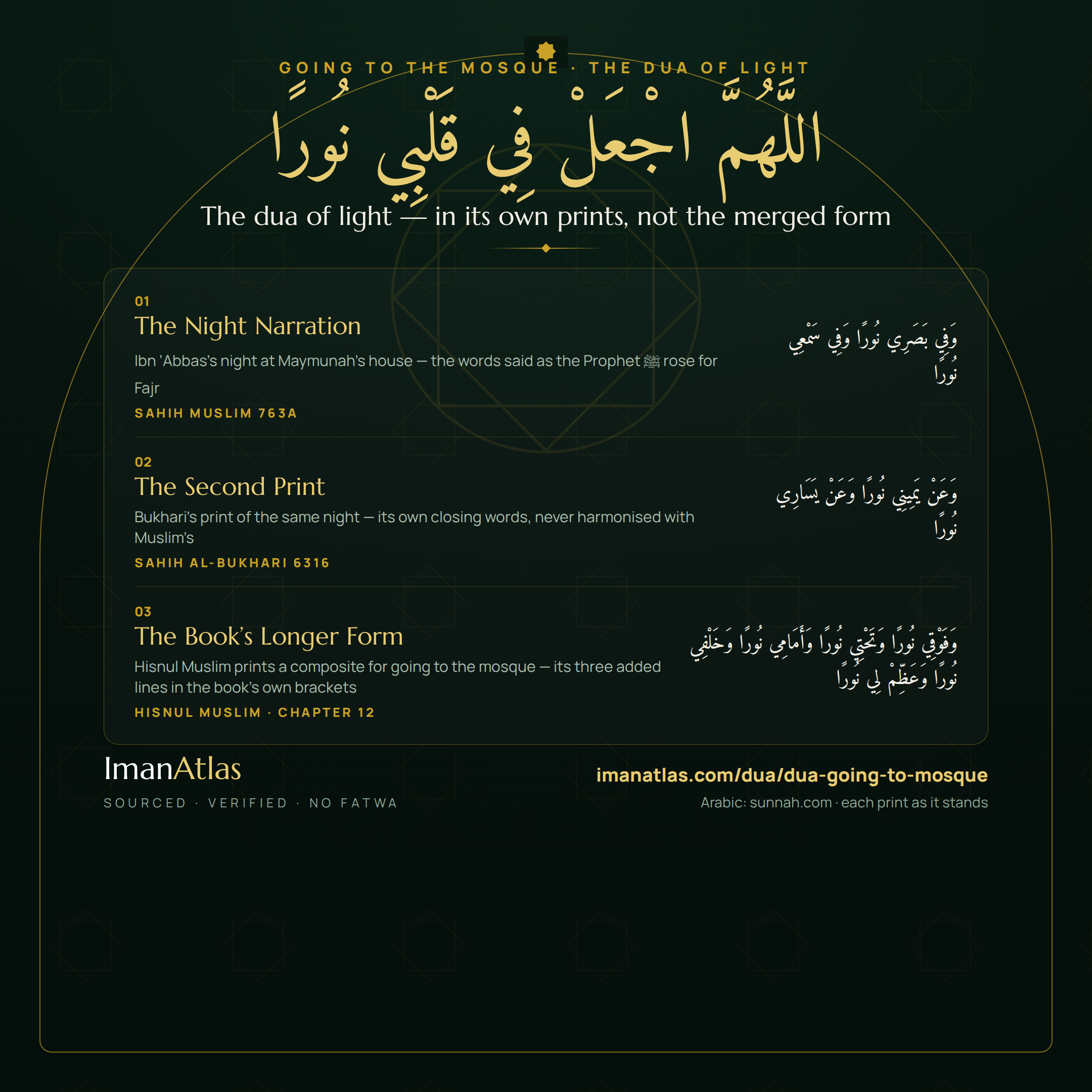
The long text is not an invention. It stands in a real book, in a real chapter, and the book is honest about how it is put together — its own reference line names the two narrations it rests on, and it holds three of its lines apart in brackets, each with a source of its own. What the retellings do is quieter: they copy the book’s text, drop its brackets, and hand the whole back as a single dua the Prophet ﷺ said on his way to the mosque. The narrations tell a different story about where the words were said, and a shorter one. This page prints all three forms — Muslim’s print, Bukhari’s print, and the book’s composite — and lets each stand under its own name.
The dua inside the night narration
Muslim places the narration in his Book of Prayer – Travellers, in a chapter he names “The prayer and the supplication of the Prophet (saws) at night” — and the setting matters, so it stands here first, in the narration’s own words. ‘Abdullah ibn ‘Abbas spent a night at the house of his maternal aunt Maymunah. The Prophet ﷺ prayed thirteen rak‘ahs in the night, with the boy standing at his right. He lay down and slept. Then Bilal came and told him of the prayer — and he stood up for the Fajr prayer without performing a new ablution, and his supplication included the words of light. Said where the narration says they were said: at the end of a night of prayer, rising for Fajr. The block below is Muslim’s narration printed whole — the dua sentence first, with its transliteration line, then the translation of the whole report, then the Arabic of what follows the sentence inside the narration: Kuraib’s seven.
اللَّهُمَّ اجْعَلْ فِي قَلْبِي نُورًا وَفِي بَصَرِي نُورًا وَفِي سَمْعِي نُورًا وَعَنْ يَمِينِي نُورًا وَعَنْ يَسَارِي نُورًا وَفَوْقِي نُورًا وَتَحْتِي نُورًا وَأَمَامِي نُورًا وَخَلْفِي نُورًا وَعَظِّمْ لِي نُورًا
Allāhumma-j’al fī qalbī nūran, wa fī baṣarī nūran, wa fī sam’ī nūran, wa ‘an yamīnī nūran, wa ‘an yasārī nūran, wa fawqī nūran, wa taḥtī nūran, wa amāmī nūran, wa khalfī nūran, wa ‘aẓẓim lī nūran.
Ibn `Abbas reported: I spent a night with my maternal aunt (sister of my mother) Maimuna. The Apostle of Allah (ﷺ) got up during the night and relieved himself, then washed his face and hands and went to sleep. He then got up again, and came to the water skin and loosened its straps, then performed good ablution between the two extremes. He then stood up and observed prayer. I also stood up and stretched my body fearing that he might be under the impression that I was there to find out (what he did at night). So I also performed ablution and stood up to pray, but I stood on his left. He took hold of my hand and made me go around to his right side. The Messenger of Allah (ﷺ) completed thirteen rak`ahs of his night prayer. He then lay down and slept and snored (and it was his habit to snore while asleep). Then Bilal came and he informed him about the prayer. He (the Holy Prophet) then stood up for prayer and did not perform ablution, and his supplication included these words: "O Allah, place light in my heart, light in my sight, light in my hearing, light on my right hand, light on my left hand, light above me, light below me, light in front of me, light behind me, and enhance light for me." Kuraib (the narrator) said: There are seven (words more) which are in my heart (but I cannot recall them) and I met some of the descendants of Al-`Abbas and they narrated these words to me and mentioned in them: (Light) in my sinew, in my flesh, in my blood, in my hair, in my skin, and made a mention of two more things.
قَالَ كُرَيْبٌ وَسَبْعًا فِي التَّابُوتِ فَلَقِيتُ بَعْضَ وَلَدِ الْعَبَّاسِ فَحَدَّثَنِي بِهِنَّ فَذَكَرَ عَصَبِي وَلَحْمِي وَدَمِي وَشَعَرِي وَبَشَرِي وَذَكَرَ خَصْلَتَيْنِ
Sahih Muslim 763a · The Book of Prayer – Travellers, chapter “The prayer and the supplication of the Prophet (saws) at night” · in-book Book 6, Hadith 216 · narrated by ‘Abdullah ibn ‘Abbas, via his client Kuraib · the narration is printed whole above, in its own order: the night at Maymunah’s house, the thirteen rak‘ahs, Bilal’s call, and the words said as he rose for the Fajr prayer · Muslim prints no transliteration: the line under the dua sentence is a derivation, checked word for word against the Arabic · Kuraib’s seven — the second Arabic passage — carry NO transliteration line: they are the narrator’s recalled list inside the narration, not a wording this page presents for recitation
Kuraib is the student who narrates from Ibn ‘Abbas, and his seven are the narration’s own loose end, left loose. There were seven more words, he said, in his heart, that he could not recall; some of the descendants of al-‘Abbas later supplied five of them — sinew, flesh, blood, hair, skin — and mentioned two more that the print does not name. This page does not name them either. What matters for the long form, further down, is where those five end up: inside the body of the book’s text, as if they had always stood in the dua sentence itself.
Bukhari’s print of the same night
Bukhari prints the same narration — the same night, the same route up through Kuraib — in his Book of Invocations, under a chapter of his own naming: “The invocation by one who wakes up at night”. His print is not a copy of Muslim’s. The dua sentence runs in the same order — sight before hearing, as in Muslim — and then closes differently: where Muslim’s print ends «وَعَظِّمْ لِي نُورًا», “and enhance light for me”, Bukhari’s ends «وَاجْعَلْ لِي نُورًا», “and make for me light”. Neither print carries the tongue. Bukhari’s translation, unusually, embeds a romanisation of the sentence inside itself; it stands under his Arabic below, as his line, checked against his print — the two prints are never harmonised, and no line is borrowed from one block to the other.
اللَّهُمَّ اجْعَلْ فِي قَلْبِي نُورًا، وَفِي بَصَرِي نُورًا، وَفِي سَمْعِي نُورًا، وَعَنْ يَمِينِي نُورًا، وَعَنْ يَسَارِي نُورًا، وَفَوْقِي نُورًا، وَتَحْتِي نُورًا، وَأَمَامِي نُورًا، وَخَلْفِي نُورًا، وَاجْعَلْ لِي نُورًا
Allahumma ij`al fi qalbi nuran wa fi basari nuran, wa fi sam`i nuran, wa`an yamini nuran, wa`an yasari nuran, wa fawqi nuran, wa tahti nuran, wa amami nuran, wa khalfi nuran, waj`al li nuran.
Narrated Ibn `Abbas: One night I slept at the house of Maimuna. The Prophet (ﷺ) woke up, answered the call of nature, washed his face and hands, and then slept. He got up (late at night), went to a water skin, opened the mouth thereof and performed ablution not using much water, yet he washed all the parts properly and then offered the prayer. I got up and straightened my back in order that the Prophet (ﷺ) might not feel that I was watching him, and then I performed the ablution, and when he got up to offer the prayer, I stood on his left. He caught hold of my ear and brought me over to his right side. He offered thirteen rak`at in all and then lay down and slept till he started blowing out his breath as he used to do when he slept. In the meantime Bilal informed the Prophet (ﷺ) of the approaching time for the (Fajr) prayer, and the Prophet offered the Fajr (Morning) prayer without performing new ablution. He used to say in his invocation, Allahumma ij`al fi qalbi nuran wa fi basari nuran, wa fi sam`i nuran, wa`an yamini nuran, wa`an yasari nuran, wa fawqi nuran, wa tahti nuran, wa amami nuran, wa khalfi nuran, waj`al li nuran." Kuraib (a sub narrator) said, "I have forgotten seven other words, (which the Prophet (ﷺ) mentioned in this invocation). I met a man from the offspring of Al-`Abbas and he narrated those seven things to me, mentioning, ‘(Let there be light in) my nerves, my flesh, my blood, my hair and my body,’ and he also mentioned two other things."
Sahih al-Bukhari 6316 · the Book of Invocations, chapter “The invocation by one who wakes up at night” · in-book Book 80, Hadith 13 · the same night, by the same route — Sufyan, from Salamah ibn Kuhayl, from Kuraib, from Ibn ‘Abbas · the romanisation line above is the one printed inside this narration’s own translation at sunnah.com, where it also stands; as a line it is checked word for word against THIS print’s Arabic — no line is carried across from Muslim’s block, because the two prints’ closing words differ
The longer form the dua books print
Hisnul Muslim — the small book of daily duas found in mosques and homes everywhere — sets this dua in its chapter 12, “When going to the mosque”. That placement is the book’s, and this page records it as the book’s: the narrations above do not place the words on the road to the mosque, and the book does not claim its chapter is a narration. What the book prints is a composite, and it shows its own working. Its reference line, printed after the text, says the unbracketed part rests on Bukhari 6316 and Muslim 763. Against those two prints, the book’s body adds the tongue (set second, before hearing — where the narration prints have no tongue at all, and put sight before hearing), the soul, “make me a light”, “grant me light”, and Kuraib’s five, standing in the body of the text. Then three more lines stand apart in the book’s own brackets, each carrying its own source in the book’s reference lines: light in the grave and in the bones, from at-Tirmidhi 3419; “increase me in light” three times, from al-Bukhari’s al-Adab al-Mufrad 695; and “grant me light upon light”, named from Fath al-Bari. Even the book’s own translation and romanisation part company in one word — “body” in the translation where the romanisation reads laḥmī, flesh — and both stand below as printed. The block prints the book’s form whole: body, brackets, and reference lines, under the book’s name.
اللّهُـمَّ اجْعَـلْ فِي قَلْبـي نُوراً ، وَفي لِسَـانِي نُوراً، وَفِي سَمْعِي نُوراً, وَفِي بَصَرِيِ نُوراً, وَمِنْ فََوْقِي نُوراً , وَ مِنْ تَحْتِي نُوراً, وَ عَنْ يَمِينيِ نُوراَ, وعَنْ شِمَالِي نُوراً, وَمْن أَماَمِي نُوراً, وَمِنْ خَلْفيِ نُوراَ, واجْعَلْ فِي نَفْسِي نُوراً, وأَعْظِمْ لِي نُوراً, وَعظِّمْ لِي نُوراً, وَاجْعَلْ لِي نُوراً, واجْعَلنِي نُوراً, أللَّهُمَّ أَعْطِنِي نُوراً, واجْعَلْ فِي عَصَبِي نُوراً, وَفِي لَحْمِي نُوراً, وَفِي دَمِي نُوراً وَفِي شَعْرِي نُوراً, وفِي بَشَرِي نُوراً
Allāhummaj’al fī qalbī nūran, wa fī lisānī nūran, wa fī sam`ī nūran, wa fī baṣarī nūran, wa min fawqī nūran, wa min taḥtī nūran, wa `an yamīnī nūran, wa `an shimālī nūran, wa min ‘amāmī nūran, wa min khalfī nūran, waj`al fī nafsī nūran, wa ‘a`ẓim lī nūran, wa `ẓẓim lī nūran, waj`allī nūran, waj`alnī nūran, Allāhumma ‘a`tinī nūran, waj’al fī `aṣabī nūran, wa fī laḥmī nūran, wa fī damī nūran, wa fī sha`rī nūran, wa fī basharī nūran.
O Allah, place light in my heart, and on my tongue light, and in my ears light and in my sight light, and above me light, and below me light, and to my right light, and to my left light, and before me light and behind me light. Place in my soul light. Magnify for me light, and amplify for me light. Make for me light and make me a light. O Allah, grant me light, and place light in my nerves, and in my body light and in my blood light and in my hair light and in my skin light.
(أَللَّهُمَّ اجِعَلْ لِي نُوراً فِي قّبْرِي وَ نُوراَ فِي عِظاَمِي)
[O Allah, make for me a light in my grave… and a light in my bones.]
The book’s own reference line for this bracket: (At-Tirmidhi 5/483 (Hadith no. 3419).)
(وَزِدْنِي نُوراً, وَزِدْنِي نُوراَ , وَزِدْنِي نُوراً)
[Increase me in light, increase me in light, increase me in light .]
The book’s own reference line for this bracket: (Al-Bukhari in Al-‘Adab Al-Mufrad (Hadith no. 695), p. 258. See also Al-Albani, Sahih Al-‘Adab Al-Mufrad(no. 536).)
(وَهَبْ لِي نُوراً عَلَى نُوراً )
[Grant me light upon light.]
The book’s own reference line for this bracket: (Al-Bukhari, cf. Al-Asqalani, Fathul-Bari 11/118.)
Hisn al-Muslim, chapter 12 — “When going to the mosque” (entry 19 at sunnah.com) · the book’s own reference line, printed after the text: “Reference: 1 Up to this point was reported by Al-Bukhari 11 / 116 (Hadith no. 6316) and by Muslim 1/526, 529-530 (Hadithno. 763).” — “up to this point” is the unbracketed body above; the three bracketed additions stand after it in the book’s own brackets, each with its own source, exactly as printed · the form in this block is the book’s composite, printed as the book prints it — it is not one narration, and this page never presents it as one · the transliteration line is the book’s own printed romanisation of the composite’s body; the bracketed additions carry no separate transliteration lines
At-Tirmidhi 3419, the first bracket’s named route, is itself a long night supplication of Ibn ‘Abbas, in which the grave is named near the close. It is named on this page because the book names it; its text is not printed here, and the grave-and-bones line is quoted only where the book puts it — inside the bracket, as the book’s addition, not sliced out of at-Tirmidhi’s narration and handed back as a standalone dua.
What this page does not do
It gives no ruling on when or where these words are to be said. The narrations’ setting is recorded above, and the book’s placement is recorded as the book’s; whether the words are said at home, on the road, or inside the mosque — and whether a part of the form may be said on its own — are questions of practice, and they are routed, not answered: the line at the head of this page applies. It sets no count: the only “three times” anywhere near this dua stands inside the book’s second bracket, as part of that bracket’s wording, not as an instruction this page gives. And it prints no list of what the light does for the one who asks for it — the texts ask for light in the heart, the sight, the hearing and the rest, and beyond their asking this page claims nothing. One neighbour is named only to be kept apart: the famous “light verse” of the Qur’an, 24:35 — “Allah is the Light of the heavens and the earth” — is a verse of the Qur’an, not this dua, and it is not printed here as one.
Beyond what these texts themselves say, this page adds nothing — no ruling, no count, and no benefit the sources do not name.
The words for the mosque door itself — the dua on entering and the dua on leaving — stand on their own page in this library: Entering and Leaving the Mosque, where four separate narrations are printed apart, not merged into one script. This page stands under the hub page, Duas & Azkar, where the library’s duas are gathered. The book whose chapter 12 is printed above is indexed whole on this site’s Hisnul Muslim index page, where chapter 12 is marked with what this library prints of it.
ImanAtlas does not give fatwas. For your own situation, ask a qualified scholar you trust.
Frequently asked questions
Where is the dua of light narrated?
In one narration, printed in two collections. ‘Abdullah ibn ‘Abbas spent a night at the house of his aunt Maymunah, and his report of that night — the Prophet’s ﷺ night prayer, and the words said as he rose for Fajr — stands in Sahih Muslim 763a, in Muslim’s chapter “The prayer and the supplication of the Prophet (saws) at night”, and in Sahih al-Bukhari 6316, in Bukhari’s chapter “The invocation by one who wakes up at night”. The longer form stands in Hisnul Muslim, chapter 12.
Did the Prophet ﷺ say the dua of light when going to the mosque?
The narrations themselves place the words somewhere else, and this page reports their setting as they give it: a night at Maymunah’s house, thirteen rak‘ahs of night prayer, then Bilal’s call — and the words standing in the supplication he made as he stood up for the Fajr prayer, without a new ablution. The going-to-the-mosque placement is Hisnul Muslim’s: the book sets its longer form in its chapter “When going to the mosque”. Both facts stand on this page; neither is dressed as the other.
Why is the dua of light in the dua books longer than the hadith?
Because the book’s form is a composite. Against the two narration prints, Hisnul Muslim’s text adds the tongue, the soul, “make me a light” and “grant me light”, and sets Kuraib’s five — sinew, flesh, blood, hair, skin — inside the body of the text. Three further lines the book itself holds apart in brackets, each with its own source in its reference lines: light in the grave and in the bones (at-Tirmidhi 3419), “increase me in light” three times (al-Adab al-Mufrad 695), and “light upon light” (named from Fath al-Bari). The book’s own reference line names Bukhari 6316 and Muslim 763 as the base of the unbracketed part. Nothing here is hidden — the field simply reprints the whole as one dua and drops the brackets.
What are the seven things Kuraib could not recall?
Five of them, the prints name; two, they do not — and this page leaves the two unnamed, exactly as the prints leave them. Kuraib, who narrates from Ibn ‘Abbas, said there were seven more words in his heart that he could not recall; he met some of the descendants of al-‘Abbas, and they mentioned: light in his sinew, in his flesh, in his blood, in his hair, in his skin — “and made a mention of two more things”. Muslim’s print ends the matter there, and so does Bukhari’s.
Where does ‘light in my grave’ come from?
From a line Hisnul Muslim itself sets in brackets. In the book’s chapter the words “O Allah, make for me a light in my grave, and a light in my bones” do not stand in the body of the text; the book brackets them, and its reference line for the bracket names at-Tirmidhi 5/483 (Hadith no. 3419). That narration — at-Tirmidhi 3419 — is itself a long night supplication of Ibn ‘Abbas; this page quotes the grave-and-bones line only as it stands inside the book’s bracket, and does not slice it out of at-Tirmidhi’s narration as a dua of its own.
Why do Muslim’s and Bukhari’s prints of the dua differ?
In the closing words, and this page shows both rather than choosing one. Muslim’s print closes «وَعَظِّمْ لِي نُورًا» — “and enhance light for me”. Bukhari’s closes «وَاجْعَلْ لِي نُورًا» — “and make for me light”. In the order of sight and hearing the two prints agree — sight before hearing in both, in the Arabic and in the translations; it is the book’s composite that reorders them, setting the tongue second and hearing before sight. Bukhari also frames the narration in a different chapter — the invocation of one who wakes at night — where Muslim frames it as the Prophet’s ﷺ prayer and supplication at night.
When should the dua of light be said — before leaving home, or on the way? And can only part of it be said?
Both are questions of practice, and this page answers neither. What the page gives is the record any answer has to work from: the narrations’ own setting — the words said rising for Fajr, inside a night narration — and the book’s placement of its longer form at going to the mosque, recorded as the book’s placement. When the words are to be said, and whether a part may be said on its own, are rulings for the scholars; the line at the head of this page applies.
Sources
Every wording on this page comes from these pages, printed from this page’s own captures of their sources. At-Tirmidhi 3419 is listed because the book’s bracket names it; no wording on this page is taken from it.
- The anchor print — the night narration, with Kuraib’s seven — Sahih Muslim 763a — sunnah.com
- The second print of the same night — Sahih al-Bukhari 6316 — sunnah.com
- The book’s composite, with its brackets and reference lines — Hisn al-Muslim 19 (chapter 12) — sunnah.com
- The first bracket’s named route — At-Tirmidhi 3419 — sunnah.com
- The mosque-door duas, in the same library — Entering and Leaving the Mosque
- The hub this page belongs to — Duas & Azkar
- The book whose chapter 12 this is — Hisnul Muslim — The Complete Chapter Index
Found an error? We correct mistakes within 24 hours, with a note on the page — write to us through the website.