بِسْمِ اللَّهِ الرَّحْمَٰنِ الرَّحِيمِ
Dua & Azkar · Rain Duas
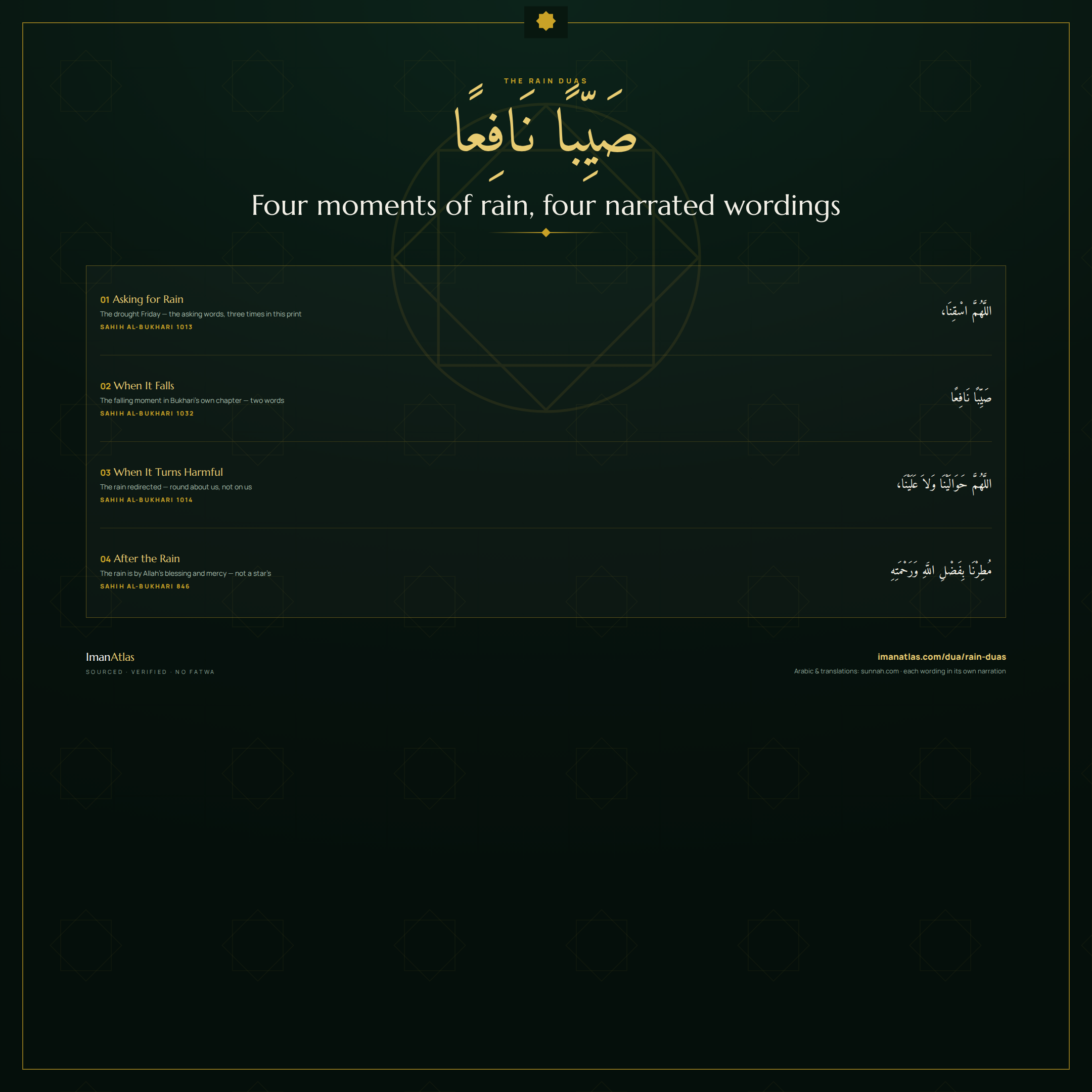
The Rain Duas — Asking for Rain, When It Falls, When It Harms, and After It
Ask for the dua for rain and most pages hand back one merged list — the asking words, the falling words, the harmful-rain words and the after-rain words stirred together, their prints and grades nowhere in sight. The sources keep the moments apart: four moments of rain, four narrations. This page prints each wording inside its own narration, as its book gives it.
Rain has more than one dua, because rain has more than one moment. There are words for asking for it in a drought, words for the moment it falls, words for when it turns harmful, and words for after it — and the collections keep those moments in separate narrations. The pages that rank for these searches mostly do not: they gather every rain wording into a single list, file one wording under the wrong moment, and print the long forms without separating their prints or naming a grade. This page follows the sources instead. Each moment stands in its own section, each wording inside its own narration, each print exactly as its book gives it — where two prints of one moment differ by a word, both stand, and neither is corrected from the other.
Asking for rain — the Friday of the drought
The asking words stand inside a story. On a Friday of drought, a man came into the mosque while the Prophet ﷺ was delivering the khutba and asked him to pray for rain; the Prophet ﷺ raised his hands and asked, three times in this print. A cloud rose, the rain came, and it rained until the next Friday — when a man came again and asked for the rain to be withheld, and the Prophet ﷺ answered with different words, the words of the fourth section below. Bukhari prints this event twice, as 1013 and 1014, through the same chain — Sharik, from Anas — and this page treats them as what they are: two transmissions of one Friday, not two events. The first transmission stands here, whole; the second stands in the section on harmful rain, where its wording does its own work.
The asking words — as Bukhari 1013 prints them
اللَّهُمَّ اسْقِنَا، اللَّهُمَّ اسْقِنَا، اللَّهُمَّ اسْقِنَا
Allahumma-sqina, Allahumma-sqina, Allahumma-sqina.
“Narrated Sharik bin `Abdullah bin Abi Namir: I heard Anas bin Malik saying, "On a Friday a person entered the main Mosque through the gate facing the pulpit while Allah’s Messenger (ﷺ) was delivering the Khutba. The man stood in front of Allah’s Apostle and said, ‘O Allah’s Messenger (ﷺ)! The livestock are dying and the roads are cut off; so please pray to Allah for rain.’ " Anas added, "Allah’s Messenger (ﷺ) (p.b.u.h) raised both his hands and said, ‘O Allah! Bless us with rain! O Allah! Bless us with rain! O Allah! Bless us with rain!’ " Anas added, "By Allah, we could not see any trace of cloud in the sky and there was no building or a house between us and (the mountains of) Sila." Anas added, "A heavy cloud like a shield appeared from behind it (i.e. Sila’ Mountain). When it came in the middle of the sky, it spread and then rained." Anas further said, "By Allah! We could not see the sun for a week. Next Friday a person entered through the same gate and at that time Allah’s Messenger (ﷺ) was delivering the Friday’s Khutba. The man stood in front of him and said, ‘O Allah’s Messenger (ﷺ)! The livestock are dying and the roads are cut off, please pray to Allah to withhold rain.’ " Anas added, "Allah’s Messenger (ﷺ) I raised both his hands and said, ‘O Allah! Round about us and not on us. O Allah! On the plateaus, on the mountains, on the hills, in the valleys and on the places where trees grow.’ So the rain stopped and we came out walking in the sun." Sharik asked Anas whether it was the same person who had asked for the rain (the last Friday). Anas replied that he did not know.”
Sahih al-Bukhari 1013 · Invoking Allah for Rain (Istisqaa), chapter “Istisqa’ in the main mosque (of the town)” · in-book Book 15, Hadith 8 · narrated by Sharik ibn ’Abdullah, from Anas ibn Malik — Sahih al-Bukhari prints no per-hadith grade field at sunnah.com · sunnah.com prints no transliteration for this narration; the line above covers its asking words and is a derivation from the Arabic, checked word for word against it · this print’s second dua — the redirect — stands in full in the “When rain turns harmful” section, in Bukhari’s second transmission of this same event
Note the asking word in this print: isqina — “give us drink”. In Bukhari’s second transmission of the same event, printed in the fourth section below, the asking word is a different one — aghithna, “relieve us”. Both stand as their books print them.
When rain falls
Bukhari gives the falling moment a chapter of its own: “What should be said (or what to say) if it rains.” His narration is ’Aisha’s, and it is short — whenever the Prophet ﷺ saw rain, he said two words.
The words for the moment rain falls — as Bukhari 1032 prints them
صَيِّبًا نَافِعًا
Sayyiban nafi’an.
“Narrated Aisha: Whenever Allah’s Messenger (ﷺ) saw the rain, he used to say, "O Allah! Let it be a strong fruitful rain."”
Sahih al-Bukhari 1032 · Invoking Allah for Rain (Istisqaa), chapter “What should be said (or what to say) if it rains” · in-book Book 15, Hadith 27 · narrated by ’Aisha — Sahih al-Bukhari prints no per-hadith grade field at sunnah.com · the transliteration line above is a derivation from the Arabic, checked word for word against it
Bukhari’s Arabic print carries the two words alone — sayyiban nafi’an, “a beneficial downpour”. His printed translation opens them with “O Allah!”, and the longer prints of this same moment, in the next section, carry “Allahumma” inside their Arabic. The wording is printed here as Bukhari gives it, without borrowing the opening from its neighbours.
The same moment, two other prints
The same moment stands in two more books, and neither print is quite the one above. Abu Dawud’s narration comes to the rain through the cloud: the Prophet ﷺ, seeing a cloud formation, would stop what he was doing and seek refuge from its evil — and if it rained, he said these words. Ibn Majah’s print of the same scene carries the refuge in a fuller form and the rain words in a different spelling. The two rain wordings differ by one word and by one word’s shape: hani’an against nafi’an, sayyiban against sayban. Each print stands below as its book gives it.
The same moment — Abu Dawud’s print (hani’an)
اللَّهُمَّ صَيِّبًا هَنِيئًا
Allahumma sayyiban hani’an.
“Narrated Aisha, Ummul Mu’minin (mother of the believers): When the Prophet (ﷺ) saw a cloud formation in the sky, he would stop what he was doing, even if he were in prayer, and then would say: "O Allah! I seek refuge in You from its evil. "If it rained, he would say: "O Allah! send a beneficial downpour."”
Sunan Abi Dawud 5099 · General Behavior (Kitab Al-Adab), chapter “What to say when a strong wind blows” · in-book Book 43, Hadith 327 · narrated by ’Aisha — Grade: Sahih (Al-Albani), as printed at sunnah.com · the transliteration line above is a derivation from the Arabic, checked word for word against it
The same moment — Ibn Majah’s print (sayban)
اللَّهُمَّ سَيْبًا نَافِعًا
Allahumma sayban nafi’an.
“Aishah narrated that when the Prophet (ﷺ) saw a cloud approaching from any horizon, he would stop what he was doing, even if he was praying, and turn to face it, then he would say: “Allahumma inna na’udhu bika min sharri ma ursila bihi (O Allah, we seek refuge with You from the evil of that with which it is sent).” Then if it rained he would say: “Allahumma sayyiban nafi’an (O Allah, a beneficial rain),” two or three times. And if Allah dispelled it and it did not rain, he would praise Allah for that.”
Sunan Ibn Majah 3889 · the Book of Supplication · in-book Book 34, Hadith 63 · English translation Vol. 5, Book 34, Hadith 3889 · narrated by ’Aisha — Grade: Sahih (Darussalam), as printed at sunnah.com (the research capture had not shown the grade; it was read from the live page for this page) · its printed translation romanises the words “sayyiban nafi’an”, but its Arabic reads sayban, and the transliteration line above follows the Arabic — a derivation, checked word for word against it
Two details are kept visible rather than smoothed over. Ibn Majah’s narration itself carries a count — “two or three times” — and that count stands inside its narration above, where it belongs; this page prescribes no count of its own. And Ibn Majah’s printed translation romanises his rain words as “sayyiban nafi’an”, although his Arabic print spells the downpour sayban; the transliteration line under his block follows his Arabic, and the difference is named here.
When rain turns harmful
A week of unbroken rain brought the second request: the livestock dying, the roads cut off, a plea for the rain to be withheld. The words the Prophet ﷺ answered with do not ask for the rain to be taken back. They redirect it — round about us, and not on us — and then name where it should fall: the plateaus, the hills, the valley beds, the places where trees grow. Bukhari’s second transmission of the Friday event prints that answer in full:
The redirect — as Bukhari 1014 prints it
اللَّهُمَّ حَوَالَيْنَا وَلاَ عَلَيْنَا، اللَّهُمَّ عَلَى الآكَامِ وَالظِّرَابِ وَبُطُونِ الأَوْدِيَةِ وَمَنَابِتِ الشَّجَرِ
Allahumma hawalayna wa la ’alayna. Allahumma ’alal-akam wadh-dhirab wa butunil-awdiyah wa manabitish-shajar.
“Narrated Sharik: Anas bin Malik said, "A person entered the Mosque on a Friday through the gate facing the Daril-Qada’ and Allah’s Messenger (ﷺ) was standing delivering the Khutba (sermon). The man stood in front of Allah’s Messenger (ﷺ) and said, ‘O Allah’s Messenger (ﷺ), livestock are dying and the roads are cut off; please pray to Allah for rain.’ So Allah’s Messenger (ﷺ) (p.b.u.h) raised both his hands and said, ‘O Allah! Bless us with rain. O Allah! Bless us with rain. O Allah! Bless us with rain!" Anas added, "By Allah, there were no clouds in the sky and there was no house or building between us and the mountain of Sila’. Then a big cloud like a shield appeared from behind it (i.e. Silas Mountain) and when it came in the middle of the sky, it spread and then rained. By Allah! We could not see the sun for a week. The next Friday, a person entered through the same gate and Allah’s Messenger (ﷺ) was delivering the Friday Khutba and the man stood in front of him and said, ‘O Allah’s Messenger (ﷺ)! The livestock are dying and the roads are cut off; Please pray to Allah to withhold rain.’ " Anas added, "Allah’s Messenger (ﷺ) raised both his hands and said, ‘O Allah! Round about us and not on us. O Allah!’ On the plateaus, on the mountains, on the hills, in the valleys and on the places where trees grow.’ " Anas added, "The rain stopped and we came out, walking in the sun." Sharik asked Anas whether it was the same person who had asked for rain the previous Friday. Anas replied that he did not know.”
Sahih al-Bukhari 1014 · Invoking Allah for Rain (Istisqaa), chapter “To invoke Allah for rain in the Khutba of Friday facing a direction other than the Qiblah” · in-book Book 15, Hadith 9 · narrated by Sharik, from Anas ibn Malik — Sahih al-Bukhari prints no per-hadith grade field at sunnah.com · the transliteration line above is a derivation from the Arabic, checked word for word against it
Set this print beside the first transmission and two things differ. Its asking word, earlier in the narration, is aghithna where 1013 reads isqina. And its list of places is shorter: 1013’s print names the mountains and the hillocks — al-jibal and al-ajam — where this print does not. Neither print has been completed from the other.
The short form of these words also stands on its own. Bukhari prints a narration under the chapter “To say, ‘Around us and not on us,’ when it rains excessively” (1021), where the whole dua is the short clause:
اللَّهُمَّ حَوَالَيْنَا وَلاَ عَلَيْنَا — “O Allah! Round about us and not on us.” (Sahih al-Bukhari 1021, quoted from its printed text.)
Muslim prints the same Friday event too (897a), and his print of the clause reads hawlana — “around us” in a slightly different shape — with the list of places following it:
اللَّهُمَّ حَوْلَنَا وَلاَ عَلَيْنَا اللَّهُمَّ عَلَى الآكَامِ وَالظِّرَابِ وَبُطُونِ الأَوْدِيَةِ وَمَنَابِتِ الشَّجَرِ — “O Allah, let it (rain) fall in our suburbs and not on us, O Allah (send it down) on the hillocks and small mountains and the river-beds and at places where trees grow.” (Sahih Muslim 897a, quoted from its printed text.)
After the rain
The last moment comes after a rainy night at al-Hudaibiya. The Prophet ﷺ led the Fajr prayer and then turned to the people with words he attributed to Allah: some had woken believing, and some disbelieving — and the line between them was a sentence about the rain. Whoever said the rain came by the blessing and mercy of Allah had believed in Him and disbelieved in the stars; whoever said it rained because of a particular star had done the reverse. The attribution wording and the warning against the star stand inside one narration, and this page keeps them together:
The words after a rainy night — as Bukhari 846 prints them
مُطِرْنَا بِفَضْلِ اللَّهِ وَرَحْمَتِهِ
Mutirna bi-fadlillahi wa rahmatih.
“Narrated Zaid bin Khalid Al-Juhani: The Prophet (ﷺ) led us in the Fajr prayer at Hudaibiya after a rainy night. On completion of the prayer, he faced the people and said, "Do you know what your Lord has said (revealed)?" The people replied, "Allah and His Apostle know better." He said, "Allah has said, ‘In this morning some of my slaves remained as true believers and some became non-believers; whoever said that the rain was due to the Blessings and the Mercy of Allah had belief in Me and he disbelieves in the stars, and whoever said that it rained because of a particular star had no belief in Me but believes in that star.’ "”
Sahih al-Bukhari 846 · Call to Prayers (Adhaan), chapter “The Imam should face the followers after finishing the prayer with Taslim” · in-book Book 10, Hadith 238 · narrated by Zayd ibn Khalid al-Juhani — Sahih al-Bukhari prints no per-hadith grade field at sunnah.com · sunnah.com prints no transliteration for this narration; the line above covers its attribution words only and is a derivation from the Arabic, checked word for word against it
The cloud on the horizon
One more wording travels with these narrations, and it is not a rain wording at all. Both Abu Dawud 5099 and Ibn Majah 3889 reach their rain words through a cloud: the Prophet ﷺ, seeing a cloud formation approach, would stop what he was doing — even in prayer — and seek refuge from its evil. The two prints of that refuge differ, and they are set out here as a note, not merged into the rain blocks above:
Abu Dawud 5099: اللَّهُمَّ إِنِّي أَعُوذُ بِكَ مِنْ شَرِّهَا — “O Allah! I seek refuge in You from its evil.” (inni — “I seek refuge”, in the singular.)
Ibn Majah 3889: اللَّهُمَّ إِنَّا نَعُوذُ بِكَ مِنْ شَرِّ مَا أُرْسِلَ بِهِ — “O Allah, we seek refuge with You from the evil of that with which it is sent.” (inna na’udhu — “we seek refuge”, with the words “that with which it is sent” added.)
These are the words for a gathering cloud, and they belong with the duas of wind and weather that this library gathers elsewhere; they stand here so that the two narrations above are not misread as if the refuge were part of the rain dua itself.
ImanAtlas does not give fatwas. For your own situation, ask a qualified scholar you trust.
Beyond what these texts themselves say, this page adds nothing — no promise about rain, no ruling, and no words the sources do not give.
This page stands under the hub page, Duas & Azkar, where the library of duas and azkar on this site is gathered by moment and need. In Hisnul Muslim’s own order, these moments stand in the chapters on the invocations for rain, on what is said when it rains, on what is said after rain, and on istisqa, the prayer for rain — chapters 63 to 66 of the book whose complete chapter index stands on this site.
ImanAtlas does not give fatwas. For your own situation, ask a qualified scholar you trust.
Frequently asked questions
What does “Allahumma hawalayna wa la ’alayna” mean?
Bukhari 1014’s printed translation renders it: “O Allah! Round about us and not on us.” The words were said when a week of rain had become harmful, and they do not ask for the rain to stop; they ask for it to fall around the people rather than on them, and the narration continues by naming the places it should fall — the plateaus, the mountains, the hills, in the valleys and where trees grow.
Does the heavy-rain dua ask Allah to stop the rain?
No. In both of Bukhari’s transmissions of the event, the man asked the Prophet ﷺ to pray for the rain to be withheld — but the words the Prophet ﷺ himself said redirect the rain: “Round about us and not on us.” The narrations then record that the rain stopped over Madinah; the wording itself never asks for the rain to be taken back.
Is it “sayyiban” or “sayban”?
Both spellings stand in the sources, in different books. Bukhari 1032 and Abu Dawud 5099 print sayyiban; Ibn Majah 3889 prints sayban. Ibn Majah’s own printed translation even romanises his wording as “sayyiban”, but his Arabic print reads sayban. This page prints each book’s wording as that book gives it.
What is the difference between sayyiban nafi’an and sayyiban haniyan?
They are two prints of the words for the moment rain falls, differing in their second word. Bukhari 1032 and Ibn Majah 3889 read nafi’an — “beneficial”: Bukhari’s translation renders it “a strong fruitful rain”, Ibn Majah’s “a beneficial rain”. Abu Dawud 5099 reads haniyan — his translation renders the words “send a beneficial downpour”. The moment is the same; the wording is each book’s own.
How many times did the Prophet ﷺ say the rain dua?
The counts stand inside the narrations, and they differ by moment. Ibn Majah 3889’s narration says the when-it-rains words were said “two or three times”. Bukhari 1013 prints the asking words three times, and Bukhari 1021’s narration says the asking words were said twice. This page reports the counts where the narrations put them and prescribes none of its own.
Sources
Every wording on this page is printed from the book named with it, exactly as that book gives it — the four moments are never merged into one list, and no print is completed or corrected from another. The translations are the sources’ own printed English, named on the hub page. The transliteration lines are derivations from the Arabic, checked word for word against it; no source prints a transliteration for these narrations.
- Asking for rain — the Friday event, first transmission — Sahih al-Bukhari 1013
- When rain falls — Sahih al-Bukhari 1032
- The same moment, Abu Dawud’s print (hani’an) — Sunan Abi Dawud 5099
- The same moment, Ibn Majah’s print (sayban); the grade was read from this live page — Sunan Ibn Majah 3889
- When rain turns harmful — the Friday event, second transmission — Sahih al-Bukhari 1014
- The short parallel — Sahih al-Bukhari 1021
- Muslim’s parallel of the Friday event (hawlana) — Sahih Muslim 897a
- After the rain — Sahih al-Bukhari 846
Parent page: Duas & Azkar — the hub · Hisnul Muslim — the complete chapter index
Share this page