The Talbiyah — Whose Words Are Whose
Ask for the Talbiyah and one long text comes back — the Prophet’s ﷺ words and another man’s lines run together as a single dua, with method wrapped around them. The narrations themselves keep the two apart, and name the second man. This page prints the wording as the sources give it, and the addition under its author’s name — in each of its prints, never merged.
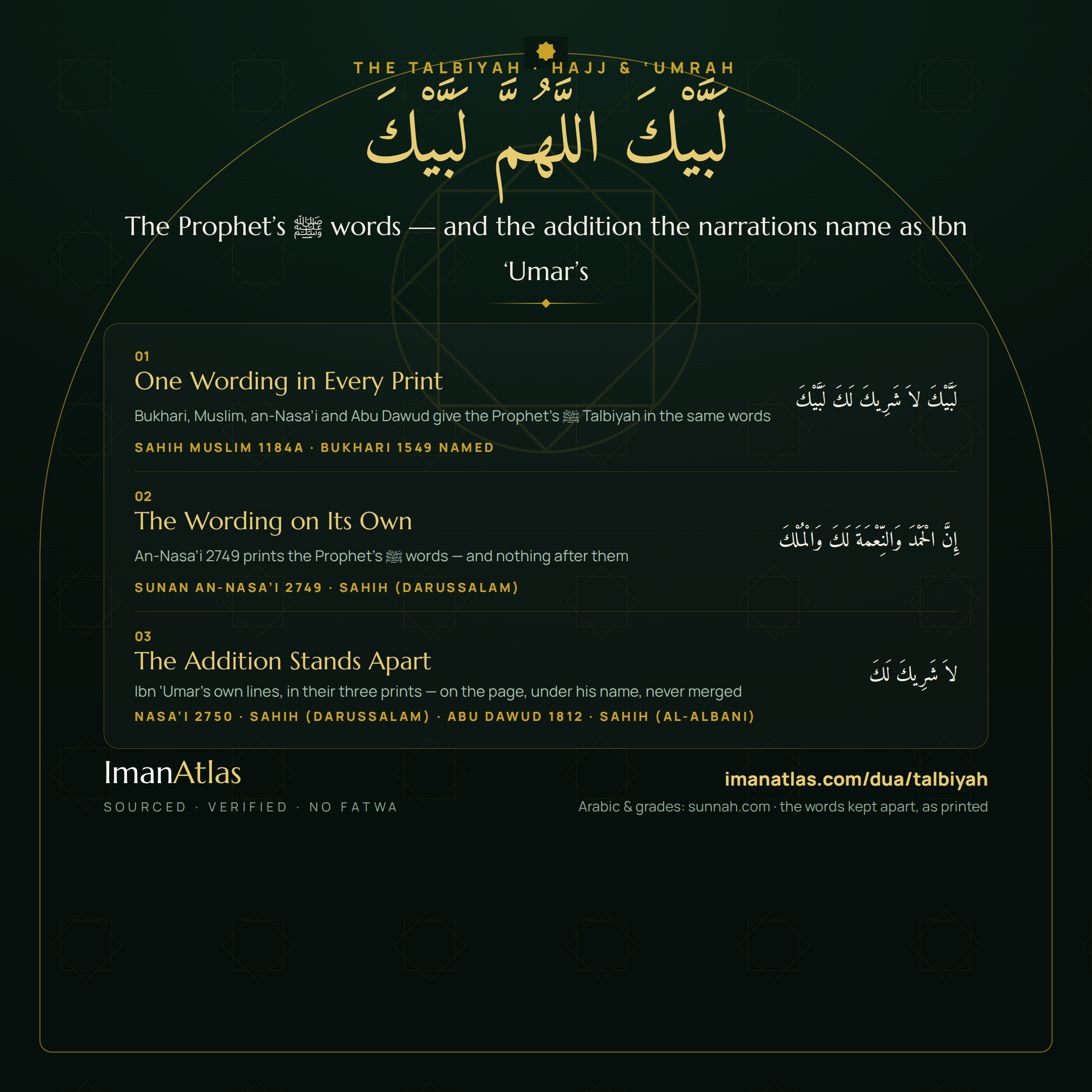
Short answer: Every narration gives the Prophet’s ﷺ Talbiyah in the same words: ‘Labbaykallahumma labbayk…’ — and then the narrations themselves say who added more. ‘Abdullah ibn ‘Umar, who reports the Prophet’s ﷺ words, used to add lines of his own — ‘Labbayka wa sa’dayk…’ The field prints both as one text; the sources keep them apart.
ImanAtlas does not give fatwas. For your own situation, ask a qualified scholar you trust.
Every narration on this page comes through one man. ‘Abdullah ibn ‘Umar heard the Prophet’s ﷺ Talbiyah and reported it; the report passed to his freedman Nafi‘, and from Nafi‘ to Malik — and by that one route it stands in Sahih Muslim, in an-Nasa’i, in Abu Dawud and in Sahih al-Bukhari. The wording those narrations give for the Prophet ﷺ is one wording. Then, inside the same narrations, a second set of lines appears — and before giving them, the narrations stop and name their author: Ibn ‘Umar himself. The field usually prints the two as a single long Talbiyah. This page does not.
The Prophet’s ﷺ Talbiyah: one wording in every print
Muslim places the narration in his Book of Pilgrimage, in a chapter he names “The Talbiyah, its description and timing”. His print is the anchor of this page because it is the one that shows the seam. The Prophet’s ﷺ wording stands first, whole. Then comes the narrator’s own sentence naming the addition as Ibn ‘Umar’s. Then the addition itself. Nothing is rearranged: the block below is Muslim’s narration in Muslim’s order, its two Arabic parts standing apart exactly as his text sets them apart — the addition’s Arabic after the translation, so that no reader meets the two as one text.
لَبَّيْكَ اللَّهُمَّ لَبَّيْكَ لَبَّيْكَ لاَ شَرِيكَ لَكَ لَبَّيْكَ إِنَّ الْحَمْدَ وَالنِّعْمَةَ لَكَ وَالْمُلْكَ لاَ شَرِيكَ لَكَ
Labbaika Allahumma Labbaik, Labbaika la sharika laka labbaik. Innal-hamda wan-ni’mata laka wal-mulk, la sharika lak
“’Abdullah b. ‘Umar (Allah be pleased with them) reported that the Talbiya of the Messenger of Allah (ﷺ) was this: Here I am at Thy service. O Allah, here I am at Thy service, here I am at Thy service. There is no associate with Thee; here I am at Thy service. Verily all praise and grace is due to Thee, and the sovereignty (too). There is no associate with Thee. He (the narrator) further said that ‘Abdullah b. ‘Umar (Allah be pleased with them) made this addition to it: Here I am at Thy service; here I am at Thy service; ready to obey Thee, and good is in Thy Hand; here I am at Thy service; unto Thee is the petition, and deed (is also for Thee).”
لَبَّيْكَ لَبَّيْكَ وَسَعْدَيْكَ وَالْخَيْرُ بِيَدَيْكَ لَبَّيْكَ وَالرَّغْبَاءُ إِلَيْكَ وَالْعَمَلُ
Labbayka labbayka wa sa’dayka wal-khayru bi yadayka, labbayka war-raghba’u ilayka wal-‘amal.
Sahih Muslim 1184a · The Book of Pilgrimage, chapter “The Talbiyah, its description and timing” · in-book Book 15, Hadith 21 · narrated by ‘Abdullah ibn ‘Umar, via Nafi‘, from Malik · the narration is printed whole and in its own order: the Prophet’s ﷺ wording, then the narrator’s own sentence naming the addition as Ibn ‘Umar’s — it stands inside the translation above — then the addition itself, its Arabic standing after the translation so the two parts are never run together · Muslim prints no transliteration: the first line above is the romanisation printed inside an-Nasa’i 2749’s translation, adopted here because the Arabic of the two prints is character-for-character the same (verified for this page); the addition’s line is a derivation from Muslim’s own print of it, checked word for word against it
An-Nasa’i prints the narration in his chapter “The Talbiyah” — and his first print, 2749, carries the Prophet’s ﷺ wording and stops there. No addition stands in it at all. A wording-only print is the control the merged texts never show: what the Prophet ﷺ is reported to have said fits inside these lines, and this print gives nothing beyond them.
لَبَّيْكَ اللَّهُمَّ لَبَّيْكَ لَبَّيْكَ لاَ شَرِيكَ لَكَ لَبَّيْكَ إِنَّ الْحَمْدَ وَالنِّعْمَةَ لَكَ وَالْمُلْكَ لاَ شَرِيكَ لَكَ
Labbaika Allahumma Labbaik, Labbaika la sharika laka labbaik. Innal-hamda wan-ni’mata laka wal-mulk, la sharika lak
“It was narrated that ‘Abdullah bin ‘Umar said: "The Talbiyah of the Messenger of Allah was: "Labbaika Allahumma Labbaik, Labbaika la sharika laka labbaik. Innal-hamda wan-ni’mata laka wal-mulk, la sharika lak (Here I am, O Allah, here I am. Here I am, You have no partner, here I am. Verily all praise and blessings are Yours, and all sovereignty, You have no partner."”
Sunan an-Nasa’i 2749 · The Book of Hajj, chapter “The Talbiyah” · in-book Book 24, Hadith 131 · the same Malik – Nafi‘ – Ibn ‘Umar route — Grade: Sahih (Darussalam), as printed at sunnah.com · this print carries the Prophet’s ﷺ wording ONLY — no addition stands in it · the romanisation line above is the one printed inside this narration’s own translation at sunnah.com, where it also stands; as a line it is checked word for word against the Arabic
A fifth print stands in Sahih al-Bukhari 1549, in his chapter “The Talbiya” — the same Malik – Nafi‘ – Ibn ‘Umar route, and the same words. Bukhari’s page romanises them: ‘Labbaika Allahumma labbaik, Labbaika la sharika Laka labbaik, Inna-l-hamda wan-ni’mata Laka walmulk, La sharika Laka’. It is named here rather than given a block of its own: its Arabic is the identical wording already printed above, letter for letter apart from its commas, and four blocks carry this page. Five prints, one wording — that is the whole of the Prophet’s ﷺ Talbiyah as these narrations give it.
The addition the narrations name as Ibn ‘Umar’s
The addition has three prints on this page: Muslim’s, inside the narration above; an-Nasa’i’s second print, 2750; and Abu Dawud’s, 1812. The three agree on whose lines these are — each narration names Ibn ‘Umar as it gives them. They do not agree with each other in three small ways, and those differences are exactly the kind that vanish the moment a page merges the prints into one ‘complete’ text. An-Nasa’i’s print comes first:
لَبَّيْكَ اللَّهُمَّ لَبَّيْكَ لَبَّيْكَ لاَ شَرِيكَ لَكَ لَبَّيْكَ إِنَّ الْحَمْدَ وَالنِّعْمَةَ لَكَ وَالْمُلْكَ لاَ شَرِيكَ لَكَ
Labbaika Allahumma Labbaik, Labbaika la sharika laka labbaik. Innal-hamda wan-ni’mata laka wal-mulk, la sharika lak
“It was narrated from ‘Ubaidullah bin ‘Abdullah bin ‘Umar that his father said: "The Talbiyah of the Messenger of Allah was: "Labbaika Allahumma Labbaik, Labbaika la sharika laka labbaik. Innal-hamda wan-ni’mata laka wal-mulk, la sharika lak (Here I am, O Allah, here I am. Here I am, You have no partner, here I am. Verily all praise and blessings are Yours, and all sovereignty, You have no partner)." And Ibn ‘Umar added: "Labbaika Labbaika wasa’daika wal-khayr fi yadika, warraghba’ ilaika wal-‘aml (Here I am, here I am, and at Your service; all good is in Your hands, seeking Your pleasure and striving for Your sake)."”
لَبَّيْكَ لَبَّيْكَ وَسَعْدَيْكَ وَالْخَيْرُ فِي يَدَيْكَ وَالرَّغْبَاءُ إِلَيْكَ وَالْعَمَلُ
Labbaika Labbaika wasa’daika wal-khayr fi yadika, warraghba’ ilaika wal-‘aml
Sunan an-Nasa’i 2750 · the same chapter · in-book Book 24, Hadith 132 · narrated from ‘Ubaidullah ibn ‘Abdullah ibn ‘Umar, from his father — Grade: Sahih (Darussalam), as printed at sunnah.com · both romanisation lines are the ones printed inside this narration’s own translation, where they also stand · the addition’s line is this print’s own: its “fi yadika” is never swapped with Muslim’s “bi yadayka” line above
Abu Dawud’s print stands in his chapter “The Procedure Of The Talbiyah”. Its narrator’s sentence is the plainest of the three — ‘‘Abd Allaah bin ‘Umar used to add to his talbiyah…’ — and its addition opens with labbayk three times, where both other prints have it twice:
لَبَّيْكَ اللَّهُمَّ لَبَّيْكَ لَبَّيْكَ لاَ شَرِيكَ لَكَ لَبَّيْكَ إِنَّ الْحَمْدَ وَالنِّعْمَةَ لَكَ وَالْمُلْكَ لاَ شَرِيكَ لَكَ
Labbaika Allahumma Labbaik, Labbaika la sharika laka labbaik. Innal-hamda wan-ni’mata laka wal-mulk, la sharika lak
“Ibn ‘Umar said Talbiyah uttered by the Apostle of Allaah(ﷺ) was Labbaik(always ready to obey), O Allaah labbaik, labbaik; Thou hast no partner, praise and grace are Thine, and the Dominion, Thou hast no partner. The narrator said ‘Abd Allaah bin ‘Umar used to add to his talbiyah Labbaik, labbaik, labbaik wa sa’daik(give me blessing after blessing) and good is Thy hands, desire and actions are directed towards Thee.”
لَبَّيْكَ لَبَّيْكَ لَبَّيْكَ وَسَعْدَيْكَ وَالْخَيْرُ بِيَدَيْكَ وَالرَّغْبَاءُ إِلَيْكَ وَالْعَمَلُ
Sunan Abi Dawud 1812 · The Rites of Hajj (Kitab Al-Manasik), chapter “The Procedure Of The Talbiyah” · in-book Book 11, Hadith 92 · the same Malik – Nafi‘ – Ibn ‘Umar route — Grade: Sahih (Al-Albani), as printed at sunnah.com · the first line above is the same adopted romanisation as on Muslim’s block — the Arabic here is character-for-character the same · the addition carries NO transliteration line: Abu Dawud’s print of it opens with labbayk three times and differs from both other prints of the addition, and no source prints a romanisation of this print — this page does not construct one
Set side by side, the three prints of the addition differ in exactly three places. The opening labbayk stands twice in Muslim’s and an-Nasa’i’s prints, and three times in Abu Dawud’s. For the hand, Muslim and Abu Dawud print «بِيَدَيْكَ» — bi yadayk — while an-Nasa’i prints «فِي يَدَيْكَ» — fi yadika. And before ‘war-raghba’u ilayka’, Muslim’s print carries one more labbayk that neither of the others has. Each print stands on this page as its book gives it. No fourth, composite text is built out of them: a merged ‘full Talbiyah’ is a text that no narration on this page contains.
Whose words are whose
Whose words are whose is not a puzzle the sources leave open. The reporter and the author are one man in two roles: Ibn ‘Umar reports the Prophet’s ﷺ wording, and Ibn ‘Umar adds lines of his own, and the narrations keep the two roles apart in so many words. What the sources do not give this page is anything beyond the record. Whether a pilgrim may say the addition is a ruling — it is the question the field puts to the scholars, taken up, for one, at IslamQA 220989 — and this page gives no ruling. When the Talbiyah is begun, when it is ended, and how Hajj and ‘Umrah are performed are method, and no method stands on this page. Two neighbouring narrations are named here only to be left where they belong: Jabir’s long narration of the Prophet’s ﷺ Hajj (Sahih Muslim 1218) tells the journey whole and belongs to its own page, and the narrations about raising the voice in the Talbiyah are a different family, not captured here. In Hisnul Muslim the Talbiyah stands in chapter 115, “The Talbiyah for Hajj or ‘Umrah” — the book whose complete chapter index stands on this site.
Beyond what these texts themselves say, this page adds nothing — no method, no timing, no count, and no ruling the sources do not give.
This page stands under the hub page, Duas & Azkar, where the library’s duas are gathered. The chapter index named above is this site’s Hisnul Muslim index page, where chapter 115 is marked with what this library prints of it.
ImanAtlas does not give fatwas. For your own situation, ask a qualified scholar you trust.
Frequently asked questions
Who added ‘Labbayka wa sa’dayk’ to the Talbiyah?
‘Abdullah ibn ‘Umar — and the narration itself says so. In Sahih Muslim 1184a, after the Prophet’s ﷺ wording, the narrator goes on: ‘He (the narrator) further said that ‘Abdullah b. ‘Umar (Allah be pleased with them) made this addition to it.’ An-Nasa’i 2750 says the same in its own words: ‘And Ibn ‘Umar added…’ The addition is never anonymous in the sources. It becomes anonymous only in retellings that merge it into the wording.
Is ‘Labbayka wa sa’dayk’ part of the Prophet’s ﷺ Talbiyah?
In no print on this page. The Prophet’s ﷺ wording ends ‘…la sharika lak’ — ‘there is no associate with Thee’ — in Muslim 1184a, an-Nasa’i 2749 and Abu Dawud 1812 alike, and Bukhari 1549 prints the same wording. Where the extra lines stand — Muslim 1184a, an-Nasa’i 2750, Abu Dawud 1812 — the narration names them as Ibn ‘Umar’s addition. And an-Nasa’i 2749 prints the Prophet’s ﷺ wording with nothing after it.
Why do the prints of the addition differ from each other?
In three small ways, and this page shows them rather than smoothing them out. The opening word labbayk stands twice in Muslim’s and an-Nasa’i’s prints and three times in Abu Dawud’s. Where Muslim and Abu Dawud print «بِيَدَيْكَ» (bi yadayk), an-Nasa’i prints «فِي يَدَيْكَ» (fi yadika). And Muslim’s print carries one more labbayk before ‘war-raghba’u ilayka’ that the other two do not. Each print stands as its book gives it; no composite ‘full’ text is made from them.
Which hadith collections narrate the Talbiyah?
The prints on this page are Sahih Muslim 1184a, an-Nasa’i 2749 and 2750, and Abu Dawud 1812, with Sahih al-Bukhari 1549 named as a fifth print of the same wording. All of them reach ‘Abdullah ibn ‘Umar by the same route — Malik, from Nafi‘, from Ibn ‘Umar. Jabir’s long narration of the Prophet’s ﷺ Hajj (Sahih Muslim 1218) is a different narration; it is not quoted on this page and belongs to its own.
How many times should the Talbiyah be said?
No narration on this page gives a count — not for the wording, and not for the addition. The only numbers inside these prints are inside the addition’s own wording: labbayk twice at its opening in two prints, three times in Abu Dawud’s. Those are the prints’ words, not a prescription, and this page adds no count of its own.
When do I begin and end the Talbiyah — and may I say Ibn ‘Umar’s addition?
Both are questions of practice and ruling, and this page answers neither. When the Talbiyah is begun and ended belongs to the method of Hajj and ‘Umrah, which this page does not teach. Whether the addition may be said is a ruling the field takes to the scholars — it is the very question put to IslamQA (220989). What this page gives is the record any ruling has to work from: whose words are whose, in each print. For the rest, the line at the head of this page applies.
Sources
Every wording and grade on this page comes from these pages, printed from this page’s own captures of their sources. The IslamQA page is listed because this page names it as one place the ruling question is taken up; it is not a source for any text here.
- The anchor print — the whole narration, with the narrator’s own seam — Sahih Muslim 1184a — sunnah.com
- The wording-only print — Sunan an-Nasa’i 2749 — sunnah.com
- The addition in an-Nasa’i’s print (fi yadika) — Sunan an-Nasa’i 2750 — sunnah.com
- The addition in Abu Dawud’s print (labbayk three times) — Sunan Abi Dawud 1812 — sunnah.com
- The fifth print, named in the text — Sahih al-Bukhari 1549 — sunnah.com
- The ruling question, named and routed — IslamQA 220989 — islamqa.info
- The hub this page belongs to — Duas & Azkar
- The book whose chapter 115 this is — Hisnul Muslim — The Complete Chapter Index
Found an error? We correct mistakes within 24 hours, with a note on the page — write to us through the website.