Allahumma Aslamtu — the Dua to Make Your Last Words at Night
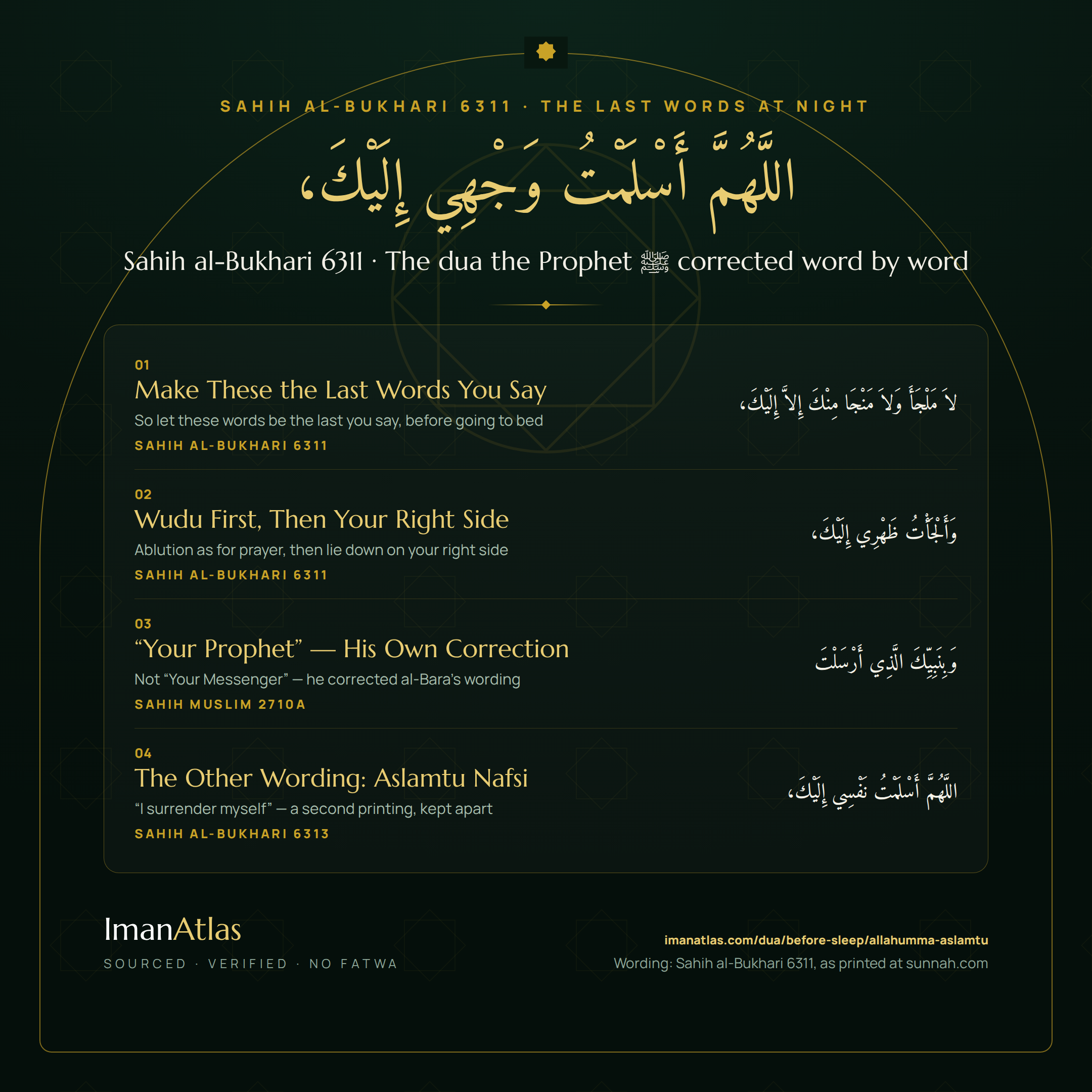
One dua for the moment of lying down — taught to al-Bara’ ibn ‘Azib, and corrected by the Prophet ﷺ himself, word by word, when al-Bara’ repeated it back to him. Both printed wordings stand here, kept apart.
Short answer: When al-Bara’ ibn ‘Azib went to bed, the Prophet ﷺ told him: do wudu as for prayer, lie on your right side, and say ‘Allahumma aslamtu wajhi ilayk…’ — ‘make these the last words you say; if you die that night, you die on the fitrah’ (Sahih al-Bukhari 6311).
Translations on this page: the translations printed at sunnah.com. ImanAtlas presents sources, not fatwas; for a ruling on your own situation, ask a qualified scholar you trust.
What this dua is
It is the dua of surrender at the door of sleep. Al-Bara’ ibn ‘Azib reports that the Prophet ﷺ taught it to him for going to bed, and its first word is its whole posture: aslamtu — I surrender, I hand myself over. “I surrender my face to You, and I entrust my affair to You, and I lean my back on You, in hope of You and in fear of You.” On the Duas Before Sleeping page it stands as the closing block of the bedtime set. Here it has a page of its own, because no list gives its three parts the room they need: the frame the Prophet ﷺ set around it, the correction he made inside it, and the second wording another printing carries.
Sahih Muslim prints the same narration at 2710a, in the same wording family. What follows works from the two Bukhari printings, 6311 and 6313, with Muslim’s printing named where it carries the story furthest.
The narration in full — Sahih al-Bukhari 6311
The block below stands exactly as it stands on the pillar — the dua’s Arabic, its transliteration as sunnah.com prints it inside the translation, the narration’s words, and the reference line:
The surrender dua — let it be the last words you say
اللَّهُمَّ أَسْلَمْتُ وَجْهِي إِلَيْكَ، وَفَوَّضْتُ أَمْرِي إِلَيْكَ، وَأَلْجَأْتُ ظَهْرِي إِلَيْكَ، رَغْبَةً وَرَهْبَةً إِلَيْكَ، لاَ مَلْجَأَ وَلاَ مَنْجَا مِنْكَ إِلاَّ إِلَيْكَ، آمَنْتُ بِكِتَابِكَ الَّذِي أَنْزَلْتَ، وَبِنَبِيِّكَ الَّذِي أَرْسَلْتَ
Allahumma aslamtu wajhi ilaika, wa fawwadtu ‘amri ilaika wa alja’tu dhahri ilaika, raghbatan wa rahbatan ilaika, la malja’a wa la manja minka illa ilaika. Amantu bikitabik al-ladhi anzalta wa binabiyyika al-ladhi arsalta.
“When you want to go to bed, perform ablution as you do for prayer, then lie down on your right side and say: ‘Allahumma aslamtu wajhi ilaika…’ (O Allah, I surrender my face to You and entrust my affair to You…). If you should die then (after reciting this) you will die on the religion of Islam (i.e., as a Muslim); so let these words be the last you say (before going to bed).” When al-Bara’ repeated the dua back with the word “rasulika” (Your Messenger), the Prophet ﷺ corrected him: the wording is “binabiyyika” — “the Apostle (Nabi) whom Thou sent”. Bukhari 6313 prints a version opening “aslamtu nafsi” (I surrender myself) — the page prints 6311’s wording and notes the variant rather than merging them.
Sahih al-Bukhari 6311 · Sahih Muslim 2710a · the variant at Sahih al-Bukhari 6313.
Sunnah.com’s full printed translation of 6311 runs: “When you want to go to bed, perform ablution as you do for prayer, then lie down on your right side and say: ‘Allahumma aslamtu wajhi ilaika, wa fawwadtu ‘amri ilaika wa alja’tu dhahri ilaika, raghbatan wa rahbatan ilaika, la malja’a wa la manja minka illa ilaika. Amantu bikitabik al-ladhi anzalta wa binabiyyika al-ladhi arsalta’. If you should die then (after reciting this) you will die on the religion of Islam (i.e., as a Muslim); so let these words be the last you say (before going to bed)” Hold on to its last clause. The dua is not one bedtime item among others in the narration’s own telling; it is placed last on purpose — “so let these words be the last you say (before going to bed)”.
“Your Prophet”, not “Your Messenger” — the correction inside the narration
Then al-Bara’ did what any student would do: he repeated the dua back to his teacher to check he had it right. In the repeating, one word slipped. He said wa bi rasulika — “and in Your Messenger” — where the taught wording was wa bi nabiyyika, “and in Your Prophet”. The Prophet ﷺ stopped him. The narration, as it is quoted in IslamQA’s list of sound bedtime hadiths (145543), gives the exchange in his words: “I said, ‘wa bi rasulika (and in Your Messenger).’ He said: ‘No; wa bi nabiyyika (and in Your Prophet).’”
Muslim’s printing (2710a) carries the correction at its fullest: “Say: I affirm my faith in the Apostle (Nabi) whom Thou sent”. Two words, near in meaning, and he ﷺ would not let the near one stand in place of the given one. That is why this page prints the dua exactly as it was taught, and why the variant in the next section is printed as its own narration rather than blended into this one: the wording of this dua was fixed by the Prophet ﷺ himself, in person, in the very narration that carries it.
The other wording — “aslamtu nafsi” (Bukhari 6313)
Bukhari prints the narration a second time, at 6313, and its dua opens differently: aslamtu nafsi ilaika — “I surrender myself to You” — where 6311 opens aslamtu wajhi, “I surrender my face to You”. The 6313 wording also carries a clause 6311 does not: wa wajjahtu wajhi ilaika, “and I turn my face to You”. It is a genuine second printing, not a copyist’s slip, and it stands here as its own block:
اللَّهُمَّ أَسْلَمْتُ نَفْسِي إِلَيْكَ، وَفَوَّضْتُ أَمْرِي إِلَيْكَ، وَوَجَّهْتُ وَجْهِي إِلَيْكَ، وَأَلْجَأْتُ ظَهْرِي إِلَيْكَ، رَغْبَةً وَرَهْبَةً إِلَيْكَ، لاَ مَلْجَأَ وَلاَ مَنْجَا مِنْكَ إِلاَّ إِلَيْكَ، آمَنْتُ بِكِتَابِكَ الَّذِي أَنْزَلْتَ، وَبِنَبِيِّكَ الَّذِي أَرْسَلْتَ. فَإِنْ مُتَّ مُتَّ عَلَى الْفِطْرَةِ
Sunnah.com’s printed translation of this printing carries the dua in its romanised form: “’Allahumma aslamtu nafsi ilaika wa fauwadtu `Amri ilaika, wa wajjahtu wajhi ilaika wa alja’tu zahri ilaika…” — and closes: “And if you should die then (after reciting this before going to bed) you will die on the religion of Islam.”
Sahih al-Bukhari 6313 · sunnah.com/bukhari:6313
From the same chapter of Sahih Muslim: Allahumma Khalaqta Nafsi — the dua for the soul at bedtime
The two wordings are never merged on this site — not here, and not on the pillar. A reader who says the dua from 6311’s page gets 6311’s words; the 6313 wording stands beside it with its own reference, and each keeps its own shape.
What the frame words carry — wudu, the right side, the last words
The dua does not float free in the narration; it arrives inside a frame of three instructions, all in the Prophet’s ﷺ words: “When you want to go to bed, perform ablution as you do for prayer, then lie down on your right side and say:” First the ablution, done as carefully as the one for prayer. Then the right side. Then the words. And the words come with their own instruction, quoted in full above: let them be the last thing said before sleep.
One more phrase in the frame draws the eye: “If you should die then (after reciting this) you will die on the religion of Islam (i.e., as a Muslim)”. The printed translation glosses the narration’s “on the fitrah” itself — dying on the religion of Islam. Those are the narration’s words about its own dua, and they stand here as his ﷺ words inside the quote, nowhere else on this page. This site adds no promise of its own, and it builds no ruling out of the frame: whether the ablution is a condition of the dua, or what holds when the order is missed, are questions for a scholar, not for a page of sources.
Questions, answered from the sources
What does dying on the fitrah mean?
It is the narration’s own phrase, and its printed translation glosses it in the same breath: “If you should die then (after reciting this) you will die on the religion of Islam (i.e., as a Muslim)” (Sahih al-Bukhari 6311). The words stand inside the narration, as his ﷺ words to al-Bara’ — this page quotes them there and turns them into no promise of its own.
Do I need wudu before sleeping to say the aslamtu dua?
The narration’s frame runs: “When you want to go to bed, perform ablution as you do for prayer, then lie down on your right side and say…” (Sahih al-Bukhari 6311). That is what the text says, and this page reports it as the frame the Prophet ﷺ himself set. Whether the ablution is a condition, and what follows if it is missed, are rulings — ask a qualified scholar you trust.
What if I say “wa bi rasulika” instead of “wa bi nabiyyika”?
You would be repeating the slip the narration itself records. Al-Bara’ repeated the dua back with “wa bi rasulika” (and in Your Messenger), and the Prophet ﷺ corrected him on the spot: “No; wa bi nabiyyika (and in Your Prophet)” — as the narration is quoted at IslamQA 145543. The wording he ﷺ fixed is the wording printed on this page. What the slip means for a prayer already said is a ruling; ask a qualified scholar you trust.
Which surahs should I read before sleeping?
The bedtime set on this site stands on the Duas Before Sleeping page: the Three Quls blown into the palms, Surah al-Kafirun, Surah al-Mulk with Surah as-Sajdah, and a pointer to the last two verses of al-Baqarah — each item with its own narration and reference. This dua stands in the same set, as its closing words.
Sources
Every text and claim on this page comes from these pages, read on 28 November 2026. Translations: sunnah.com’s printed translations.
- The narration in full — Sahih al-Bukhari 6311
- The same narration, with the correction at its fullest — Sahih Muslim 2710a
- The second wording — Sahih al-Bukhari 6313
- The correction exchange, as quoted in the list of sound bedtime hadiths — IslamQA 145543
- The full bedtime set this page belongs to — Duas Before Sleeping
- Hub — Duas & Azkar
Found an error? We correct mistakes within 24 hours, with a note on the page — write to us through the website.