Duas Before Sleeping, exactly as narrated
The adhkar said on going to bed — Arabic, translation, reference and grade for every one.
Short answer: Before sleep, the Prophet ﷺ recited Ayat al-Kursi, gathered the three Quls into his palms and wiped them over his body three times, said the 33-33-34 tasbih taught to Fatima, and ended with short duas of surrender. This page gives the bedtime set in order, each with its Arabic, translation, reference and grade.
Translations on this page: Qur’an — Dr. Mustafa Khattab (via quran.com); hadith — the translations printed at sunnah.com. Arabic is copied from those pages, never typed from memory. Repetition counts are printed only where the hadith itself states them. ImanAtlas presents sources, not fatwas; for a ruling on your own situation, ask a qualified scholar you trust.
When are these said?
On going to bed — in the narrations’ own phrases: “whenever you go to bed”, “when anyone of you intends to go to sleep”, “when you go to your beds”. This is the bedtime set, distinct from the evening set (said from Maghrib) and from the after-salah set — some items overlap in the sources, and each page prints the narration framed for its own moment.
Recitation before sleep
The three Quls, gathered into the palms
قُلْ هُوَ ٱللَّهُ أَحَدٌ ٱللَّهُ ٱلصَّمَدُ لَمْ يَلِدْ وَلَمْ يُولَدْ وَلَمْ يَكُن لَّهُۥ كُفُوًا أَحَدٌۢ
قُلْ أَعُوذُ بِرَبِّ ٱلْفَلَقِ مِن شَرِّ مَا خَلَقَ وَمِن شَرِّ غَاسِقٍ إِذَا وَقَبَ وَمِن شَرِّ ٱلنَّفَّٰثَٰتِ فِى ٱلْعُقَدِ وَمِن شَرِّ حَاسِدٍ إِذَا حَسَدَ
قُلْ أَعُوذُ بِرَبِّ ٱلنَّاسِ مَلِكِ ٱلنَّاسِ إِلَٰهِ ٱلنَّاسِ مِن شَرِّ ٱلْوَسْوَاسِ ٱلْخَنَّاسِ ٱلَّذِى يُوَسْوِسُ فِى صُدُورِ ٱلنَّاسِ مِنَ ٱلْجِنَّةِ وَٱلنَّاسِ
qul huwa l-lahu aḥadun al-lahu l-ṣamadu lam yalid walam yūlad walam yakun lahu kufuwan aḥadun
qul aʿūdhu birabbi l-falaqi min sharri mā khalaqa wamin sharri ghāsiqin idhā waqaba wamin sharri l-nafāthāti fī l-ʿuqadi wamin sharri ḥāsidin idhā ḥasada
qul aʿūdhu birabbi l-nāsi maliki l-nāsi ilāhi l-nāsi min sharri l-waswāsi l-khanāsi alladhī yuwaswisu fī ṣudūri l-nāsi mina l-jinati wal-nāsi
“Whenever the Prophet ﷺ went to bed every night, he used to cup his hands together and blow over it after reciting Surat Al-Ikhlas, Surat Al-Falaq and Surat An-Nas, and then rub his hands over whatever parts of his body he was able to rub, starting with his head, face and front of his body. He used to do that three times.”
Three times — the whole gather, recite and wipe action, as narratedSahih al-Bukhari 5017 — the surahs’ Arabic is the Tanzil text via quran.com (112, 113, 114).
Ayat al-Kursi on going to bed — the Abu Huraira story
إِذَا أَوَيْتَ إِلَى فِرَاشِكَ فَاقْرَأْ آيَةَ الْكُرْسِيِّ اللَّهُ لاَ إِلَهَ إِلاَّ هُوَ الْحَىُّ الْقَيُّومُ حَتَّى تَخْتِمَ الآيَةَ، فَإِنَّكَ لَنْ يَزَالَ عَلَيْكَ مِنَ اللَّهِ حَافِظٌ وَلاَ يَقْرَبَنَّكَ شَيْطَانٌ حَتَّى تُصْبِحَ
Abu Huraira’s story: a prisoner he was guarding — who proved to be Satan — told him: “Whenever you go to bed, recite ‘Ayat-al-Kursi’ — ‘Allahu la ilaha illa huwa-l-Haiy-ul Qaiyum’ — till you finish the whole verse. (If you do so), Allah will appoint a guard for you who will stay with you and no satan will come near you till morning.” The Prophet ﷺ said of the speaker: “He really spoke the truth, although he is an absolute liar.” The instruction is the prisoner’s words inside the story, confirmed by the Prophet ﷺ — this page keeps that attribution exact.
Sahih al-Bukhari 2311 — the verse itself (Qur’an 2:255) is printed in full, with its translation, on the Evening page; it is not reprinted here.
Surah al-Kafirun — a disavowal of shirk
قُلْ يَٰٓأَيُّهَا ٱلْكَٰفِرُونَ لَآ أَعْبُدُ مَا تَعْبُدُونَ وَلَآ أَنتُمْ عَٰبِدُونَ مَآ أَعْبُدُ وَلَآ أَنَا۠ عَابِدٌ مَّا عَبَدتُّمْ وَلَآ أَنتُمْ عَٰبِدُونَ مَآ أَعْبُدُ لَكُمْ دِينُكُمْ وَلِىَ دِينِ
qul yāayyuhā l-kāfirūna lā aʿbudu mā taʿbudūna walā antum ʿābidūna mā aʿbudu walā anā ʿābidun mā ʿabadttum walā antum ʿābidūna mā aʿbudu lakum dīnukum waliya dīni
The Prophet ﷺ said to Nawfal: “Recite (the Surah) ‘Say, O you disbelievers!’ and then go to sleep at its end, for it is a declaration of freedom from polytheism.”
Sunan Abi Dawud 5055 · Grade: Sahih (Al-Albani) — the same instruction is at Jami’ at-Tirmidhi 3403. No count is stated in either narration, so none is printed.
Surah al-Mulk and Surah as-Sajdah
إِنَّ سُورَةً مِنَ الْقُرْآنِ ثَلاَثُونَ آيَةً شَفَعَتْ لِرَجُلٍ حَتَّى غُفِرَ لَهُ وَهِيَ سُورَةُ تَبَارَكَ الَّذِي بِيَدِهِ الْمُلْكُ
The intercession narration: “Indeed there is a Surah in the Qur’an of thirty Ayat, which intercedes for a man until he is forgiven. It is [Surah] Tabarak Alladhi Biyadihil-Mulk.” That narration names the surah — it states no time for reading it: not “before sleep”, not “at night”, and no count. The bedtime connection comes from a different report: “The Prophet ﷺ would not sleep until he recited Alif Lam Mim Tanzil (Surah as-Sajdah) and Tabarak Alladhi Biyadihil-Mulk.”
Jami’ at-Tirmidhi 2891 · Grade: Hasan (Darussalam) (the intercession narration) · the habit report is Jami’ at-Tirmidhi 3404 · Grade: Hasan (Darussalam) — disclosed in full: sunnah.com’s printing of this same habit report at Jami’ at-Tirmidhi 2892 grades it Da’if (Darussalam). We print both grades, as printed, and choose neither. Read the surahs at quran.com/67 and quran.com/32, or find them in the Surah index.
Its own page: Surah al-Mulk Before Sleep — what the narrations actually say
One more night recitation: the last two verses of al-Baqarah (2:285–286) — “that will be sufficient for him” (Sahih al-Bukhari 5009). They are printed in full on the Evening page; this page does not print a third copy.
The tasbih taught to Fatima
The tasbih taught to Fatima — on going to bed
إِذَا أَخَذْتُمَا مَضَاجِعَكُمَا فَكَبِّرَا اللَّهَ أَرْبَعًا وَثَلاَثِينَ، وَاحْمَدَا ثَلاَثًا وَثَلاَثِينَ، وَسَبِّحَا ثَلاَثًا وَثَلاَثِينَ، فَإِنَّ ذَلِكَ خَيْرٌ لَكُمَا مِمَّا سَأَلْتُمَاهُ
Fatima asked the Prophet ﷺ for a servant. He came to her and ‘Ali at night and said: “Shall I tell you a thing which is better than what you asked me for? When you go to your beds, say: ‘Allahu Akbar (i.e. Allah is Greater)’ for 34 times, and ‘Al hamdu Li llah (i.e. all the praises are for Allah)’ for 33 times, and Subhan Allah (i.e. Glorified be Allah) for 33 times. This is better for you than what you have requested.” (Bukhari 5361 prints the same teaching with the tasbih named first; the counts are identical.)
Allahu Akbar ×34 · Alhamdulillah ×33 · SubhanAllah ×33Sahih al-Bukhari 3113 · Sahih al-Bukhari 5361 · Sahih Muslim 2727a — a bedtime teaching, a different narration from the tasbih after salah (the After Salah page carries that set).
Its own page: The Tasbih of Fatimah — the words taught for the night
The duas as you lie down
Bismika Allahumma amutu wa ahya — in Your name I die and I live
بِاسْمِكَ اللَّهُمَّ أَمُوتُ وَأَحْيَا
Bismika Allahumma amutu wa ahya.
“Whenever the Prophet ﷺ intended to go to bed, he would recite: ‘Bismika Allahumma amutu wa ahya (With Your name, O Allah, I die and I live).’” This is the short dua most people know as the “sone ki dua” — it is one item in the bedtime set, not the whole set. Bukhari 6312 prints the shorter wording “Bismika amutu wa ahya”, without “Allahumma”.
Sahih al-Bukhari 6324 (also 6312, 6325) — its waking pair from the same narration is in the On waking section below.
Bismika Rabbi wada’tu janbi — in Your name I lay down my side
بِاسْمِكَ رَبِّ وَضَعْتُ جَنْبِي، وَبِكَ أَرْفَعُهُ، إِنْ أَمْسَكْتَ نَفْسِي فَارْحَمْهَا، وَإِنْ أَرْسَلْتَهَا فَاحْفَظْهَا بِمَا تَحْفَظُ بِهِ عِبَادَكَ الصَّالِحِينَ
Bismika Rabbi Wada`tu Janbi wa bika arfa’uhu, In amsakta nafsi farhamha wa in arsaltaha fahfazha bima tahfazu bihi ibadakas-salihin.
“When anyone of you go to bed, he should shake out his bed with the inside of his waist sheet, for he does not know what has come on to it after him, and then he should say: ‘Bismika Rabbi Wada’tu Janbi wa bika arfa’uhu, In amsakta nafsi farhamha wa in arsaltaha fahfazha bima tahfazu bihi ibadakas-salihin’” — in Your name, my Lord, I lay down my side and in Your name I raise it; if You take my soul, have mercy on it, and if You return it, protect it as You protect Your righteous servants. The bed-shaking belongs to this narration; this page builds no separate manners section.
Sahih al-Bukhari 6320 · Sahih Muslim 2714.
Allahumma qini ‘adhabaka — guard me from Your punishment
اللَّهُمَّ قِنِي عَذَابَكَ يَوْمَ تَبْعَثُ عِبَادَكَ
Allahumma qini ‘adhabaka yawma tab’athu ‘ibadak.
Hafsah reported: “When the Messenger of Allah ﷺ wanted to go to sleep, he put his right hand under his cheek and would then say: O Allah, guard me from Thy punishment on the day when Thou raisest up Thy servants.” Abu Dawud’s text adds the words “three times” — read the grade line below before counting: it is printed whole, exactly as sunnah.com prints it, because it excludes those very words. Al-Bara’s version at-Tirmidhi states no count at all.
Sunan Abi Dawud 5045 · Grade: Sahih, apart from the words ‘three times’ (Al-Albani) · Jami’ at-Tirmidhi 3399 · Grade: Sahih (Darussalam), and at-Tirmidhi himself called it hasan gharib from this route. This page prints no count for this dua.
Allahumma Rabbas-samawati — the long refuge dua
اللَّهُمَّ رَبَّ السَّمَوَاتِ وَرَبَّ الأَرْضِ وَرَبَّ الْعَرْشِ الْعَظِيمِ رَبَّنَا وَرَبَّ كُلِّ شَىْءٍ فَالِقَ الْحَبِّ وَالنَّوَى وَمُنْزِلَ التَّوْرَاةِ وَالإِنْجِيلِ وَالْفُرْقَانِ أَعُوذُ بِكَ مِنْ شَرِّ كُلِّ شَىْءٍ أَنْتَ آخِذٌ بِنَاصِيَتِهِ اللَّهُمَّ أَنْتَ الأَوَّلُ فَلَيْسَ قَبْلَكَ شَىْءٌ وَأَنْتَ الآخِرُ فَلَيْسَ بَعْدَكَ شَىْءٌ وَأَنْتَ الظَّاهِرُ فَلَيْسَ فَوْقَكَ شَىْءٌ وَأَنْتَ الْبَاطِنُ فَلَيْسَ دُونَكَ شَىْءٌ اقْضِ عَنَّا الدَّيْنَ وَأَغْنِنَا مِنَ الْفَقْرِ
Allahumma Rabbas-samawati wa Rabbal-ardi wa Rabbal-‘arshil-‘azim, Rabbana wa Rabba kulli shay’, faliqal-habbi wan-nawa, wa munzilat-Tawrati wal-Injili wal-Furqan, a’udhu bika min sharri kulli shay’in anta akhidhun bi-nasiyatih. Allahumma antal-awwalu fa-laysa qablaka shay’, wa antal-akhiru fa-laysa ba’daka shay’, wa antaz-zahiru fa-laysa fawqaka shay’, wa antal-batinu fa-laysa dunaka shay’, iqdi ‘annad-dayna wa aghnina minal-faqr.
“When any one of you intends to go to sleep, he should lie on the bed on his right side and then say: ‘O Allah. the Lord of the Heavens and the Lord of the Earth and Lord of the Magnificent Throne, our Lord, and the Lord of everything, the Splitter of the grain of corn and the datestone (or fruit kernal), the Revealer of Torah and Injil (Bible) and Criterion (the Holy Qur’an), I seek refuge in Thee from the evil of everything Thou art to seize by the forelock (Thou hast perfect control over it). O Allah, Thou art the First, there is naught before Thee, and Thou art the Last and there is naught after Thee, and Thou art Evident and there is nothing above Thee, and Thou art Innermost and there is nothing beyond Thee. Remove the burden of debt from us and relieve us from want.’”
Sahih Muslim 2713a.
The surrender dua — let it be the last words you say
اللَّهُمَّ أَسْلَمْتُ وَجْهِي إِلَيْكَ، وَفَوَّضْتُ أَمْرِي إِلَيْكَ، وَأَلْجَأْتُ ظَهْرِي إِلَيْكَ، رَغْبَةً وَرَهْبَةً إِلَيْكَ، لاَ مَلْجَأَ وَلاَ مَنْجَا مِنْكَ إِلاَّ إِلَيْكَ، آمَنْتُ بِكِتَابِكَ الَّذِي أَنْزَلْتَ، وَبِنَبِيِّكَ الَّذِي أَرْسَلْتَ
Allahumma aslamtu wajhi ilaika, wa fawwadtu ‘amri ilaika wa alja’tu dhahri ilaika, raghbatan wa rahbatan ilaika, la malja’a wa la manja minka illa ilaika. Amantu bikitabik al-ladhi anzalta wa binabiyyika al-ladhi arsalta.
“When you want to go to bed, perform ablution as you do for prayer, then lie down on your right side and say: ‘Allahumma aslamtu wajhi ilaika…’ (O Allah, I surrender my face to You and entrust my affair to You…). If you should die then (after reciting this) you will die on the religion of Islam (i.e., as a Muslim); so let these words be the last you say (before going to bed).” When al-Bara’ repeated the dua back with the word “rasulika” (Your Messenger), the Prophet ﷺ corrected him: the wording is “binabiyyika” — “the Apostle (Nabi) whom Thou sent”. Bukhari 6313 prints a version opening “aslamtu nafsi” (I surrender myself) — the page prints 6311’s wording and notes the variant rather than merging them.
Sahih al-Bukhari 6311 · Sahih Muslim 2710a · the variant at Sahih al-Bukhari 6313.
Its own page: Allahumma Aslamtu — the dua to make your last words at night
On waking
Alhamdulillahilladhi ahyana — the waking dua
الْحَمْدُ لِلَّهِ الَّذِي أَحْيَانَا بَعْدَ مَا أَمَاتَنَا، وَإِلَيْهِ النُّشُورُ
Al-hamdu lil-lahil-ladhi ahyana ba’da ma amatana; wa ilaihi an-nushur.
“And when he woke up from his sleep, he would say: ‘Al-hamdu lil-lahil-ladhi ahyana ba’da ma amatana; wa ilaihi an-nushur (All the Praises are for Allah Who has made us alive after He made us die (sleep) and unto Him is the Resurrection).’” The sleeping and waking duas travel in one narration — that is why this short section sits on this page.
Sahih al-Bukhari 6324 (also 6312, 6325).
For waking in the middle of the night, a longer dhikr is narrated — “La ilaha illallah wahdahu la sharika lah…” followed by “Allahumma ighfir li” — at Sahih al-Bukhari 1154. It is a waking narration, not a bedtime one, so it is named here with its reference rather than given a block.
A note on a dua you will see in other lists
The bedtime istighfar — printed with its grade
أَسْتَغْفِرُ اللَّهَ الْعَظِيمَ الَّذِي لاَ إِلَهَ إِلاَّ هُوَ الْحَىَّ الْقَيُّومَ وَأَتُوبُ إِلَيْهِ
Astaghfirullāha [al-`Aẓim] alladhi lā ilāha illā huw, al-Ḥayyul-Qayyūm, wa atūbu ilaihi
“Whoever says, when he goes to his bed: ‘I seek forgiveness from Allah, [the Magnificent] the One whom there is none worthy of worship except for Him, the Living, the Sustainer, and I repent to Him’ three times, Allah shall forgive him his sins if they were like the foam of the sea…” — the narration continues with further comparisons, all part of the same text. It appears in many bedtime lists as a headline promise, without its grade. Its grade, as printed, is below; this page keeps it out of the main set for that reason.
Jami’ at-Tirmidhi 3397 · Grade: Da’if (Darussalam) — at-Tirmidhi himself called it hasan gharib and said it is known only from this route.
What this page does not cover
Three bedtime items appear in the fatwa lists but were not verified at sunnah.com in this page’s research, so they are not printed here as practice: the dua “Allahumma khalaqta nafsi…”, the dua “Alhamdu lillahilladhi at’amana wa saqana…”, and the report of Surah al-Isra and Surah az-Zumar before sleep. “Not verified here” is not a ruling on them — it is this page’s sourcing standard. Rulings about sleeping postures are likewise not this page’s business; the right side and wudu appear above only inside the narrations that carry them. For your own situation, ask a qualified scholar you trust.
How long does the set take, and how to start?
The core of the set — the Quls action, Ayat al-Kursi, the tasbih and two or three short duas — takes a few minutes at a calm pace. A workable start: the three-Quls action, “Bismika Allahumma amutu wa ahya” and the tasbih of Fatima for the first week, then add one item at a time. The surrender dua is placed last on this page because its own narration says to make it the last words — not because this page invents an order for the rest.
Share this page
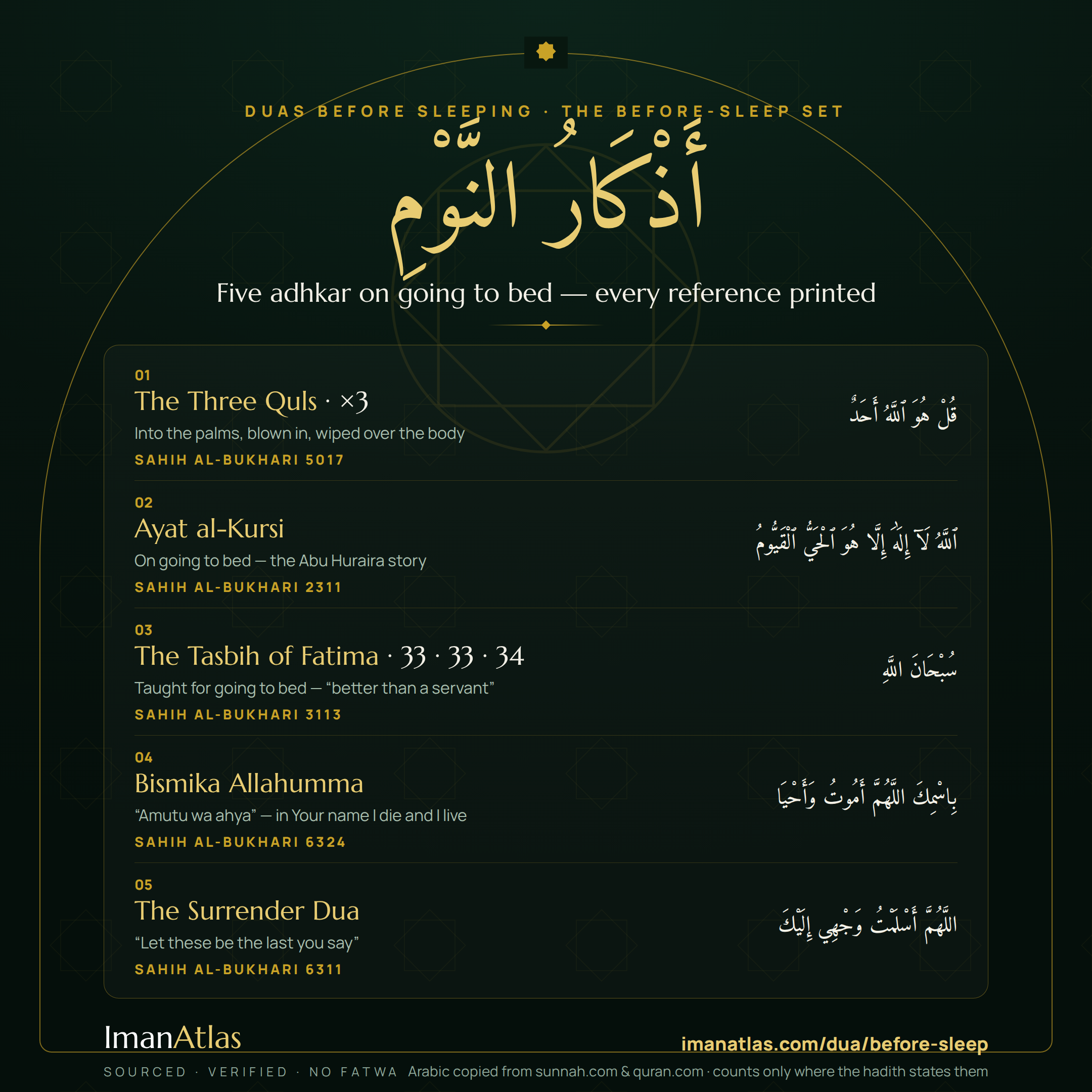
The bedtime duas, one by one
Four of these bedtime recitations now have a page of their own, with the narrations around them:
Surah al-Mulk Before Sleep — the thirty verses, in the two narrations that carry them, at their true status (Jami’ at-Tirmidhi 2891).
The Tasbih of Fatimah — the three phrases taught to Fatimah for the night, takbir first (Sahih al-Bukhari 3113).
Allahumma Khalaqta Nafsi — the dua for the soul at bedtime, from the same chapter of Sahih Muslim (Muslim 2712).
Allahumma Aslamtu — the dua the Prophet ﷺ told al-Bara’ to make his last words of the night (Sahih al-Bukhari 6311).
Questions
What should I say before sleeping?
The bedtime set, in this page’s order: the three Quls gathered into the palms and wiped over the body three times (Bukhari 5017), Ayat al-Kursi (Bukhari 2311), Surah al-Kafirun (Abu Dawud 5055), Surah as-Sajdah and al-Mulk (Tirmidhi 3404, with the grade note on this page), the tasbih of Fatima — Allahu Akbar 34, Alhamdulillah 33, SubhanAllah 33 (Bukhari 3113) — then the short duas as you lie down, ending with the surrender dua (Bukhari 6311). Start with two or three items and build up.
What is the main dua for sleeping — the sone ki dua?
“Bismika Allahumma amutu wa ahya” — “With Your name, O Allah, I die and I live” (Sahih al-Bukhari 6324). It is the dua most people learn first, and it is one item in a larger bedtime set, not the whole set.
Is Ayat al-Kursi read at bedtime?
Yes — it has its own bedtime narration. In Bukhari 2311, Abu Huraira’s prisoner — Satan — told him: “Whenever you go to bed, recite Ayat-al-Kursi till you finish the whole verse”, and the Prophet ﷺ confirmed: “He really spoke the truth, although he is an absolute liar.” The verse is printed in full on the Evening page.
Are the last two verses of al-Baqarah part of the bedtime adhkar?
The Prophet ﷺ said: “If somebody recited the last two Verses of Surat Al-Baqara at night, that will be sufficient for him” (Sahih al-Bukhari 5009). The narration’s word is “at night”, and the verses are printed in full on the Evening page — this page points there rather than printing a third copy.
Is the bedtime tasbih the same as the tasbih after salah?
No. The bedtime tasbih was taught to Fatima and ‘Ali for going to bed: Allahu Akbar 34 times, Alhamdulillah 33, SubhanAllah 33 (Bukhari 3113 and 5361; Muslim 2727a). The after-salah tasbih is a different narration (Muslim 597a and 596a, on the After Salah page). One caution: some lists cite the bedtime tasbih to “Bukhari 4943” — on sunnah.com, 4943 is an unrelated narration in the Book of Tafsir. The correct references are the ones above.
Which dua should be the last thing I say?
The surrender dua, “Allahumma aslamtu wajhi ilayk…” The narration itself says so: after teaching it, the Prophet ﷺ said, “so let these words be the last you say (before going to bed)” (Sahih al-Bukhari 6311; also Sahih Muslim 2710a).
Should Surah al-Mulk be read before sleeping? Does it protect from the punishment of the grave?
Two different claims are often merged. The intercession narration (Tirmidhi 2891, graded Hasan (Darussalam)) says a thirty-verse surah “intercedes for a man until he is forgiven” — it states no time for reading it. The bedtime habit comes from a separate report (Tirmidhi 3404) whose two printings on sunnah.com carry different grades — Hasan at 3404, Da’if at 2892; this page prints both. The sentence “it protects from the punishment of the grave” is traced in the fatwa literature to a statement of the Companion Ibn Mas’ud, not to a narration of the Prophet ﷺ — so this page does not print it as a hadith.
Is “Allahumma qini ‘adhabaka” said three times?
This page prints no count for it. Abu Dawud 5045’s text contains the words “three times”, but its printed grade on sunnah.com reads: “Sahih, apart from the words ‘three times’ (Al-Albani)”. Al-Bara’s version (Tirmidhi 3399, graded Sahih (Darussalam)) states no count.
Is the bedtime “Astaghfirullah… al-hayyul-qayyum” three times authentic?
Its narration is Jami’ at-Tirmidhi 3397, and sunnah.com prints its grade as Da’if (Darussalam) — weak — even though at-Tirmidhi himself called it hasan gharib and said it is known only from this route. Its forgiveness wording, including “even if like the foam of the sea”, is part of that same narration. This page names it in a note below, with its grade, rather than in the main set.
What do I say when I wake up?
From the same narration as the sleeping dua: “Al-hamdu lil-lahil-ladhi ahyana ba’da ma amatana; wa ilaihi an-nushur” — “All the Praises are for Allah Who has made us alive after He made us die (sleep) and unto Him is the Resurrection” (Sahih al-Bukhari 6324). For waking in the middle of the night, Bukhari 1154 carries a longer dhikr, named in the On waking section above.
How long does the bedtime set take?
A few minutes at a calm pace. If you are starting, begin with the three-Quls action, “Bismika Allahumma amutu wa ahya” and the tasbih of Fatima; add one further item each week. Nothing on this page promises a result for completing the set — the narrations say what they say, and this page adds nothing to them.
Sources
Every dua on this page was copied from its primary source on 28 November 2026:
- Sahih al-Bukhari 5017 — the three Quls into the palms (sunnah.com)
- Sahih al-Bukhari 2311 — Ayat al-Kursi at bedtime (sunnah.com)
- Sahih al-Bukhari 5009 — the last two verses of al-Baqarah at night (sunnah.com)
- Sunan Abi Dawud 5055 — Surah al-Kafirun before sleep (sunnah.com)
- Jami’ at-Tirmidhi 3403 — Surah al-Kafirun, corroboration (sunnah.com)
- Jami’ at-Tirmidhi 2891 — Surah al-Mulk intercession (sunnah.com)
- Jami’ at-Tirmidhi 3404 — as-Sajdah and al-Mulk habit, Hasan printing (sunnah.com)
- Jami’ at-Tirmidhi 2892 — the same habit report, Da’if printing (sunnah.com)
- Sahih al-Bukhari 3113 — the tasbih of Fatima (sunnah.com)
- Sahih al-Bukhari 5361 — the tasbih, second printing (sunnah.com)
- Sahih Muslim 2727a — the tasbih at going to sleep (sunnah.com)
- Sahih al-Bukhari 6324 — Bismika Allahumma, and its waking pair (sunnah.com)
- Sahih al-Bukhari 6312 — the shorter Bismika wording (sunnah.com)
- Sahih al-Bukhari 6325 — Bismika Allahumma, Abu Dharr (sunnah.com)
- Sahih al-Bukhari 6320 — Bismika Rabbi wada’tu janbi (sunnah.com)
- Sahih Muslim 2714 — Bismika Rabbi (sunnah.com)
- Sunan Abi Dawud 5045 — Allahumma qini ‘adhabaka, with its grade line (sunnah.com)
- Jami’ at-Tirmidhi 3399 — qini ‘adhabaka, al-Bara’ version (sunnah.com)
- Sahih Muslim 2713a — the long refuge dua (sunnah.com)
- Sahih al-Bukhari 6311 — the surrender dua, wajhi wording (sunnah.com)
- Sahih al-Bukhari 6313 — the surrender dua, nafsi variant (sunnah.com)
- Sahih Muslim 2710a — the surrender dua (sunnah.com)
- Sahih al-Bukhari 1154 — the night-waking dhikr (sunnah.com)
- Jami’ at-Tirmidhi 3397 — the bedtime istighfar, graded Da’if (sunnah.com)
- Qur’an 2:255 — Ayat al-Kursi (quran.com)
- Qur’an 109 — Surah al-Kafirun (quran.com)
- Qur’an 67 — Surah al-Mulk (quran.com)
- Qur’an 32 — Surah as-Sajdah (quran.com)
How we verify: Sources & Method · Accuracy & Correction Policy · No-Fatwa Disclaimer. Spotted an error? Our correction policy explains how we fix it within 24 hours.