Surah al-Mulk Before Sleep: What the Narrations Actually Say
Thirty verses, two narrations — one about the surah, one about the Prophet’s ﷺ nights — and a famous wording that is not a hadith at all. Each is printed here at its true status.
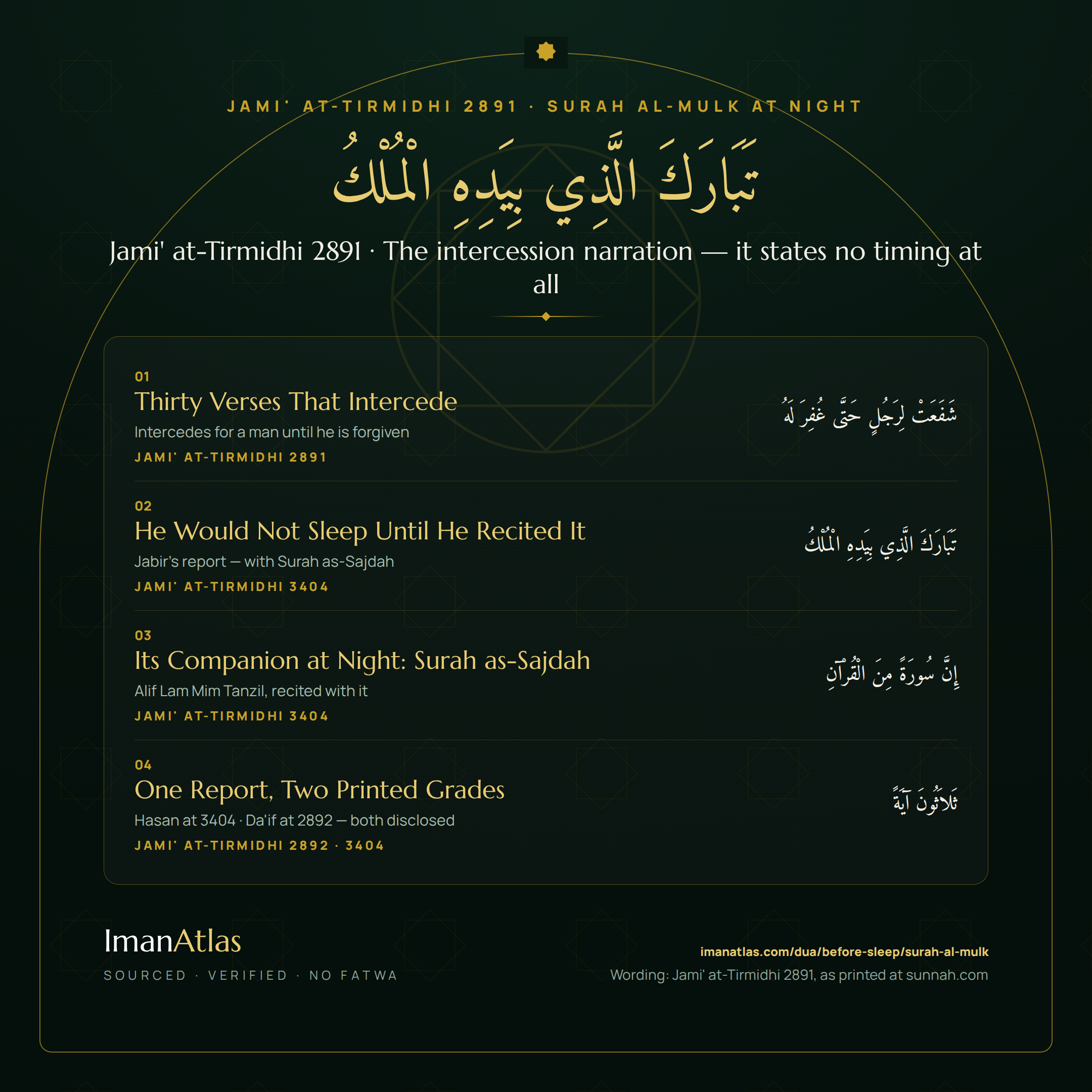
Short answer: Two narrations carry Surah al-Mulk at night. In one, the Prophet ﷺ said a surah of thirty verses intercedes for a man until he is forgiven — and named this surah (Jami’ at-Tirmidhi 2891). In the other, Jabir reports the Prophet ﷺ would not sleep until he recited it, with Surah as-Sajdah (Tirmidhi 3404).
Translations on this page: the translations printed at sunnah.com. The verses of Surah al-Mulk itself are not reprinted here — a link to read the surah stands below, in its own section. ImanAtlas presents sources, not fatwas; for a ruling on your own situation, ask a qualified scholar you trust.
What the narrations say
Two narrations carry Surah al-Mulk at night, and they do different work. The first speaks about the surah itself: a surah of thirty verses that intercedes for a man until he is forgiven (Jami’ at-Tirmidhi 2891). It names the surah — and says nothing about when to read it. The second speaks about the Prophet’s ﷺ nights: Jabir reports that he ﷺ would not sleep until he recited this surah together with Surah as-Sajdah (Jami’ at-Tirmidhi 3404).
Every claim made for this surah at night traces back to one of these two reports — or to a third wording, examined below, which is not a hadith at all. The full bedtime set stands on this site’s Duas Before Sleeping page; this page gives al-Mulk’s two narrations the room they need.
The intercession narration — Tirmidhi 2891 in full
The first narration stands here exactly as it stands on the pillar — Arabic, printed translation, and its full reference line, with the grade disclosure the pillar carries:
Surah al-Mulk and Surah as-Sajdah
إِنَّ سُورَةً مِنَ الْقُرْآنِ ثَلاَثُونَ آيَةً شَفَعَتْ لِرَجُلٍ حَتَّى غُفِرَ لَهُ وَهِيَ سُورَةُ تَبَارَكَ الَّذِي بِيَدِهِ الْمُلْكُ
The intercession narration: “Indeed there is a Surah in the Qur’an of thirty Ayat, which intercedes for a man until he is forgiven. It is [Surah] Tabarak Alladhi Biyadihil-Mulk.” That narration names the surah — it states no time for reading it: not “before sleep”, not “at night”, and no count. The bedtime connection comes from a different report: “The Prophet ﷺ would not sleep until he recited Alif Lam Mim Tanzil (Surah as-Sajdah) and Tabarak Alladhi Biyadihil-Mulk.”
Jami’ at-Tirmidhi 2891 · Grade: Hasan (Darussalam) (the intercession narration) · the habit report is Jami’ at-Tirmidhi 3404 · Grade: Hasan (Darussalam) — disclosed in full: sunnah.com’s printing of this same habit report at Jami’ at-Tirmidhi 2892 grades it Da’if (Darussalam). We print both grades, as printed, and choose neither. Read the surahs at quran.com/67 and quran.com/32, or find them in the Surah index.
At-Tirmidhi closes the narration with his own words: هَذَا حَدِيثٌ حَسَنٌ — “this hadith is hasan.” Read the block closely and one absence stands out: there is no time in it. Not “before sleep”, not “at night”, not “every night”, and no count. Whatever this narration says, it says about the surah itself — the timing has to come from somewhere else.
The habit narration — “he would not sleep until…” (Tirmidhi 3404)
The timing comes from Jabir’s report of the Prophet’s ﷺ habit — the only narration in this set that mentions sleep at all. It pairs al-Mulk with Surah as-Sajdah, Alif Lam Mim Tanzil. Sunnah.com prints this one report twice, with two wordings and two grades; the 3404 printing is:
Jabir’s report, as printed at Jami’ at-Tirmidhi 3404: “The Prophet would not sleep until he reached Tanzil as-Sajdah and Tabarak.”
Jami’ at-Tirmidhi 3404 · Grade: Hasan (Darussalam) — sunnah.com/tirmidhi:3404
Disclosed in full: sunnah.com’s printing of this same report at Jami’ at-Tirmidhi 2892 gives its words as: “The Prophet (ﷺ) would not sleep until he recited Alif Lam Mim Tanzil and: Tabarak Alladhi Biyadihil-Mulk.” — and grades it Da’if (Darussalam). We print both grades, as printed, and choose neither.
The disclosure inside that block is not a footnote to skip. It is the subject of the next section.
One report, two printed grades
One report, one chain: both printings run through Layth b. Abi Sulaim, from Abu az-Zubair, from Jabir. Yet the two Darussalam printings grade it differently — Hasan (Darussalam) at 3404, Da’if (Darussalam) at 2892. Both printings also carry at-Tirmidhi’s own discussion of the chain: Zuhair’s question to Abu az-Zubair, who said he heard it from Safwan or Ibn Safwan, not directly from Jabir.
A reader who looks the report up meets whichever printing they open first, and most pages quietly pick the stronger grade. This page does what the pillar does: it prints both grades, as printed, and chooses neither. The difference is real, and hiding it would not make it smaller.
Where the bedtime timing comes from — and where it does not
So where does “read Surah al-Mulk before sleeping” come from? From the habit narration alone. The intercession narration (2891) states no timing and no frequency; a reader who meets only that text has not been told “nightly” or “before sleep” by it. The habit report says the Prophet ﷺ would not sleep until he recited it — a description of his nights, and that is where this surah’s bedtime place rests.
Lists that print the two as a single instruction — “recite al-Mulk every night before sleep and it will intercede for you” — have merged two reports into a sentence neither of them speaks. Here they stand apart, each saying only what it says.
The “protection from the grave” wording — a Companion’s statement
One more sentence is attached to this surah everywhere: that it shields its reader from the punishment of the grave. Its status needs care. That wording is a statement of the Companion Ibn Mas’ud — mawquf, stopping at him — recorded at an-Nasa’i 10479, as the fatwa literature reports it. It is not a narration of the Prophet ﷺ, and this page does not print it as one, here or anywhere. The two narrations above are what this site can set before you as his ﷺ words on this surah — no more, and no less.
Read the surah
This page prints the narrations, not the surah. Surah al-Mulk’s thirty verses stand at quran.com/67, and the surah has its row in this site’s Surah index. Its companion in the habit narration, Surah as-Sajdah, stands at quran.com/32. Read them there, in full, in the Qur’an’s own place — then return to the narrations above for what was said about them.
The listening question
A question the fatwa sites field again and again: is listening enough, for a person who cannot recite, or who simply prefers to listen? Look at what the narrations actually say. Their word is reciting: “would not sleep until he recited Alif Lam Mim Tanzil and: Tabarak Alladhi Biyadihil-Mulk” (Tirmidhi 2892, as printed). This page reports that wording and stops there. Whether listening carries the same standing is a ruling, and rulings belong to scholars, not to a page of sources. ImanAtlas presents sources, not fatwas; for your own situation, ask a qualified scholar you trust.
Questions, answered from the sources
Will I get the virtue of Surah al-Mulk if I recite it after Maghrib?
The intercession narration (Jami’ at-Tirmidhi 2891) speaks of the surah itself and states no time at all — not after Maghrib, and not before sleep. The only narration that ties this surah to a time of day is the habit report: the Prophet ﷺ would not sleep until he recited it. This page prints both narrations and assigns no virtue to any hour in its own voice; for a ruling on your own practice, ask a qualified scholar you trust.
Does the night for these recitations start at Maghrib or after Isha?
The narrations name no clock point. Their wording ties the recitation to going to sleep — “would not sleep until he recited” — not to Maghrib and not to Isha. When the night begins for a given practice is a question scholars discuss; this page reports the narrations’ words and settles nothing. Ask a qualified scholar you trust.
Is it enough to listen to Surah al-Mulk instead of reciting it?
The narrations’ own word is reciting: “would not sleep until he recited Alif Lam Mim Tanzil and: Tabarak Alladhi Biyadihil-Mulk” (Jami’ at-Tirmidhi 2892, as printed). Whether listening carries the same standing — for someone who cannot read, or for anyone else — is a ruling, and rulings are not this site’s work. The wording is reported above; ask a qualified scholar you trust for your own situation.
Which surahs should I read before sleeping?
The bedtime set on this site stands on the Duas Before Sleeping page. The habit narration pairs Surah as-Sajdah with Surah al-Mulk; the same set carries the Three Quls blown into the palms, Surah al-Kafirun, and a pointer to the last two verses of al-Baqarah — each item with its own narration and reference.
Is Surah al-Mulk’s protection-from-the-grave wording a hadith of the Prophet ﷺ?
No. That wording is a statement of the Companion Ibn Mas’ud — mawquf, stopping at him — recorded at an-Nasa’i 10479, as the fatwa literature reports it. It is not a narration of the Prophet ﷺ, and this page does not print it as one. What he ﷺ is narrated as saying about this surah stands in the two narrations above, with their references.
Can Surah al-Mulk be read at any time of night, not only just before sleep?
The intercession narration (Tirmidhi 2891) sets no time and no frequency, so its words are not tied to any hour. The habit narration ties the recitation to the moment before sleep. This page prints both wordings as they stand and turns neither into a timetable; for your own practice, ask a qualified scholar you trust.
Sources
Every text and claim on this page comes from these pages, read on 28 November 2026. Translations: sunnah.com’s printed translations.
- The intercession narration — Jami’ at-Tirmidhi 2891
- The habit narration, as printed at 3404 — Jami’ at-Tirmidhi 3404
- The same report, as printed at 2892 — Jami’ at-Tirmidhi 2892
- Read the surah — Surah al-Mulk at quran.com/67 · its companion — Surah as-Sajdah at quran.com/32
- The full bedtime set this page belongs to — Duas Before Sleeping
- Every surah, one index — Surah index
- Hub — Duas & Azkar
Found an error? We correct mistakes within 24 hours, with a note on the page — write to us through the website.