The Dua of Arafat — One Narration, Four Grade Records
Ask for the dua of the Day of Arafat and the words come back with a single grade attached — hasan on one page, da’if on another, as if the record agreed with itself. It does not. The narration is one, and the records grading it are four. This page prints the narration once, exactly as at-Tirmidhi gives it, and lets every record stand where its own source puts it.
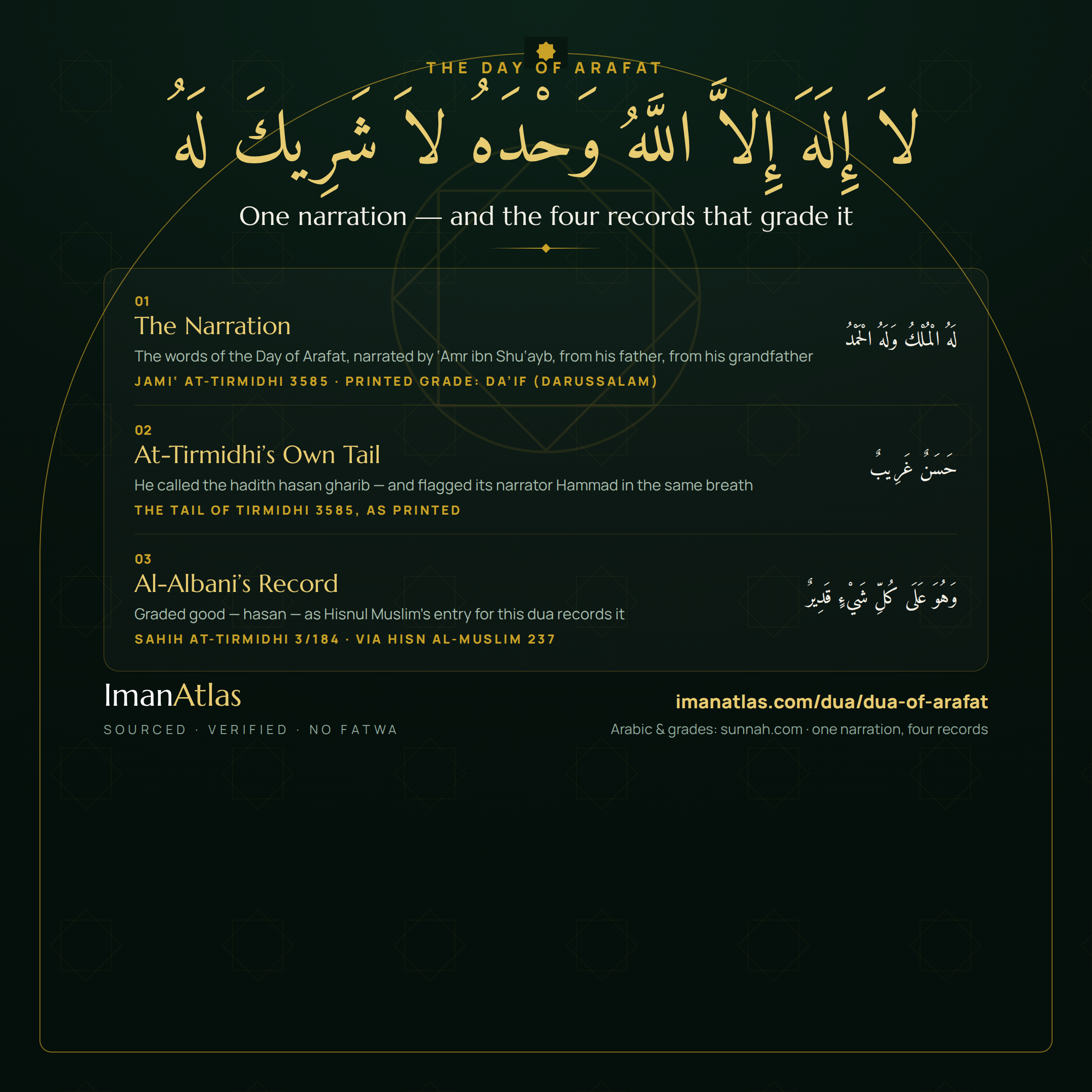
Short answer: One narration names the best words of the Day of Arafat: ‘La ilaha illallahu wahdahu la sharika lah…’ (Tirmidhi 3585). Its grade record does not agree with itself: at-Tirmidhi called it hasan gharib while flagging a weak narrator; Al-Albani graded it hasan; sunnah.com’s printed field says Da’if. This page prints the narration with every record standing.
ImanAtlas does not give fatwas. For your own situation, ask a qualified scholar you trust.
The words on this page travel on one chain: ‘Amr ibn Shu‘ayb, from his father, from his grandfather — the grandfather being ‘Abdullah ibn ‘Amr ibn al-‘As. The narration they carry is the one text the field reaches for when the Day of Arafat comes: a short wording, and before it a sentence in which the Prophet ﷺ calls it the best of supplication and the best of what he and the Prophets before him said. That sentence is his, and on this page it stands where he put it — inside the narration, in quotation — never lifted out as this site’s own claim about the day. What divides the field is not the wording. It is the record underneath it.
The narration: the words of the Day of Arafat
At-Tirmidhi places the narration in his Chapters on Supplication, in a chapter he names “Concerning The Supplication Of The Day Of Arafah”. His print is the whole of this page’s text: the narration first, and after it — as at-Tirmidhi left it, in the same entry — his own tail, where he grades the hadith and names the man in its chain he does not trust. Both parts stand in the block below, in his order. The tail is not a footnote added by a later editor; it is part of the print, and this page treats it as part of the print.
خَيْرُ الدُّعَاءِ دُعَاءُ يَوْمِ عَرَفَةَ وَخَيْرُ مَا قُلْتُ أَنَا وَالنَّبِيُّونَ مِنْ قَبْلِي لاَ إِلَهَ إِلاَّ اللَّهُ وَحْدَهُ لاَ شَرِيكَ لَهُ لَهُ الْمُلْكُ وَلَهُ الْحَمْدُ وَهُوَ عَلَى كُلِّ شَيْءٍ قَدِيرٌ
Lā ilāha illallāh, waḥdahu lā sharīka lahu, lahul-mulku wa lahul-ḥamdu, wa huwa `alā kulli shai’in qadīr
`Amr bin Shu`aib narrated from his father, from his grandfather, that the Prophet (ﷺ) said: “The best of supplication is the supplication of the Day of `Arafah. And the best of what I and the Prophets before me have said is: None has the right to be worshipped but Allah, Alone, without partner, to Him belongs all that exists, and to Him belongs the Praise, and He is powerful over all things. (Lā ilāha illallāh, waḥdahu lā sharīka lahu, lahul-mulku wa lahul-ḥamdu, wa huwa `alā kulli shai’in qadīr).’”
قَالَ هَذَا حَدِيثٌ حَسَنٌ غَرِيبٌ مِنْ هَذَا الْوَجْهِ . وَحَمَّادُ بْنُ أَبِي حُمَيْدٍ هُوَ مُحَمَّدُ بْنُ أَبِي حُمَيْدٍ وَهُوَ أَبُو إِبْرَاهِيمَ الأَنْصَارِيُّ الْمَدَنِيُّ وَلَيْسَ هُوَ بِالْقَوِيِّ عِنْدَ أَهْلِ الْحَدِيثِ
At-Tirmidhi’s tail, rendered: “This hadith is hasan, gharib from this route. And Hammad ibn Abi Humayd is Muhammad ibn Abi Humayd, Abu Ibrahim al-Ansari al-Madani, and he is not strong among the people of hadith.”
Jami‘ at-Tirmidhi 3585 · Chapters on Supplication, chapter “Concerning The Supplication Of The Day Of Arafah” · in-book Book 48, Hadith 216 · narrated by ‘Amr ibn Shu‘ayb, from his father, from his grandfather — Grade: Da’if (Darussalam), the grade field as printed at sunnah.com: the first of the four records on this page, and the site adopts none of them · the second Arabic passage is at-Tirmidhi’s own tail, printed with the narration as he left it; sunnah.com prints no English for the tail, and the rendering above follows its words · the romanisation line is the one printed inside this narration’s own translation at sunnah.com, where it also stands; as a line it is checked word for word against the Arabic
One thing the narration does not contain is worth naming before the records: no count. The words are given once, with no number of repetitions attached — not in the text, and not in the tail. Whatever the field adds about repeating them belongs to method, and method is dealt with below, where this page says what it does not do.
Four records, none of them hidden
The first record is the one a search result shows: sunnah.com’s printed grade field for this entry, Da’if (Darussalam). It stands in the block’s reference line above, where the site’s prints always carry their grade. A reader who stops there has one record of four.
The second record is the author’s own. In the tail printed in the block above, at-Tirmidhi calls the hadith «حَسَنٌ غَرِيبٌ» — hasan, gharib from this route — and in the same breath names Hammad ibn Abi Humayd, the narrator between ‘Abdullah ibn Nafi‘ and ‘Amr ibn Shu‘ayb, and says of him «وَلَيْسَ هُوَ بِالْقَوِيِّ عِنْدَ أَهْلِ الْحَدِيثِ»: he is not strong among the people of hadith. The grade and the flag are one record, not two; quoting the ‘hasan gharib’ without the flag — as the field routinely does — prints half of what at-Tirmidhi wrote.
The third record is Al-Albani’s: hasan. It stands in sunnah.com’s own entry for this dua in Hisnul Muslim, where the book prints the wording for the Day of ‘Arafah in its chapter 119 and its reference line carries his grading. The exhibit below is that entry — its translation, its printed romanisation, and its reference line quoted whole. It is not a second printing of the dua: the book’s Arabic is the same wording, unvocalised, and it is shown once on this page, in at-Tirmidhi’s block above.
The Prophet (ﷺ) said: The best invocation is that of the Day of Arafat, and the best that anyone can say is what I and the Prophets before me have said: Lā ‘ilāha ‘illallāhu waḥdahu lā sharīka lahu, lahul-mulku wa lahul-ḥamdu wa huwa `alā kulli shay’in qadīr. None has the right to be worshipped but Allah Alone, Who has no partner. His is the dominion and His is the praise, and He is Able to do all things.
Lā ‘ilāha ‘illallāhu waḥdahu lā sharīka lahu, lahul-mulku wa lahul-ḥamdu wa huwa `alā kulli shay’in qadīr
Hisn al-Muslim 237 · chapter 119, “The Day of ‘Arafah” · the book’s reference line, as printed at sunnah.com: “Reference: At-Tirmidhi. Al-Albani graded it good in Sahih At-Tirmidhi 3/184, and also Silsilatul-‘Ahadith As-Sahihah 4/6.” — Al-Albani’s hasan record stands in that line, in the book’s own entry · the book prints the wording in unvocalised Arabic — the same words as at-Tirmidhi’s print above, shown there once and not reprinted here as a second block · the romanisation line above is the book’s own printed form: its opening “Lā ’ilāha ’illallāhu” differs from at-Tirmidhi’s embedded “Lā ilāha illallāh” — each form stays with its own print, and the two are never swapped
The fourth record is Zubair Ali Zai’s: weak. It stands in the grading line that hadithunlocked.com gives this same narration — ‘Weak (‘Ali Za’i)’. It is recorded here by name, as a grade and nothing more: no wording, translation or romanisation on this page comes from that source, and its entry in the Sources below is marked as a grade record only.
Four records, then: a printed Da’if field; the author’s own hasan gharib with a flag inside it; a later hasan, carried by the most-reprinted dua book in the field; and a weak. This page does not average them into a fifth record of its own making, and it does not pick one and hide the rest. The records disagree, and the disagreement is printed — that is the whole of the site’s position. What a reader does with a record that disagrees with itself is a question for the scholars; the line at the head of this page applies.
What this page does not do
It gives no repetition count, because the narration gives none. Instructions to repeat the words through the day, or a fixed number of times, are method added around the text; how the Day of Arafat is to be practised is a question this page routes, it does not answer it. It rules on no date: which day the Day of Arafat falls on in a given year belongs to the calendar, and this site’s Prayer and Ramadan pages carry that frame — this page names the day only as the narration names it. And it settles no one’s practice: the narration names the day, and its wording carries no place-restriction in its own words — that much the text shows; whether the words are for pilgrims standing at Arafat alone or for every believer on that day is a ruling the field takes to the scholars, put, for one, to IslamQA (70282).
The wording here is close kin to another page on this site. ‘La ilaha illallahu wahdahu la sharika lah…’ is also the core of the Talbiyah — but the Talbiyah is a different narration, through a different Companion, for a different occasion, and the two are not merged here or there: the Talbiyah page prints its own prints and names its own addition. In Hisnul Muslim this dua stands in chapter 119, “The Day of ‘Arafah” — the book whose complete chapter index stands on this site.
Beyond what these texts themselves say, this page adds nothing — no verdict of its own on the records, no count, no date, and no promise.
This page stands under the hub page, Duas & Azkar, where the library’s duas are gathered. The chapter index named above is this site’s Hisnul Muslim index page, where chapter 119 is marked with what this library prints of it.
ImanAtlas does not give fatwas. For your own situation, ask a qualified scholar you trust.
Frequently asked questions
What is the grade of Tirmidhi 3585?
There is no single grade on record — there are four, and this page prints all of them. Sunnah.com’s printed field says Da’if (Darussalam). At-Tirmidhi himself, in the tail he prints with the hadith, called it hasan gharib — and flagged a narrator in the same breath. Al-Albani graded it hasan, as Hisnul Muslim’s entry for this dua records. Zubair Ali Zai graded it weak. The site gives no verdict of its own, and it does not average the four into a fifth.
Why do some pages call the Arafat dua hasan and others da’if?
Because each page prints one grader’s record as if it were the only one. The pages that say hasan are usually carrying Al-Albani’s record — sometimes without naming him. The database page a search shows first carries its printed field: Da’if (Darussalam). Both records exist, and so do two more. A page that shows only one has made a choice it does not tell you about; this page shows all four records standing side by side.
What did at-Tirmidhi himself say about this hadith?
In the tail printed with the hadith, he says: ‘This hadith is hasan, gharib from this route. And Hammad ibn Abi Humayd is Muhammad ibn Abi Humayd, Abu Ibrahim al-Ansari al-Madani, and he is not strong among the people of hadith.’ The grade and the warning stand together, from the same pen, in the same breath — which is why this page never quotes his «حَسَنٌ غَرِيبٌ» without the flag on Hammad that follows it.
What did Al-Albani grade the Arafat dua?
Hasan — ‘good’. The record stands in sunnah.com’s own Hisn entry for this dua (Hisn al-Muslim 237, chapter 119): ‘At-Tirmidhi. Al-Albani graded it good in Sahih At-Tirmidhi 3/184, and also Silsilatul-‘Ahadith As-Sahihah 4/6.’ That reference line is quoted on this page exactly as the book’s entry prints it, inside the exhibit above.
Is the Arafat dua authentic?
That is the question the four records leave open, and this page does not close it. What the record itself shows: the narration stands in at-Tirmidhi’s Chapters on Supplication (3585); its own author called it hasan gharib while flagging Hammad ibn Abi Humayd as not strong among the people of hadith; Al-Albani graded it hasan; the printed Darussalam field says Da’if, and Zubair Ali Zai’s record says weak. For a verdict on your own practice, the scholars are the address — the line at the head of this page applies.
How many times should the Arafat dua be said?
The narration gives no number. Nothing in Tirmidhi 3585 — neither its text nor its tail — counts a repetition. The instructions in the field to repeat the words through the day, or a fixed number of times, are method added around the text, not the text itself. How to practise on the Day of Arafat is a question this page routes rather than answers.
Is this dua also in Sahih Muslim or Sahih al-Bukhari?
This wording stands in at-Tirmidhi (3585). The two Sahihs do not carry it. Its words are close kin to the Talbiyah’s — ‘La ilaha illallahu wahdahu la sharika lah…’ opens both — but they are different narrations on different occasions, and this site keeps them on their own pages: the Talbiyah page prints its prints, and this page prints this one.
Sources
Every wording and grade on this page comes from these pages, printed from this page’s own captures of their sources. The hadithunlocked entry is listed as a grade record only — no wording on this page is taken from it. The IslamQA page is listed because this page names it as one place the practice question is taken up; it is not a source for any text here.
- The narration, its printed grade field and its tail — Jami‘ at-Tirmidhi 3585 — sunnah.com
- The book’s print of the dua, and Al-Albani’s record in its reference line — Hisn al-Muslim 237 (chapter 119, The Day of ‘Arafah) — sunnah.com
- Zubair Ali Zai’s grade record — grading line only, no wording taken from it — Jami‘ at-Tirmidhi 3585 — hadithunlocked.com
- The practice question, named and routed — IslamQA 70282 — islamqa.info
- The neighbouring narration, on its own page — The Talbiyah — Whose Words Are Whose
- The hub this page belongs to — Duas & Azkar
- The book whose chapter 119 this is — Hisnul Muslim — The Complete Chapter Index
Found an error? We correct mistakes within 24 hours, with a note on the page — write to us through the website.