Dua Qunut in Witr — The Words the Prophet ﷺ Taught al-Hasan
Search for Dua Qunut and the first text you meet is a long one, taught in method guides as the standard words of Witr — with its source rarely named. The sources carry another text for this place: shorter words the Prophet ﷺ himself taught his grandson al-Hasan, printed in three of the six books. This page prints the taught words first, in all three prints, and keeps the two texts apart.
Short answer: Two different texts are called Dua Qunut, and they do not have the same source. The words the Prophet ﷺ taught his grandson al-Hasan — ‘Allahumma-hdini fiman hadayt…’ — stand in Abu Dawud 1425, at-Tirmidhi 464 and an-Nasa’i 1745, all graded Sahih. The longer ‘Allahumma inna nasta’inuka…’ text is traced to ‘Umar, outside the six books.
ImanAtlas does not give fatwas. For your own situation, ask a qualified scholar you trust.
Ask for Dua Qunut and most pages hand you one text, as if there were only one. There are two. One is a long text traced to ‘Umar ibn al-Khattab, taught in method guides as the standard words of the Witr prayer. The other is shorter, and it stands in three of the six books of hadith: the words the Prophet ﷺ taught al-Hasan, his grandson, to say in Witr. This page prints the taught words first — in all three of their prints, with the small differences between them left standing — and then names the other text for what it is.
The words the Prophet ﷺ taught al-Hasan
Al-Hasan ibn ‘Ali, the Prophet’s ﷺ grandson, reports that the Messenger of Allah ﷺ taught him words to say in Witr. Abu Dawud prints the narration in the chapter he names “The Qunut During Witr”, in his Book of Detailed Injunctions about Witr. Al-Hasan’s own account of receiving the text is plain — the Messenger taught him some words that he says during the witr — and Abu Dawud carries a second chain’s wording for the same moment, Ibn Jawwas’s version: “I say them in the supplication of the witr.”
اللَّهُمَّ اهْدِنِي فِيمَنْ هَدَيْتَ وَعَافِنِي فِيمَنْ عَافَيْتَ وَتَوَلَّنِي فِيمَنْ تَوَلَّيْتَ وَبَارِكْ لِي فِيمَا أَعْطَيْتَ وَقِنِي شَرَّ مَا قَضَيْتَ إِنَّكَ تَقْضِي وَلاَ يُقْضَى عَلَيْكَ وَإِنَّهُ لاَ يَذِلُّ مَنْ وَالَيْتَ وَلاَ يَعِزُّ مَنْ عَادَيْتَ تَبَارَكْتَ رَبَّنَا وَتَعَالَيْتَ
Allahumma-hdini fiman hadayt, wa ‘afini fiman ‘afayt, wa tawallani fiman tawallayt, wa barik li fima a’tayt, wa qini sharra ma qadayt, innaka taqdi wa la yuqda ‘alayk, wa innahu la yadhillu man walayt, wa la ya’izzu man ‘adayt, tabarakta Rabbana wa ta’alayt.
“The Messenger of Allah (ﷺ) taught me some words that I say during the witr. (The version of Ibn Jawwas has: I say them in the supplication of the witr.) They were: "O Allah, guide me among those Thou hast guided, grant me security among those Thou hast granted security, take me into Thy charge among those Thou hast taken into Thy charge, bless me in what Thou hast given, guard me from the evil of what Thou hast decreed, for Thou dost decree, and nothing is decreed for Thee. He whom Thou befriendest is not humbled. Blessed and Exalted art Thou, our Lord."”
Sunan Abi Dawud 1425 · Prayer (Kitab Al-Salat): Detailed Injunctions about Witr, chapter “The Qunut During Witr” · in-book Book 8, Hadith 10 · English translation Book 8, Hadith 1420 · narrated by al-Hasan ibn ‘Ali — Grade: Sahih (Al-Albani), as printed at sunnah.com · sunnah.com prints no transliteration for this narration; the line above is a derivation from the Arabic, checked word for word against it
At-Tirmidhi prints the same narration in his Book on Al-Witr, in the chapter “What Has Been Related About The Qunut In Al-Witr”. His print is shorter by one clause, and his book does something neither of the others does: it speaks after the narration, in a tail this page quotes further down. His printed translation carries the Arabic words in Roman letters inside itself — the romanised line under his Arabic below is that printed form, kept as his page spells it.
اللَّهُمَّ اهْدِنِي فِيمَنْ هَدَيْتَ وَعَافِنِي فِيمَنْ عَافَيْتَ وَتَوَلَّنِي فِيمَنْ تَوَلَّيْتَ وَبَارِكْ لِي فِيمَا أَعْطَيْتَ وَقِنِي شَرَّ مَا قَضَيْتَ فَإِنَّكَ تَقْضِي وَلاَ يُقْضَى عَلَيْكَ وَإِنَّهُ لاَ يَذِلُّ مَنْ وَالَيْتَ تَبَارَكْتَ رَبَّنَا وَتَعَالَيْتَ
Allahummahdini fiman hadait, wa a’fini fiman afait, wa tawallani fiman tawallait, wa barik Li fima atait, wa qini sharra ma qadait, fa Innaka taqdi wa la yuqda Alaik, wa innahu la yadhillu man walait, tabarakta Rabbana wa ta’alait.
“Al-Hasan bin Ali [may Allah be pleased with him] said: "Allah’s Messenger taught me some phrases to say during Al-Witr (Allahummahdini fiman hadait, wa a’fini fiman afait, wa tawallani fiman tawallait, wa barik Li fima atait, wa qini sharra ma qadait, fa Innaka taqdi wa la yuqda Alaik, wa innahu la yadhillu man walait, tabarakta Rabbana wa ta’alait.) ‘O Allah guide me among those You have guided, pardon me among those You have pardoned, befriend me among those You have befriended, bless me in what You have granted, and save me from the evil that You decreed. Indeed You decree, and none can pass decree, and none can pass decree upon You, indeed he is not humiliated whom You have befriended, blessed are You our Lord and Exalted.’"”
Jami‘ at-Tirmidhi 464 · The Book on Al-Witr, chapter “What Has Been Related About The Qunut In Al-Witr” · in-book Book 3, Hadith 12 · English translation Vol. 1, Book 3, Hadith 464 · narrated by al-Hasan ibn ‘Ali — Grade: Sahih (Darussalam), as printed at sunnah.com · its printed translation carries the words in Roman letters inside itself; the line above is that printed form, judged against the Arabic word for word
An-Nasa’i prints the narration a third time, in his Book of the Night Prayer, in the chapter he names “Supplicating during witr”. His frame words the moment most fully of the three: these are words “to say in witr in Qunut”. His printed translation, too, carries the words in Roman letters inside itself.
اللَّهُمَّ اهْدِنِي فِيمَنْ هَدَيْتَ وَعَافِنِي فِيمَنْ عَافَيْتَ وَتَوَلَّنِي فِيمَنْ تَوَلَّيْتَ وَبَارِكْ لِي فِيمَا أَعْطَيْتَ وَقِنِي شَرَّ مَا قَضَيْتَ إِنَّكَ تَقْضِي وَلاَ يُقْضَى عَلَيْكَ وَإِنَّهُ لاَ يَذِلُّ مَنْ وَالَيْتَ تَبَارَكْتَ رَبَّنَا وَتَعَالَيْتَ
Allahumma ihdini fiman hadayta wa ‘afini fiman afayta wa tawallani fiman tawallayta wa barik li fima a’tayta, wa qini sharra ma qadayta, fa innaka taqdi wa la yuqda ‘alayk, wa innahu la yadhilluman walayta, tabarakta Rabbana wa at’alayt
“It was narrated that Abu Al-Jawza said: "Al-Hasan said: "The Messenger of Allah (ﷺ) taught me some words to say in witr in Qunut: Allahumma ihdini fiman hadayta wa ‘afini fiman afayta wa tawallani fiman tawallayta wa barik li fima a’tayta, wa qini sharra ma qadayta, fa innaka taqdi wa la yuqda ‘alayk, wa innahu la yadhilluman walayta, tabarakta Rabbana wa at’alayt (O Allah, guide me among those whom You have guided, pardon me among those You have pardoned, turn to me in friendship among those on whom You have turned in friendship, and bless me in what You have bestowed, and save me from the evil of what You have decreed. For verily You decree and none can influence You; and he is not humiliated whom You have befriended. Blessed are You, O Lord, and Exalted.)’"”
Sunan an-Nasa’i 1745 · The Book of Qiyam Al-Lail (The Night Prayer) and Voluntary Prayers During the Day, chapter “Supplicating during witr” · in-book Book 20, Hadith 148 · English translation Vol. 2, Book 20, Hadith 1746 · narrated by al-Hasan ibn ‘Ali — Grade: Sahih (Darussalam), as printed at sunnah.com · its printed translation carries the words in Roman letters inside itself, in the spelling it prints them; the line above is that printed form, judged against the Arabic word for word
Three prints of one text — where they differ
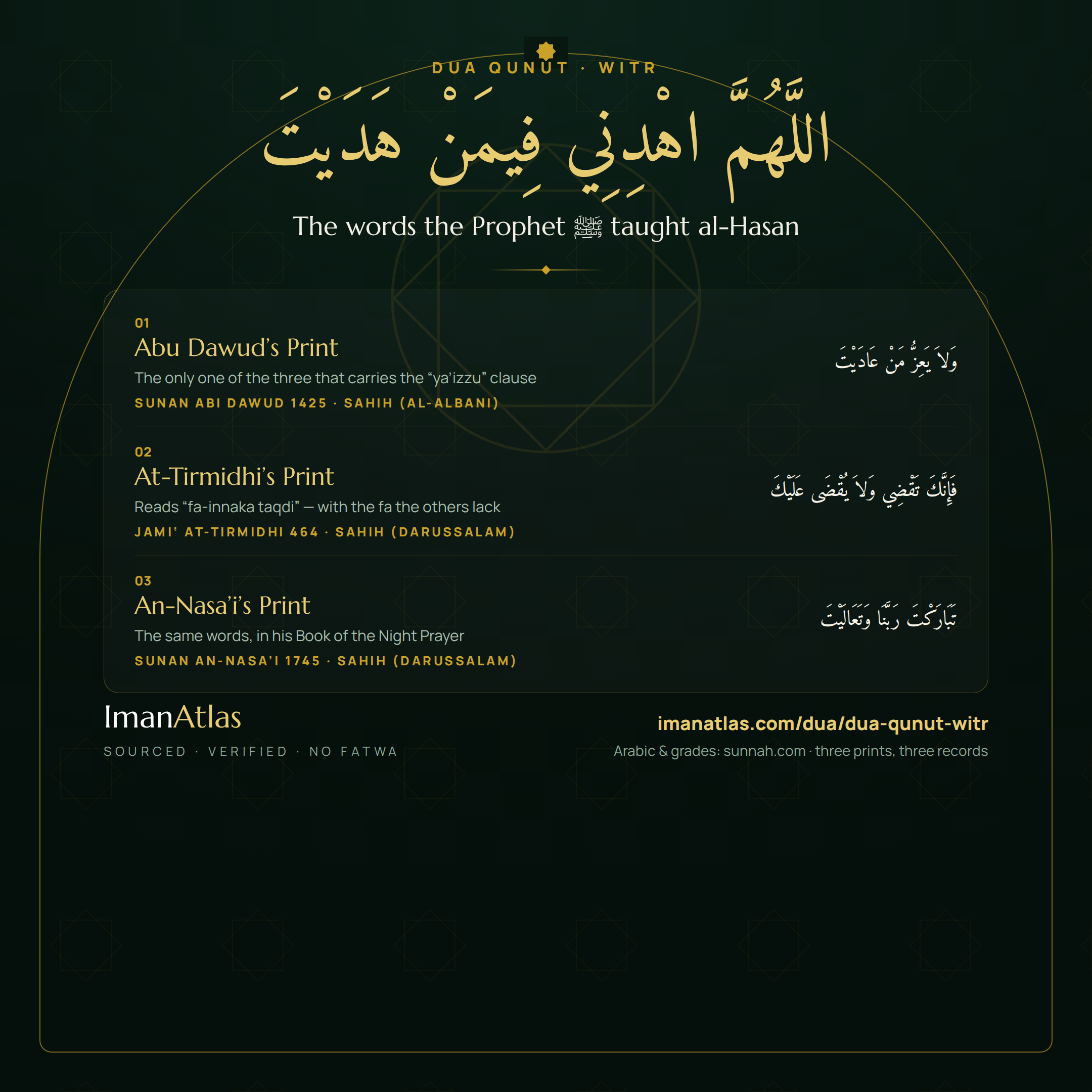
Set side by side, the three prints are one text with two small differences, and this page leaves both standing. The first is a clause. Abu Dawud’s Arabic carries one clause the other two prints do not — a clause about the one who is opposed, that he is not honoured — set after the words on the one befriended not being humbled:
Abu Dawud 1425: وَلاَ يَعِزُّ مَنْ عَادَيْتَ
Abu Dawud’s own printed translation passes over that clause without rendering it: his English moves from “He whom Thou befriendest is not humbled” straight to “Blessed and Exalted art Thou, our Lord.” The clause stands in his Arabic, under his reference, and this page leaves his translation exactly as his book prints it.
The second difference is one small word. Where Abu Dawud’s and an-Nasa’i’s Arabic open the decree clause with “innaka taqdi”, at-Tirmidhi’s Arabic opens it with the fa:
Abu Dawud 1425 · an-Nasa’i 1745: إِنَّكَ تَقْضِي
At-Tirmidhi 464: فَإِنَّكَ تَقْضِي
An-Nasa’i’s printed translation romanises the clause with the fa as well, although his Arabic stands without it. The romanised line under his block is his printed form, kept exactly as his page gives it — the difference is named here rather than smoothed away, and no print on this page has been corrected from another.
A fourth route stands in Ibn Majah (1178). The record of it that search returns opens with the ‘afiyah clause — a different arrangement of the same clauses. Its full text was not captured from its source for this page, so it is named here and not printed; this library prints only what it has captured.
The other text called Dua Qunut
The text most searchers meet first is a different one. It opens with the words “Allahumma inna nasta’inuka…” and runs much longer than the taught text. It is traced to ‘Umar ibn al-Khattab: a mawquf text, one that stops at a Companion and is not carried back to the Prophet ﷺ as his teaching. Its routes stand outside the six books — in al-Bayhaqi’s Sunan al-Kubra and in the Musannafs.
None of that is said on the pages that teach it. The Hanafi guide at iqraexpert.in presents this text as the standard text taught in Indian madrasas, and teaches it as the Dua Qunut of Witr. The method guide at thequranworld.com prints it as the Qunut text inside its Witr method, with no source named at all. A reader of those pages comes away believing the Prophet ﷺ taught these words for Witr. The sources do not say that. They say he taught al-Hasan a different, shorter text — the one printed above.
This page therefore does not print the ‘Umar text — not its Arabic, and not a translation of it. The reason is the library’s own rule, not a verdict on the text: ImanAtlas prints only what it can capture from a primary source, and no capture of this text exists on sunnah.com. What can be done honestly is what is done here — the text is named, its attribution is named, and the taught words stand in its place with their sources open.
What at-Tirmidhi’s own tail records about placement
At-Tirmidhi’s print carries something the other two do not: a tail, in which the collector speaks in his own person after the narration and records what the scholars held. This page quotes it rather than summarising it away. On the hadith itself, at-Tirmidhi’s word is “hasan” — he says the hadith is hasan, known only from this one route, and that he knows nothing from the Prophet ﷺ about Qunut in Witr finer than it:
At-Tirmidhi, on the hadith: قَالَ أَبُو عِيسَى هَذَا حَدِيثٌ حَسَنٌ لاَ نَعْرِفُهُ إِلاَّ مِنْ هَذَا الْوَجْهِ
وَلاَ نَعْرِفُ عَنِ النَّبِيِّ صلى الله عليه وسلم فِي الْقُنُوتِ فِي الْوِتْرِ شَيْئًا أَحْسَنَ مِنْ هَذَا
The grade printed for this hadith at sunnah.com today is “Sahih (Darussalam)”; at-Tirmidhi’s own word, in his own tail, is “hasan”. Both records stand on this page, each under its own name, and neither has been averaged into the other. On placement, the tail records two holdings. Ibn Mas‘ud held the Qunut in Witr through the whole year, and chose it before ruku‘:
The tail, on Ibn Mas‘ud: فَرَأَى عَبْدُ اللَّهِ بْنُ مَسْعُودٍ الْقُنُوتَ فِي الْوِتْرِ فِي السَّنَةِ كُلِّهَا وَاخْتَارَ الْقُنُوتَ قَبْلَ الرُّكُوعِ
— and the tail names Sufyan ath-Thawri, Ibn al-Mubarak, Ishaq and the people of Kufa with that view:
وَبِهِ يَقُولُ سُفْيَانُ الثَّوْرِيُّ وَابْنُ الْمُبَارَكِ وَإِسْحَاقُ وَأَهْلُ الْكُوفَةِ
Against it, the tail reports of ‘Ali that he did Qunut only in the last half of Ramadan, and after ruku‘:
The tail, on ‘Ali: وَقَدْ رُوِيَ عَنْ عَلِيِّ بْنِ أَبِي طَالِبٍ أَنَّهُ كَانَ لاَ يَقْنُتُ إِلاَّ فِي النِّصْفِ الآخِرِ مِنْ رَمَضَانَ وَكَانَ يَقْنُتُ بَعْدَ الرُّكُوعِ
— and names ash-Shafi‘i and Ahmad with that view:
وَبِهِ يَقُولُ الشَّافِعِيُّ وَأَحْمَدُ
That is where the sources leave the question: two placements, each with its named holders, recorded by the collector himself. Whether the Qunut is obligatory, and where it stands in the prayer, are rulings built on records like these — and rulings are not this page’s to give. The line at the head of this page applies.
The Prophet’s ﷺ Witr in ‘A’isha’s narration
‘A’isha’s long narration of the Prophet’s ﷺ night prayer — the one in which she says his character was the Qur’an — describes his Witr from inside the household. She tells how she would prepare his tooth stick and his water for ablution, and how, in the last sitting of the Witr, he would sit and remember Allah, praise Him and supplicate Him, and only then give the salam, loudly enough for them to hear:
“He would then sit, remember, praise Him and supplicate Him and then utter a salutation loud enough for us to hear.”
Sahih Muslim 746a · narrated by ‘A’isha — one clause of her long narration of the Prophet’s ﷺ night prayer, describing the close of his Witr; the narration records remembrance, praise and supplication there, and gives no wording for the supplication · no transliteration line: this block prints no Arabic text of its own
The narration records that his Witr closed with remembrance, praise and supplication. It does not record words for that supplication, and this page supplies none. The wording the sources do give for Witr is the taught text above — al-Hasan’s words, in their three prints. The night’s other sourced words — what he ﷺ said on lying down and on waking — are gathered on this site’s Duas Before Sleeping page.
Beyond what these texts themselves say, this page adds nothing — no method, no ruling, and no words the sources do not give.
This page stands under the hub page, Duas & Azkar, where the library’s duas are gathered. In the book’s own order, this text belongs to chapter 32 of Hisnul Muslim, the Qunut in Witr — the book whose complete chapter index stands on this site’s Hisnul Muslim index page.
ImanAtlas does not give fatwas. For your own situation, ask a qualified scholar you trust.
Frequently asked questions
Did the Prophet ﷺ teach the words of Dua Qunut?
Yes — that is the narration this page is built on. Al-Hasan ibn ‘Ali reports that the Messenger of Allah ﷺ taught him words to say in Witr, and the words stand in three of the six books: Sunan Abi Dawud 1425, Jami‘ at-Tirmidhi 464 and Sunan an-Nasa’i 1745, each graded Sahih as its book prints it. The three prints differ in small ways, and this page prints all three rather than merging them into one.
Is ‘Allahumma inna nasta’inuka’ the Dua Qunut of the Prophet ﷺ?
No record in the six books presents that text as the Prophet’s ﷺ teaching. The longer text that opens with those words is traced to ‘Umar ibn al-Khattab and travels outside the six books, through al-Bayhaqi’s Sunan al-Kubra and the Musannafs. The words the Prophet ﷺ is recorded teaching for Witr are al-Hasan’s, printed above in their three prints.
Where does ‘Allahumma inna nasta’inuka’ come from?
It is traced to ‘Umar ibn al-Khattab — a text that stands on a Companion’s authority, not a narration from the Prophet ﷺ in the six books. The method guides that teach it rarely say so on the page; the Hanafi guide at iqraexpert.in presents it as the standard text taught in Indian madrasas, and the method guide at thequranworld.com prints it as the Qunut of Witr without naming its source. This page names the text and its attribution, and does not print its wording, because this library prints only what it can capture from a primary source.
Is Dua Qunut obligatory in Witr, and is it said before or after ruku‘?
At-Tirmidhi’s own tail to the al-Hasan hadith records the disagreement without settling it: Ibn Mas‘ud held the Qunut in Witr through the whole year and chose it before ruku‘, and Sufyan ath-Thawri, Ibn al-Mubarak, Ishaq and the people of Kufa are named with that view; it is reported of ‘Ali that he did Qunut only in the last half of Ramadan, after ruku‘, and ash-Shafi‘i and Ahmad are named with that view. Whether it is obligatory, and where it stands, are rulings — and this page gives no rulings; the line printed at the head of this page applies.
Do Hanafis and Shafi‘is recite different Qunut texts?
The records this page prints show two different things, and they should not be merged. The texts differ: the taught words of al-Hasan’s narration, and the longer text traced to ‘Umar, which the Hanafi method guides in the search results teach as their standard Qunut text. The placements also differ, in the record at-Tirmidhi himself leaves in his tail, quoted on this page. Which text a person recites is a question for the scholarship they follow; this page prints the sources and adds no ruling.
What if I don’t know Dua Qunut by heart?
The sources printed on this page record the wording that was taught, and the disagreement the books themselves record about its place. What a person who has not memorised it should do — in the prayer, and while learning — is a ruling, and this page gives no rulings. Ask a qualified scholar you trust; the line at the head of this page is there for exactly such questions.
Sources
Every text and claim on this page comes from these pages. The three prints of the taught words and the clause from ‘A’isha’s narration are printed from this page’s own captures of their sources. The fourth route is listed so the naming in the text can be checked — it is not printed. The longer text traced to ‘Umar is not listed with a link, because no primary capture of it exists on sunnah.com; its routes are al-Bayhaqi’s Sunan al-Kubra and the Musannafs, as the text above records.
- The taught words, Abu Dawud’s print — Sunan Abi Dawud 1425 — sunnah.com
- The taught words, at-Tirmidhi’s print, with his tail — Jami‘ at-Tirmidhi 464 — sunnah.com
- The taught words, an-Nasa’i’s print — Sunan an-Nasa’i 1745 — sunnah.com
- ‘A’isha’s narration of the night prayer — Sahih Muslim 746a — sunnah.com
- The fourth route, named and not printed — Sunan Ibn Majah 1178 — sunnah.com
- The hub this page belongs to — Duas & Azkar
- The book whose chapter 32 this text is — Hisnul Muslim — The Complete Chapter Index
- The night’s other sourced words — Duas Before Sleeping
Found an error? We correct mistakes within 24 hours, with a note on the page — write to us through the website.