Kaffaratul Majlis — the Words That Close a Sitting
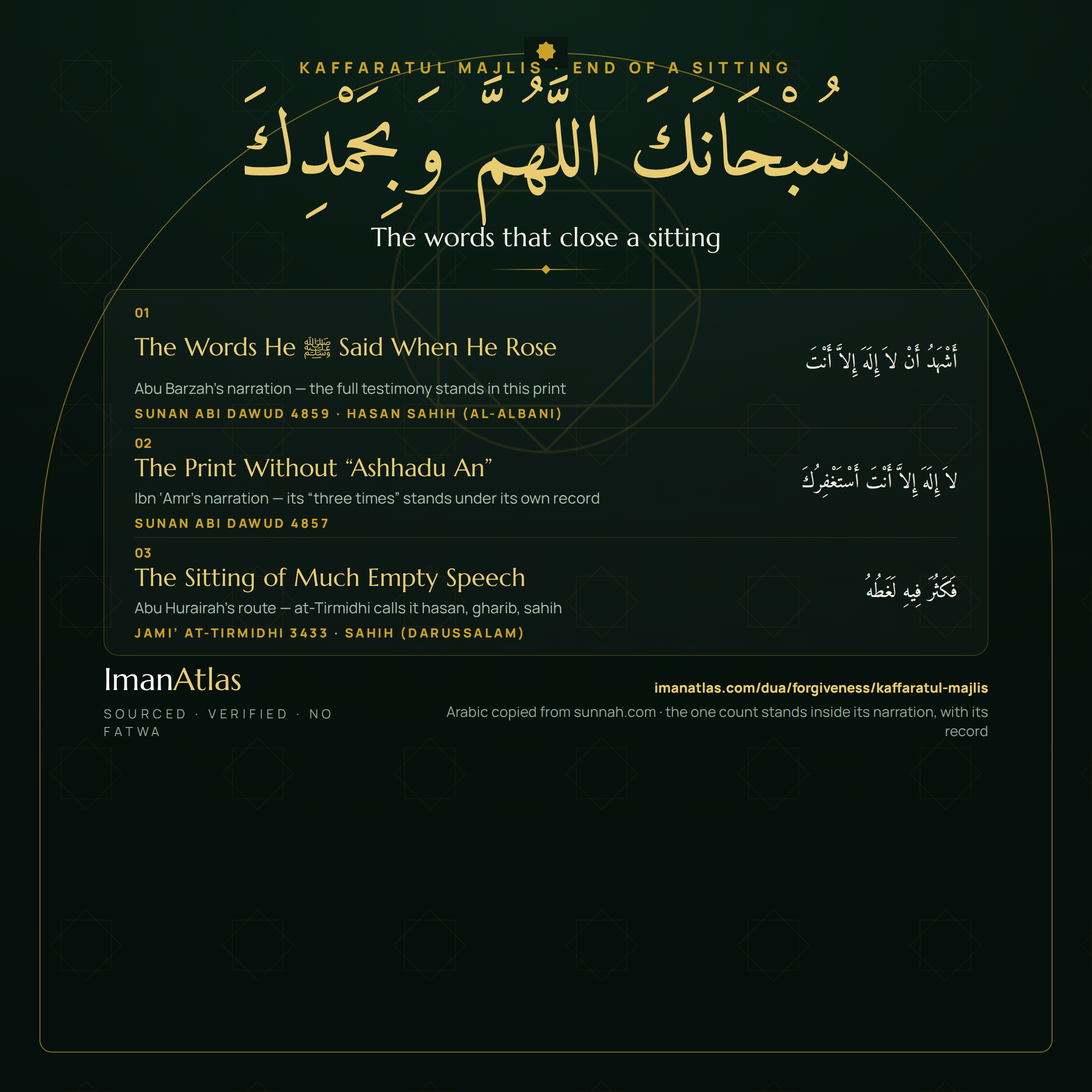
One set of words, three Companions, three prints — and the prints do not all say the same thing. One drops two words. One attaches “three times” that its own grade record sets apart. This page prints each route whole, with its own record, and merges nothing.
Short answer: When the Prophet ﷺ rose from a sitting, he said: ‘Subhanakallahumma wa bihamdika, ashhadu an la ilaha illa anta, astaghfiruka wa atubu ilayk’ — and called it an atonement for what happened in that sitting (Abu Dawud 4859). One route prints the words without ‘ashhadu an’; another narration attaches ‘three times’ — a clause its grade record sets apart.
ImanAtlas does not give fatwas. For your own situation, ask a qualified scholar you trust.
Beyond what these texts themselves say, this page adds nothing — no count, no course, no date for the Night, and no checklist for your repentance.
Three Companions carry these words, and their prints are not identical. Abu Barzah al-Aslami reports the Prophet ﷺ saying them as he rose from a sitting — and naming them himself, when a man asked. ‘Abdullah ibn ‘Amr reports the same words inside a frame about assemblies and a signet-ring, with two of the words missing. Abu Hurairah’s route, in at-Tirmidhi, frames a sitting full of empty speech. Set side by side, the three prints raise two questions the field usually settles without showing its work: whether “ashhadu an” belongs in the words, and whether “three times” belongs with them. This page settles neither by assertion. It prints each route whole, under its own number and its own record, and lets the records stand.
The words he ﷺ said when he rose — Sunan Abi Dawud 4859
Abu Dawud places these words in the Book of General Behavior, in the chapter he named “Regarding expiation of a gathering”. The narration is Abu Barzah al-Aslami’s. The Prophet ﷺ says the words as he is about to rise; a man notices that they are new, and asks about them; the answer names what they are:
سُبْحَانَكَ اللَّهُمَّ وَبِحَمْدِكَ أَشْهَدُ أَنْ لاَ إِلَهَ إِلاَّ أَنْتَ أَسْتَغْفِرُكَ وَأَتُوبُ إِلَيْكَ
Subḥānaka Allāhumma wa biḥamdika, ashhadu an lā ilāha illā anta, astaghfiruka wa atūbu ilaik
“Narrated AbuBarzah al-Aslami: When the Messenger of Allah (ﷺ) intended to get up from the assembly he used to say in the last. Glory be to Thee. O Allah, and I begin with praise of Thee, I testify that there is no god but Thou; I ask Thy pardon, and return to Thee in repentance. The man asked: Messenger of Allah! you utter the words now which you did not do in the past? He replied: (This is an) atonement for what takes place in the assembly.”
Sunan Abi Dawud 4859 · Book 43 (General Behavior), chapter “Regarding expiation of a gathering” · in-book Book 43, Hadith 87 · narrated by Abu Barzah al-Aslami — sunnah.com prints no transliteration for this narration; the line above is a derivation from the Arabic, checked word for word against it
Grade: Hasan Sahih (Al-Albani), as printed at sunnah.com
Two things stand out in this print. The words carry the full testimony — “ashhadu an la ilaha illa anta”, I testify that there is no god but Thou. And no count is attached to them: the frame is “when he intended to get up”, and the words stand once. The name he ﷺ gives them in his reply is the name Abu Dawud’s chapter heading carries — it stands inside the narration above, quoted, and this page adds no promise of its own to it.
The same words without “ashhadu an” — Sunan Abi Dawud 4857
Two narrations earlier in the same chapter, Abu Dawud prints ‘Abdullah ibn ‘Amr’s report of the same words. His narration opens with the frame — what the words do in an assembly, and the image of a document stamped with a signet-ring — and then gives the words themselves:
سُبْحَانَكَ اللَّهُمَّ وَبِحَمْدِكَ لاَ إِلَهَ إِلاَّ أَنْتَ أَسْتَغْفِرُكَ وَأَتُوبُ إِلَيْكَ
Subḥānaka Allāhumma wa biḥamdika, lā ilāha illā anta, astaghfiruka wa atūbu ilaik
“Narrated Abdullah ibn Amr ibn al-‘As: There are some expressions which a man utters three times when he gets up from an assembly he will be forgiven for what happened in the assembly; and no one utters them in an assembly held for a noble cause or for remembrance of Allah but that is stamped with them just as a document is stamped with a signet-ring. These expressions are: Glory be to Thee, O Allah, and I begin with praise of Thee, there is no god but thou; I ask Thy pardon, and return to Thee in repentance.”
Sunan Abi Dawud 4857 · Book 43 (General Behavior), chapter “Regarding expiation of a gathering” · in-book Book 43, Hadith 85 · narrated by ‘Abdullah ibn ‘Amr ibn al-‘As — its wording differs from Abu Dawud 4859’s print by the missing “ashhadu an”, so it carries its own transliteration line — a derivation from its Arabic, checked word for word against it; no line is borrowed from the other print
Grade, as printed at sunnah.com (Arabic line only): صحيح دون قوله ثلاث مرات (Al-Albani) — “Sahih, apart from his words ‘three times’”; sunnah.com’s English grade cell for this narration stands empty
Read the words against Abu Barzah’s print and one difference is exact: أَشْهَدُ أَنْ is not there. The testimony stands — “there is no god but thou” — but “I bear witness that” does not open it. Neither print is corrected against the other on this page.
Then the count. Ibn ‘Amr’s frame says “three times”, and that is the clause the field repeats as the settled way to say this dua. But look at this narration’s own grade record, as sunnah.com prints it. The English grade cell is empty. The Arabic line reads: صحيح دون قوله ثلاث مرات — “Sahih, apart from his words ‘three times’” (Al-Albani). The one clause that carries the count is the one clause the record sets apart from the rest of the narration. This page prints that record whole, beside the narration it belongs to. It does not present the count as settled, and it prescribes no count to the reader.
A third Companion’s route — Jami’ at-Tirmidhi 3433
Abu Hurairah’s route stands in at-Tirmidhi’s Chapters on Supplication, in the chapter “What One Says When Getting Up From His Sitting”. His print keeps “ashhadu an”, and frames the sitting differently — one in which there was much laght, empty and meaningless speech:
سُبْحَانَكَ اللَّهُمَّ وَبِحَمْدِكَ أَشْهَدُ أَنْ لاَ إِلَهَ إِلاَّ أَنْتَ أَسْتَغْفِرُكَ وَأَتُوبُ إِلَيْكَ
Subḥānaka Allāhumma wa biḥamdika, ashhadu an lā ilāha illā anta, astaghfiruka wa atūbu ilaik
“Abu Hurairah narrated that: The Messenger of Allah (ﷺ) said: “Whoever sits in a sitting and engages in much empty, meaningless speech and then says before getting from that sitting of his: ‘Glory is to You, O Allah, and praise, I bear witness that there is none worthy of worship except You, I seek You forgiveness, and I repent to You, (Subḥānaka Allāhumma wa biḥamdika, ashhadu an lā ilāha illā anta, astaghfiruka wa atūbu ilaik)’ whatever occurred in that sitting would be forgiven to him.””
Jami‘ at-Tirmidhi 3433 · Book 48 (Chapters on Supplication), chapter “What One Says When Getting Up From His Sitting” · in-book Book 48, Hadith 64 · narrated by Abu Hurairah — at-Tirmidhi’s own note on the hadith, printed in his Arabic, calls it hasan gharib sahih from this route; its printed translation carries the words in Roman letters inside itself, and the line above is that printed form, judged against the Arabic word for word
Grade: Sahih (Darussalam), as printed at sunnah.com
At-Tirmidhi’s own verdict stands in his Arabic, after the narration: قَالَ هَذَا حَدِيثٌ حَسَنٌ غَرِيبٌ صَحِيحٌ مِنْ هَذَا الْوَجْهِ — “This hadith is hasan, gharib, sahih from this route.” It is recorded in his reference line above, beside the grade sunnah.com prints for the book, not smoothed into it. And his print’s romanisation, carried inside the translation above, belongs to this route’s wording; it stands under no other block.
One more Abu Dawud entry belongs in this section — in prose, because Abu Dawud prints no wording in it. Entry 4858 transmits the same from Abu Hurairah “through a different chain of narrators”; its Arabic ends …مِثْلَهُ — “the like of it”. It witnesses the chain. It is not a fourth text, and it carries no block on this page.
What the records do and do not give
What the records give is three prints of one set of words, each with its own record. What they do not give is a single merged text, and this page does not manufacture one: the two-word difference stands, because the prints differ.
They also do not give the reader a count. The only count in any print is Ibn ‘Amr’s “three times”, and its own grade record qualifies exactly that clause. A page that turned it into an instruction would be adding something that none of the three prints, read with their records, says.
The outcome words in these narrations stand where the narrations put them: inside the blocks above, and in the chapter names the collectors gave. The site’s own voice adds none. The words also stand in Hisnul Muslim, chapter 85; this site’s index of the book links that chapter here: Hisnul Muslim — the complete index.
Decisions, methods and your own situation
Whether you should adopt a count, which print you should follow in your own practice, and what to do about a sitting you have already left — these are ruling questions, and the three prints above do not answer them. The prints are given, with their sources; the rulings belong to scholars. This page belongs to the pillar it stands under: Duas for Forgiveness, Repentance & Laylatul Qadr, where the wider set of istighfar texts is printed with the same discipline.
ImanAtlas does not give fatwas. For your own situation, ask a qualified scholar you trust.
Beyond what these texts themselves say, this page adds nothing — no count, no course, no date for the Night, and no checklist for your repentance.
Frequently asked questions
What does “kaffaratul majlis” mean?
Kaffarah is an expiation — an atonement; a majlis is a sitting, a gathering. The name is not this site’s coinage. Abu Dawud heads the chapter that carries these words “Regarding expiation of a gathering”, and in Abu Dawud 4859 the Prophet ﷺ himself, asked about the words he had just said, replied: “(This is an) atonement for what takes place in the assembly.” The page uses the name as the sources give it, and the outcome word stands inside that quotation, where the narration puts it.
Is Kaffaratul Majlis authentic?
The page prints the records as they stand, and they are these. Abu Dawud 4859: Hasan Sahih (Al-Albani). Jami’ at-Tirmidhi 3433: Sahih (Darussalam), with at-Tirmidhi’s own note calling the hadith hasan gharib sahih from this route. Abu Dawud 4857: its printed record, in Arabic only, qualifies one clause of its frame — the next answer gives it whole. Three Companions carry the words: Abu Barzah al-Aslami, ‘Abdullah ibn ‘Amr and Abu Hurairah. This page adds no verdict of its own to the records it prints.
Do you say Kaffaratul Majlis three times?
The only count in any print stands inside Abu Dawud 4857’s narration — and that narration’s own printed grade record reads, in Arabic, “Sahih, apart from his words ‘three times’” (Al-Albani); sunnah.com’s English grade cell for the narration is empty. Abu Dawud 4859 and at-Tirmidhi 3433 give the words with no count at all. So this page presents no count as settled and prescribes none. Whether a count belongs in your own practice is a ruling question for a qualified scholar.
Why do some prints of the dua not have “ashhadu an”?
Because the prints differ, and each is shown as its book gives it. Abu Dawud 4859 and at-Tirmidhi 3433 read “ashhadu an la ilaha illa anta” — “I testify that there is no god but Thou”. Abu Dawud 4857’s print reads “la ilaha illa anta” — the testimony stands, without its opening “I bear witness that”. Neither print is corrected against the other here, and the two are never merged into one composite text.
Do you say it before standing up, or after?
The prints frame the moment in their own words, and the frames are quoted in the blocks above: at-Tirmidhi 3433, “before getting from that sitting of his”; Abu Dawud 4859, “when he intended to get up from the assembly”; Abu Dawud 4857, “when he gets up from an assembly”. Turning those frames into a rule of practice is a scholar’s work, not this page’s; the page prints the frames as they stand.
Can I say it after a class or a meeting — and what if I forget to say it?
That is a practice question, and this page routes it rather than answering it. What the texts themselves say is printed above: Abu Dawud 4857 speaks of an assembly, and of “an assembly held for a noble cause or for remembrance of Allah” being stamped with these words as a document is stamped with a signet-ring. Whether that covers your class, your meeting, or a sitting you left without the words is a ruling for a qualified scholar. This page reports the texts and routes the ruling to scholars; it does not answer it.
Sources
Every text and claim on this page comes from these pages, read on 29 November 2026. The Arabic and the printed translations are copied from sunnah.com, exactly as captured; where a source prints no grade in English or no transliteration, this page adds none of its own.
- The words he ﷺ said when he rose — Sunan Abi Dawud 4859 — sunnah.com
- The same words without “ashhadu an” — Sunan Abi Dawud 4857 — sunnah.com
- The chain-witness, named in prose — Sunan Abi Dawud 4858 — sunnah.com
- A third Companion’s route — Jami’ at-Tirmidhi 3433 — sunnah.com
- The book’s index, chapter 85 — Hisnul Muslim — the complete index
- The pillar this page belongs to — Duas for Forgiveness, Repentance & Laylatul Qadr
- Hub — Duas & Azkar
Found an error? We correct mistakes within 24 hours, with a note on the page — write to us through the website.