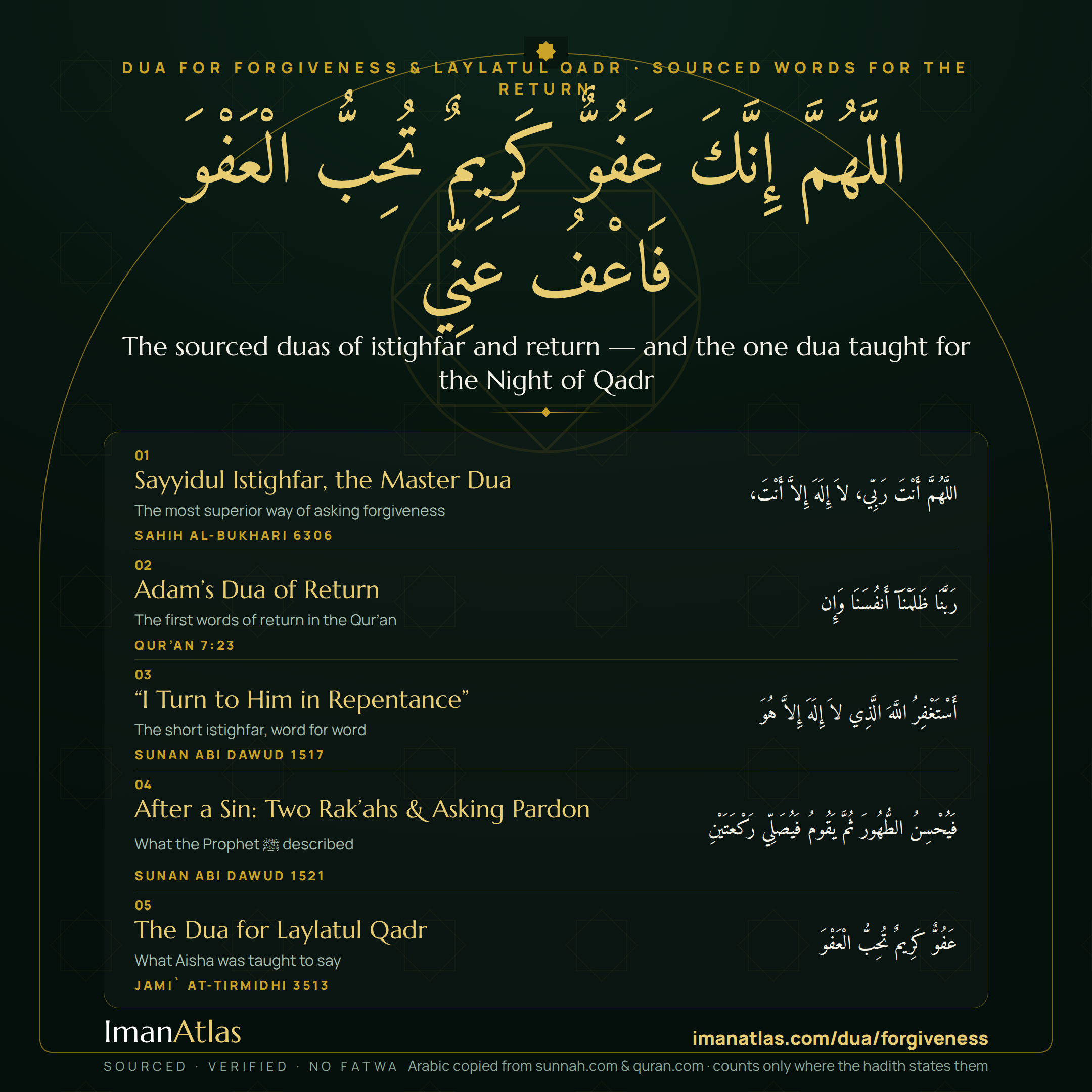
Duas for Forgiveness, Repentance & Laylatul Qadr
The sourced duas of return — the master istighfar, Adam’s first words, and the one dua taught for the Night of Qadr — each whole, each with its reference and grade.
Short answer: The Qur’an’s door stands open: “Do not lose hope in Allah’s mercy, for Allah certainly forgives all sins” (39:53). This page prints the forgiveness duas as their sources give them — Sayyidul Istighfar (Bukhari 6306), Adam’s first words of return (7:23), and the dua taught for Laylatul Qadr (Tirmidhi 3513) — each with its grade.
ImanAtlas does not give fatwas. For your own situation, ask a qualified scholar you trust.
Beyond what these texts themselves say, this page adds nothing — no count, no course, no date for the Night, and no checklist for your repentance.
The door stands open
A framing verse, not a dua — Allah’s own address to those who have gone too far, printed whole, including its “Say” opening. The site does not crop it to a slogan or re-voice it as its own promise:
قُلْ يَٰعِبَادِىَ ٱلَّذِينَ أَسْرَفُوا۟ عَلَىٰٓ أَنفُسِهِمْ لَا تَقْنَطُوا۟ مِن رَّحْمَةِ ٱللَّهِ إِنَّ ٱللَّهَ يَغْفِرُ ٱلذُّنُوبَ جَمِيعًا إِنَّهُۥ هُوَ ٱلْغَفُورُ ٱلرَّحِيمُ
qul yāʿibādiya alladhīna asrafū ʿalā anfusihim lā taqnaṭū min raḥmati l-lahi inna l-laha yaghfiru l-dhunūba jamīʿan innahu huwa l-ghafūru l-raḥīmu
“Say, ˹O Prophet, that Allah says,˺ "O My servants who have exceeded the limits against their souls! Do not lose hope in Allah’s mercy, for Allah certainly forgives all sins. He is indeed the All-Forgiving, Most Merciful."”
Qur’an 39:53
Whoever seeks forgiveness finds Allah Forgiving
A framing pair, not duas — the Qur’an’s statement of what the seeker finds, and a prophet’s call to his people. Seeking is the only step either verse asks for:
وَمَن يَعْمَلْ سُوٓءًا أَوْ يَظْلِمْ نَفْسَهُۥ ثُمَّ يَسْتَغْفِرِ ٱللَّهَ يَجِدِ ٱللَّهَ غَفُورًا رَّحِيمًا
waman yaʿmal sūan aw yaẓlim nafsahu thumma yastaghfiri l-laha yajidi l-laha ghafūran raḥīman
“Whoever commits evil or wrongs themselves then seeks Allah’s forgiveness will certainly find Allah All-Forgiving, Most Merciful.”
Qur’an 4:110
وَٱسْتَغْفِرُوا۟ رَبَّكُمْ ثُمَّ تُوبُوٓا۟ إِلَيْهِ إِنَّ رَبِّى رَحِيمٌ وَدُودٌ
wa-is’taghfirū rabbakum thumma tūbū ilayhi inna rabbī raḥīmun wadūdun
“So seek your Lord’s forgiveness and turn to Him in repentance. Surely my Lord is Most Merciful, All-Loving.” — Shu’ayb, to his people
Qur’an 11:90
Sayyidul Istighfar — the master supplication for forgiveness
The Prophet ﷺ named this himself: “the most superior way of asking for forgiveness”. It is printed whole — the dua, and the narration’s closing sentence with its condition, “with firm faith in it”, travelling inside the quote:
اللَّهُمَّ أَنْتَ رَبِّي، لاَ إِلَهَ إِلاَّ أَنْتَ، خَلَقْتَنِي وَأَنَا عَبْدُكَ، وَأَنَا عَلَى عَهْدِكَ وَوَعْدِكَ مَا اسْتَطَعْتُ، أَعُوذُ بِكَ مِنْ شَرِّ مَا صَنَعْتُ، أَبُوءُ لَكَ بِنِعْمَتِكَ عَلَىَّ وَأَبُوءُ لَكَ بِذَنْبِي، فَاغْفِرْ لِي، فَإِنَّهُ لاَ يَغْفِرُ الذُّنُوبَ إِلاَّ أَنْتَ
Allahumma anta Rabbi la ilaha illa anta, Khalaqtani wa ana `Abduka, wa ana `ala `ahdika wa wa`dika mastata`tu, A`udhu bika min Sharri ma sana`tu, abu’u Laka bini`matika `alaiya, wa abu’u laka bidhanbi faghfir lee fa innahu la yaghfiru adhdhunuba illa anta
“Narrated Shaddad bin Aus: The Prophet (ﷺ) said "The most superior way of asking for forgiveness from Allah is: O Allah, You are my Lord, there is none worthy of worship except You. You have created me, and I am Your servant, and I am faithful to Your covenant and promise as much as I can. I seek refuge in You from the evil of what I have done. I acknowledge Your blessings upon me, and I admit my sins. So forgive me, for none forgives sins except You. (Allahumma anta Rabbi la ilaha illa anta, Khalaqtani wa ana `Abduka, wa ana `ala `ahdika wa wa`dika mastata`tu, A`udhu bika min Sharri ma sana`tu, abu’u Laka bini`matika `alaiya, wa abu’u laka bidhanbi faghfir lee fa innahu la yaghfiru adhdhunuba illa anta)" The Prophet (ﷺ) added. "If somebody recites it during the day with firm faith in it, and dies on the same day before the evening, he will be from the people of Paradise; and if somebody recites it at night with firm faith in it, and dies before the morning, he will be from the people of Paradise."”
Sahih al-Bukhari 6306
Its morning and evening homes — the narration’s own framing — are the Morning and Evening pages; here it stands as what it is, the forgiveness dua itself.
The first return: Adam’s dua
The Qur’an’s first recorded words of return — Adam and his wife, after the slip. The verse opens “they both said”; their words begin at “Our Lord”:
رَبَّنَا ظَلَمْنَآ أَنفُسَنَا وَإِن لَّمْ تَغْفِرْ لَنَا وَتَرْحَمْنَا لَنَكُونَنَّ مِنَ ٱلْخَٰسِرِينَ
rabbanā ẓalamnā anfusanā wa-in lam taghfir lanā watarḥamnā lanakūnanna mina l-khāsirīna
“They replied, "Our Lord! We have wronged ourselves. If You do not forgive us and have mercy on us, we will certainly be losers."”
Qur’an 7:23
The short istighfar
A short istighfar with a startling clause in its narration — pardon “even if he has fled in time of battle”, desertion being among the gravest sins in the texts’ own scale. The clause stays inside the narration’s quoted words. This narration stands on two routes that differ by exactly one word; Abu Dawud’s wording is printed, Tirmidhi’s stands beneath it — the two are never merged:
أَسْتَغْفِرُ اللَّهَ الَّذِي لاَ إِلَهَ إِلاَّ هُوَ الْحَىُّ الْقَيُّومُ وَأَتُوبُ إِلَيْهِ — followed in the narration by the outcome: غُفِرَ لَهُ وَإِنْ كَانَ فَرَّ مِنَ الزَّحْفِ
“Narrated Zayd, the client of the Prophet: The Prophet (ﷺ) said: If anyone says: "I ask pardon of Allah than Whom there is no deity, the Living, the eternal, and I turn to Him in repentance," he will be pardoned, even if he has fled in time of battle.”
Sunan Abi Dawud 1517
Grade: Sahih (Al-Albani), as printed at sunnah.com
أَسْتَغْفِرُ اللَّهَ الْعَظِيمَ الَّذِي لاَ إِلَهَ إِلاَّ هُوَ الْحَىَّ الْقَيُّومَ وَأَتُوبُ إِلَيْهِ
Astaghfirullāhal-`Aẓīm alladhī lā ilāha illā huwal-Ḥayyul-Qayyūmu wa atūbu ilaih
“Bilal bin Yasar bin Zaid [the freed slave of the Prophet(ﷺ)] narrated: "My father narrated to me, from my grandfather, that he heard the Prophet (ﷺ) say: ‘Whoever says: "I seek forgiveness from Allah, the Magnificent, whom there is none worthy of worship but Him, the Living, Al-Qayyum, and I repent to him," (Astaghfirullāhal-`Aẓīm alladhī lā ilāha illā huwal-Ḥayyul-Qayyūmu wa atūbu ilaih) then Allah will forgive him, even if he fled from battle.’"”
Jami` at-Tirmidhi 3577 — the same dua with one word more: al-‘Azim, “the Magnificent”, after “Allah”
Grade: Hasan (Darussalam), as printed at sunnah.com — at-Tirmidhi adds that the hadith is gharib, known only from this route.
After a sin: what the Prophet ﷺ described
Abu Bakr’s narration, reported whole. Its sequence — ablution well, two rak’ahs, asking pardon — is the narration’s own content; this page reports it and does not reassemble it into a method of its own, adds no surah choice for the rak’ahs and no hour:
مَا مِنْ عَبْدٍ يُذْنِبُ ذَنْبًا فَيُحْسِنُ الطُّهُورَ ثُمَّ يَقُومُ فَيُصَلِّي رَكْعَتَيْنِ ثُمَّ يَسْتَغْفِرُ اللَّهَ إِلاَّ غَفَرَ اللَّهُ لَهُ
“Narrated AbuBakr as-Siddiq: Asma’ bint al-Hakam said: I heard Ali say: I was a man; when I heard a tradition from the Messenger of Allah (ﷺ), Allah benefited me with it as much as He willed. But when some one of his companions narrated a tradition to me I adjured him. When he took an oath, I testified him. AbuBakr narrated to me a tradition, and AbuBakr narrated truthfully. He said: I heard the apostle of Allah (ﷺ) saying: When a servant (of Allah) commits a sin, and he performs ablution well, and then stands and prays two rak’ahs, and asks pardon of Allah, Allah pardons him. He then recited this verse: "And those who, when they commit indecency or wrong their souls, remember Allah" (Al-Qur’an 3:135).”
Sunan Abi Dawud 1521
Grade: Sahih (Al-Albani), as printed at sunnah.com
Its own page: After a Sin, where this narration stands whole as a report, with no method added.
The verse he ﷺ recited
Not a dua — the Qur’an’s description of the people who return, and the verse the narration above ends with him ﷺ reciting. Remember Allah, seek forgiveness, do not knowingly persist: the closest the sources come to describing repentance’s shape, printed as the description it is:
وَٱلَّذِينَ إِذَا فَعَلُوا۟ فَٰحِشَةً أَوْ ظَلَمُوٓا۟ أَنفُسَهُمْ ذَكَرُوا۟ ٱللَّهَ فَٱسْتَغْفَرُوا۟ لِذُنُوبِهِمْ وَمَن يَغْفِرُ ٱلذُّنُوبَ إِلَّا ٱللَّهُ وَلَمْ يُصِرُّوا۟ عَلَىٰ مَا فَعَلُوا۟ وَهُمْ يَعْلَمُونَ
wa-alladhīna idhā faʿalū fāḥishatan aw ẓalamū anfusahum dhakarū l-laha fa-is’taghfarū lidhunūbihim waman yaghfiru l-dhunūba illā l-lahu walam yuṣirrū ʿalā mā faʿalū wahum yaʿlamūna
“˹They are˺ those who, upon committing an evil deed or wronging themselves, remember Allah and seek forgiveness for their sins—and who forgives sins except Allah?—and they do not knowingly persist in wrongdoing.”
Qur’an 3:135
The Prophet’s ﷺ own hundred
Not a dua and not a prescription — a report of his ﷺ own practice. The one who was forgiven sought forgiveness a hundred times a day, and named a “shade” over the heart as its occasion. The hundred is his practice, quoted as a report; this page turns it into no target and no programme:
إِنَّهُ لَيُغَانُ عَلَى قَلْبِي وَإِنِّي لأَسْتَغْفِرُ اللَّهَ فِي الْيَوْمِ مِائَةَ مَرَّةٍ
“Al-Agharr al-Muzani, who was one amongst the Companions (of the Holy Prophet) reported that Allah’s Messenger (ﷺ) said: There is (at times) some sort of shade upon my heart, and I seek forgiveness from Allah a hundred times a day.”
Sahih Muslim 2702
Its own page: The Prophet’s ﷺ Own Istighfar, where all three reports of his own practice stand together.
The dua for the Night of Qadr
Aisha asked what to SAY if she came upon the Night — the narration answers with words, not with a date, a sign, or a count. It stands on two routes that differ by exactly one word; Tirmidhi’s wording is printed, Ibn Majah’s stands beneath it — never merged:
اللَّهُمَّ إِنَّكَ عَفُوٌّ كَرِيمٌ تُحِبُّ الْعَفْوَ فَاعْفُ عَنِّي
Allāhumma innaka `Afuwwun [Karīmun], tuḥibbul-`afwa fa`fu `annī
“Aishah narrated: "I said: ‘O Messenger of Allah, what is your view if I know when the Night of Al-Qadr is, then what should I say in it?" He said: ‘Say: "O Allah, indeed You are Pardoning, [Generous,] You love pardon, so pardon me (Allāhumma innaka `Afuwwun [Karīmun], tuḥibbul-`afwa fa`fu `annī).’"”
Jami` at-Tirmidhi 3513
Grade: Sahih (Darussalam), as printed at sunnah.com — at-Tirmidhi’s own words in the narration call it hasan sahih.
Its own page: The Dua for Laylatul Qadr, where both printings of this dua stand side by side.
اللَّهُمَّ إِنَّكَ عَفُوٌّ تُحِبُّ الْعَفْوَ فَاعْفُ عَنِّي
Allahumma innaka ‘afuwwun tuhibbul-‘afwa, fa’fu ‘anni
“It was narrated from ‘Aishah that she said: "O Messenger of Allah, what do you think I should say in my supplication, if I come upon Laylatul-Qadr?" He said: "Say: ‘Allahumma innaka ‘afuwwun tuhibbul-‘afwa, fa’fu ‘anni (O Allah, You are Forgiving and love forgiveness, so forgive me).’"”
Sunan Ibn Majah 3850 — the same dua without the word Karīm, “Generous”
Grade: Sahih (Darussalam), as printed at sunnah.com.
Which night the Night falls on is not stated in either narration, and this page does not date it. This site’s expected-dates frame for Ramadan — the odd nights of the last ten, with the moon-sighting caveat — lives on the Ramadan hub.
More sourced words of return
Nuh’s call to his people — “Ask forgiveness of your Lord” (Qur’an 71:10–12) — is printed in full on the Duas for Rizq, Debt, Job & Business page. Yunus’s istighfar from inside the distress (Qur’an 21:87–88, with Jami` at-Tirmidhi 3505) lives on the Anxiety & Stress page. Abu Bakr’s confession-dua taught for inside the prayer — “I have wronged myself with great wrongdoing” (Sahih al-Bukhari 834) — is printed in the Dua hub’s after-prayer section.
Summaries, methods and your own situation
These pages print the texts with their sources; they do not judge any person’s repentance. Scholars summarise what the captured texts themselves describe — the verse’s “remember Allah, seek forgiveness, do not knowingly persist”, the narration’s ablution, two rak’ahs and asking — as leaving the sin, regret, a firm resolve not to return, and putting right what is owed to others; that summary is the scholars’, and whether a particular repentance is accepted is not this site’s call.
ImanAtlas does not give fatwas. For your own situation, ask a qualified scholar you trust.
Beyond what these texts themselves say, this page adds nothing — no count, no course, no date for the Night, and no checklist for your repentance.
Widely shared claims, checked
The “way out of every distress” narration, with its grade shown. The narration behind nearly every “benefits of istighfar” list online was captured for this page, and its printed grade is shown with it — the page neither hides it nor sells it:
مَنْ لَزِمَ الاِسْتِغْفَارَ جَعَلَ اللَّهُ لَهُ مِنْ كُلِّ ضِيقٍ مَخْرَجًا وَمِنْ كُلِّ هَمٍّ فَرَجًا وَرَزَقَهُ مِنْ حَيْثُ لاَ يَحْتَسِبُ
“Narrated Abdullah ibn Abbas: The Prophet (ﷺ) said: If anyone continually asks pardon, Allah will appoint for him a way out of every distress, and a relief from every anxiety, and will provide for him from where he did not reckon.”
Sunan Abi Dawud 1518
Grade: Da’if (Al-Albani), as printed at sunnah.com.
Its theme-mate on another route (Sunan Ibn Majah 3819) is likewise Da’if as printed, and stands in the Anxiety page’s checked-claims section. Because of what the printed record holds, these promises are not printed anywhere on this site as established benefits of istighfar.
The counts and courses attached to these duas online. Figures circulate with this topic: the Hayyul-Qayyum istighfar 100 times with sins forgiven “even if they are as much as the foam of the sea” — a version traced by secondary scholarship to a Companion’s statement about five times, in a collection this site does not print from; istighfar 313 times and 1,000 times as daily programmes; “complete forgiveness in 7 days”. None of these figures or courses appears in any source on this page. The one number the sources do give — the Prophet’s ﷺ hundred — is his practice, printed above as a report, not a target.
The dating of the Night. Pages that declare Laylatul Qadr to be the 27th night, or present a shortlist as settled, go beyond every text on this page. Aisha’s narration answers what to say; this site’s expected-dates frame, with its moon-sighting caveat, lives on the Ramadan hub. Nothing here identifies the Night.
The conditions lists. The numbered conditions of repentance — three, four or five, varying by site — are summaries drawn up by scholars; an-Nawawi’s, at the head of his repentance chapter, is the famous one. They are not a hadith and not a verse, and this page does not print them as an acceptance checklist in its own voice. Its closing section carries one attributed sentence of that summary, and the texts themselves — the verse’s description, the narration’s sequence — stand above it.
The forgiveness duas, one by one
Four of these duas now have a page of their own, where their printings and their reports are set out in full. Each page keeps this page’s frame: no guarantee, no count prescribed, and no ruling added.
The Dua for Laylatul Qadr — the Night of Qadr dua in both of its transmissions, side by side (Tirmidhi 3513 · Ibn Majah 3850), with no night dated.
After a Sin — Abu Bakr’s narration (Abu Dawud 1521) and the verse he recited (Qur’an 3:135), printed whole as a report; no method, checklist or ruling added.
Rabbighfir Li wa Tub ‘Alayya — the short istighfar the Companions counted a hundred times in one sitting (Abu Dawud 1516 · Ibn Majah 3814 · Tirmidhi 3434), its two endings side by side; the count is their report, not a prescription.
The Prophet’s ﷺ Own Istighfar — the three reports of his own practice (Bukhari 6307 · Muslim 2702a · Muslim 2702b), their numbers left standing, none prescribed to the reader.
Frequently asked questions
What is the best dua for forgiveness?
The one the Prophet ﷺ named himself: Sayyidul Istighfar — “the most superior way of asking for forgiveness from Allah” (Sahih al-Bukhari 6306). Its full Arabic and translation are the anchor block on this page.
Does Sayyidul Istighfar guarantee Paradise if I recite it and die the same day?
The narration’s own words, quoted whole, are: “If somebody recites it during the day with firm faith in it, and dies on the same day before the evening, he will be from the people of Paradise; and if somebody recites it at night with firm faith in it, and dies before the morning, he will be from the people of Paradise” (Sahih al-Bukhari 6306). This page prints the sentence as the narration states it — with its “with firm faith in it” condition inside it — and adds no guarantee of its own.
Is my sin too big to be forgiven?
The Qur’an’s own words frame this page: “O My servants who have exceeded the limits against their souls! Do not lose hope in Allah’s mercy, for Allah certainly forgives all sins” (Qur’an 39:53). And the short istighfar’s narration carries pardon “even if he has fled in time of battle” (Sunan Abi Dawud 1517, Sahih) — quoted as the sources’ words. A verdict on any person’s case is not this site’s to give: ImanAtlas does not give fatwas. For your own situation, ask a qualified scholar you trust.
What is the dua for Laylatul Qadr?
“O Allah, indeed You are Pardoning, [Generous,] You love pardon, so pardon me” — taught to Aisha when she asked what to say if she came upon the Night (Jami` at-Tirmidhi 3513, Sahih). It also stands at Sunan Ibn Majah 3850 (Sahih) — the same dua without the word “Generous”. Both routes are printed on this page, the one-word difference shown, never merged.
Which night is Laylatul Qadr — is it the 27th?
This page does not date it, and neither does Aisha’s narration — it answers what to say, not which night. This site’s expected-dates frame (the odd nights of the last ten, with the moon-sighting caveat) lives on the Ramadan hub. Identifying the Night in your own practice is a question of fiqh: ImanAtlas does not give fatwas. For your own situation, ask a qualified scholar you trust.
How many times a day should I say astaghfirullah — is 100 required?
No text on this page prescribes a count to the reader. The hundred in Sahih Muslim 2702 is the Prophet’s ﷺ own practice — “I seek forgiveness from Allah a hundred times a day” — printed here as a report of what he did, not as a target set for anyone else. The circulating version of the Hayyul-Qayyum istighfar with “100 times” and sins “like the foam of the sea” appears in no source on this page and is named in its checked-claims section.
Is the hadith “whoever sticks to istighfar, Allah makes a way out of every distress” authentic?
It was captured for this page at Sunan Abi Dawud 1518, and sunnah.com prints its grade as Da’if (Al-Albani). Its route-mate at Sunan Ibn Majah 3819 is likewise Da’if (Darussalam) as printed. The narration is shown whole, with its grade, in this page’s checked-claims section — neither hidden nor promoted into the main set.
I have just committed a sin — what do I do?
This page reports what the Prophet ﷺ described, in Abu Bakr’s narration: “When a servant (of Allah) commits a sin, and he performs ablution well, and then stands and prays two rak’ahs, and asks pardon of Allah, Allah pardons him” — after which he ﷺ recited Qur’an 3:135 (Sunan Abi Dawud 1521, Sahih). It is printed as the narration’s content, not assembled into this site’s own method or ruling.
What are the conditions for repentance to be accepted?
No hadith or verse on this page issues a conditions list. The numbered lists online — three, four or five conditions — are scholars’ summaries; an-Nawawi’s, at the head of his repentance chapter, is the famous one, gathering what the texts describe as leaving the sin, regret, firm resolve, and putting right what is owed to others. The texts’ own description stands at Qur’an 3:135. Whether a particular repentance is accepted is not this site’s call: ImanAtlas does not give fatwas. For your own situation, ask a qualified scholar you trust.
Sources
Translations on this page: hadith — the translations printed at sunnah.com (its Abu Dawud texts are the older renderings, printed as captured, never silently modernised); Qur’an — Dr. Mustafa Khattab (via quran.com). Arabic is copied from those sources, never typed from memory. No repetition count is printed unless the narration itself states it — and the one number on this page is the Prophet’s ﷺ own practice, quoted as a report.
- Qur’an 39:53 — quran.com · Qur’an 4:110 — quran.com · Qur’an 11:90 — quran.com
- Sahih al-Bukhari 6306 (Sayyidul Istighfar) — sunnah.com · Qur’an 7:23 — quran.com
- Sunan Abi Dawud 1517 — sunnah.com · Jami` at-Tirmidhi 3577 — sunnah.com
- Sunan Abi Dawud 1521 — sunnah.com · Qur’an 3:135 — quran.com
- Sahih Muslim 2702 — sunnah.com · Jami` at-Tirmidhi 3513 — sunnah.com · Sunan Ibn Majah 3850 — sunnah.com
- Sunan Abi Dawud 1518 (note section) — sunnah.com · Sahih al-Bukhari 834 (pointer) — sunnah.com
- Qur’an 71:10–12 (pointer) — quran.com · Qur’an 21:87 (pointer) — quran.com
- IslamQA 104818 — the istighfar-count status record · Tanzil — Qur’an text (Uthmani)
Share this set