The Dua for Laylatul Qadr — Tirmidhi 3513 · Ibn Majah 3850
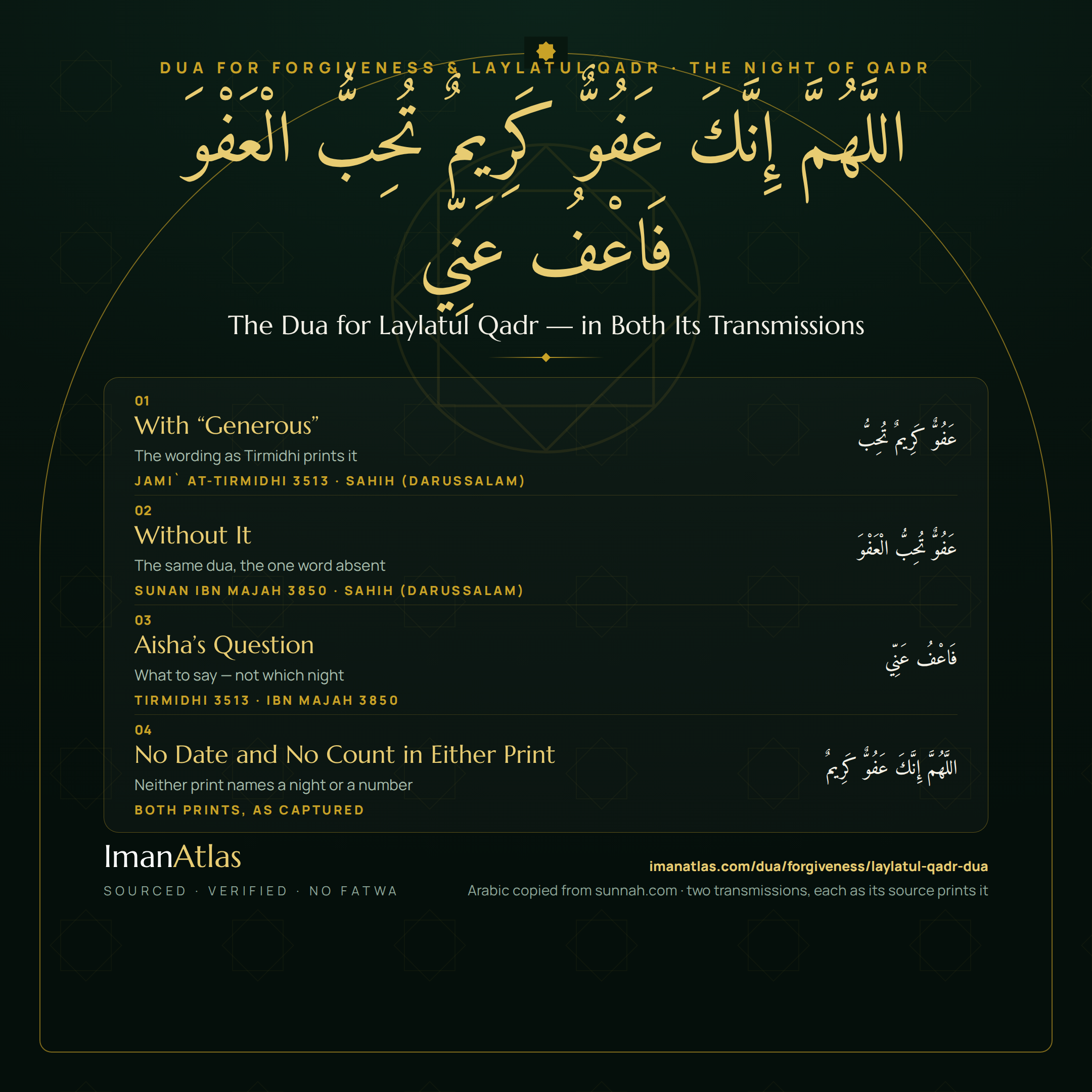
One dua was taught for the Night of Qadr, and the books carry it in two transmissions that differ by a single word. This page prints both, whole, side by side — Tirmidhi’s wording with “Generous” in it, Ibn Majah’s without — each with its own grade, and merges neither into the other.
Short answer: One dua was taught for the Night of Qadr, and it reaches us in two transmissions that differ by a single word: Tirmidhi’s print carries “Generous” (Karīm), Ibn Majah’s does not. This page prints both, side by side, exactly as their sources give them — no merged text, and no night is dated.
ImanAtlas does not give fatwas. For your own situation, ask a qualified scholar you trust.
Beyond what these texts themselves say, this page adds nothing — no count, no course, no date for the Night, and no checklist for your repentance.
Every Ramadan, the same short dua is printed on a thousand graphics — and on a good share of them, the citation underneath names two books while the Arabic above it matches only one of them. The dua Aisha was taught for Laylatul Qadr stands in Jami` at-Tirmidhi and in Sunan Ibn Majah, and the two prints are not the same text: one carries an extra word, Karīm, “Generous”, and the other does not. Most pages settle the matter silently, one way or the other. This page settles nothing: it prints both transmissions whole, in their own blocks, and lets the difference stand where any reader can see it.
The dua itself — Jami` at-Tirmidhi 3513
Tirmidhi places this narration in his Chapters on Supplication, in a chapter he named for asking Allah for al-`afiyah and al-mu`afah — pardon, and being kept safe and sound. The chain runs through Kahmas ibn al-Hasan, from `Abdullah ibn Buraydah, from Aisha. Her question is the frame of the whole narration: she asked what she should say if she knew when the Night of Qadr was. The answer she was given is a sentence of words, and in Tirmidhi’s print the sentence carries the word Karīm — “Generous” — which sunnah.com’s printed translation sets in brackets, [Generous,], exactly as captured:
اللَّهُمَّ إِنَّكَ عَفُوٌّ كَرِيمٌ تُحِبُّ الْعَفْوَ فَاعْفُ عَنِّي
Allāhumma innaka `Afuwwun [Karīmun], tuḥibbul-`afwa fa`fu `annī
“Aishah narrated: "I said: ‘O Messenger of Allah, what is your view if I know when the Night of Al-Qadr is, then what should I say in it?" He said: ‘Say: "O Allah, indeed You are Pardoning, [Generous,] You love pardon, so pardon me (Allāhumma innaka `Afuwwun [Karīmun], tuḥibbul-`afwa fa`fu `annī).’"”
Jami` at-Tirmidhi 3513
Grade: Sahih (Darussalam), as printed at sunnah.com — at-Tirmidhi’s own words in the narration call it hasan sahih.
Two things in that block belong to the record and are kept with it. The bracket around “Generous” is sunnah.com’s own bracket in its printed translation — it stays in the quote, because the quote is printed as captured. And at-Tirmidhi’s own words inside his narration call the hadith hasan sahih; the grade line prints the Darussalam grade, Sahih, and discloses the tail beside it rather than folding the two into a single label. The transliteration line under the Arabic is the one this site’s pillar carries, audited against this print; the romanisation inside the quoted translation is the source’s own and stays inside its quote.
The second transmission — Sunan Ibn Majah 3850
Ibn Majah prints the same teaching in his Book of Supplication, in a chapter named for supplicating for forgiveness and for being kept safe and sound — the same chain, Kahmas from Ibn Buraydah from Aisha, and the same question in a slightly different dress: what should she say in her supplication if she came upon Laylatul-Qadr? The answer is the same sentence, shorter by one word. There is no Karīm in it:
اللَّهُمَّ إِنَّكَ عَفُوٌّ تُحِبُّ الْعَفْوَ فَاعْفُ عَنِّي
Allahumma innaka ‘afuwwun tuhibbul-‘afwa, fa’fu ‘anni
“It was narrated from ‘Aishah that she said: "O Messenger of Allah, what do you think I should say in my supplication, if I come upon Laylatul-Qadr?" He said: "Say: ‘Allahumma innaka ‘afuwwun tuhibbul-‘afwa, fa’fu ‘anni (O Allah, You are Forgiving and love forgiveness, so forgive me).’"”
Sunan Ibn Majah 3850 — the same dua without the word Karīm, “Generous”
Grade: Sahih (Darussalam), as printed at sunnah.com.
That is the whole difference, and it is the subject of this page. Ibn Majah’s grade, printed at sunnah.com, is also Sahih (Darussalam) — the two prints stand level in grade and apart in wording. Neither block above has been adjusted toward the other: Tirmidhi’s Arabic carries the word, Ibn Majah’s does not, and the transliteration line under each block is the line its own print carries on this site’s pillar.
One word apart — Karīm, shown and never merged
Why does this need a page of its own? Because the field, almost without exception, hides the difference. One common shape prints the dua without Karīm and cites both books jointly beneath it — Tirmidhi’s number set over Ibn Majah’s wording, so a reader who checks the citation against Tirmidhi finds a word his copy does not have. Another grades the pair together with a single merged label, borrowing at-Tirmidhi’s hasan sahih tail and applying it to both routes, where sunnah.com prints Sahih (Darussalam) for each. A third prints the dua in both its forms on one page, in different sections, and never says the two forms are two transmissions of one teaching. And the question “with the word or without it?” is answered in ruling voice by a fatwa — both are good, it concludes, and both should be said — a harmonisation that treats two transmissions as two interchangeable duas and closes the question this page exists to open.
What stands here instead is the record itself. One teaching, two transmissions, one word of difference. Each print is whole, each carries its own reference and its own grade, and the word that divides them is named in the open. Which wording a reader says in the Night is a matter of practice, and practice is not settled on this page — the section below says where those questions belong.
Aisha’s question — what to say, not which night
Read the two frames again. In Tirmidhi, Aisha asks: what is your view, if I know when the Night of Al-Qadr is, then what should I say in it? In Ibn Majah: what do you think I should say in my supplication, if I come upon Laylatul-Qadr? Both questions suppose the Night found, and both ask the same thing — not how to find it, not how to recognise it, but what to say in it. And both answers give words. Neither narration identifies the night, describes a sign by which it may be known, or attaches the words to a date.
That restraint is kept on this page. This site’s frame for the Night’s dates — the last ten nights, the odd nights among them, the expected Gregorian dates for Ramadan 1448 with the moon-sighting caveat attached — lives where it belongs, on the Ramadan hub, and no date is restated here. A page that prints the dua does not need to date the Night, and this one does not.
‘Afw — the pardon this dua asks for
The dua is built on one word: `afw. Tirmidhi’s printed translation renders it “Pardoning… You love pardon, so pardon me”; Ibn Majah’s renders it “Forgiving and love forgiveness, so forgive me”. The word is the pardon that wipes the record — not a lesser charge, not a postponed one, but the offence removed. It is the only thing the dua asks for. It does not ask for the Night’s reward to be calculated, for a sign to be shown, or for an outcome to be promised; it asks the Pardoning One, who loves pardon, for pardon. Whatever commentary beyond the printed translations would add belongs to the scholars’ books, and this page imports none of it.
What neither print contains — no date, no count, no sign
It is worth listing what stands in neither transmission, because the Night attracts additions the way the dua attracts citations. No date: neither print names a night of the month, and the declarations that fix the Night to a single numbered night — the twenty-seventh, most often — stand in no text on this page. No shortlist either: the narration that speaks of seeking the Night in the odd nights is a narration about seeking, and it is not printed here as a dating answer. No count: neither print says the dua once, or a set number of times, and the repetition courses built for the Night — so many times a night, so many nights running — appear in neither source. And no sign: neither print describes anything by which the Night announces itself, and this page spots no signs.
What the two prints contain is a question about words and an answer of words. Everything beyond that is the genre’s apparatus around one short sentence, and it is named here as apparatus — not practised, and not endorsed.
Decisions, methods and your own situation
Which wording to say, how often, on which nights to seek the Night, and what to make of a Ramadan already spent — these are ruling and practice questions, and the two transmissions above do not answer them. The texts are printed, with their sources; the rulings belong to scholars. The rest of this cluster — the master dua of forgiveness, the words of return after a sin, the Prophet’s ﷺ own daily istighfar — stands on the pillar this page belongs to: Duas for Forgiveness, Repentance & Laylatul Qadr. And the dates frame for the Night, such as this site gives one, is on the Ramadan hub.
ImanAtlas does not give fatwas. For your own situation, ask a qualified scholar you trust.
Beyond what these texts themselves say, this page adds nothing — no count, no course, no date for the Night, and no checklist for your repentance.
Frequently asked questions
What is the dua for Laylatul Qadr?
“O Allah, indeed You are Pardoning, [Generous,] You love pardon, so pardon me” — taught to Aisha when she asked what to say if she came upon the Night (Jami` at-Tirmidhi 3513, Sahih). It also stands at Sunan Ibn Majah 3850 (Sahih) — the same dua without the word “Generous”. Both transmissions are printed whole at the head of this page, the one-word difference shown, never merged.
Which night is Laylatul Qadr — is it the 27th?
This page does not date it, and neither does Aisha’s narration — it answers what to say, not which night. This site’s expected-dates frame (the odd nights of the last ten, given as expected dates with the moon-sighting caveat) lives on the Ramadan hub. Identifying the Night in your own practice is a question of fiqh, and questions of that kind belong to a qualified scholar you trust.
Should the dua be said with “Generous” (Karīm) or without it — which wording is correct?
Both wordings are transmissions of the one teaching, and both are printed at sunnah.com with the grade Sahih (Darussalam): Tirmidhi’s carries Karīm, Ibn Majah’s does not. This page prints both and merges neither, and it does not rule between them. Which wording a reader follows in his or her own practice is a question for a qualified scholar — this site reports the transmissions; it does not settle practice.
How many times should the dua be said on the Night?
Neither print states a number — not once, not a hundred times, not any times. The narration gives words for the Night and attaches no repetition to them. The courses and graphics that fix a count for this dua on this Night are additions found in neither source on this page, and this page prints no count.
Can this dua be said on other nights, outside Laylatul Qadr?
The narration ties the words to the Night: Aisha asked what to say if she knew when the Night was, or came upon it, and the answer names the Night’s own occasion. Whether the same words are taken up on other nights is a question of practice, and practice questions belong to a qualified scholar. This page prints what the two transmissions say, and adds no ruling of its own.
Sources
Every text and claim on this page comes from these pages, read on 29 November 2026. The Arabic of both transmissions is copied from sunnah.com, exactly as captured; the grades printed are the grades sunnah.com prints, and at-Tirmidhi’s hasan sahih tail is disclosed beside his.
- The first transmission, with Karīm — Jami` at-Tirmidhi 3513 — sunnah.com
- The second transmission, without it — Sunan Ibn Majah 3850 — sunnah.com
- The pillar this page belongs to — Duas for Forgiveness, Repentance & Laylatul Qadr
- The Night’s expected-dates frame — Ramadan
- Hub — Duas & Azkar
Found an error? We correct mistakes within 24 hours, with a note on the page — write to us through the website.