Duas & Adhkar After Salah, exactly as narrated
The remembrances said after every obligatory prayer — Arabic, translation, reference and grade for every one.
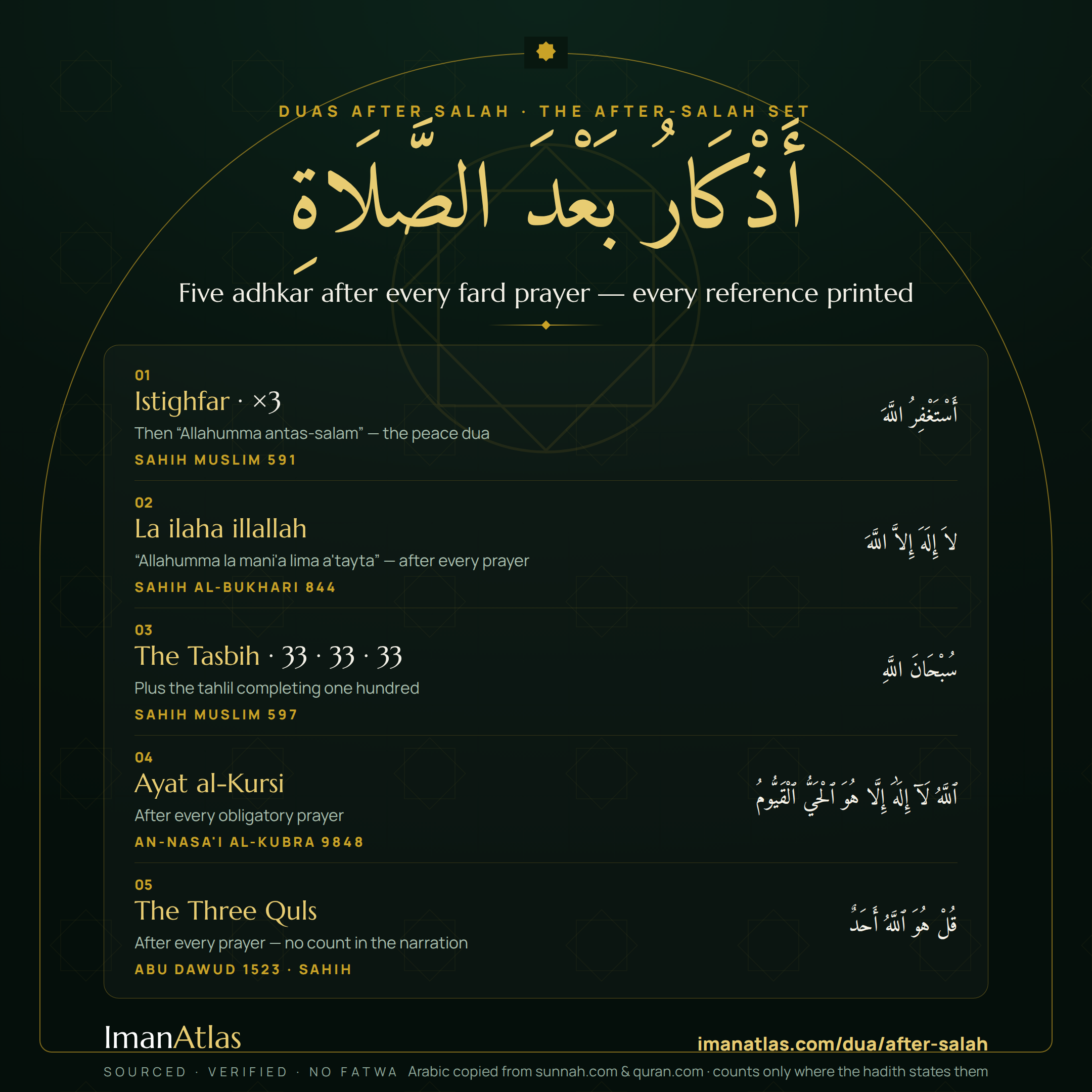
Short answer: After every obligatory prayer, the Prophet ﷺ said a short set of remembrances: Astaghfirullah three times, ‘Allahumma antas-salam’, the declaration of Allah’s oneness, the 33-fold tasbih, Ayat al-Kursi and the three Quls. This page gives the set in order, each with its Arabic, translation, reference and grade.
Translations on this page: Qur’an — Dr. Mustafa Khattab (via quran.com); hadith — the translations printed at sunnah.com. Arabic is copied from those pages, never typed from memory. Repetition counts are printed only where the hadith itself states them. ImanAtlas presents sources, not fatwas; for a ruling on your own situation, ask a qualified scholar you trust.
When are these said?
The Qur’an joins remembrance to the moment the prayer ends: فَإِذَا قَضَيْتُمُ ٱلصَّلَوٰةَ فَٱذْكُرُوا۟ ٱللَّهَ قِيَٰمًا وَقُعُودًا وَعَلَىٰ جُنُوبِكُمْ فَإِذَا ٱطْمَأْنَنتُمْ فَأَقِيمُوا۟ ٱلصَّلَوٰةَ إِنَّ ٱلصَّلَوٰةَ كَانَتْ عَلَى ٱلْمُؤْمِنِينَ كِتَٰبًا مَّوْقُوتًا — “When the prayers are over, remember Allah—whether you are standing, sitting, or lying down. But when you are secure, establish regular prayers. Indeed, performing prayers is a duty on the believers at the appointed times” (Qur’an 4:103, translation: Dr. Mustafa Khattab).
The narrations below carry their own framing: “after every compulsory prayer” (Bukhari 844), “after every prescribed prayer” (Muslim 596), “after every prayer” (Abu Dawud 1522, 1523). That is the wording this page reports. Whether a person’s adhkar come right after the obligatory prayer or after any voluntary prayers they pray with it is a question of practice on which scholars have written — this page prints the texts and their wording, and leaves personal practice to the reader and their scholar. The prayers these adhkar follow are on the Prayer Times page.
The adhkar after every prayer, in order
The narrations describe the items; they do not chain them into one fixed sequence. The order below follows how the sources present the set, beginning with the istighfar that opens Sahih Muslim’s chapter. Work through them in this order, or begin with the first three and add the rest over days — every count shown is the count its own hadith states, and where a hadith states no count, none is printed.
Istighfar, three times — then “Allahumma antas-salam”
أَسْتَغْفِرُ اللَّهَ أَسْتَغْفِرُ اللَّهَ · اللَّهُمَّ أَنْتَ السَّلاَمُ وَمِنْكَ السَّلاَمُ تَبَارَكْتَ ذَا الْجَلاَلِ وَالإِكْرَامِ
Astaghfirullah, astaghfirullah — Allahumma antas-salamu wa minkas-salam, tabarakta dha’l-jalali wal-ikram.
“When the Messenger of Allah (ﷺ) finished his prayer, he begged forgiveness three times and said: O Allah! Thou art Peace, and peace comes from Thee; Blessed art Thou, O Possessor of Glory and Honour.” Asked how the seeking of forgiveness was worded, al-Awza’i — one of the narrators — replied: “You should say: I beg forgiveness from Allah, I beg forgiveness from Allah.” ‘A’isha reported that the Prophet ﷺ would sit after the salutation only long enough to say this supplication. One honest textual note: Muslim 591 prints the ending as “dha’l-jalali wal-ikram”, while a second narration in Muslim (592) records Ibn Numair’s wording as “يَا ذَا الْجَلاَلِ وَالإِكْرَامِ” (“ya dha’l-jalali wal-ikram”) — both wordings are in Muslim, and this page prints 591’s in the block above and notes the variant rather than hiding it.
Recite: istighfar three times — the count is in the hadithSahih Muslim 591 — sunnah.com/muslim:591 · wording variant at sunnah.com/muslim:592a
“La ilaha illallah… Allahumma la mani’a lima a’tayta”
لاَ إِلَهَ إِلاَّ اللَّهُ وَحْدَهُ لاَ شَرِيكَ لَهُ، لَهُ الْمُلْكُ، وَلَهُ الْحَمْدُ، وَهْوَ عَلَى كُلِّ شَىْءٍ قَدِيرٌ، اللَّهُمَّ لاَ مَانِعَ لِمَا أَعْطَيْتَ، وَلاَ مُعْطِيَ لِمَا مَنَعْتَ، وَلاَ يَنْفَعُ ذَا الْجَدِّ مِنْكَ الْجَدُّ
La ilaha illa l-lahu wahdahu la sharika lahu, lahu l-mulku wa lahu l-hamdu, wa huwa `ala kulli shay’in qadir. Allahumma la mani`a lima a`taita, wa la mu`tiya lima mana`ta, wa la yanfa`u dhal-jaddi minka l-jadd.
The Prophet ﷺ used to say this after every compulsory prayer: “There is no Deity but Allah, Alone, no Partner to Him. His is the Kingdom and all praise, and Omnipotent is he. O Allah! Nobody can hold back what you gave, nobody can give what You held back, and no struggler’s effort can benefit against You.” The narration states no number of times, so none is printed.
Sahih al-Bukhari 844 — sunnah.com/bukhari:844 · Sahih Muslim 593 — sunnah.com/muslim:593a
The longer tahlil of Ibn az-Zubayr
لاَ إِلَهَ إِلاَّ اللَّهُ وَحْدَهُ لاَ شَرِيكَ لَهُ لَهُ الْمُلْكُ وَلَهُ الْحَمْدُ وَهُوَ عَلَى كُلِّ شَىْءٍ قَدِيرٌ لاَ حَوْلَ وَلاَ قُوَّةَ إِلاَّ بِاللَّهِ لاَ إِلَهَ إِلاَّ اللَّهُ وَلاَ نَعْبُدُ إِلاَّ إِيَّاهُ لَهُ النِّعْمَةُ وَلَهُ الْفَضْلُ وَلَهُ الثَّنَاءُ الْحَسَنُ لاَ إِلَهَ إِلاَّ اللَّهُ مُخْلِصِينَ لَهُ الدِّينَ وَلَوْ كَرِهَ الْكَافِرُونَ
La ilaha illallah wahdahu la sharika lah, lahul-mulku wa lahul-hamdu wa huwa ‘ala kulli shay’in qadir. La hawla wa la quwwata illa billah. La ilaha illallah wa la na’budu illa iyyah, lahun-ni’matu wa lahul-fadlu wa lahuth-thana’ul-hasan. La ilaha illallah mukhlisina lahud-dina wa law karihal-kafirun.
“There is no god but Allah. He is alone. There is no partner with Him. Sovereignty belongs to Him and He is Potent over everything. There is no might or power except with Allah. There is no god but Allah and we do not worship but Him alone. To Him belong all bounties, to Him belongs all Grace, and to Him is worthy praise accorded. There is no god but Allah, to Whom we are sincere in devotion, even though the unbelievers should disapprove it.” Ibn az-Zubayr uttered these words at the end of every prayer after pronouncing the salutation, and the narrator adds: “He (the Holy Prophet) uttered it at the end of every (obligatory) prayer.” No count is stated in this narration either.
Sahih Muslim 594 — sunnah.com/muslim:594a
The tasbih — two narrations, kept separate
Two narrations in Sahih Muslim give the counted tasbih after prayer, with different numbers. Most lists merge them into one instruction; this page prints them as the two narrations they are. The teaching behind them: the poor emigrants came to the Messenger of Allah ﷺ saying the wealthy had taken the highest ranks, and he ﷺ taught them: “Extol Allah, declare His Greatness, and Praise Him thirty-three times after every prayer” (Muslim 595).
First narration: 33, 33, 33 — and the tahlil completing one hundred
سُبْحَانَ اللَّهِ · الْحَمْدُ لِلَّهِ · اللَّهُ أَكْبَرُ
SubhanAllah · Alhamdulillah · Allahu Akbar.
“If anyone extols Allah after every prayer thirty-three times, and praises Allah thirty-three times, and declares His Greatness thirty-three times, ninety-nine times in all, and says to complete a hundred: ‘There is no god but Allah, having no partner with Him, to Him belongs sovereignty and to Him is praise due, and He is Potent over everything,’ his sins will be forgiven even if these are as abundant as the foam of the sea.” The promise is quoted as the hadith’s own words, with its reference — this page adds no promise of its own.
Recite: SubhanAllah 33 · Alhamdulillah 33 · Allahu Akbar 33, then the tahlil once, completing 100 — the counts are in the hadithSahih Muslim 597 — sunnah.com/muslim:597a · framing narration Muslim 595
Its own page: The Tasbih After Salah — all three narrations side by side
Second narration: 33, 33, 34
سُبْحَانَ اللَّهِ · الْحَمْدُ لِلَّهِ · اللَّهُ أَكْبَرُ
SubhanAllah · Alhamdulillah · Allahu Akbar.
Ka’b b. ‘Ujra reported Allah’s Messenger (ﷺ) as saying: “There are certain remembrances, the repeaters of which or the performers of which after every prescribed prayer will never be caused disappointment: ‘Glory be to Allah’ thirty-three times, ‘Praise be to Allah’ thirty-three times, and ‘Allah is most Great’ thirty-four times.” This is a separate narration with its own count — thirty-four takbirs and no completing tahlil — printed alongside the first, not blended into it. A third 33/33/34 you may know belongs to a different occasion altogether: the tasbih the Prophet ﷺ taught for going to bed (Sahih al-Bukhari 3113; also Sahih Muslim 2727a). It is not part of the after-salah set, and the two settings should not be merged.
Recite: SubhanAllah 33 · Alhamdulillah 33 · Allahu Akbar 34 — the counts are in this narrationSahih Muslim 596 — sunnah.com/muslim:596a
Ayat al-Kursi — after every obligatory prayer
A narration in an-Nasa’i’s larger collection (al-Kubra) says: “Whoever reads Ayat al-Kursi at the end of (after) each mandatory prayer, nothing prevents him from entering paradise except death.” Stated exactly as its sourcing runs: Sunan an-Nasa’i al-Kubra is not one of the six books as hosted at sunnah.com, and this narration reaches the page through sunnah.com’s own search-result quotation of it (al-Kubra 9848, also in at-Tabarani 7532), graded Sahih by Ibn Hibban and al-Albani — it is not dressed up here as a Bukhari or Muslim narration, and the quoted words are not turned into a headline promise.
ٱللَّهُ لَآ إِلَٰهَ إِلَّا هُوَ ٱلْحَىُّ ٱلْقَيُّومُ لَا تَأْخُذُهُۥ سِنَةٌ وَلَا نَوْمٌ لَّهُۥ مَا فِى ٱلسَّمَٰوَٰتِ وَمَا فِى ٱلْأَرْضِ مَن ذَا ٱلَّذِى يَشْفَعُ عِندَهُۥٓ إِلَّا بِإِذْنِهِۦ يَعْلَمُ مَا بَيْنَ أَيْدِيهِمْ وَمَا خَلْفَهُمْ وَلَا يُحِيطُونَ بِشَىْءٍ مِّنْ عِلْمِهِۦٓ إِلَّا بِمَا شَآءَ وَسِعَ كُرْسِيُّهُ ٱلسَّمَٰوَٰتِ وَٱلْأَرْضَ وَلَا يَـُٔودُهُۥ حِفْظُهُمَا وَهُوَ ٱلْعَلِىُّ ٱلْعَظِيمُ
al-lahu lā ilāha illā huwa l-ḥayu l-qayūmu lā takhudhuhu sinatun walā nawmun lahu mā fī l-samāwāti wamā fī l-arḍi man dhā alladhī yashfaʿu ʿindahu illā bi-idh’nihi yaʿlamu mā bayna aydīhim wamā khalfahum walā yuḥīṭūna bishayin min ʿil’mihi illā bimā shāa wasiʿa kur’siyyuhu l-samāwāti wal-arḍa walā yaūduhu ḥif’ẓuhumā wahuwa l-ʿaliyu l-ʿaẓīmu
“Allah! There is no god ˹worthy of worship˺ except Him, the Ever-Living, All-Sustaining. Neither drowsiness nor sleep overtakes Him. To Him belongs whatever is in the heavens and whatever is on the earth. Who could possibly intercede with Him without His permission? He ˹fully˺ knows what is ahead of them and what is behind them, but no one can grasp any of His knowledge—except what He wills ˹to reveal˺. His Seat encompasses the heavens and the earth, and the preservation of both does not tire Him. For He is the Most High, the Greatest.”
Qur’an 2:255 — quran.com/2/255 (translation: Dr. Mustafa Khattab; Arabic: Tanzil Uthmani text) · Narration: Sunan an-Nasa’i al-Kubra 9848, as quoted at sunnah.com
The three Quls — after every prayer
‘Uqbah b. ‘Amir reported: “The Messenger of Allah (ﷺ) commanded me to recite Mu’awwidhatan (the last three surahs of the Qur’an) after every prayer.” One discipline this page keeps: this narration states no number of times. The three-times instruction belongs to a different narration (Abu Dawud 5082) whose own framing is the morning and the evening — it is not imported here.
Surah Al-Ikhlas (112)
قُلْ هُوَ ٱللَّهُ أَحَدٌ ٱللَّهُ ٱلصَّمَدُ لَمْ يَلِدْ وَلَمْ يُولَدْ وَلَمْ يَكُن لَّهُۥ كُفُوًا أَحَدٌۢ
qul huwa l-lahu aḥadun al-lahu l-ṣamadu lam yalid walam yūlad walam yakun lahu kufuwan aḥadun
Surah Al-Falaq (113)
قُلْ أَعُوذُ بِرَبِّ ٱلْفَلَقِ مِن شَرِّ مَا خَلَقَ وَمِن شَرِّ غَاسِقٍ إِذَا وَقَبَ وَمِن شَرِّ ٱلنَّفَّٰثَٰتِ فِى ٱلْعُقَدِ وَمِن شَرِّ حَاسِدٍ إِذَا حَسَدَ
qul aʿūdhu birabbi l-falaqi min sharri mā khalaqa wamin sharri ghāsiqin idhā waqaba wamin sharri l-nafāthāti fī l-ʿuqadi wamin sharri ḥāsidin idhā ḥasada
Surah An-Nas (114)
قُلْ أَعُوذُ بِرَبِّ ٱلنَّاسِ مَلِكِ ٱلنَّاسِ إِلَٰهِ ٱلنَّاسِ مِن شَرِّ ٱلْوَسْوَاسِ ٱلْخَنَّاسِ ٱلَّذِى يُوَسْوِسُ فِى صُدُورِ ٱلنَّاسِ مِنَ ٱلْجِنَّةِ وَٱلنَّاسِ
qul aʿūdhu birabbi l-nāsi maliki l-nāsi ilāhi l-nāsi min sharri l-waswāsi l-khanāsi alladhī yuwaswisu fī ṣudūri l-nāsi mina l-jinati wal-nāsi
The translation of the three surahs used on this site is Dr. Mustafa Khattab’s, at quran.com/112, /113 and /114.
Sunan Abi Dawud 1523 — sunnah.com/abudawud:1523 · Grade: Sahih (Al-Albani), as printed at sunnah.com · Arabic: Tanzil Uthmani text
The dua the Prophet ﷺ told Mu’adh never to leave
اللَّهُمَّ أَعِنِّي عَلَى ذِكْرِكَ وَشُكْرِكَ وَحُسْنِ عِبَادَتِكَ
Allahumma a’inni ‘ala dhikrika wa shukrika wa husni ‘ibadatik.
“O Allah, help me in remembering You, in giving You thanks, and worshipping You well.” Mu’adh b. Jabal reported that the Messenger of Allah ﷺ caught his hand and said: “By Allah, I love you, Mu’adh. I give some instruction to you. Never leave to recite this supplication after every (prescribed) prayer.” Mu’adh passed the instruction on to the narrator after him, and he to the next — the narration itself carries the chain of people who refused to drop it. No count is stated, so none is printed.
Sunan Abi Dawud 1522 — sunnah.com/abudawud:1522 · Grade: Sahih (Al-Albani), as printed at sunnah.com
The Fajr addition: the tahlil ten times, before speaking
لاَ إِلَهَ إِلاَّ اللَّهُ وَحْدَهُ لاَ شَرِيكَ لَهُ لَهُ الْمُلْكُ وَلَهُ الْحَمْدُ يُحْيِي وَيُمِيتُ وَهُوَ عَلَى كُلِّ شَيْءٍ قَدِيرٌ
Lā ilāha illallāh, waḥdahu lā sharīka lahu, lahul-mulku wa lahul-ḥamdu, yuḥyī wa yumītu, wa huwa `alā kulli shay’in qadīr
Abu Dharr narrated that the Messenger of Allah (ﷺ) said: “Whoever says at the end of every Fajr prayer, while his feet are still folded, before speaking: ‘None has the right to be worshipped but Allah, Alone without partner, to Him belongs all that exists, and to Him is the praise, He gives life and causes death, and He is powerful over all things’ — ten times, then ten good deeds shall be written for him, ten evil deeds shall be wiped away from him, ten degrees shall be raised up for him, and he shall be in security all that day from every disliked thing, and he shall be in protection from Shaitan, and no sin will meet him or destroy him that day, except for associating partners with Allah.” Two honest notes. First, the citation: this narration is widely cited in lists and apps to “Muslim” — but Sahih Muslim 594 is the Ibn az-Zubayr tahlil printed above, a different narration with no count; the ten-times narration verified at its source for this page is at-Tirmidhi 3474. Second, the scope: the narration is worded for Fajr. A matching ten-times practice after Maghrib circulates widely, but its narration was not verified at a primary source in this page’s research, so the page does not print the pairing as established. And the dua the Prophet ﷺ said right after the Fajr salam — “Allahumma inni as’aluka ‘ilman nafi’an…” (Ibn Majah 925) — has its own section on the Morning Duas & Azkar page; it is linked there rather than duplicated here.
Recite: ten times after Fajr, feet still folded, before speaking — the count and its conditions are in the hadithJami` at-Tirmidhi 3474 — sunnah.com/tirmidhi:3474 · Grade: Hasan (Darussalam), as printed at sunnah.com
Aloud or silent?
Both manners have a history, and the shared evidence is one narration. Ibn ‘Abbas said: “In the lifetime of the Prophet (ﷺ) it was the custom to celebrate Allah’s praises aloud after the compulsory congregational prayers” — adding, “When I heard the Dhikr, I would learn that the compulsory congregational prayer had ended” (Sahih al-Bukhari 841).
How scholars have read that narration differs. Dar al-Ifta Egypt’s summary of the difference reports: “there is a scholarly consensus on the permissibility of making dhikr after the prescribed prayers. However, some scholars are of the view that making dhikr audibly after the prescribed prayers is permissible, while others — who explained making dhikr audibly with the purpose of teaching — maintained that it is more proper to make it silently.” That is the difference, reported with its source; this page adopts no side in it. For your own practice, ask a qualified scholar you trust.
How should I count — fingers or beads?
The narration this page can quote describes fingers. ‘Abdullah b. ‘Amr said: “I saw the Messenger of Allah (ﷺ) counting the glorification of Allah on fingers” — and in one version, “with his right hand” (Sunan Abi Dawud 1502, Grade: Sahih (Al-Albani), as printed at sunnah.com). It is also worth knowing that Abu Dawud placed this narration in his chapter headed “At-Tasbih (Glorifying Allah) Using Pebbles” — the chapter heading is Abu Dawud’s own. On counting with beads, scholars have differed; this page quotes the narration, notes the difference exists, and declares neither side permitted or forbidden. Ask a qualified scholar you trust for your own practice.
A note on a dua you will see in other lists
One further supplication appears in many printed after-prayer lists, usually as a core step. Its narration is graded Da’if (weak) at sunnah.com, so this page names it here, with its grade, rather than presenting it inside the set above.
“Allahumma ajirni minan-nar” seven times — اللَّهُمَّ أَجِرْنِي مِنَ النَّارِ (“O Allah, protect me from Hell”). Al-Harith b. Muslim reported that his father said the Messenger of Allah (ﷺ) told him secretly: “When you finish the sunset prayer, say: ‘O Allah, protect me from Hell’ seven times; for if you say that and die that night, protection from it would be recorded for you; and when you finish the dawn prayer, say it in a similar way, for if you die that day, protection from it would be recorded for you.” Sunan Abi Dawud 5079 · Grade: Da’if (Al-Albani), as printed at sunnah.com/abudawud:5079. Its seven-times count and its protection wording are part of that same weak narration — the page states the grade and leaves the item here, outside the verified set.
What this page does not cover
The adhkar after Witr. When the Prophet ﷺ gave the salutation in the Witr prayer, he would say “Subhan al-Malik al-Quddus” (Sunan Abi Dawud 1430, graded Sahih (Al-Albani)). Witr is not one of the five obligatory prayers, so its after-dhikr is out of this page’s scope — an exclusion of scope, not a judgement on the narration. Note also that Abu Dawud 1430’s text states no count; the “three times” found in other collections’ versions is not attached to this reference here.
The before-sleep adhkar — including the bedtime 33/33/34 — belong to a separate set, on their own page: Duas Before Sleeping. The hundred-times remembrances of the morning and evening (SubhanAllahi wa bihamdihi ×100, the tahlil ×100 in a day, Sayyidul Istighfar) are not after-salah-specific; they are on the Morning and Evening pages, each with its source.
How long does the set take — and how do I start?
Read at a calm pace, the core set above takes only a few minutes after each prayer; the tasbih is most of it. If you are beginning, start smaller and steady: the istighfar with “Allahumma antas-salam” and the 33-fold tasbih take about a minute together. Add one more item each week — Ayat al-Kursi, then the three Quls, then the Mu’adh dua. The full collection for every part of the day is on the Duas & Azkar hub, each page with the same sourcing.
Questions, answered from the sources
What should I say after salah?
A short set the Prophet ﷺ said after every obligatory prayer: Astaghfirullah three times, then ‘Allahumma antas-salam wa minkas-salam’ (Muslim 591); the declaration ‘La ilaha illallah wahdahu… Allahumma la mani’a lima a’tayta’ (Bukhari 844); the 33-fold tasbih (Muslim 597); Ayat al-Kursi (Qur’an 2:255); the three Quls (Abu Dawud 1523); and the dua ‘Allahumma a’inni ‘ala dhikrika’ (Abu Dawud 1522). Every item on this page carries its Arabic, translation, reference and grade.
Are these adhkar said after the fard prayer only?
The narrations carry their own wording: ‘after every compulsory prayer’ (Bukhari 844), ‘after every prescribed prayer’ (Muslim 596), ‘after every (prescribed) prayer’ (Abu Dawud 1522). This page reports the texts and their wording. Whether your own adhkar come immediately after the obligatory prayer or after voluntary prayers prayed with it is a question of practice — for a ruling on your situation, ask a qualified scholar you trust.
Is it 33 or 34 times Allahu Akbar?
Both numbers are narrated, in two different narrations, and this page keeps them separate: Muslim 597 counts SubhanAllah 33, Alhamdulillah 33 and Allahu Akbar 33, then completes one hundred with the tahlil; Muslim 596 counts 33, 33 and 34, with no completing tahlil. A third 33/33/34 — the one taught for going to bed (Bukhari 3113) — is a different occasion and is not part of the after-salah set.
Is there a fixed order for the after-salah adhkar?
The narrations describe the items; they do not chain them into one obligatory sequence. The order on this page follows how the sources present the set, beginning with the istighfar that opens Sahih Muslim’s chapter (Muslim 591). This page does not invent a ‘correct order’ ruling.
Should the adhkar after prayer be said aloud or silently?
Ibn ‘Abbas reported that in the Prophet’s ﷺ lifetime, raising the voice with dhikr when people finished the obligatory prayers was the custom (Bukhari 841). Scholars have differed over how to read that narration: Dar al-Ifta Egypt’s summary reports that some scholars hold audible dhikr after the prescribed prayers permissible, while others — explaining the audible dhikr as teaching — hold it more proper to make it silently, with the permissibility of dhikr itself agreed. This page reports the difference and takes no side.
Should I count on my fingers or use tasbih beads?
‘Abdullah b. ‘Amr said: ‘I saw the Messenger of Allah (ﷺ) counting the glorification of Allah on fingers’ — in one version, with his right hand (Abu Dawud 1502, graded Sahih (Al-Albani)). Abu Dawud placed the narration in a chapter he headed ‘At-Tasbih Using Pebbles’. On beads, scholars have differed; this page quotes the narration and notes the difference without declaring either side.
Is ‘Allahumma ajirni minan-nar’ seven times after Fajr and Maghrib authentic?
Its narration is Sunan Abi Dawud 5079, and sunnah.com prints its grade as Da’if (Al-Albani) — weak. The narration does prescribe saying ‘O Allah, protect me from Hell’ seven times after the sunset prayer and likewise after the dawn prayer, but the count and the protection wording rest on that same weak narration. Many lists print it as a core step with no grade; this page names it in a separate note, with its grade shown.
Is the tahlil said ten times after Maghrib too?
The ten-times narration verified at a primary source for this page is worded for Fajr: say it at the end of the Fajr prayer, feet still folded, before speaking (Jami’ at-Tirmidhi 3474, graded Hasan (Darussalam)). It is often mis-cited to ‘Muslim 594’ — but Muslim 594 is the Ibn az-Zubayr tahlil, a different narration with no count. A Maghrib pairing circulates widely, but its narration was not verified at sunnah.com in this page’s research, so this page states that plainly instead of printing the pairing as established.
Are the adhkar after Witr on this page?
No. Witr is not one of the five obligatory prayers, so its after-dhikr is outside this page’s set. For accuracy: when the Prophet ﷺ gave the salutation in the Witr prayer, he would say ‘Subhan al-Malik al-Quddus’ (Abu Dawud 1430, graded Sahih (Al-Albani)) — and that narration’s text states no count.
How long does the after-salah set take?
A few minutes at a calm pace — the tasbih is most of it. If you are starting, the istighfar with ‘Allahumma antas-salam’ and the 33-fold tasbih together take about a minute; add one further item each week.
Sources
Every dua and claim on this page comes from these pages, read on 28 November 2026. Translations: Qur’an — Dr. Mustafa Khattab; hadith — sunnah.com’s printed translations.
- Remembrance after the prayers — Qur’an 4:103 (quran.com)
- Istighfar and “Allahumma antas-salam” — Sahih Muslim 591 · 592a (wording variant)
- “La ilaha illallah… la mani’a lima a’tayta” — Sahih al-Bukhari 844 · Sahih Muslim 593
- The longer tahlil of Ibn az-Zubayr — Sahih Muslim 594
- The tasbih narrations — Sahih Muslim 595 · 596 · 597
- Ayat al-Kursi — Qur’an 2:255 (quran.com) · narration: Sunan an-Nasa’i al-Kubra 9848, as quoted at sunnah.com
- The three Quls — Sunan Abi Dawud 1523 · quran.com/112 · /113 · /114
- The Mu’adh dua — Sunan Abi Dawud 1522
- The Fajr tahlil, ten times — Jami` at-Tirmidhi 3474
- Dhikr aloud after the prayers — Sahih al-Bukhari 841 · the difference as reported — Dar al-Ifta Egypt, fatwa 7915
- Counting on the fingers — Sunan Abi Dawud 1502
- Flagged item — Sunan Abi Dawud 5079
- Out-of-scope item, named for accuracy — Sunan Abi Dawud 1430
- Hub — Duas & Azkar
Found an error? We correct mistakes within 24 hours, with a note on the page — write to us through the website.