Morning Duas & Azkar, exactly as narrated
The morning remembrances of the Prophet ﷺ — Arabic, translation, reference and grade for every one.
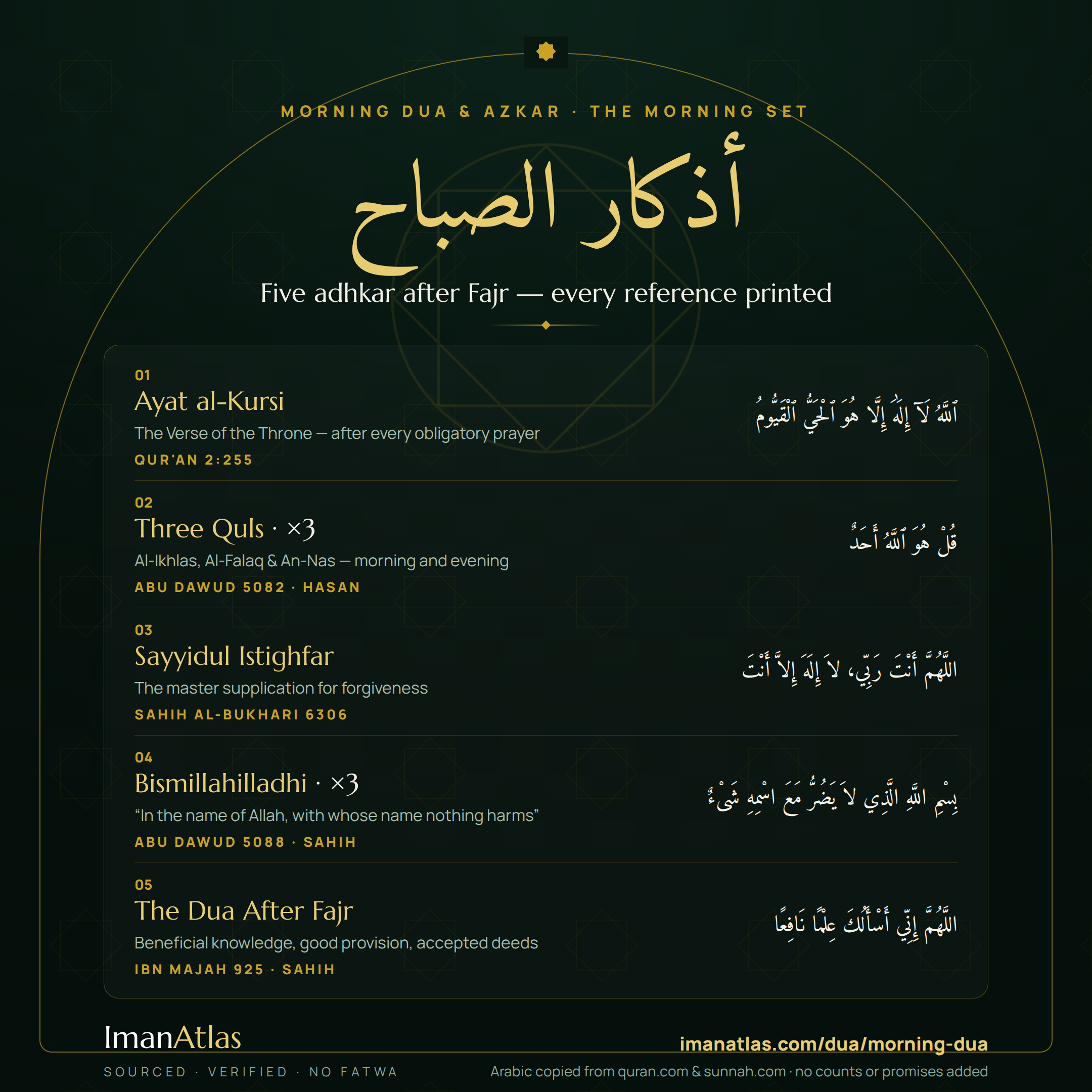
Short answer: The morning adhkar are the remembrances the Prophet ﷺ said between Fajr and sunrise. This page gives the core set in order — Ayat al-Kursi, the three Quls, Sayyidul Istighfar and the morning supplications — each with its Arabic from the source, a named translation, its hadith reference, and its grade.
Translations on this page: Qur’an — Dr. Mustafa Khattab (via quran.com); hadith — the translations printed at sunnah.com. Arabic is copied from those pages, never typed from memory. Repetition counts are printed only where the hadith itself states them. ImanAtlas presents sources, not fatwas; for a ruling on your own situation, ask a qualified scholar you trust.
When is the time for the morning adhkar?
The Qur’an joins remembrance to the two ends of the day: وَسَبِّحُوهُ بُكْرَةً وَأَصِيلًا — “and glorify Him morning and evening” (Qur’an 33:42, translation: Dr. Mustafa Khattab). The morning adhkar below are the words the Prophet ﷺ used in that morning time, after the Fajr prayer.
One narration describes the fullest form of that morning sitting. The Prophet ﷺ said: “Whoever prays Fajr in congregation, then sits remembering Allah until the sun has risen, then he prays two Rak’ah, then for him is the reward like that of a Hajj and Umrah” — “complete, complete, complete” (Jami` at-Tirmidhi 586; at-Tirmidhi called this hadith hasan gharib). The words are his ﷺ; this page simply carries them with their source. For today’s Fajr and sunrise in your city, see the Prayer Times page.
Right after Fajr: the dua he ﷺ said at the salam
Before the adhkar set itself, one short dua belongs to the Fajr prayer directly. Umm Salamah narrated that when the Prophet ﷺ performed the Subh (morning) prayer and said the salam, he would say:
Beneficial knowledge, good provision, accepted deeds
اللَّهُمَّ إِنِّي أَسْأَلُكَ عِلْمًا نَافِعًا، وَرِزْقًا طَيِّبًا، وَعَمَلاً مُتَقَبَّلاً
Allahumma inni as’aluka ‘ilman nafi’an, wa rizqan tayyiban, wa ‘amalan mutaqabbalan.
“O Allah, I ask You for beneficial knowledge, goodly provision and acceptable deeds.”
Sunan Ibn Majah 925 — sunnah.com/ibnmajah:925 · Grade: Sahih (Darussalam), as printed at sunnah.com
The core morning adhkar, in order
Work through them in this order, or begin with the first three and add the rest over days — the order below follows how the sources present them, and every count shown is the count its own hadith states.
The full set after every prayer: the dua above is the one said right after the Fajr salam — the complete after-salah set (istighfar, the tahlil, the 33-fold tasbih, Ayat al-Kursi and the three Quls) is on the Duas & Adhkar After Salah page.
Ayat al-Kursi — the Verse of the Throne
ٱللَّهُ لَآ إِلَٰهَ إِلَّا هُوَ ٱلْحَيُّ ٱلْقَيُّومُ ۚ لَا تَأْخُذُهُۥ سِنَةٌ وَلَا نَوْمٌ ۚ لَّهُۥ مَا فِي ٱلسَّمَٰوَٰتِ وَمَا فِي ٱلْأَرْضِ ۗ مَن ذَا ٱلَّذِي يَشْفَعُ عِندَهُۥٓ إِلَّا بِإِذْنِهِۦ ۚ يَعْلَمُ مَا بَيْنَ أَيْدِيهِمْ وَمَا خَلْفَهُمْ ۖ وَلَا يُحِيطُونَ بِشَيْءٍ مِّنْ عِلْمِهِۦٓ إِلَّا بِمَا شَآءَ ۚ وَسِعَ كُرْسِيُّهُ ٱلسَّمَٰوَٰتِ وَٱلْأَرْضَ ۖ وَلَا يَـُٔودُهُۥ حِفْظُهُمَا ۚ وَهُوَ ٱلْعَلِيُّ ٱلْعَظِيمُ
al-lahu lā ilāha illā huwa l-ḥayu l-qayūmu lā takhudhuhu sinatun walā nawmun lahu mā fī l-samāwāti wamā fī l-arḍi man dhā alladhī yashfaʿu ʿindahu illā bi-idh’nihi yaʿlamu mā bayna aydīhim wamā khalfahum walā yuḥīṭūna bishayin min ʿil’mihi illā bimā shāa wasiʿa kur’siyyuhu l-samāwāti wal-arḍa walā yaūduhu ḥif’ẓuhumā wahuwa l-ʿaliyu l-ʿaẓīmu
“Allah! There is no god worthy of worship except Him, the Ever-Living, All-Sustaining. Neither drowsiness nor sleep overtakes Him. To Him belongs whatever is in the heavens and whatever is on the earth. Who could possibly intercede with Him without His permission? He fully knows what is ahead of them and what is behind them, but no one can grasp any of His knowledge — except what He wills to reveal. His Seat encompasses the heavens and the earth, and the preservation of both does not tire Him. For He is the Most High, the Greatest.”
Qur’an 2:255 — quran.com/2/255
Its own page: Ayat al-Kursi — the full verse with its narrations
The three Quls, three times
The Prophet ﷺ said: “Say: ‘Say, He is Allah, One’ [Surah Al-Ikhlas], and al-Mu’awwadhatan [Surah Al-Falaq and Surah An-Nas] three times in the morning and evening; they will serve you for every purpose.”
Surah Al-Ikhlas (112)
قُلْ هُوَ ٱللَّهُ أَحَدٌ ٱللَّهُ ٱلصَّمَدُ لَمْ يَلِدْ وَلَمْ يُولَدْ وَلَمْ يَكُن لَّهُۥ كُفُوًا أَحَدٌۢ
qul huwa l-lahu aḥadun al-lahu l-ṣamadu lam yalid walam yūlad walam yakun lahu kufuwan aḥadun
Surah Al-Falaq (113)
قُلْ أَعُوذُ بِرَبِّ ٱلْفَلَقِ مِن شَرِّ مَا خَلَقَ وَمِن شَرِّ غَاسِقٍ إِذَا وَقَبَ وَمِن شَرِّ ٱلنَّفَّٰثَٰتِ فِى ٱلْعُقَدِ وَمِن شَرِّ حَاسِدٍ إِذَا حَسَدَ
qul aʿūdhu birabbi l-falaqi min sharri mā khalaqa wamin sharri ghāsiqin idhā waqaba wamin sharri l-nafāthāti fī l-ʿuqadi wamin sharri ḥāsidin idhā ḥasada
Surah An-Nas (114)
قُلْ أَعُوذُ بِرَبِّ ٱلنَّاسِ مَلِكِ ٱلنَّاسِ إِلَٰهِ ٱلنَّاسِ مِن شَرِّ ٱلْوَسْوَاسِ ٱلْخَنَّاسِ ٱلَّذِى يُوَسْوِسُ فِى صُدُورِ ٱلنَّاسِ مِنَ ٱلْجِنَّةِ وَٱلنَّاسِ
qul aʿūdhu birabbi l-nāsi maliki l-nāsi ilāhi l-nāsi min sharri l-waswāsi l-khanāsi alladhī yuwaswisu fī ṣudūri l-nāsi mina l-jinati wal-nāsi
The translation of the three surahs used on this site is Dr. Mustafa Khattab’s, at quran.com/112, /113 and /114.
Recite: each surah three times, morning and evening — the count is in the hadithSunan Abi Dawud 5082 — sunnah.com/abudawud:5082 · Grade: Hasan (Al-Albani), as printed at sunnah.com · Arabic: Tanzil Uthmani text
Their own page: The Three Quls — both narrations in full
Sayyidul Istighfar — the master supplication for forgiveness
اللَّهُمَّ أَنْتَ رَبِّي، لاَ إِلَهَ إِلاَّ أَنْتَ، خَلَقْتَنِي وَأَنَا عَبْدُكَ، وَأَنَا عَلَى عَهْدِكَ وَوَعْدِكَ مَا اسْتَطَعْتُ، أَعُوذُ بِكَ مِنْ شَرِّ مَا صَنَعْتُ، أَبُوءُ لَكَ بِنِعْمَتِكَ عَلَىَّ وَأَبُوءُ لَكَ بِذَنْبِي، فَاغْفِرْ لِي، فَإِنَّهُ لاَ يَغْفِرُ الذُّنُوبَ إِلاَّ أَنْتَ
Allahumma anta Rabbi la ilaha illa anta, Khalaqtani wa ana `Abduka, wa ana `ala `ahdika wa wa`dika mastata`tu, A`udhu bika min Sharri ma sana`tu, abu’u Laka bini`matika `alaiya, wa abu’u laka bidhanbi faghfir lee fa innahu la yaghfiru adhdhunuba illa anta
“O Allah, You are my Lord, there is none worthy of worship except You. You have created me, and I am Your servant, and I am faithful to Your covenant and promise as much as I can. I seek refuge in You from the evil of what I have done. I acknowledge Your blessings upon me, and I admit my sins. So forgive me, for none forgives sins except You.” The hadith adds: “If somebody recites it during the day with firm faith in it, and dies on the same day before the evening, he will be from the people of Paradise; and if somebody recites it at night with firm faith in it, and dies before the morning, he will be from the people of Paradise.”
Sahih al-Bukhari 6306 — sunnah.com/bukhari:6306
Its own page: Sayyidul Istighfar — the full narration and its wording
We have entered the morning — Asbahna wa asbahal-mulku lillah
أَصْبَحْنَا وَأَصْبَحَ الْمُلْكُ لِلَّهِ
“We entered upon morning and the whole Kingdom of Allah entered upon morning.”
Sahih Muslim 2723 records this supplication in full with its evening opening — “Amsayna wa amsal-mulku lillah” (We have entered the evening…) — and then states that when it was morning, the Prophet ﷺ said the same supplication, beginning with the morning opening printed above. The supplication continues by praising Allah, affirming His oneness, and asking Him for the good of the day and refuge from laziness, the evil of old age, the torment of the Fire and the torment of the grave. Read the complete text, in both its morning and evening forms, at the source link — this page does not re-word a narration to fit the hour.
Sahih Muslim 2723 — sunnah.com/muslim:2723b
By You we enter the morning — Allahumma bika asbahna
اللَّهُمَّ بِكَ أَصْبَحْنَا وَبِكَ أَمْسَيْنَا وَبِكَ نَحْيَا وَبِكَ نَمُوتُ وَإِلَيْكَ الْمَصِيرُ
Allāhumma bika aṣbaḥnā wa bika amsainā wa bika naḥyā wa bika namūtu wa ilaikal-maṣīr
“O Allah, by You we enter the morning, and by You we enter the evening, and by You we live, and by You we died, and to You is the Return.” The Prophet ﷺ taught his Companions: “When one of you reached the morning, then let him say” this.
Jami` at-Tirmidhi 3391 — sunnah.com/tirmidhi:3391 · Grade: Hasan — at-Tirmidhi’s own words in the narration, as printed at sunnah.com
Its own page: Allahumma Bika Amsayna — the morning and evening forms side by side
In the name of Allah, with whose name nothing harms
بِسْمِ اللَّهِ الَّذِي لاَ يَضُرُّ مَعَ اسْمِهِ شَىْءٌ فِي الأَرْضِ وَلاَ فِي السَّمَاءِ وَهُوَ السَّمِيعُ الْعَلِيمُ
Bismillahilladhi la yadurru ma’a ismihi shay’un fil-ardi wa la fis-sama’, wa huwas-sami’ul-‘alim.
“In the name of Allah, when Whose name is mentioned nothing on Earth or in Heaven can cause harm, and He is the Hearer, the Knower.” The hadith states the count itself: whoever says it three times in the morning will not suffer sudden affliction till the evening.
Recite: three times — the count is in the hadithSunan Abi Dawud 5088 — sunnah.com/abudawud:5088 · Grade: Sahih (Al-Albani), as printed at sunnah.com
Its own page: Bismillahilladhi La Yadurru — both narrations in full
SubhanAllahi wa bihamdihi — one hundred times
سُبْحَانَ اللَّهِ وَبِحَمْدِهِ
SubhanAllahi wa bihamdihi.
“Exalted is Allah (He is free from imperfection) and all praise is due to Him.” The Prophet ﷺ said that whoever recites it one hundred times in the morning and the evening, no one will bring anything better on the Day of Resurrection except one who said the same or more.
Recite: one hundred times, morning and evening — the count is in the hadithSahih Muslim 2692 — sunnah.com/muslim:2692
Its own page: Subhanallahi wa Bihamdihi — the full narration
La ilaha illallah wahdahu — one hundred times in a day
لاَ إِلَهَ إِلاَّ اللَّهُ وَحْدَهُ لاَ شَرِيكَ لَهُ، لَهُ الْمُلْكُ، وَلَهُ الْحَمْدُ، وَهُوَ عَلَى كُلِّ شَىْءٍ قَدِيرٌ
La ilaha illallah wahdahu la sharika lah, lahul-mulku wa lahul-hamd, wa huwa ‘ala kulli shay’in qadir.
“None has the right to be worshipped but Allah, the Alone Who has no partners, to Him belongs Dominion and to Him belong all the Praises, and He has power over all things.” Said one hundred times in a day, the Prophet ﷺ said, it brings the reward of freeing ten slaves, one hundred good deeds written and one hundred bad deeds erased, and protection from Satan that day till evening.
Recite: one hundred times in a day — the count is in the hadithSahih al-Bukhari 3293 — sunnah.com/bukhari:3293
The ‘afiyah dua — he ﷺ never left it, morning or evening
اللَّهُمَّ إِنِّي أَسْأَلُكَ الْعَافِيَةَ فِي الدُّنْيَا وَالآخِرَةِ اللَّهُمَّ إِنِّي أَسْأَلُكَ الْعَفْوَ وَالْعَافِيَةَ فِي دِينِي وَدُنْيَاىَ وَأَهْلِي وَمَالِي اللَّهُمَّ اسْتُرْ عَوْرَتِي وَآمِنْ رَوْعَاتِي اللَّهُمَّ احْفَظْنِي مِنْ بَيْنِ يَدَىَّ وَمِنْ خَلْفِي وَعَنْ يَمِينِي وَعَنْ شِمَالِي وَمِنْ فَوْقِي وَأَعُوذُ بِعَظَمَتِكَ أَنْ أُغْتَالَ مِنْ تَحْتِي
“O Allah, I ask Thee for security in this world and in the Hereafter. O Allah, I ask Thee for forgiveness and security in my religion and my worldly affairs, in my family and my property. O Allah, conceal my fault or faults (according to Uthman’s version) and keep me safe from the things which I fear. O Allah, guard me in front of me and behind me, on my right hand and on my left, and from above me — and I seek in Thy greatness from receiving unexpected harm from below me.” Ibn Umar narrated that the Messenger of Allah ﷺ never failed to utter these supplications in the evening and in the morning.
Sunan Abi Dawud 5074 — sunnah.com/abudawud:5074 · Grade: Sahih (Al-Albani), as printed at sunnah.com
Ya Hayyu ya Qayyum — when a matter distresses you
يَا حَىُّ يَا قَيُّومُ بِرَحْمَتِكَ أَسْتَغِيثُ
Yā Ḥayyu yā Qayyūm, bi-raḥmatika astaghīth
“O Living, O Self-Sustaining Sustainer! In Your Mercy do I seek relief.” Anas ibn Malik narrated that whenever a matter would distress the Prophet ﷺ, he would say this. It stands in the morning chapter of the adhkar collections, and its words suit any hard morning.
Jami` at-Tirmidhi 3524 — sunnah.com/tirmidhi:3524 · Grade: Hasan (Darussalam), as printed at sunnah.com
A note on three duas you will see in other morning lists
Three further supplications appear in many printed morning lists. Their narrations are graded Da’if (weak) at sunnah.com, so this page names them with their grades rather than presenting them as established — and leaves each reader to weigh them with that knowledge.
“Allahumma ma asbaha bi min ni’mah” — “O Allah, whatever favour has come to me, it comes from Thee alone Who has no partner; to Thee praise is due and thanksgiving” (اللَّهُمَّ مَا أَصْبَحَ بِي مِنْ نِعْمَةٍ فَمِنْكَ وَحْدَكَ لاَ شَرِيكَ لَكَ فَلَكَ الْحَمْدُ وَلَكَ الشُّكْرُ). Sunan Abi Dawud 5073 · Grade: Da’if (Al-Albani), as printed at sunnah.com/abudawud:5073.
“Radina billahi rabba” — “I am pleased with Allah as Lord, with Islam as religion, with Muhammad as Prophet” (رَضِينَا بِاللَّهِ رَبًّا وَبِالإِسْلاَمِ دِينًا وَبِمُحَمَّدٍ رَسُولاً). Sunan Abi Dawud 5072 · Grade: Da’if (Al-Albani), as printed at sunnah.com/abudawud:5072. Note: this narration states no repetition count — the “three times” attached to it in many lists does not come from this text.
“Allahumma inni asbahtu ushhiduk” — “O Allah, in the morning we call Thee, the bearers of Thy Throne, Thy angels and all Thy creatures to witness that Thou art Allah…” (اللَّهُمَّ إِنِّي أَصْبَحْتُ أُشْهِدُكَ وَأُشْهِدُ حَمَلَةَ عَرْشِكَ وَمَلاَئِكَتَكَ وَجَمِيعَ خَلْقِكَ أَنَّكَ أَنْتَ اللَّهُ لاَ إِلَهَ إِلاَّ أَنْتَ وَأَنَّ مُحَمَّدًا عَبْدُكَ وَرَسُولُكَ). Sunan Abi Dawud 5069 · Grade: Da’if (Al-Albani), as printed at sunnah.com/abudawud:5069. The narration’s one-to-four-times emancipation wording is part of that same weak narration.
And one item this page does not carry at all: “Hasbiyallah…” seven times in the morning and evening (Sunan Abi Dawud 5081). Its words are from the Qur’an (9:129), but the narration attaching the seven-times morning-and-evening practice to them is graded Mawdu’ (Fabricated) by Al-Albani, as printed at sunnah.com/abudawud:5081 — so it is not presented here as the Prophet’s ﷺ teaching. The FAQ below answers the question in full.
How long does the morning set take — and how do I start?
Read at a calm pace, the full set above takes roughly ten to fifteen minutes; the two hundred-count remembrances are most of it. If you are beginning, start smaller and steady: the dua after Fajr (Ibn Majah 925), Ayat al-Kursi, the three Quls and Sayyidul Istighfar take only a few minutes together. Add one more each week. A short set said daily carries more than a long set said once — and every word of it is here with its source whenever you want to check it.
The paired evening set is now its own page too: Evening Duas & Azkar — the night set, with the same sourcing. More duas for the rest of the day are on the Duas & Azkar hub — evening adhkar, duas after prayer, and duas for anxiety, forgiveness and your parents, each with the same sourcing.
Questions, answered from the sources
What are the morning adhkar, and which ones should I start with if I am new?
The morning adhkar are the remembrances the Prophet ﷺ said in the morning, after Fajr. If you are new, start with four: the short dua he said at the salam of the Fajr prayer (Ibn Majah 925), Ayat al-Kursi (Qur’an 2:255), the three Quls three times (Abu Dawud 5082) and Sayyidul Istighfar (Bukhari 6306). Add the rest one at a time — every dua on this page carries its source so you can verify it yourself.
When is the time for the morning adhkar? What if I wake up after sunrise?
The texts tie them to the morning: the Qur’an speaks of glorifying Allah ‘morning and evening’ (33:42), and the narrations place the adhkar after Fajr, with one narration describing sitting in remembrance until the sun rises (Tirmidhi 586). If you wake after sunrise, whether the adhkar are made up and how is a question of ruling — ImanAtlas does not give fatwas, so ask a qualified scholar you trust for your situation.
How long do the morning adhkar take to recite?
The core starter set — the after-Fajr dua, Ayat al-Kursi, the three Quls and Sayyidul Istighfar — takes a few minutes. The full set on this page, including the two remembrances said one hundred times, takes roughly ten to fifteen minutes at a calm pace.
How many times should I recite each morning dua?
Only where the hadith itself says so. On this page the stated counts are: the three Quls three times (Abu Dawud 5082), ‘Bismillahilladhi la yadurru’ three times (Abu Dawud 5088), ‘SubhanAllahi wa bihamdihi’ one hundred times morning and evening (Muslim 2692), and ‘La ilaha illallah wahdahu’ one hundred times in a day (Bukhari 3293). Where a narration states no count, this page prints none.
What is Sayyidul Istighfar, and why is it said in the morning?
It is the supplication the Prophet ﷺ called ‘the most superior way of asking forgiveness’ (Bukhari 6306). Its words confess Allah’s lordship, our servitude, His blessings and our sins, and ask His forgiveness. The same narration says whoever recites it during the day with firm faith and dies that day before the evening will be from the people of Paradise — the Prophet’s ﷺ words, quoted with their source above.
Why is Ayat al-Kursi recited in the morning?
Ayat al-Kursi is Qur’an 2:255, the Verse of the Throne. The morning connection is the narration that whoever recites it after each obligatory prayer — Fajr among them — nothing prevents him from entering Paradise except death (Sunan an-Nasa’i al-Kubra 9848). The full verse, with its translation, is in the core set above.
What is the difference between the morning adhkar and the duas after Salah?
They overlap but are not the same list. The duas after Salah are said immediately at the end of each obligatory prayer — the dua at the salam of Fajr (Ibn Majah 925) and Ayat al-Kursi after every prayer belong there. The morning adhkar are the wider remembrances tied to the morning hours after Fajr. This page keeps the two visibly separate: the after-Fajr dua has its own section, and the adhkar follow it.
Is ‘Hasbiyallah la ilaha illa huwa’ seven times an authentic morning dhikr?
The words are a verse of the Qur’an (9:129) and are true words. But the narration that prescribes saying them seven times in the morning and evening (Abu Dawud 5081) is graded Mawdu’ (Fabricated) by Al-Albani, as printed at sunnah.com — so this page does not present the seven-times practice as something the Prophet ﷺ taught. Many popular lists print it without the grade; checking the source is exactly what this page is for.
Sources
Every dua and claim on this page comes from these pages, read on 27–28 November 2026. Translations: Qur’an — Dr. Mustafa Khattab; hadith — sunnah.com’s printed translations.
- Qur’an 2:255 and 33:42 — quran.com/2/255 · quran.com/33/42
- After Fajr — Sunan Ibn Majah 925
- The three Quls — Sunan Abi Dawud 5082
- Sayyidul Istighfar — Sahih al-Bukhari 6306
- Asbahna wa asbahal-mulku lillah — Sahih Muslim 2723
- Allahumma bika asbahna — Jami` at-Tirmidhi 3391
- Bismillahilladhi — Sunan Abi Dawud 5088
- SubhanAllahi wa bihamdihi — Sahih Muslim 2692
- La ilaha illallah wahdahu — Sahih al-Bukhari 3293
- The ‘afiyah dua — Sunan Abi Dawud 5074
- Ya Hayyu ya Qayyum — Jami` at-Tirmidhi 3524
- Sitting after Fajr — Jami` at-Tirmidhi 586
- Flagged items — Abu Dawud 5073 · 5072 · 5069 · 5081
- Hub — Duas & Azkar
Found an error? We correct mistakes within 24 hours, with a note on the page — write to us through the website.