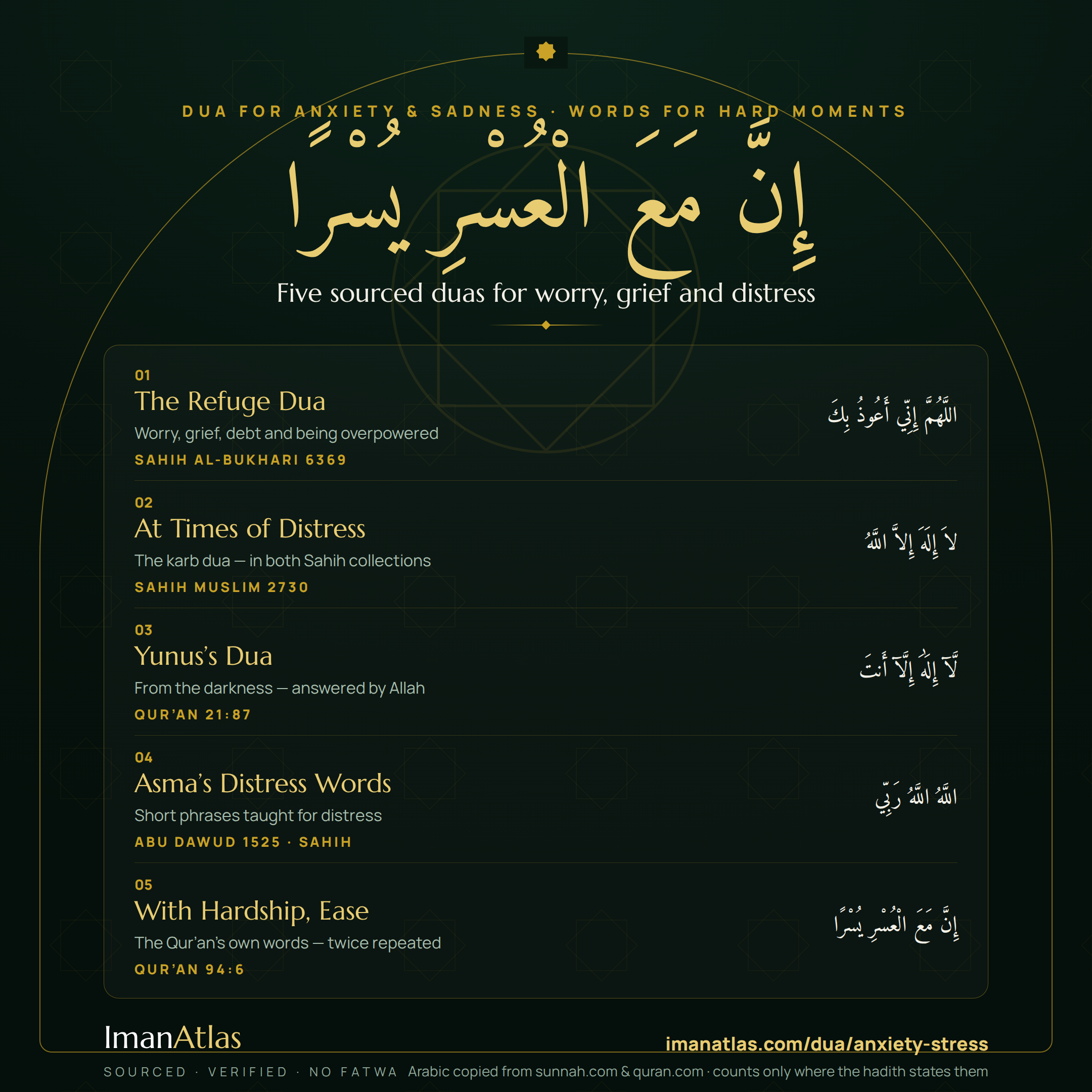
Words for worry and grief, exactly as narrated
Authentic duas for anxiety, stress, sadness and distress — Arabic, translation, reference and grade for every one.
Short answer: The duas the Prophet ﷺ himself used for worry and grief are collected here with their sources: his frequent refuge dua against anxiety, sorrow, debt and being overpowered (Bukhari 6369), the dua at times of distress (Muslim 2730), Yunus’s words from the darkness (Qur’an 21:87), and Asma’s short distress dua (Abu Dawud 1525).
These are the words the Prophet ﷺ and the prophets before him turned to in hard moments. If sadness or anxiety stays with you day after day, please reach out as well — to family, to a trusted friend, and to a doctor or counsellor. Accepting support from people is part of looking after yourself.
Translations on this page: hadith — the translations printed at sunnah.com; Qur’an — Dr. Mustafa Khattab (via quran.com). Arabic is copied from those pages, never typed from memory. No repetition count is printed on this page, because none of its narrations states one. ImanAtlas presents sources, not fatwas; this page is duas with their sources, not medical advice.
The dua for worry, grief, debt and being overpowered
Anas ibn Malik reports that the Prophet ﷺ said this dua frequently — a single refuge that names worry about what is coming (hamm), sorrow over what has passed (huzn), incapacity, laziness, cowardice, miserliness, the weight of debt, and being overpowered by men. It is this page’s anchor because it is the fullest wording the Prophet ﷺ himself used, in a Sahih narration.
اللَّهُمَّ إِنِّي أَعُوذُ بِكَ مِنَ الْهَمِّ وَالْحَزَنِ، وَالْعَجْزِ وَالْكَسَلِ، وَالْجُبْنِ وَالْبُخْلِ، وَضَلَعِ الدَّيْنِ، وَغَلَبَةِ الرِّجَالِ
Allahumma inni a’udhu bika minal-hammi wal-hazan, wal-‘ajzi wal-kasal, wal-jubni wal-bukhl, wa dala’id-dayn, wa ghalabatir-rijal.
“Narrated Anas bin Malik: The Prophet (ﷺ) used to say, ‘O Allah! I seek refuge with You from worry and grief, from incapacity and laziness, from cowardice and miserliness, from being heavily in debt and from being overpowered by (other) men.’”
Sahih al-Bukhari 6369 — sunnah.com/bukhari:6369
Its own page: The Dua for Worry and Grief — the full narration, on its own page
The narration attaches no time of day and no number of repetitions to this dua — it is simply what he ﷺ used to say. A morning-and-evening instruction and an outcome story are attached to a different, weaker narration of a similar dua; that narration is shown with its grade in the note section below.
The dua at times of distress (karb)
At moments of severe distress (karb), the Prophet ﷺ would say these words — recorded in both Sahih collections with the same Arabic. The translation printed below is Sahih Muslim’s, named as such, because Sahih al-Bukhari’s printed English for this hadith is a partial, romanised rendering.
لاَ إِلَهَ إِلاَّ اللَّهُ الْعَظِيمُ الْحَلِيمُ، لاَ إِلَهَ إِلاَّ اللَّهُ رَبُّ الْعَرْشِ الْعَظِيمِ، لاَ إِلَهَ إِلاَّ اللَّهُ رَبُّ السَّمَوَاتِ وَرَبُّ الأَرْضِ وَرَبُّ الْعَرْشِ الْكَرِيمِ
La ilaha illallahul-‘Azimul-Halim, la ilaha illallah Rabbul-‘arshil-‘azim, la ilaha illallah Rabbus-samawati wa Rabbul-ard wa Rabbul-‘arshil-karim.
“There is no god but Allah, the Great, the Tolerant, there is no god but Allah, the Lord of the Magnificent Throne There is no god but Allah, the Lord of the Heaven and the earth, the Lord of the Edifying Throne.” (Translation as printed at Sahih Muslim 2730a.)
Sahih al-Bukhari 6346 — sunnah.com/bukhari:6346 · Sahih Muslim 2730a — sunnah.com/muslim:2730a
Its own page: Dua al-Karb — the distress dua, and why this site prints Muslim’s translation
“Do not leave me to myself for an instant”
Abu Bakrah — the Prophet’s ﷺ Companion — taught these as “the supplications to be used by one who is distressed”: a plea not to be abandoned to oneself even for the blink of an eye, and for every affair to be set right.
اللَّهُمَّ رَحْمَتَكَ أَرْجُو فَلاَ تَكِلْنِي إِلَى نَفْسِي طَرْفَةَ عَيْنٍ وَأَصْلِحْ لِي شَأْنِي كُلَّهُ لاَ إِلَهَ إِلاَّ أَنْتَ
Allahumma rahmataka arju, fala takilni ila nafsi tarfata ‘ayn, wa aslih li sha’ni kullah, la ilaha illa ant.
“The supplications to be used by one who is distressed are: ‘O Allah! Thy mercy is what I hope for. Do not abandon me to myself for an instant, but put all my affairs in good order for me. There is no god but Thou.’”
Sunan Abi Dawud 5090 — sunnah.com/abudawud:5090 · Grade: Hasan in chain (Al-Albani), as printed at sunnah.com
The same narration also carries a health dua taught for morning and evening — that part belongs to the Morning and Evening sets. The distress words above carry no repetition count in the narration.
Short words for a moment of distress
The shortest item on this page. The Prophet ﷺ said to Asma bint ‘Umays — a woman who had known real grief — “May I not teach you phrases which you utter in distress?”
اللَّهُ اللَّهُ رَبِّي لاَ أُشْرِكُ بِهِ شَيْئًا
Allahu Allahu Rabbi, la ushriku bihi shay’a.
“May I not teach you phrases which you utter in distress? (These are:) ‘Allah, Allah is my Lord, I do not associate anything as partner with Him.’”
Sunan Abi Dawud 1525 — sunnah.com/abudawud:1525 · Grade: Sahih (Al-Albani), as printed at sunnah.com
Some fatwa sites cite this hadith as “Abu Dawud 1520” — that is the numbering of the older English translation; the Darussalam reference numbering used across this site gives 1525. Same hadith, two numberings.
Yunus’s dua from the darkness
In the belly of the whale, in layers of darkness, the Prophet Yunus (Jonah) called out the words the Qur’an itself preserves — and the verse that follows says Allah answered him and rescued him from al-ghamm, anguish.
أَن لَّآ إِلَٰهَ إِلَّآ أَنتَ سُبْحَٰنَكَ إِنِّى كُنتُ مِنَ ٱلظَّٰلِمِينَ
an lā ilāha illā anta sub’ḥānaka innī kuntu mina l-ẓālimīna
“And ˹remember˺ when the Man of the Whale stormed off ˹from his city˺ in a rage, thinking We would not restrain him. Then in the ˹veils of˺ darkness he cried out, ‘There is no god ˹worthy of worship˺ except You. Glory be to You! I have certainly done wrong.’” (Qur’an 21:87) “So We answered his prayer and rescued him from anguish. And so do We save the ˹true˺ believers.” (Qur’an 21:88)
Qur’an 21:87–88 — quran.com/21/87 · quran.com/21/88
Its own page: The Dua of Yunus — the words, and what the narration does and does not say
A hadith in at-Tirmidhi’s collection carries the same words, with this sentence — printed here as the narration’s own words, not as this site’s promise: “The supplication of Dhun-Nun (Prophet Yunus) when he supplicated, while in the belly of the whale was: ‘There is none worthy of worship except You, Glory to You, Indeed, I have been of the transgressors.’ So indeed, no Muslim man supplicates with it for anything, ever, except Allah responds to him.” (Jami` at-Tirmidhi 3505 — Grade: Sahih (Darussalam), as printed at sunnah.com/tirmidhi:3505.) The narration states no number of repetitions — see the questions below on the counts often attached to it.
Ayyub’s words when adversity touched him
The Prophet Ayyub (Job), in long adversity, said no more than this — he named his harm and named his Lord’s mercy, and complained to no one else.
أَنِّى مَسَّنِىَ ٱلضُّرُّ وَأَنتَ أَرْحَمُ ٱلرَّٰحِمِينَ
annī massaniya l-ḍuru wa-anta arḥamu l-rāḥimīna
“And ˹remember˺ when Job cried out to his Lord, ‘I have been touched with adversity, and You are the Most Merciful of the merciful.’”
Qur’an 21:83 — quran.com/21/83
“Allah is sufficient for us”
When the believers were warned that an army had gathered against them, the Qur’an says the warning only increased them in faith, and they answered with these words. Ibn ‘Abbas’s narration, printed below, traces the same words back to Ibrahim at the fire.
حَسْبُنَا ٱللَّهُ وَنِعْمَ ٱلْوَكِيلُ
ḥasbunā l-lahu waniʿ’ma l-wakīlu
“Those who were warned, ‘Your enemies have mobilized their forces against you, so fear them,’ the warning only made them grow stronger in faith and they replied, ‘Allah ˹alone˺ is sufficient ˹as an aid˺ for us and ˹He˺ is the best Protector.’” (Qur’an 3:173)
Qur’an 3:173 — quran.com/3/173 · Sahih al-Bukhari 4563 — sunnah.com/bukhari:4563
Ibn ‘Abbas narrated: “‘Allah is Sufficient for us and He Is the Best Disposer of affairs,’ was said by Abraham when he was thrown into the fire; and it was said by Muhammad when they (i.e. hypocrites) said, ‘A great army is gathering against you, therefore, fear them,’ but it only increased their faith and they said: ‘Allah is Sufficient for us, and He is the Best Disposer (of affairs, for us).’” (Sahih al-Bukhari 4563.)
Ya Hayyu ya Qayyum — by Your mercy I seek help
Anas reports that when a matter distressed the Prophet ﷺ, he would say these words. The full narration lives on the Morning Duas & Azkar page; it is listed here in short form so this set stays complete without printing the same block twice.
يَا حَىُّ يَا قَيُّومُ بِرَحْمَتِكَ أَسْتَغِيثُ
Yā Ḥayyu yā Qayyūm, bi-raḥmatika astaghīth
“O Living, O Sustainer! By Your mercy I seek help.”
Jami` at-Tirmidhi 3524 — sunnah.com/tirmidhi:3524 · Grade: Hasan (Darussalam), as printed at sunnah.com; at-Tirmidhi himself called the hadith gharib
What the Qur’an says around these duas
Two short verses frame everything above. They are printed as the Qur’an’s own words — quoted and attributed, not turned into a promise about any reader’s timeline.
فَإِنَّ مَعَ ٱلْعُسْرِ يُسْرًا · إِنَّ مَعَ ٱلْعُسْرِ يُسْرًا
fa-inna maʿa l-ʿus’ri yus’ran
inna maʿa l-ʿus’ri yus’ran
“So, surely with hardship comes ease.” (Qur’an 94:5) “Surely with ˹that˺ hardship comes ˹more˺ ease.” (Qur’an 94:6)
Qur’an 94:5–6 — quran.com/94/5 · quran.com/94/6
وَمَن يَتَوَكَّلْ عَلَى ٱللَّهِ فَهُوَ حَسْبُهُۥٓ
waman yatawakkal ʿalā l-lahi fahuwa ḥasbuhu
“And whoever puts their trust in Allah, then He ˹alone˺ is sufficient for them. Certainly Allah achieves His Will. Allah has already set a destiny for everything.” (The verse’s full translation, as printed at quran.com, begins: “and provide for them from sources they could never imagine.”)
Qur’an 65:3 — quran.com/65/3
One more verse belongs in this company: “Allah does not require of any soul more than what it can afford” — the close of Surah al-Baqarah (2:286). Its full text, with the narration that its two verses suffice for the night, is on the Evening Duas & Azkar page.
Two widely shared narrations — with their grades shown
Two narrations are shared for anxiety more than almost any others. Both are printed at sunnah.com with a Da’if (weak) grade. ImanAtlas does not hide that, and does not build a practice on them — they are shown here, labelled, so you can see exactly what is being shared and what its grade is.
The Abu Umamah story — Sunan Abi Dawud 1555
The narration tells of Abu Umamah sitting in the mosque outside prayer time because anxieties and debts had overwhelmed him; the Prophet ﷺ taught him words to say in the morning and evening, and the narration ends with Abu Umamah’s words that Allah removed his care and settled his debt. Two honest notes: its dua wording differs from Bukhari 6369’s (it repeats the refuge formula clause by clause), and its ending is the narration’s own report — not a promise to any reader.
Sunan Abi Dawud 1555 — sunnah.com/abudawud:1555 · Grade: Da’if (Al-Albani), as printed at sunnah.com
Persisting in istighfar — Sunan Ibn Majah 3819
“Whoever persists in asking for forgiveness, Allah will grant him relief from every worry, and a way out from every hardship, and will grant him provision from (sources) he could never imagine.” One precision: this narration speaks of persisting in istighfar generally — it does not contain any specific formula, and no narration verified for this page ties one particular istighfar wording to relief from distress.
Sunan Ibn Majah 3819 — sunnah.com/ibnmajah:3819 · Grade: Da’if (Darussalam), as printed at sunnah.com
One famous dua still waiting — and one now printed
Honesty about what is missing matters as much as what is printed. When this page was first built, two of the most famous distress duas could not be printed here, because our research could not verify their Arabic text and grade at the primary source. One of them has since been verified — and printed.
The first is the long dua beginning “Allahumma inni ‘abduka” (“O Allah, I am Your slave, the son of Your slave…”), widely quoted from the Musnad of Imam Ahmad. It has now been verified in sunnah.com’s printing of Hisn al-Muslim (entry 120), which carries its Arabic, its translation and its grading note — so it is printed in full, with its source shown, on its own page: Allahumma Inni Abduka — Ibn Mas’ud’s dua for anxiety and grief. The second is “Allahumma la sahla illa ma ja’altahu sahla” (“O Allah, there is no ease except what You make easy”), reported from Sahih Ibn Hibban. Its wording has also since been verified, in the same Hisn al-Muslim printing (entry 139); it belongs with the duas for difficulty rather than with anxiety, so it is still named here, not printed — it will appear with those duas.
When sadness or worry stays
These are the words the Prophet ﷺ and the prophets before him turned to in hard moments. If sadness or anxiety stays with you day after day, please reach out as well — to family, to a trusted friend, and to a doctor or counsellor. Accepting support from people is part of looking after yourself.
Two companion sets sit beside this page: the protection words of the morning and evening — “Bismillahilladhi” (Abu Dawud 5088) and the ‘afiyah dua (Abu Dawud 5074) — are in full on the Morning and Evening pages, and the full nightly set is on the Duas Before Sleeping page.
The anxiety duas, one by one
Five of these duas now have a page of their own, with the narrations around them:
The Dua for Worry and Grief — the eight refuges, in full (Sahih al-Bukhari 6369).
The Dua of Yunus — the words from inside the whale, and what the narration does and does not say (Qur’an 21:87).
Allahumma Inni Abduka — Ibn Mas’ud’s long dua for anxiety and grief, verified in the Hisn al-Muslim printing (Musnad Ahmad 1/391).
Asma bint ‘Umays’s Words for Distress — the short words the Prophet ﷺ taught her for times of distress, in both its narrations (Abu Dawud 1525 · Ibn Majah 3882).
Dua al-Karb — the distress dua the Prophet ﷺ turned to in hard moments (Sahih al-Bukhari 6346).
Frequently asked questions
What is the best dua for anxiety in Islam?
The fullest wording the Prophet ﷺ himself used is the refuge dua of Sahih al-Bukhari 6369 — Anas reports that he ﷺ said it frequently. In one dua it seeks refuge from worry (hamm) and grief (huzn), incapacity and laziness, cowardice and miserliness, heavy debt, and being overpowered by men. It is the first block on this page, with its Arabic and source.
How many times should the dua of Yunus be read?
No number. The hadith that carries Yunus’s dua (Jami` at-Tirmidhi 3505, graded Sahih (Darussalam) as printed at sunnah.com) states no count at all, and no narration verified for this page attaches one. Large figures sometimes shared for it — such as 125,000 times — appear in no narration we could verify, so this page prints none.
Is the Abu Umamah dua for anxiety and debt authentic?
The story is narrated in Sunan Abi Dawud 1555 and is graded Da’if (Al-Albani) as printed at sunnah.com — it is shown in this page’s note section with its grade. The dua at its heart is established separately, without the morning-and-evening instruction and the outcome story, by the Sahih narration of Bukhari 6369, which is this page’s first block.
Do these duas cure depression?
This page makes no such claim. It collects, with their sources, the words the Prophet ﷺ and the prophets before him turned to in worry, grief and distress — it is a page of duas, not a treatment, and it does not diagnose or promise outcomes. If sadness or anxiety stays with you day after day, please reach out as well — to family, to a trusted friend, and to a doctor or counsellor. Accepting support from people is part of looking after yourself.
What does “Hasbunallah wa ni’mal-wakil” mean, and when was it said?
It means “Allah is sufficient for us, and He is the best Protector (Disposer of affairs)” — the believers’ answer in Qur’an 3:173 when warned that an army had gathered against them. Ibn ‘Abbas narrated that Ibrahim said the same words when he was thrown into the fire, and the Prophet ﷺ and his companions said them when threatened (Sahih al-Bukhari 4563).
What about the famous dua “Allahumma inni ‘abduka”?
It is printed — on its own page. When this page was first built, the dua could not be verified at its source, so it was named here instead of printed unchecked. It has since been verified in sunnah.com’s printing of Hisn al-Muslim (entry 120), and the full text, with its translation and grading note, is here: Allahumma Inni Abduka.
What is the dua when something is difficult — “Allahumma la sahla”?
The words “O Allah, there is no ease except what You make easy, and You make the difficult easy if You wish” are reported from Sahih Ibn Hibban. Its wording has since been verified in sunnah.com’s printing of Hisn al-Muslim (entry 139). It belongs with the duas for difficulty, so it is named here rather than printed on this page; it will be printed with those duas, with its reference and grade.
Can I read these duas in translation instead of Arabic?
Every block on this page prints the Arabic together with a named translation — the translations printed at sunnah.com for the hadith, and Dr. Mustafa Khattab’s for the Qur’an — precisely so a reader can understand the words they are saying. Reading the translation alongside the Arabic is a reasonable way to learn them; this page describes the sources and leaves rulings to qualified scholars.
Sources
Hadith Arabic and translations: the pages printed at sunnah.com — Bukhari 6369 · Bukhari 6346 · Muslim 2730a · Abu Dawud 5090 · Abu Dawud 1525 · Abu Dawud 1555 · Ibn Majah 3819 · Tirmidhi 3505 · Tirmidhi 3524 · Bukhari 4563. Qur’an Arabic: the Tanzil Uthmani text (tanzil.net); Qur’an translation: Dr. Mustafa Khattab, as printed at quran.com — 21:83 · 21:87 · 21:88 · 3:173 · 94:5 · 94:6 · 65:3. Grades are exactly as printed at sunnah.com. Every claim on this page was checked against these pages on 28 November 2026.
Share this set