The Tasbih of Fatimah — the Bedtime Dhikr Better Than a Servant
When Fatimah asked for a servant, the Prophet ﷺ came to her bedside and gave her words instead — three phrases, counted on the way to sleep. This page prints the teaching in its own order, and keeps it apart from the tasbih said after prayer.
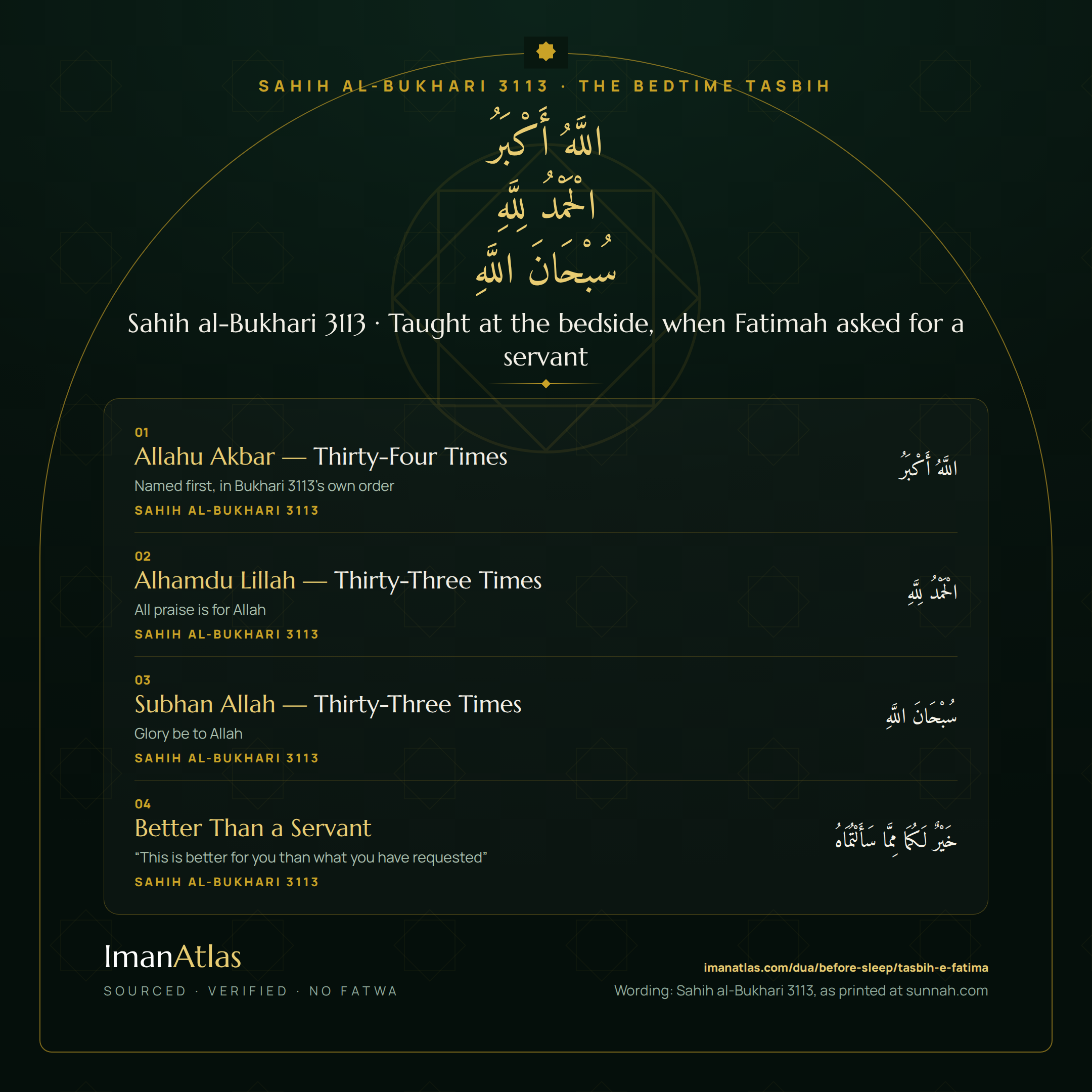
Short answer: When Fatimah asked the Prophet ﷺ for a servant, he came to her bedside and taught instead: say Allahu Akbar thirty-four times, Alhamdu lillah thirty-three times, and Subhan Allah thirty-three times — ‘better for you than what you have requested’ (Sahih al-Bukhari 3113).
Translations on this page: the translations printed at sunnah.com. ImanAtlas presents sources, not fatwas; for a ruling on your own situation, ask a qualified scholar you trust.
What Fatimah asked, and what she was given instead
Fatimah’s hands were worn from work. Bukhari 3113’s narration opens with her need, in its printed words: “Fatima complained of what she suffered from the hand mill and from grinding, when she got the news that some slave girls of the booty had been brought to Allah’s Messenger (ﷺ). She went to him to ask for a maid-servant, but she could not find him, and told `Aisha of her need.” She asked for help with the labour of the house — a servant.
What came back was not a servant. “The Prophet (ﷺ) came to our house when we had gone to our beds.” He ﷺ came to the house of Fatimah and ‘Ali at night, after they had already lain down, and taught them words for that very moment — the moment of going to bed. The teaching that carries her name begins there: not in a lesson, not in the mosque, but at a bedside, in answer to tired hands. On the Duas Before Sleeping page it stands as one item of the bedtime set. Here it has a page of its own, because its own details — the order of its phrases, the count of thirty-four, and the way its printings differ — are exactly what lists flatten away.
The words, in the order Bukhari 3113 gives them
The block below stands exactly as it stands on the pillar — the narration’s Arabic, its printed translation, the narration’s own count, and the reference line:
The tasbih taught to Fatima — on going to bed
إِذَا أَخَذْتُمَا مَضَاجِعَكُمَا فَكَبِّرَا اللَّهَ أَرْبَعًا وَثَلاَثِينَ، وَاحْمَدَا ثَلاَثًا وَثَلاَثِينَ، وَسَبِّحَا ثَلاَثًا وَثَلاَثِينَ، فَإِنَّ ذَلِكَ خَيْرٌ لَكُمَا مِمَّا سَأَلْتُمَاهُ
Fatima asked the Prophet ﷺ for a servant. He came to her and ‘Ali at night and said: “Shall I tell you a thing which is better than what you asked me for? When you go to your beds, say: ‘Allahu Akbar (i.e. Allah is Greater)’ for 34 times, and ‘Al hamdu Li llah (i.e. all the praises are for Allah)’ for 33 times, and Subhan Allah (i.e. Glorified be Allah) for 33 times. This is better for you than what you have requested.” (Bukhari 5361 prints the same teaching with the tasbih named first; the counts are identical.)
Allahu Akbar ×34 · Alhamdulillah ×33 · SubhanAllah ×33Sahih al-Bukhari 3113 · Sahih al-Bukhari 5361 · Sahih Muslim 2727a — a bedtime teaching, a different narration from the tasbih after salah (the After Salah page carries that set).
Hold on to the order. In this printing the takbir is named first, and it alone carries the larger count: Allahu Akbar thirty-four times, then Alhamdulillah thirty-three, then Subhan Allah thirty-three. The three phrases themselves, in the order this narration names them:
اللَّهُ أَكْبَرُ · الْحَمْدُ لِلَّهِ · سُبْحَانَ اللَّهِ
Allahu Akbar · Alhamdulillah · SubhanAllah.
The same three phrases stand on the Tasbih After Salah page, where the pillar’s audit-verified phrase line runs in that page’s order; here the line follows 3113’s order, takbir first. Nothing else is claimed for the wording: the closing words of the teaching — “better for you than what you have requested” — are the narration’s, and they appear on this page only inside its quotes.
How this differs from the tasbih after salah
The same three phrases are counted after every obligatory prayer — and that is a different teaching, not this one moved to another hour. The after-salah set rests on Sahih Muslim’s narrations: thirty-three of each phrase, completed to a hundred with the tahlil (Muslim 597a), and a second narration whose takbir is thirty-four (Muslim 596a). This bedtime teaching rests on the Fatimah narrations: it is said on going to bed, it carries no completing tahlil, and in its fullest printings the thirty-four belongs to the takbir named first.
Two settings, two sources, two counts — the pages on this site keep them apart on purpose, because merging them produces a formula no single narration prints. The after-salah narrations stand in full on The Tasbih After Salah, and the whole after-prayer set on the Duas After Salah page. Which form to say in which place is a question this page leaves where it belongs: the narrations are printed; the ruling is a scholar’s.
The other narrations of the same teaching
Bukhari prints the teaching a second time, at 5361, and the order turns around: there the tasbih is named first and the takbir — still thirty-four — comes last. Its printed translation runs: “Shall I direct you to something better than what you have requested? When you go to bed say ‘Subhan Allah’ thirty-three times, ‘Al hamduli l-lah’ thirty three times, and Allahu Akbar’ thirty four times, for that is better for you than a servant.” Its Arabic as printed:
إِذَا أَخَذْتُمَا مَضَاجِعَكُمَا ـ أَوْ أَوَيْتُمَا إِلَى فِرَاشِكُمَا ـ فَسَبِّحَا ثَلاَثًا وَثَلاَثِينَ، وَاحْمَدَا ثَلاَثًا وَثَلاَثِينَ، وَكَبِّرَا أَرْبَعًا وَثَلاَثِينَ، فَهْوَ خَيْرٌ لَكُمَا مِنْ خَادِمٍ
The counts agree; the sequence does not, and neither printing is corrected against the other here. Bukhari’s Book of Invocations carries the teaching again, at 6318 — this printing gives thirty-three of each phrase, and then its own narrators add a note about the tasbih’s count:
فَكَبِّرَا ثَلاَثًا وَثَلاَثِينَ، وَسَبِّحَا ثَلاَثًا وَثَلاَثِينَ، وَاحْمَدَا ثَلاَثًا وَثَلاَثِينَ، فَهَذَا خَيْرٌ لَكُمَا مِنْ خَادِمٍ
“Shall I not tell you of a thing which is better for you than a servant? When you (both) go to your beds, say ‘Allahu Akbar’ thirty-three times, and ‘Subhan Allah’ thirty-three times, ‘Al hamdu ‘illah’ thirty-three times, for that is better for you than a servant.” The printed text then carries a note from the route’s own narrators: “Ibn Seereen said, “Subhan Allah’ (is to be said for) thirty-four times.”” (Arabic: التَّسْبِيحُ أَرْبَعٌ وَثَلاَثُونَ).
Allahu Akbar ×33 · SubhanAllah ×33 · Alhamdulillah ×33Sahih al-Bukhari 6318 · sunnah.com/bukhari:6318
And Muslim prints it at 2727a, from ‘Ali’s telling — the cold of the Prophet’s ﷺ feet on his chest as he sat between them is in this route’s frame. Its count stands with 3113’s: the takbir at thirty-four:
أَنْ تُكَبِّرَا اللَّهَ أَرْبَعًا وَثَلاَثِينَ وَتُسَبِّحَاهُ ثَلاَثًا وَثَلاَثِينَ وَتَحْمَدَاهُ ثَلاَثًا وَثَلاَثِينَ فَهُوَ خَيْرٌ لَكُمَا مِنْ خَادِمٍ
“May I not direct you to something better than what you have asked for? When you go to your bed, you should recite Takbir (Allah-o-Akbar) thirty-four times and Tasbih (Subhan Allah) thirty-three times and Tahmid (al-Hamdu li-Allah) thirty-three times, and that is better than the servant for you.”
Allahu Akbar ×34 · SubhanAllah ×33 · Alhamdulillah ×33Sahih Muslim 2727a · sunnah.com/muslim:2727a
A further printing stands in Sunan Abi Dawud (5062), recorded on the pillar; it is named here, not reprinted, so that this page’s texts all come from pages read in full. Four printings, one teaching — each with its own order and its own count, and none of them blended into a single formula.
Questions, answered from the sources
What is Tasbih Fatimah and why is it called that?
It carries Fatimah’s name because it was taught to her. The Prophet’s ﷺ daughter came asking for a servant — her hands were worn from the hand mill — and that night he ﷺ came to her and her husband ‘Ali and taught them these words for going to bed instead: “When you go to your beds, say: ‘Allahu Akbar (i.e. Allah is Greater)’ for 34 times, and ‘Al hamdu Li llah (i.e. all the praises are for Allah)’ for 33 times, and Subhan Allah (i.e. Glorified be Allah) for 33 times. This is better for you than what you have requested” (Sahih al-Bukhari 3113).
What are the exact numbers — 33, 33, 34 or 33 each?
Each printing carries its own count, and this page merges none of them. Bukhari 3113 and Muslim 2727a give the thirty-four to the takbir. Bukhari 5361 also gives thirty-four takbir, naming it last. Bukhari 6318 prints thirty-three of each — and its own text adds Ibn Sirin’s note that the tasbih is thirty-four. All four stand on this page with their references. Which count to follow is a question for a qualified scholar you trust; this page prints the narrations, it does not settle between them.
Is Tasbih Fatimah said after prayer or before sleep?
This teaching is for the bedside — every printing of it opens with going to bed: “When you go to your beds…” (Sahih al-Bukhari 3113). The tasbih after prayer is a different teaching in different narrations (Sahih Muslim 597a and 596a), and it has its own page on this site. The three phrases are the same; the settings, the counts and the sources are not, and the two are not merged here.
What did the Prophet ﷺ say when Fatimah asked for a servant?
In Bukhari 3113’s telling: “Shall I tell you a thing which is better than what you asked me for?” — then the words and their counts, closing: “This is better for you than what you have requested.” Muslim’s printing (2727a) ends the same teaching: “and that is better than the servant for you.” The comparison is the narration’s own; this page repeats it only inside those quotes.
Can the same tasbih be said after salah instead?
The three phrases are said after salah too — but on the strength of other narrations, with their own counts: SubhanAllah thirty-three, Alhamdulillah thirty-three, Allahu Akbar thirty-three, completed to a hundred with the tahlil (Sahih Muslim 597a), and a second narration ending on thirty-four takbir (Muslim 596a). They stand in full on the Tasbih After Salah page. Whether this bedtime wording may be carried into the after-prayer place is a ruling, not a reading — ask a qualified scholar you trust.
Sources
Every text and claim on this page comes from these pages, read on 28 November 2026. Translations: sunnah.com’s printed translations.
- The teaching in full — Sahih al-Bukhari 3113
- Bukhari’s second printing, tasbih named first — Sahih al-Bukhari 5361
- The Book of Invocations printing, thirty-three of each — Sahih al-Bukhari 6318
- The same teaching from ‘Ali’s telling — Sahih Muslim 2727a
- A further printing, named on the pillar — Sunan Abi Dawud 5062
- The full bedtime set this page belongs to — Duas Before Sleeping
- The other tasbih, after salah — The Tasbih After Salah
- Hub — Duas & Azkar
Found an error? We correct mistakes within 24 hours, with a note on the page — write to us through the website.