After a Sin — Abu Dawud 1521 · Qur’an 3:135
One narration stands behind the prayer the books call Salat al-Tawbah. The field around it sells a method — steps, conditions, rulings. This page does the plainer thing: it prints Abu Bakr’s narration whole, as the report it is, sets the verse he recited beside it, and assembles nothing of its own.
Short answer: After a sin, Abu Bakr heard the Prophet ﷺ describe a servant who performs wudu well, prays two rak’ahs, and asks Allah’s pardon — and he then recited Qur’an 3:135. This page prints that narration whole, as a report, and assembles no method, checklist or ruling of its own.
ImanAtlas does not give fatwas. For your own situation, ask a qualified scholar you trust.
Beyond what these texts themselves say, this page adds nothing — no count, no course, no date for the Night, and no checklist for your repentance.
Search for what to do after a sin and the results arrive as instructions: how the prayer is offered, how many rak’ahs, whether it may be prayed after ‘Asr, which surahs to read in it, what conditions make the repentance valid, even what is said to multiply its reward. Underneath all of that apparatus stands a single narration — Abu Bakr’s, in Sunan Abi Dawud — and a single verse of the Qur’an that the Prophet ﷺ recited at its end. This page prints those two texts whole and stops there. It is a report of a narration, not a method for a prayer, and the difference is the subject of the page.
The narration itself — Sunan Abi Dawud 1521
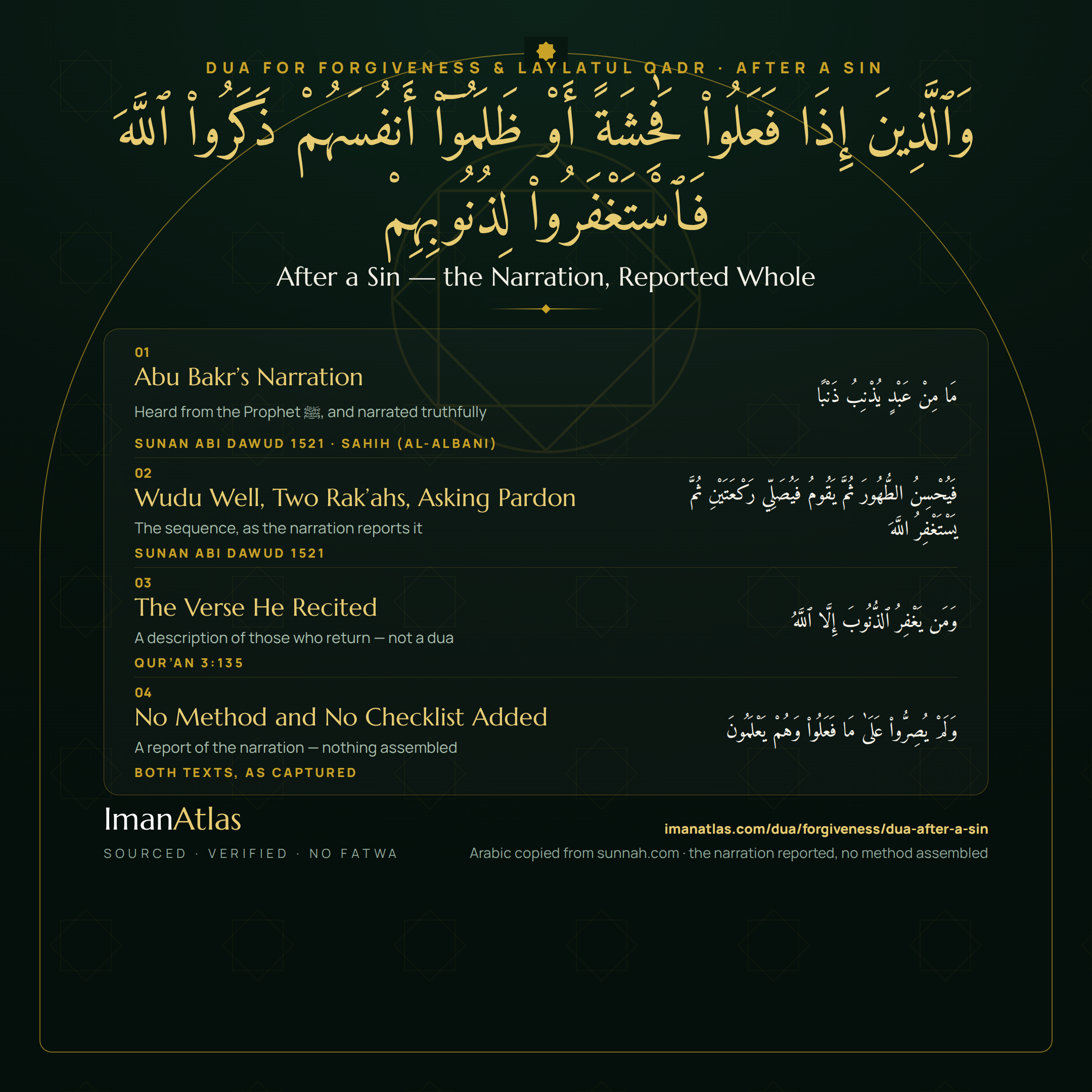
The narration reaches Abu Dawud through a chain that is itself part of the report: Asma’ bint al-Hakam heard it from ‘Ali, who tells how he would adjure any companion who narrated a hadith to him — and how Abu Bakr, when adjured, narrated truthfully. What Abu Bakr had heard from the Prophet ﷺ is a description, in sequence: a servant commits a sin; he performs his ablution well; he stands and prays two rak’ahs; he asks Allah’s pardon. The outcome the narration attaches to that sequence stands inside its own words, in the block below, and nowhere else on this page:
مَا مِنْ عَبْدٍ يُذْنِبُ ذَنْبًا فَيُحْسِنُ الطُّهُورَ ثُمَّ يَقُومُ فَيُصَلِّي رَكْعَتَيْنِ ثُمَّ يَسْتَغْفِرُ اللَّهَ إِلاَّ غَفَرَ اللَّهُ لَهُ
“Narrated AbuBakr as-Siddiq: Asma’ bint al-Hakam said: I heard Ali say: I was a man; when I heard a tradition from the Messenger of Allah (ﷺ), Allah benefited me with it as much as He willed. But when some one of his companions narrated a tradition to me I adjured him. When he took an oath, I testified him. AbuBakr narrated to me a tradition, and AbuBakr narrated truthfully. He said: I heard the apostle of Allah (ﷺ) saying: When a servant (of Allah) commits a sin, and he performs ablution well, and then stands and prays two rak’ahs, and asks pardon of Allah, Allah pardons him. He then recited this verse: "And those who, when they commit indecency or wrong their souls, remember Allah" (Al-Qur’an 3:135).”
Sunan Abi Dawud 1521
Grade: Sahih (Al-Albani), as printed at sunnah.com
Three things about that block belong to the record. Its grade is the one sunnah.com prints — Sahih, by Al-Albani’s grading — and it stands on the block, not borrowed for anything else on the page. The narration gives no words of istighfar: it says the servant “asks pardon of Allah” and supplies no formula, which is why this block carries no transliteration line — sunnah.com prints none for this narration, and there is no quoted formula here for a line to follow. And the narration does not end with the pardon: it ends with the Prophet ﷺ reciting a verse, and the verse is the next section.
The verse he ﷺ recited — Qur’an 3:135
Abu Dawud’s printed text quotes the verse’s opening inside the narration — “And those who, when they commit indecency or wrong their souls, remember Allah” — and stops there. The verse itself, whole, stands on this site’s pillar and is printed here as it stands there. It is labelled plainly: this is a description, not a dua. It describes a kind of person — one who, after an evil deed or after wronging himself, remembers Allah and seeks forgiveness for his sins, asks who forgives sins except Allah, and does not knowingly persist in the wrong:
وَٱلَّذِينَ إِذَا فَعَلُوا۟ فَٰحِشَةً أَوْ ظَلَمُوٓا۟ أَنفُسَهُمْ ذَكَرُوا۟ ٱللَّهَ فَٱسْتَغْفَرُوا۟ لِذُنُوبِهِمْ وَمَن يَغْفِرُ ٱلذُّنُوبَ إِلَّا ٱللَّهُ وَلَمْ يُصِرُّوا۟ عَلَىٰ مَا فَعَلُوا۟ وَهُمْ يَعْلَمُونَ
wa-alladhīna idhā faʿalū fāḥishatan aw ẓalamū anfusahum dhakarū l-laha fa-is’taghfarū lidhunūbihim waman yaghfiru l-dhunūba illā l-lahu walam yuṣirrū ʿalā mā faʿalū wahum yaʿlamūna
“˹They are˺ those who, upon committing an evil deed or wronging themselves, remember Allah and seek forgiveness for their sins—and who forgives sins except Allah?—and they do not knowingly persist in wrongdoing.”
Qur’an 3:135
The verse carries the pillar’s audited transliteration line, as the block carries it there. Note what the description holds together: the seeking of forgiveness and the not-persisting stand in one sentence, as one portrait. The page that follows takes its discipline from that portrait — the texts describe; they do not issue a checklist, and neither does this page on their behalf.
A report, not a method — what this page does not assemble
Around this one narration, a whole genre has been built, and its apparatus is worth naming so it can be recognised. There is a spoken formula of intention, to be said aloud before the prayer — the narration contains no such formula. There are numbered lists of the conditions of a valid repentance, presented as a checklist to be completed — the narration lays down no conditions, and the verse beside it gives a description, not a list. There is the claim that saying the master dua of forgiveness after this prayer multiplies its reward — an outcome-multiplier that stands in no text printed here. And there are the rulings the genre is built to answer: how many rak’ahs, at what hours, whether after ‘Asr — each answered in a fatwa’s voice, because a method needs its rulings.
This page assembles none of it. Not because the questions are unimportant, but because they are not this page’s to answer: a site that prints narrations with their sources reports what the narration says, names what has been added around it, and routes the rulings to the people qualified to give them. The narration’s sequence is reported above, in its own words. It is not re-set here as steps, and no schema on this page describes a procedure — there is no procedure on this page to describe.
What the narration does not contain — no surah, no hour, no formula
It is worth listing what stands in neither text, because the genre supplies all of it. No surah: the narration does not name anything to be recited in the two rak’ahs — not al-Kafirun, not al-Ikhlas, not any verse. No hour: it fixes no time of day, no day of the week, no window after the sin; the servant sins, washes, stands, prays and asks, and the narration leaves the clock out of it entirely. No formula: the asking of pardon is reported, not worded — anyone who prints exact words for the servant to say inside this prayer is printing his own words, not the narration’s. And no second narration is printed beside this one: other routes for this report are cited across the field, but this site prints only what it has captured whole, and it has captured this one.
What the two texts contain is a sequence reported and a portrait described. Everything beyond that is the genre’s apparatus around them, and it is named here as apparatus — not practised, and not endorsed.
Decisions, methods and your own situation
How this prayer is offered, when it may be offered, what makes a repentance valid, and what your own repeated sin requires of you — these are ruling and practice questions, and the two texts above do not answer them. The texts are printed, with their sources; the rulings belong to scholars. The rest of this cluster stands on the pillar this page belongs to: Duas for Forgiveness, Repentance & Laylatul Qadr — including the verse of not despairing (Qur’an 39:53), printed whole there. Its companion page, on the words taught for the Night of Qadr, is here: The Dua for Laylatul Qadr — Tirmidhi 3513 · Ibn Majah 3850.
ImanAtlas does not give fatwas. For your own situation, ask a qualified scholar you trust.
Beyond what these texts themselves say, this page adds nothing — no count, no course, no date for the Night, and no checklist for your repentance.
Frequently asked questions
I have just committed a sin — what do I do now?
This page gives you the report, not a ruling. Abu Bakr narrated that the Prophet ﷺ described a servant who commits a sin, performs wudu well, stands and prays two rak’ahs, and asks Allah’s pardon — and the verse he then recited, Qur’an 3:135, describes those who remember Allah, seek forgiveness for their sins, and do not knowingly persist. Both texts are printed whole above. What they mean for your own case — its ruling, its conditions, its repair — is a question for a qualified scholar you trust.
How many rak’ahs does the narration mention?
Two. The number stands inside the narration’s own words — “he performs ablution well, and then stands and prays two rak’ahs, and asks pardon of Allah” (Sunan Abi Dawud 1521) — as part of what the Prophet ﷺ described. It is the structure of the reported act, quoted here as the narration gives it; this page issues no prescription of its own and builds no prayer method around it.
What should be recited in the two rak’ahs — is there a special surah?
The narration names none. It says the servant stands and prays two rak’ahs, and it does not name a surah, a verse or a single word to be said in them — it does not even give a formula of istighfar, only that he “asks pardon of Allah”. The named surahs and spoken formulas that circulate with this prayer are additions of the genre around it; they stand in no text on this page, and this page prints none of them.
Can this prayer be offered after ‘Asr, or at any time?
That is a ruling question — it is, word for word, one of the questions the fatwa literature on this narration answers, and rulings are not given on this site. The narration itself fixes no hour: it describes a servant who sins, washes, prays and asks pardon, and it attaches no time of day to any of it. Whether and when the prayer may be offered in your own practice belongs to a qualified scholar.
Is this prayer a condition for repentance to be accepted?
The narration does not present it as one. It describes what a servant did and what the Prophet ﷺ said of him; it does not lay down conditions, and neither does this page. The description the texts themselves give of those who return is the verse’s own — they remember Allah, seek forgiveness, and do not knowingly persist (Qur’an 3:135). Whether a particular repentance is valid or accepted is a matter of fatwa, and fatwas belong to scholars, not to this page.
I keep falling into the same sin — is the door closed for me?
Read what the verse itself describes: those who, after an evil deed or wronging themselves, remember Allah and seek forgiveness for their sins — “and who forgives sins except Allah?” — and who do not knowingly persist in wrongdoing (Qur’an 3:135). The pillar this page belongs to also prints, whole, the verse in which Allah addresses those who have transgressed against themselves and tells them not to despair of His mercy (Qur’an 39:53). Your own case — repeated, and personal — is exactly the kind a qualified scholar should hear; this page prints the texts and routes the case.
Sources
Every text and claim on this page comes from these pages, read on 29 November 2026. The narration’s Arabic and translation are copied from sunnah.com, exactly as captured; the verse’s Arabic is the Tanzil text as this site prints it, and its translation is Dr. Mustafa Khattab’s, as carried at quran.com. The grade printed is the grade sunnah.com prints.
- The narration, with its grade — Sunan Abi Dawud 1521 — sunnah.com
- The verse he recited, with translation — Qur’an 3:135 — quran.com
- The pillar this page belongs to — Duas for Forgiveness, Repentance & Laylatul Qadr
- Its companion page — The Dua for Laylatul Qadr
- Hub — Duas & Azkar
Found an error? We correct mistakes within 24 hours, with a note on the page — write to us through the website.