Morning Azkar, one dua at a time
The best-known duas of the morning adhkar, each on a page of its own — full Arabic, a transliteration taken from the source, translation, and the narrations around it.
Short answer: Morning Azkar is the index of this site’s morning dua pages — each dua from the morning adhkar given its own page, with its Arabic, a source-printed transliteration, its translation and its narrations. Ayat al-Kursi, Sayyidul Istighfar, Bismillahilladhi La Yadurru, Subhanallahi wa Bihamdihi and the Three Quls are all live. The morning set stands complete on the Morning Duas & Azkar page.
ImanAtlas presents sources, not fatwas; for a ruling on your own situation, ask a qualified scholar you trust. Nothing on this page is a dua text — the texts live on the pages listed below.
The duas, one by one
The morning adhkar are usually read as one set, straight after Fajr. This cluster gives the set’s best-known duas a page each — one dua’s full text, its transliteration as the source prints it, its translation, and the narrations around it, with nothing added. The set itself has not moved: it stands complete on the Morning Duas & Azkar page.
Ayat al-Kursi
The Throne Verse, first in the morning adhkar — its full Arabic, transliteration and translation, with the narrations that place it after every prayer and before sleep.
Source: Qur’an 2:255 (Surah al-Baqarah)
Sayyidul Istighfar
The master of seeking forgiveness, taught by the Prophet ﷺ for the morning and the evening — its full Arabic, transliteration and translation on its own page.
Source: Sahih al-Bukhari 6306
Bismillahilladhi La Yadurru
The dua of protection for the morning and the evening, recorded in two narrations whose frames and grades differ — both routes in full on its own page.
Source: Sunan Abi Dawud 5088 · Jami’ at-Tirmidhi 3388
Subhanallahi wa Bihamdihi
The short dhikr of one hundred times, morning and evening, in Sahih Muslim — its full narration and its wording on its own page.
Source: Sahih Muslim 2692
The Three Quls
Surah al-Ikhlas, al-Falaq and an-Nas, three times each in the morning and the evening — both narrations and the full Arabic on their own page.
Source: Sunan Abi Dawud 5082 · Jami’ at-Tirmidhi 3575
The full morning set
These pages slow down for one dua at a time. For the morning adhkar as a single sitting — the whole set in order, Ayat al-Kursi first — read the pillar page. The same treatment continues in the evening set.
Questions, answered from the sources
Which morning duas have their own pages?
Ayat al-Kursi, Sayyidul Istighfar, Bismillahilladhi La Yadurru, Subhanallahi wa Bihamdihi and the Three Quls each have their own page now, linked above. Every dua in the set — these three included — already stands in full on the Morning Duas & Azkar page.
What is the difference between the morning adhkar list and these individual dua pages?
The list page gives the whole morning set in its order, ready to read through after Fajr. An individual page slows down for one dua: its full Arabic, the transliteration as its source prints it, its translation, and the narrations that surround it — nothing added, nothing merged.
Where do these duas come from?
Each one from its primary source, named on its card above and in the Sources below: Ayat al-Kursi is Qur’an 2:255; Sayyidul Istighfar is recorded in Sahih al-Bukhari 6306; Bismillahilladhi La Yadurru is recorded by Abu Dawud (5088) and at-Tirmidhi (3388), each route with its own grade.
Can I read these duas from my phone?
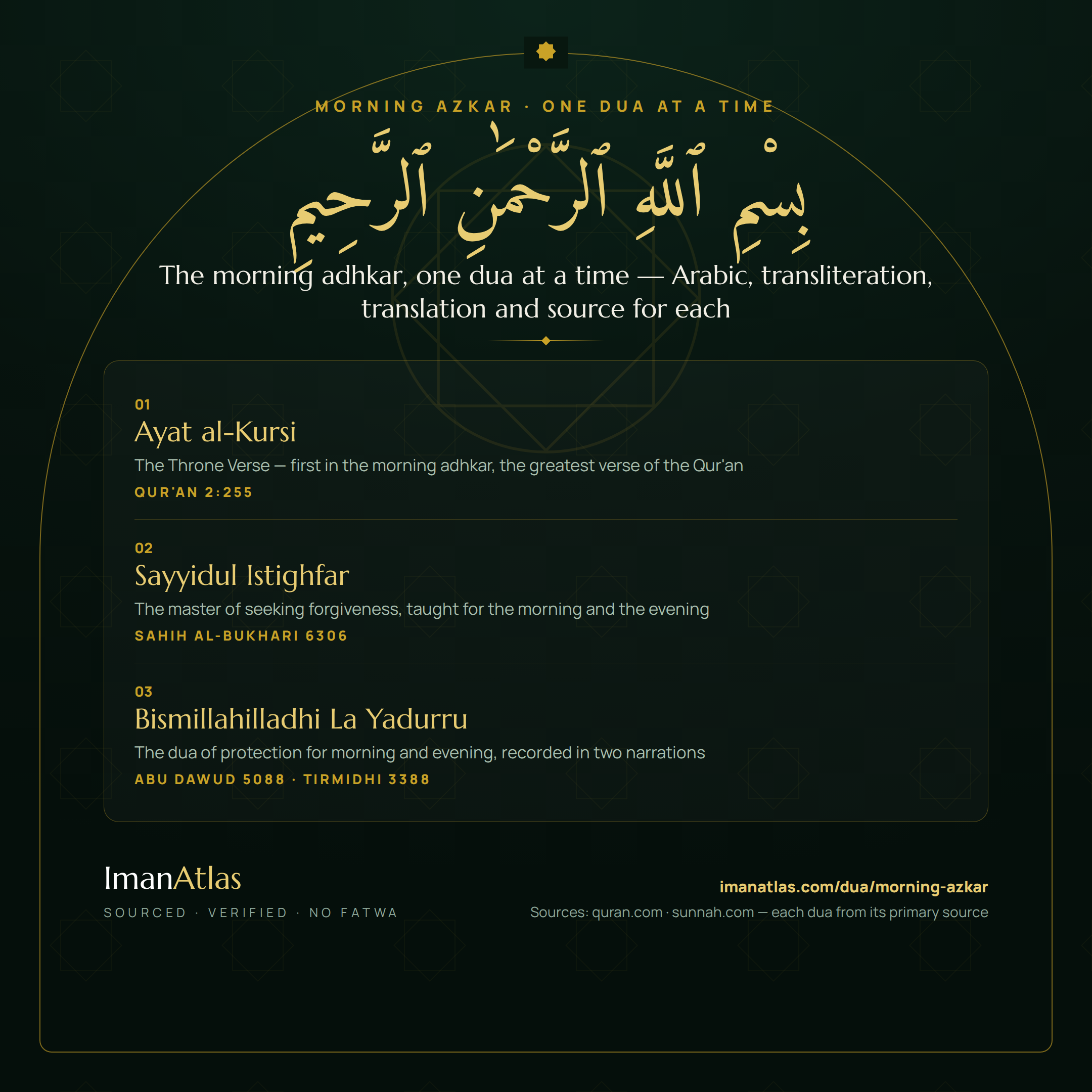
The narrations speak of reciting the duas; they do not name a medium. Each individual page prints the full Arabic, transliteration and translation so it can be read here, and the card below is made to be saved to a phone.
Sources
The three duas indexed here stand on these primary sources, read on 28 November 2026. Translations: Qur’an — Dr. Mustafa Khattab; hadith — sunnah.com’s printed translations.
- Ayat al-Kursi — Qur’an 2:255 (quran.com)
- Sayyidul Istighfar — Sahih al-Bukhari 6306
- Bismillahilladhi La Yadurru — Sunan Abi Dawud 5088 · Jami’ at-Tirmidhi 3388
- Subhanallahi wa Bihamdihi — Sahih Muslim 2692
- The Three Quls — Sunan Abi Dawud 5082 · Jami’ at-Tirmidhi 3575
- The full set — Morning Duas & Azkar · Hub — Duas & Azkar
Found an error? We correct mistakes within 24 hours, with a note on the page — write to us through the website.