The Three Quls, Morning and Evening
The Qur’an’s last three surahs — al-Ikhlas, al-Falaq and an-Nas — each three times when morning comes and three times when evening comes. All three in full, with the two narrations that carry them and each narration’s own grade.
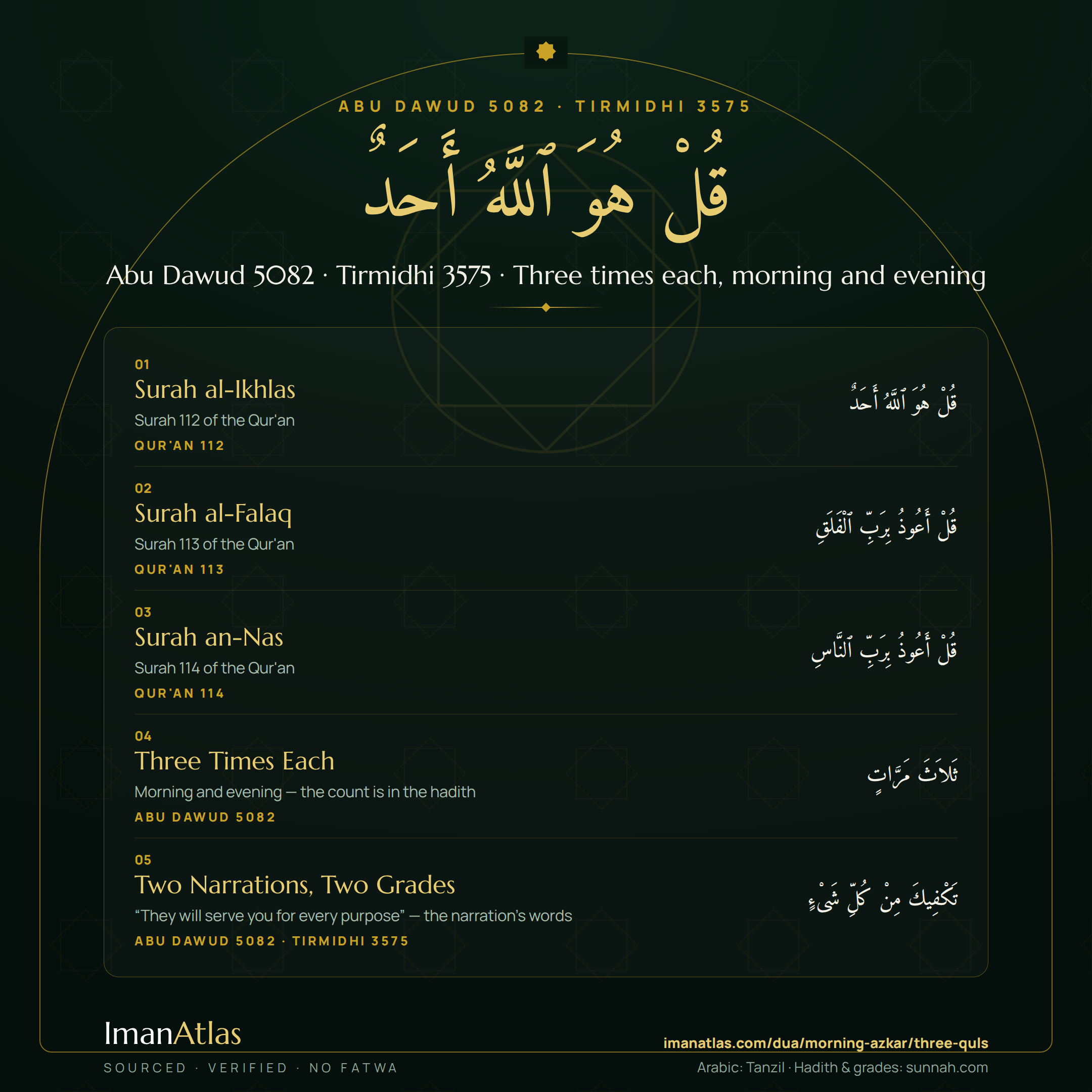
Short answer: The Three Quls are the Qur’an’s last three surahs — al-Ikhlas (112), al-Falaq (113) and an-Nas (114). The Prophet ﷺ told Abdullah ibn Khubayb to recite them three times in the morning and three times in the evening: “they will serve you for every purpose” (Abu Dawud 5082). This page prints the three surahs, with both narrations and their grades.
Translations on this page: Qur’an — Dr. Mustafa Khattab (at quran.com, linked under the surahs); hadith — the translations printed at sunnah.com. Arabic is copied from verified sources, never typed from memory. ImanAtlas presents sources, not fatwas; for a ruling on your own situation, ask a qualified scholar you trust.
What are the Three Quls?
The Three Quls are the last three surahs of the Qur’an: Surah al-Ikhlas (112), Surah al-Falaq (113) and Surah an-Nas (114). Each one opens with the command Qul — “Say” — and that shared first word is what named them. The last two, al-Falaq and an-Nas, are also called al-Mu’awwadhatan, the two surahs of seeking refuge, because each begins “Say: I seek refuge”.
They stand at the head of the morning set on the Morning Duas & Azkar page and again in the evening set, and they are the first of the Morning Azkar pages to give a whole set its own treatment: the three surahs whole, the story of the night they were taught, and both narrations side by side — each with its own grade, never blended into one.
The three surahs — Arabic and transliteration
Here are the three surahs in full, exactly as they stand in the morning set. The roman line under each surah is quran.com’s word-by-word transliteration, the same line carried on this site’s morning page. Following the pattern of the morning and evening pages, no translation is printed under the surahs here; the line beneath them points to Dr. Mustafa Khattab’s translation at quran.com. On this site, al-Falaq and an-Nas also stand with their translation on the Duas for Protection page, where the two refuge surahs are treated as protection; here their home is the adhkar — the words as they are recited, morning and evening.
Surah Al-Ikhlas (112)
قُلْ هُوَ ٱللَّهُ أَحَدٌ ٱللَّهُ ٱلصَّمَدُ لَمْ يَلِدْ وَلَمْ يُولَدْ وَلَمْ يَكُن لَّهُۥ كُفُوًا أَحَدٌۢ
qul huwa l-lahu aḥadun al-lahu l-ṣamadu lam yalid walam yūlad walam yakun lahu kufuwan aḥadun
Surah Al-Falaq (113)
قُلْ أَعُوذُ بِرَبِّ ٱلْفَلَقِ مِن شَرِّ مَا خَلَقَ وَمِن شَرِّ غَاسِقٍ إِذَا وَقَبَ وَمِن شَرِّ ٱلنَّفَّٰثَٰتِ فِى ٱلْعُقَدِ وَمِن شَرِّ حَاسِدٍ إِذَا حَسَدَ
qul aʿūdhu birabbi l-falaqi min sharri mā khalaqa wamin sharri ghāsiqin idhā waqaba wamin sharri l-nafāthāti fī l-ʿuqadi wamin sharri ḥāsidin idhā ḥasada
Surah An-Nas (114)
قُلْ أَعُوذُ بِرَبِّ ٱلنَّاسِ مَلِكِ ٱلنَّاسِ إِلَٰهِ ٱلنَّاسِ مِن شَرِّ ٱلْوَسْوَاسِ ٱلْخَنَّاسِ ٱلَّذِى يُوَسْوِسُ فِى صُدُورِ ٱلنَّاسِ مِنَ ٱلْجِنَّةِ وَٱلنَّاسِ
qul aʿūdhu birabbi l-nāsi maliki l-nāsi ilāhi l-nāsi min sharri l-waswāsi l-khanāsi alladhī yuwaswisu fī ṣudūri l-nāsi mina l-jinati wal-nāsi
The translation of the three surahs used on this site is Dr. Mustafa Khattab’s, at quran.com/112, /113 and /114.
Recite: each surah three times, morning and evening — the count is in the hadithSunan Abi Dawud 5082 — sunnah.com/abudawud:5082 · Grade: Hasan (Al-Albani), as printed at sunnah.com · Arabic: Tanzil Uthmani text
The narration: a rainy, dark night
Abdullah ibn Khubayb narrated the occasion himself. They had gone out on a rainy and very dark night, looking for the Prophet ﷺ so that he would lead them in prayer. When they reached him, the Prophet ﷺ said “Qul” — Say — and, when Abdullah said nothing, repeated it; then he gave him the words of this page. Abu Dawud recorded the narration in his Sunan, in the chapter on what to say when waking up. Here is the heart of it, first in the Arabic as sunnah.com prints it, then in its printed translation:
قُلْ هُوَ اللَّهُ أَحَدٌ وَالْمُعَوِّذَتَيْنِ حِينَ تُمْسِي وَحِينَ تُصْبِحُ ثَلاَثَ مَرَّاتٍ تَكْفِيكَ مِنْ كُلِّ شَىْءٍ
“Say: "Say, He is Allah, One," and al-Mu’awwadhatan three times in the morning and evening; they will serve you for every purpose.”
Sunan Abi Dawud 5082 — sunnah.com/abudawud:5082 · Grade: Hasan (Al-Albani), as printed at sunnah.com
The second narration — at-Tirmidhi’s route
The same teaching reached us by a second road. Mu’adh ibn Abdullah narrated it from his father — the same Abdullah ibn Khubayb — and at-Tirmidhi recorded it in his Jami’. The words are the same teaching, but the route is its own, and so is its grade: this page prints the two side by side and lets neither narration borrow the other’s standing.
“Say: “Say: He is Allah, the One” and Al-Mu`awwidhatain, when you reach evening, and when you reach morning, three times, they will suffice you against everything.”
Jami’ at-Tirmidhi 3575 — sunnah.com/tirmidhi:3575 · Grade: Hasan (Darussalam), as printed at sunnah.com · At-Tirmidhi himself called the narration hasan sahih gharib
How many times, and when?
Three times each, at both ends of the day. Both narrations say it in the same terms: when you reach the morning and when you reach the evening. That is why the Quls stand in both sets on this site — in the morning adhkar and in the evening adhkar, in the same words, with the same count. The count belongs to the narrations; this page sets no count of its own, and it gives the words no procedure — the narrations themselves attach none.
The same surahs at bedtime
These are not only morning and evening words. The Prophet ﷺ also recited al-Ikhlas and the Mu’awwadhatan when he went to his bed, in a narration recorded by al-Bukhari (5017) — the narration that speaks of blowing into the hands and wiping over the body. That narration has its own home on this site, on the Duas Before Sleeping page, and its procedure is not repeated here: the morning and evening narrations above give the words and the count, and this page adds nothing to them.
Questions, answered from the sources
Why are they called “Quls”?
Each of the three surahs opens with the word Qul — “Say”. Al-Ikhlas begins “Qul huwa Allahu ahad” (Say: He is Allah, One), and al-Falaq and an-Nas both begin “Qul a’udhu” (Say: I seek refuge). The shared opening word gave the three surahs their shared name.
Which surahs are the Mu’awwadhatan?
Al-Falaq (113) and an-Nas (114) — the two surahs of seeking refuge, each opening “Say: I seek refuge”. The narration on this page names them together: the Prophet ﷺ said to recite “Say, He is Allah, One” — al-Ikhlas — “and al-Mu’awwadhatan”, the pair that stands beside it.
How many times should the Three Quls be recited in the morning?
Three times each — and the same in the evening. That count is the narrations’ own wording, not this site’s instruction: “three times in the morning and evening” (Abu Dawud 5082), and at-Tirmidhi’s route says the same.
Who did the Prophet ﷺ teach the Three Quls to?
Abdullah ibn Khubayb. In Abu Dawud’s narration he tells how they went out on a rainy, very dark night looking for the Prophet ﷺ to lead them in prayer, and the Prophet ﷺ gave him these words. At-Tirmidhi’s route reaches the same teaching through Abdullah’s son, Mu’adh ibn Abdullah, from his father.
Is the hadith of the Three Quls authentic?
Each route carries its own grade, printed on this page beside it: Abu Dawud 5082 is graded Hasan by al-Albani, and at-Tirmidhi 3575 is graded Hasan by Darussalam, with at-Tirmidhi’s own note that it is hasan sahih gharib. This page prints the grades as the sources print them; it does not issue a verdict of its own.
Do I need to blow into my hands and wipe my body with the morning Quls?
Neither narration on this page gives any such procedure — they give the words and the count, and nothing else. The narration that does speak of blowing is a different one, about bedtime (al-Bukhari 5017), and it stands on this site’s Duas Before Sleeping page. Whether any practice follows from it is a ruling, and ImanAtlas does not give rulings; ask a qualified scholar you trust.
What does “they will serve you for every purpose” mean?
Those are the narration’s own words, in sunnah.com’s printed translation of Abu Dawud 5082 — Arabic: takfika min kulli shay’, “they will suffice you against everything”, as at-Tirmidhi’s route puts it. This page prints the words with their reference and leaves them as the narration leaves them; it builds no promise of its own on top of them.
Are the Three Quls the same as the last three surahs of the Qur’an?
Yes. Al-Ikhlas (112), al-Falaq (113) and an-Nas (114) are the final three surahs of the Qur’an in the order of the mushaf — an-Nas is the last surah of the Book. The three stand together at the end, and the adhkar take them together.
Sources
Every text and claim on this page comes from these pages, read on 28 November 2026. Translations: Qur’an — Dr. Mustafa Khattab; hadith — sunnah.com’s printed translations.
- The three surahs — Qur’an 112 · 113 · 114 (Arabic: Tanzil Uthmani text; transliteration: quran.com word-by-word)
- The narration of the rainy night — Sunan Abi Dawud 5082 (Grade: Hasan, Al-Albani)
- The second narration — Jami’ at-Tirmidhi 3575 (Grade: Hasan, Darussalam)
- The same surahs at bedtime — Sahih al-Bukhari 5017, on this site’s Duas Before Sleeping page
- The morning set — Morning Duas & Azkar · The evening set — Evening Duas & Azkar · All 114 surahs — Surah Hub · Hub — Duas & Azkar
Found an error? We correct mistakes within 24 hours, with a note on the page — write to us through the website.