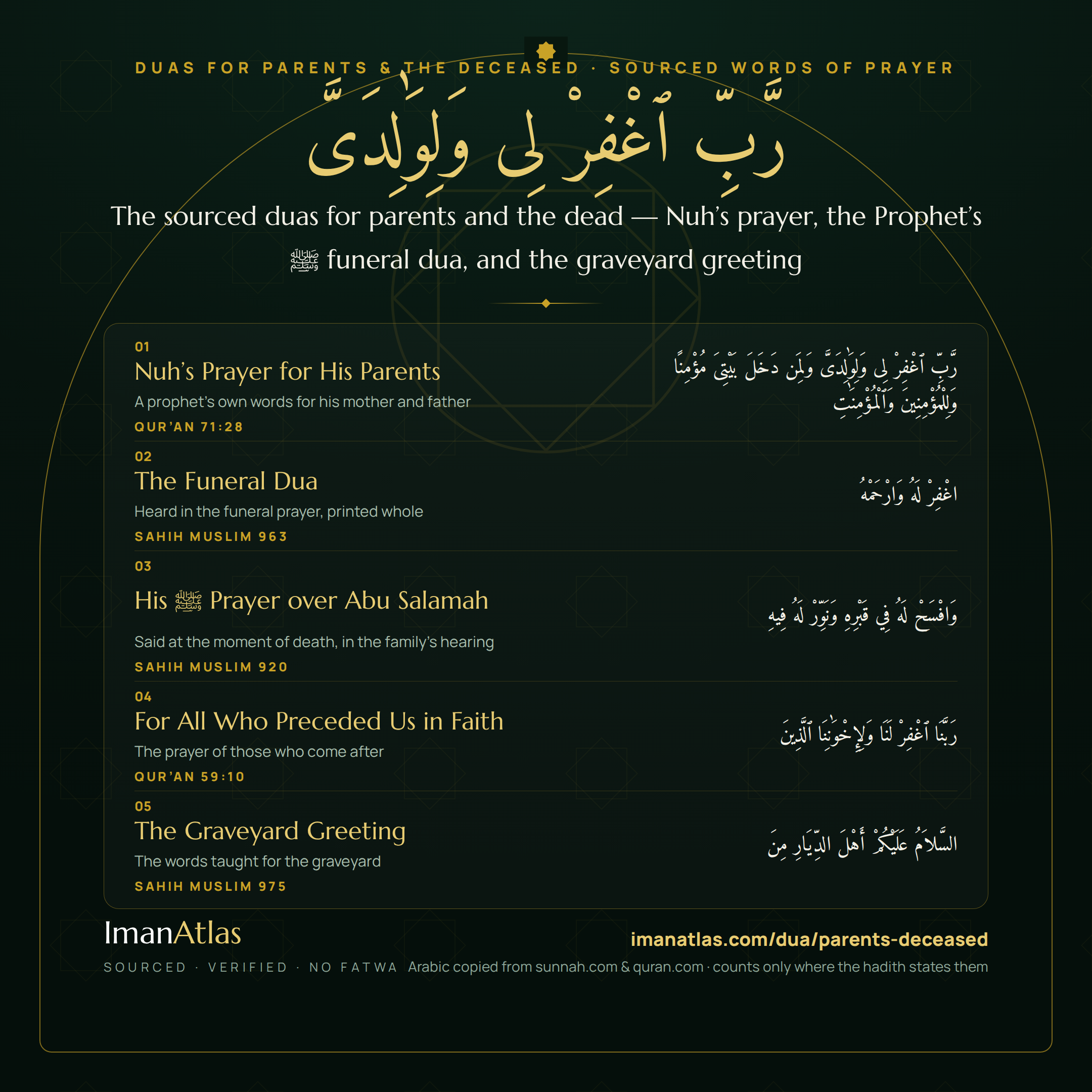
Duas for Parents, the Deceased & the Funeral Prayer
The sourced duas for parents and the dead — Nuh’s prayer, the Prophet’s ﷺ funeral duas printed whole, the graveyard greeting, and the bereaved’s own words.
Short answer: For a parent who has died, the Qur’an gives a child’s own words — Nuh’s prayer for his parents (71:28) — and the Sunnah gives the Prophet’s ﷺ words over the dead themselves: the funeral dua of Muslim 963, his prayer over Abu Salamah (Muslim 920), and the graveyard greeting of Muslim 975 — each printed here with its source.
ImanAtlas does not give fatwas. For your own situation, ask a qualified scholar you trust.
Grief that stays heavy is not a failure of faith. If it stays with you day after day, please reach out as well — to family, to a trusted friend, and to a doctor or counsellor. Accepting support from people is part of looking after yourself.
Nuh’s prayer for his parents
The Qur’an records a prophet praying for his own parents. The block prints the prayer portion of the verse; the verse then continues with Nuh’s words against the wrongdoers, which are not a prayer for anyone and are not printed in the block:
رَّبِّ ٱغْفِرْ لِى وَلِوَٰلِدَىَّ وَلِمَن دَخَلَ بَيْتِىَ مُؤْمِنًا وَلِلْمُؤْمِنِينَ وَٱلْمُؤْمِنَٰتِ
rabbi igh’fir lī waliwālidayya waliman dakhala baytiya mu’minan walil’mu’minīna wal-mu’mināti
“My Lord! Forgive me, my parents, and whoever enters my house in faith, and ˹all˺ believing men and women.”
Qur’an 71:28
For all who preceded us in faith
The Qur’an’s own picture of the generations who come after, praying for those who went before — the general dua for every deceased believer, of whom parents are the nearest:
رَبَّنَا ٱغْفِرْ لَنَا وَلِإِخْوَٰنِنَا ٱلَّذِينَ سَبَقُونَا بِٱلْإِيمَٰنِ وَلَا تَجْعَلْ فِى قُلُوبِنَا غِلًّا لِّلَّذِينَ ءَامَنُوا۟ رَبَّنَآ إِنَّكَ رَءُوفٌ رَّحِيمٌ
rabbanā igh’fir lanā wali-ikh’wāninā alladhīna sabaqūnā bil-īmāni walā tajʿal fī qulūbinā ghillan lilladhīna āmanū rabbanā innaka raūfun raḥīmun
“And those who come after them will pray, ‘Our Lord! Forgive us and our fellow believers who preceded us in faith, and do not allow bitterness into our hearts towards those who believe. Our Lord! Indeed, You are Ever Gracious, Most Merciful.’”
Qur’an 59:10
What continues after a person dies
A statement narration, not a dua — the frame for this whole page. It stands in Muslim’s Book of Wills, in the chapter he himself titled “What Reward Reaches A Man After His Death”. Its three are the deceased’s own continuing works — his charity, his knowledge, and the child who prays for him:
إِذَا مَاتَ الإِنْسَانُ انْقَطَعَ عَنْهُ عَمَلُهُ إِلاَّ مِنْ ثَلاَثَةٍ إِلاَّ مِنْ صَدَقَةٍ جَارِيَةٍ أَوْ عِلْمٍ يُنْتَفَعُ بِهِ أَوْ وَلَدٍ صَالِحٍ يَدْعُو لَهُ
“Abu Huraira (Allah be pleased with him) reported Allah’s Messenger (ﷺ) as saying: When a man dies, his acts come to an end, but three, recurring charity, or knowledge (by which people) benefit, or a pious child, who prays for him (for the deceased).”
Sahih Muslim 1631
His ﷺ dua at the moment of death, over Abu Salamah
The dua the Prophet ﷺ said over a named dead man, in the room, in his family’s hearing — with its frame: the weeping family told to supplicate only good, because the angels say Amin to what they say. The dua names Abu Salamah; this page prints it as narrated and publishes no “insert name” version:
اللَّهُمَّ اغْفِرْ لأَبِي سَلَمَةَ وَارْفَعْ دَرَجَتَهُ فِي الْمَهْدِيِّينَ وَاخْلُفْهُ فِي عَقِبِهِ فِي الْغَابِرِينَ وَاغْفِرْ لَنَا وَلَهُ يَا رَبَّ الْعَالَمِينَ وَافْسَحْ لَهُ فِي قَبْرِهِ وَنَوِّرْ لَهُ فِيهِ
“Umm Salama reported: The Messenger of Allah (may peace be upon came to Abu Salama (as he died). His eyes were fixedly open. He closed them, and then said: When the soul is taken away the sight follows it. Some of the people of his family wept and wailed. So he said: Do not supplicate for yourselves anything but good, for angels say" Amen" to what you say. He then said: O Allah, forgive Abu Salama, raise his degree among those who are rightly guided, grant him a successor in his descendants who remain. Forgive us and him, O Lord of the Universe, and make his grave spacious, and grant him light in it.”
Sahih Muslim 920
Its own page: The Dua at the Moment of Death, where this narration and Abu Dawud’s route stand together.
The funeral dua he ﷺ was heard praying
The funeral prayer’s own dua, printed whole — including its second half, which short versions drop. Its ending runs “…or the torment of the Fire”, exactly as Muslim prints it; other routes print “and”, and this page merges nothing. ‘Awf ibn Malik, who heard it, wished he were that dead man:
اللَّهُمَّ اغْفِرْ لَهُ وَارْحَمْهُ وَعَافِهِ وَاعْفُ عَنْهُ وَأَكْرِمْ نُزُلَهُ وَوَسِّعْ مُدْخَلَهُ وَاغْسِلْهُ بِالْمَاءِ وَالثَّلْجِ وَالْبَرَدِ وَنَقِّهِ مِنَ الْخَطَايَا كَمَا نَقَّيْتَ الثَّوْبَ الأَبْيَضَ مِنَ الدَّنَسِ وَأَبْدِلْهُ دَارًا خَيْرًا مِنْ دَارِهِ وَأَهْلاً خَيْرًا مِنْ أَهْلِهِ وَزَوْجًا خَيْرًا مِنْ زَوْجِهِ وَأَدْخِلْهُ الْجَنَّةَ وَأَعِذْهُ مِنْ عَذَابِ الْقَبْرِ أَوْ مِنْ عَذَابِ النَّارِ
“Jubair b. Nufair says: I heard it from ‘Auf b. Malik that the Prophet (ﷺ) said prayer on the dead body, and I remembered his prayer:" O Allah! forgive him, have mercy upon him, give him peace and absolve him. Receive him with honour and make his grave spacious; wash him with water, snow and hail. Cleanse him from faults as Thou wouldst cleanse a white garment from impurity. Requite him with an abode more excellent than his abode, with a family better than his family, and with a mate better than his mate. Admit him to the Garden, and protect him from the torment of the grave and the torment of the Fire." (‘Auf bin Malik) said: I earnestly desired that I were this dead body.”
Sahih Muslim 963
Its own page: The Funeral Dua He ﷺ Was Heard Praying, where this narration stands whole.
The funeral dua for the living and the dead
The second funeral dua — the one that prays for the whole gathering, living and dead together. The Arabic’s own order (our young, our old, our male, our female, our present, our absent) differs from its printed translation’s order; both stand as their source prints them:
اللَّهُمَّ اغْفِرْ لِحَيِّنَا وَمَيِّتِنَا وَصَغِيرِنَا وَكَبِيرِنَا وَذَكَرِنَا وَأُنْثَانَا وَشَاهِدِنَا وَغَائِبِنَا اللَّهُمَّ مَنْ أَحْيَيْتَهُ مِنَّا فَأَحْيِهِ عَلَى الإِيمَانِ وَمَنْ تَوَفَّيْتَهُ مِنَّا فَتَوَفَّهُ عَلَى الإِسْلاَمِ اللَّهُمَّ لاَ تَحْرِمْنَا أَجْرَهُ وَلاَ تُضِلَّنَا بَعْدَهُ
“Narrated AbuHurayrah: When the Messenger of Allah (ﷺ) prayed over a dead person, he said: O Allah, forgive those of us who are living and those of us who are dead, those of us who are present and those of us who are absent, our young and our old, our male and our female. O Allah, to whomsoever of us Thou givest life grant him life as a believer, and whomsoever of us Thou takest in death take him in death as a follower of Islam. O Allah, do not withhold from us the reward (of faith) and do not lead us astray after his death.”
Grade: Sahih (Al-Albani), as printed at sunnah.com.
Sunan Abi Dawud 3201
Its own page: The Funeral Dua for the Living and the Dead, where this dua and its three other prints stand side by side.
The words for the graveyard
The greeting the Prophet ﷺ taught for the graveyard, printed in Zuhair’s fuller route. Abu Bakr’s route in the same entry opens shorter — “Peace be upon the inhabitants of the city” — and the two routes are shown as two routes, never blended. The greeting’s last line is itself a dua:
السَّلاَمُ عَلَيْكُمْ أَهْلَ الدِّيَارِ مِنَ الْمُؤْمِنِينَ وَالْمُسْلِمِينَ وَإِنَّا إِنْ شَاءَ اللَّهُ لَلاَحِقُونَ أَسْأَلُ اللَّهَ لَنَا وَلَكُمُ الْعَافِيَةَ
“Peace be upon you, the inhabitants of the city, among the believers, and Muslims, and God willing we shall join you. I beg of Allah peace for us and for you.”
Sahih Muslim 975
Its own page: The Words for the Graveyard, where this chapter’s three narrations stand side by side.
The dua at calamity, for the bereaved
The words for the one who remains — carrying the Qur’an’s own words inside them (2:156). The narration’s outcome sentence stays inside its quote, and Umm Salamah’s own application is printed with it; the entry’s later account of the marriage proposal that followed is reported here in this clause only, not quoted:
إِنَّا لِلَّهِ وَإِنَّا إِلَيْهِ رَاجِعُونَ اللَّهُمَّ أْجُرْنِي فِي مُصِيبَتِي وَأَخْلِفْ لِي خَيْرًا مِنْهَا
“Umm Salama reported Allah’s Messenger (ﷺ) as saying: If any Muslim who suffers some calamity says, what Allah has commanded him," We belong to Allah and to Him shall we return; O Allah, reward me for my affliction and give me something better than it in exchange for it," Allah will give him something better than it in exchange. When Abu Salama died she said: What Muslim is better than Abu Salama whose family was the first to emigrate to the Messenger of Allah (ﷺ). I then said the words, and Allah gave me God’s Messenger (ﷺ) in exchange.”
Sahih Muslim 918
Charity on behalf of a deceased mother
A question-and-answer narration, not a dua — a son’s question about his mother, who died suddenly, and the Prophet’s ﷺ one-word answer. The page prints the exchange and draws no doctrine from it in its own voice:
إِنَّ أُمِّي افْتُلِتَتْ نَفْسُهَا، وَأَظُنُّهَا لَوْ تَكَلَّمَتْ تَصَدَّقَتْ، فَهَلْ لَهَا أَجْرٌ إِنْ تَصَدَّقْتُ عَنْهَا قَالَ ” نَعَمْ ”
“Narrated Aisha: A man said to the Prophet (p.b.u.h), "My mother died suddenly and I thought that if she had lived she would have given alms. So, if I give alms now on her behalf, will she get the reward?" The Prophet (ﷺ) replied in the affirmative.”
Sahih al-Bukhari 1388
The question asked before the funeral prayer: his debts
A narration, not a dua — before the prayer, the Prophet ﷺ asked about the dead man’s debts, and a companion’s taking the debt on himself is what the narration honours. Reported as narration; this page builds no ruling and no procedure from it:
هَلْ عَلَيْهِ دَيْنٌ … صَلُّوا عَلَى صَاحِبِكُمْ … قَالَ أَبُو قَتَادَةَ صَلِّ عَلَيْهِ يَا رَسُولَ اللَّهِ، وَعَلَىَّ دَيْنُهُ. فَصَلَّى عَلَيْهِ
“Narrated Salama bin Al-Akwa: Once, while we were sitting in the company of Prophet, a dead man was brought. The Prophet (ﷺ) was requested to lead the funeral prayer for the deceased. He said, "Is he in debt?" The people replied in the negative. He said, "Has he left any wealth?" They said, "No." So, he led his funeral prayer. Another dead man was brought and the people said, "O Allah’s Messenger (ﷺ)! Lead his funeral prayer." The Prophet (ﷺ) said, "Is he in debt?" They said, "Yes." He said, "Has he left any wealth?" They said, ”Three Dinars." So, he led the prayer. Then a third dead man was brought and the people said (to the Prophet (ﷺ) ), Please lead his funeral prayer." He said, "Has he left any wealth?" They said, "No." He asked, "Is he in debt?" They said, ("Yes! He has to pay) three Diners.’, He (refused to pray and) said, "Then pray for your (dead) companion." Abu Qatada said, "O Allah’s Messenger (ﷺ)! Lead his funeral prayer, and I will pay his debt." So, he led the prayer.”
Sahih al-Bukhari 2289
More of the family’s words
The Qur’an’s own dua for parents — “My Lord! Be merciful to them as they raised me when I was young” (Qur’an 17:24) — is printed in full on the Dua hub’s parents section. Ibrahim’s prayer for himself, his parents and the believers (Qur’an 14:41) is printed on the Marriage page. What is said at the sickbed is the Health page’s set, and the duas for a heavy heart are on the Anxiety page.
Methods, rulings and your own situation
These pages print the texts with their sources; they assemble no funeral method and rule on nothing. The questions this page routes rather than answers are the ruling questions: whether a deed’s reward reaches the dead, what counts as ongoing charity, making up a deceased person’s missed fasts or prayers, the rulings of visiting graves, and how the funeral prayer is performed.
Beyond what these texts themselves say, this page adds nothing — no steps, no count, no ruling, and no promise about what reaches anyone.
ImanAtlas does not give fatwas. For your own situation, ask a qualified scholar you trust.
Grief that stays heavy is not a failure of faith. If it stays with you day after day, please reach out as well — to family, to a trusted friend, and to a doctor or counsellor. Accepting support from people is part of looking after yourself.
Widely shared claims, checked
The remaining-kindness narration, with its grade. A narration every list on this topic is built on: a man of Banu Salamah asked, “Messenger of Allah, is there any kindness left that I can do to my parents after their death?” and the answer named praying for them, asking forgiveness for them, carrying out their instructions, joining the kinship ties that depend on them, and honouring their friends (Sunan Abi Dawud 5142). Its grade, as printed at sunnah.com, is Da’if (Al-Albani); other sites print the same narration as Sahih. The conflict is named here and resolved by neither voice — and because its grade is disputed, the narration stands in this note section, not as a practice list in the main set.
نَعَمِ، الصَّلَاةُ عَلَيْهِمَا، وَالاِسْتِغْفَارُ لَهُمَا، وَإِنْفَاذُ عَهْدِهِمَا مِنْ بَعْدِهِمَا، وَصِلَةُ الرَّحِمِ الَّتِي لاَ تُوصَلُ إِلاَّ بِهِمَا، وَإِكْرَامُ صَدِيقِهِمَا
Sunan Abi Dawud 5142 — the answer portion, as printed
Counts and composite duas. Fixed counts for the dead — a named dua a set number of times, set-day recitation schedules — appear in no source on this page. And the composite duas that circulate on this topic — fragments of different verses and narrations stitched into one text, re-gendered or given a placeholder name, and labelled with a single citation the composite does not carry — are not reproduced here: this page prints every text exactly as its own source prints it, and publishes no adapted version for any reader.
The duas for parents and the deceased, one by one
Four of these duas now have a page of their own, where their routes are set out in full. Each page keeps this page’s frame: no steps, no count, no ruling, and no promise about what reaches anyone.
The Funeral Dua He ﷺ Was Heard Praying — ‘Awf ibn Malik’s narration (Muslim 963) printed whole, its second half included, as Muslim gives it.
The Dua at the Moment of Death — the prayer over Abu Salamah in both of its routes (Muslim 920 · Abu Dawud 3118), his name standing in the words, never a blank to fill in.
The Funeral Dua for the Living and the Dead — the prayer that names the living and the dead together (Abu Dawud 3201 · Tirmidhi 1024 · Ibn Majah 1498), each print in its own order, under its own grade.
The Words for the Graveyard — the greeting and the prayer of the graveyard chapter (Muslim 974 · Muslim 975), its three narrations kept apart.
Frequently asked questions
What is the best dua for my deceased parents?
The sources give a prophet’s own prayer first: Nuh’s — “My Lord! Forgive me, my parents, and whoever enters my house in faith, and ˹all˺ believing men and women” (Qur’an 71:28) — and the prayer of those who come after, for all who preceded them in faith (Qur’an 59:10). The Qur’an’s dua for parents (17:24) is printed on the Dua hub, and Ibrahim’s prayer for his parents (14:41) on the Marriage page. This page prints the sourced words; it does not rank them into a league table.
What did the Prophet ﷺ say in the funeral prayer?
Two wordings are captured on this page, as two narrations, never merged: ‘Awf ibn Malik heard him ﷺ pray over a dead man — “O Allah! forgive him, have mercy upon him, give him peace and absolve him…” — printed whole on this page (Sahih Muslim 963); and Abu Hurayrah’s narration of the prayer for the living and the dead together (Sunan Abi Dawud 3201, Sahih (Al-Albani)).
How do I pray the janaza — what are the steps?
This page prints the funeral duas as the narrations give them and assembles no method: no takbir sequence, no step list. The performed forms of the prayer differ across the schools, and a method is learned properly from a person — your local imam or a qualified scholar. ImanAtlas does not give fatwas. For your own situation, ask a qualified scholar you trust.
Can I give charity for my deceased parents — does it reach them?
The narrations are printed on this page: Muslim 1631 names a righteous child’s prayer among the three things that continue after a person dies, and Bukhari 1388 records a son asking about charity for his mother who died suddenly — “will she get the reward?” — and the Prophet ﷺ replying in the affirmative. What scholars conclude from these texts about the transfer of reward is a ruling, and this site rules nothing: ImanAtlas does not give fatwas. For your own situation, ask a qualified scholar you trust.
What should I say when I visit a grave?
The words the Prophet ﷺ taught for the graveyard are printed on this page (Sahih Muslim 975): “Peace be upon you, the inhabitants of the city, among the believers, and Muslims, and God willing we shall join you. I beg of Allah peace for us and for you.” The rulings of visiting — when, how, for whom — are scholarly questions and route the same way.
Is there a special dua when a child dies?
Honestly: a special wording for this case circulates widely, attributed to al-Bayhaqi. It was not verified at a primary source for this page, so it is not printed here in any language; printing what it has not verified is what this site refuses to do. The duas this page does print for any deceased are Muslim 963 and Abu Dawud 3201, and for the bereaved parents themselves, the calamity dua of Muslim 918. A child-specific wording is a question for a qualified scholar.
What do I say when someone has just died?
For the one who has died, the Prophet’s ﷺ own dua at that moment is Muslim 920 — his prayer over Abu Salamah, printed on this page. For yourself, the bereaved, the words are Muslim 918’s: “We belong to Allah and to Him shall we return; O Allah, reward me for my affliction and give me something better than it in exchange for it” — with Umm Salamah’s own story of saying them, printed with the narration.
I have seen counts — recite this 40 times, or Yaseen for the dead. Are they from the sources?
No count appears in any source printed on this page — not in the funeral duas, not in the verses, not in the narrations. And no narration for reciting a named surah over the dying or the dead was captured at a primary source for this page, so none is printed or recommended here. The counts and schedules circulating online are unattributed, and this page names them as such rather than repeating them.
My grief is not lifting. Is something wrong with my faith?
No. Grief is not a failure of faith, and nothing on this page treats it as one. The duas for a heavy heart are on the Anxiety page. And if grief stays with you day after day, please reach out as well — to family, to a trusted friend, and to a doctor or counsellor. Accepting support from people is part of looking after yourself.
Sources
Translations on this page: hadith — the translations printed at sunnah.com (its Muslim texts are the older USC-MSA renderings, printed as captured, artifacts included, never silently modernised); Qur’an — Dr. Mustafa Khattab, The Clear Quran (via quran.com). Arabic is copied from those sources, never typed from memory. No repetition count is printed unless the narration itself states it — and no text in this page’s main set states one.
- Qur’an 71:28 — quran.com · Qur’an 59:10 — quran.com
- Sahih Muslim 1631 — sunnah.com · Sahih Muslim 920 — sunnah.com · Sahih Muslim 963 — sunnah.com
- Sunan Abi Dawud 3201 — sunnah.com · Sahih Muslim 975 — sunnah.com · Sahih Muslim 918 — sunnah.com
- Sahih al-Bukhari 1388 — sunnah.com · Sahih al-Bukhari 2289 — sunnah.com
- Note section: Sunan Abi Dawud 5142 — sunnah.com
- Pointers: Qur’an 17:24 — quran.com · Qur’an 14:41 — quran.com · Tanzil — Qur’an text (Uthmani)
Share this set