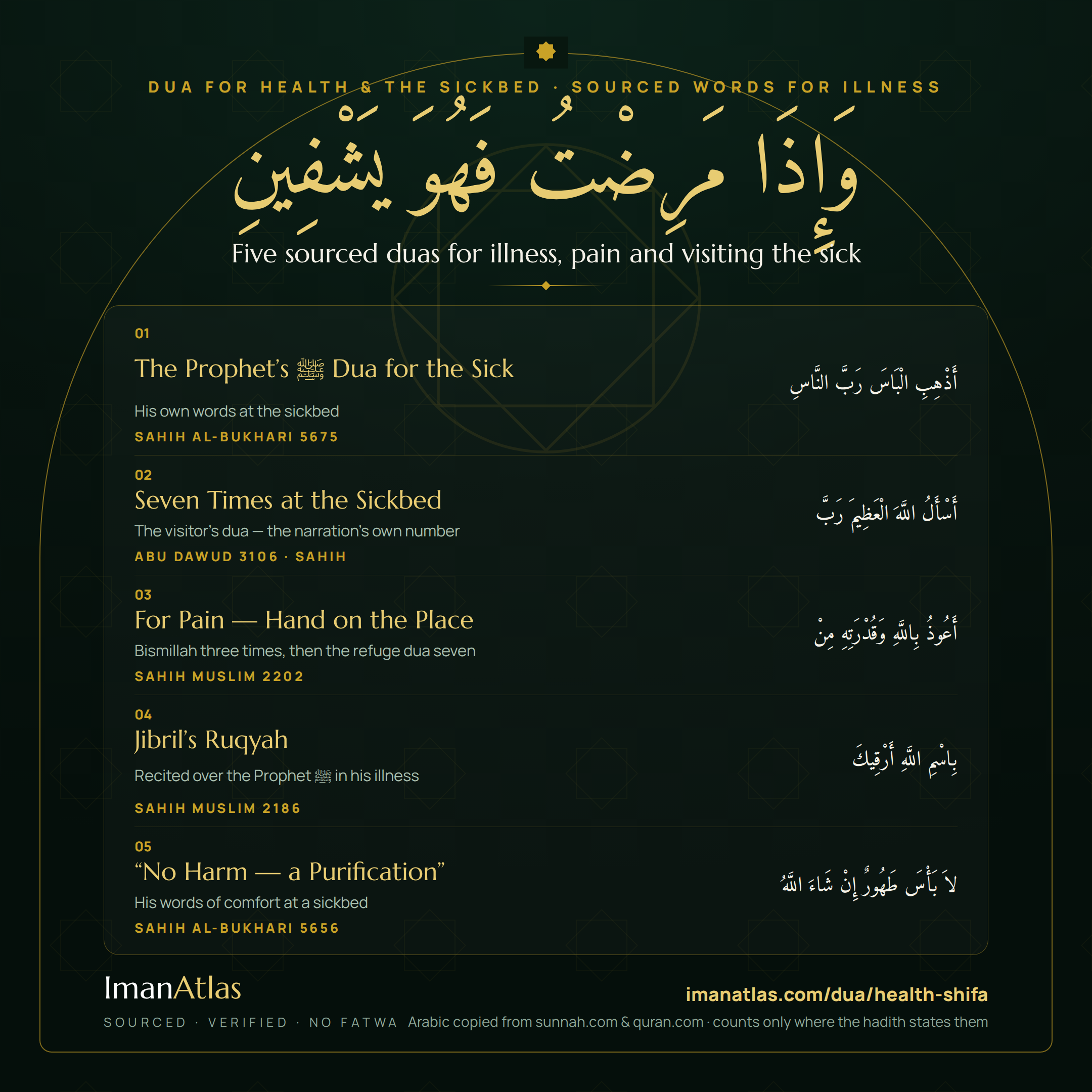
Duas for Health, Illness & Visiting the Sick
What the Prophet ﷺ said and taught at the sickbed — for the sick, for pain, and for the one who visits — every dua with its source and grade.
Short answer: When the Prophet ﷺ visited the sick, he placed his hand and prayed for them — and he taught a visitor to ask Allah seven times for the sick person’s cure (Abu Dawud 3106). This page collects his duas for illness and pain, Jibril’s ruqyah, and what he ﷺ said at the sickbed — each with its source and grade.
These are the words the Prophet ﷺ used and taught at the sickbed. They sit alongside treatment, not instead of it — he ﷺ also said that Allah has created no disease without creating its treatment (Sahih al-Bukhari 5678). If you or someone you love is ill, please see a doctor as well, and let the duas accompany the treatment.
The Prophet’s ﷺ dua for the sick
When someone fell ill, the Prophet ﷺ would visit them, rub the sick person with his right hand, and pray for them — ‘A’isha reports the practice, and the words he ﷺ used are preserved in both Sahih collections. The translation below is Sahih al-Bukhari’s printed text; Sahih Muslim’s narration (2191) is the source of the right-hand detail.
أَذْهِبِ الْبَاسَ رَبَّ النَّاسِ، اشْفِ وَأَنْتَ الشَّافِي لاَ شِفَاءَ إِلاَّ شِفَاؤُكَ، شِفَاءً لاَ يُغَادِرُ سَقَمًا
“Take away the disease, O the Lord of the people! Cure him as You are the One Who cures. There is no cure but Yours, a cure that leaves no disease.”
Sahih al-Bukhari 5675 · Sahih Muslim 2191
“No harm — it is a purification, if Allah wills”
These are the words the Prophet ﷺ himself said at a sickbed — words of comfort, not a promise the site makes. They are carried by two parallel narrations in Sahih al-Bukhari, and the fuller one is a story with an ending the page does not trim away:
لاَ بَأْسَ طَهُورٌ إِنْ شَاءَ اللَّهُ
“Narrated Ibn `Abbas: The Prophet (ﷺ) went to visit a sick bedouin. Whenever the Prophet (ﷺ) went to a patient, he used to say to him, "Don’t worry, if Allah will, it will be expiation (for your sins):" The bedouin said, "You say expiation? No, it is but a fever that is boiling or harassing an old man and will lead him to his grave without his will." The Prophet (ﷺ) said, "Then, yes, it is so."”
Sahih al-Bukhari 5656 · 5662
The visitor’s dua, seven times
For the one who visits: the Prophet ﷺ taught these words, and the narration itself sets the number — seven times — and its own condition. Both travel with the quote here, exactly as printed:
أَسْأَلُ اللَّهَ الْعَظِيمَ رَبَّ الْعَرْشِ الْعَظِيمِ أَنْ يَشْفِيَكَ
As’alullah Al-‘Azeem Rabbal ‘Arshil ‘Azeem an yashfik
Said seven times — as the narration instructs
“Narrated Abdullah ibn Abbas: The Prophet (ﷺ) said: If anyone visits a sick whose time (of death) has not come, and says with him seven times: I ask Allah, the Mighty, the Lord of the mighty Throne, to cure you, Allah will cure him from that disease.” The outcome sentence is the narration’s own words, quoted with its condition — it is not shortened here into a bare promise.
Sunan Abi Dawud 3106 · Jami` at-Tirmidhi 2083
Grade: Sahih (Al-Albani), as printed at sunnah.com for Abu Dawud 3106 · Grade: Sahih (Darussalam), as printed for Tirmidhi 2083 — at-Tirmidhi himself called it hasan gharib in the narration.
Jibril’s ruqyah
When the Prophet ﷺ himself fell ill, Jibril came and recited over him. Two narrations in Sahih Muslim preserve the words, with two wordings — both are printed, neither merged into the other:
بِاسْمِ اللَّهِ أَرْقِيكَ مِنْ كُلِّ شَىْءٍ يُؤْذِيكَ مِنْ شَرِّ كُلِّ نَفْسٍ أَوْ عَيْنِ حَاسِدٍ اللَّهُ يَشْفِيكَ بِاسْمِ اللَّهِ أَرْقِيكَ
“Abu Sa’id reported that Gabriel came to Allah’s Messenger (ﷺ) and said: Muhammad, have you fallen ill? Thereupon he said: Yes. He (Gabriel) said: "In the name of Allah I exorcise you from everything and safeguard you from every evil that may harm you and from the eye of a jealous one. Allah would cure you and I invoke the name of Allah for you."”
‘A’isha’s narration carries a second wording of the same ruqyah:
بِاسْمِ اللَّهِ يُبْرِيكَ وَمِنْ كُلِّ دَاءٍ يَشْفِيكَ وَمِنْ شَرِّ حَاسِدٍ إِذَا حَسَدَ وَشَرِّ كُلِّ ذِي عَيْنٍ
“’A’isha (the wife of Allah’s Apostle) said: When Allah’s Messenger (ﷺ) fell ill, Gabriel used to recite this: "In the name of Allah, may He cure you from all kinds of illnesses and safeguard you from the evil of a jealous one when he feels jealous and from the evil influence of eye."”
Sahih Muslim 2186 · Sahih Muslim 2185
The dua for pain: your hand on the place
‘Uthman ibn Abi al-‘As complained to the Prophet ﷺ of a pain in his body. The instruction he ﷺ gave him is printed here as the narration reports it — both counts are the narration’s own, in its own order:
أَعُوذُ بِاللَّهِ وَقُدْرَتِهِ مِنْ شَرِّ مَا أَجِدُ وَأُحَاذِرُ
A’udhu billahi wa qudratihi min sharri ma ajidu wa uhadhiru
Bismillah — three times This dua — seven times
“Place your hand at the place where you feel pain in your body and say Bismillah (in the name of Allah) three times and seven times A’udhu billahi wa qudratihi min sharri ma ajidu wa uhadhiru (I seek refuge with Allah and with His Power from the evil that I find and that I fear).” The wording printed is sunnah.com’s — “with Allah and with His Power”; some lists print a different wording (“bi-‘izzatillahi”), which is not what this narration’s printed text says.
Sahih Muslim 2202
Ruqyah with al-Fatiha
A companion recited Surah al-Fatiha as a ruqyah over a tribal chief who had been stung — and the Prophet ﷺ approved it. The story is quoted as the narration tells it; note that the narration states no number of recitations:
“Narrated Abu Sa`id: Some of the companions of the Prophet (ﷺ) went on a journey till they reached some of the ‘Arab tribes (at night). They asked the latter to treat them as their guests but they refused. The chief of that tribe was then bitten by a snake (or stung by a scorpion) and they tried their best to cure him but in vain… One of them replied, "Yes, by Allah! I can recite a Ruqya, but as you have refused to accept us as your guests, I will not recite the Ruqya for you unless you fix for us some wages for it." They agrees to pay them a flock of sheep. One of them then went and recited (Surat-ul-Fatiha)… and puffed over the chief who became all right as if he was released from a chain, and got up and started walking, showing no signs of sickness… Allah’s Messenger (ﷺ) asked, "How did you come to know that Suratul-Fatiha was recited as Ruqya?" Then he added, "You have done the right thing. Divide (what you have earned) and assign a share for me as well." The Prophet (ﷺ) smiled thereupon.”
Al-Fatiha’s own text lives on the Surah hub; it is not reprinted here.
Sahih al-Bukhari 2276
Ruqyah with the Mu’awwidhat in illness
In his final illness, the Prophet ﷺ recited the Mu’awwidhat — Surah al-Falaq and Surah an-Nas — over himself:
“Narrated `Aisha: During the Prophet’s fatal illness, he used to recite the Mu’auwidhat (Surat An-Nas and Surat Al-Falaq) and then blow his breath over his body. When his illness was aggravated, I used to recite those two Suras and blow my breath over him and make him rub his body with his own hand for its blessings.” (Ma`mar asked Az-Zuhri: How did the Prophet (ﷺ) use to blow? Az-Zuhri said: He used to blow on his hands and then passed them over his face.)
The two surahs in full, and the bedtime action narrated for them, are on the Duas Before Sleeping page — a different occasion, kept separate there.
Sahih al-Bukhari 5735
The ruqyah for a sore or injury
For someone ill, or with an ailment or an injury, ‘A’isha reports that the Prophet ﷺ would touch his forefinger to the ground, lift it, and say:
بِاسْمِ اللَّهِ تُرْبَةُ أَرْضِنَا بِرِيقَةِ بَعْضِنَا لِيُشْفَى بِهِ سَقِيمُنَا بِإِذْنِ رَبِّنَا
“The dust of our ground with the saliva of any one of us would serve as a means whereby our illness would be cured with the sanction of Allah.” The printed narration notes small wording variants in its other routes; the main wording is printed above, unmerged.
Sahih Muslim 2194
Another wording of the Prophet’s ﷺ ruqyah
امْسَحِ الْبَاسَ رَبَّ النَّاسِ، بِيَدِكَ الشِّفَاءُ، لاَ كَاشِفَ لَهُ إِلاَّ أَنْتَ
“O the Lord of the people! Remove the trouble. The cure is in Your Hands, and there is none except You who can remove it (the disease).” A second wording from the same chapter of Sahih al-Bukhari — printed as its own narration, not merged with the wording above.
Sahih al-Bukhari 5744
Refuge from diseases
A dua the Prophet ﷺ himself used to say — seeking refuge in Allah from severe diseases:
اللَّهُمَّ إِنِّي أَعُوذُ بِكَ مِنَ الْبَرَصِ وَالْجُنُونِ وَالْجُذَامِ وَمِنْ سَيِّئِ الأَسْقَامِ
“Narrated Anas ibn Malik: The Prophet (ﷺ) used to say: "O Allah, I seek refuge in Thee from leprosy, madness, elephantiasis, and evil diseases."”
Sunan Abi Dawud 1554
Grade: Sahih (Al-Albani), as printed at sunnah.com.
The virtue of visiting the sick
Why visit at all? The Prophet ﷺ described the visit itself in these words:
عَائِدُ الْمَرِيضِ فِي مَخْرَفَةِ الْجَنَّةِ حَتَّى يَرْجِعَ
“The one who visits the sick is in fact like one who is in the fruit garden of Paradise so long as he does not return.” The virtue is stated in the narration’s own words — this page adds no reward arithmetic of its own.
Sahih Muslim 2568
What the Qur’an says around illness
The Qur’an’s own words come first in this section — quoted as the Qur’an’s words, in Ibrahim’s speech, in its description of itself, and in its question about who answers the distressed:
وَإِذَا مَرِضْتُ فَهُوَ يَشْفِينِ
wa-idhā mariḍ’tu fahuwa yashfīni
“And He ˹alone˺ heals me when I am sick.” Ibrahim’s words about his Lord, spoken to his people — printed as the Qur’an’s narration of what he said.
Qur’an 26:80
يَٰٓأَيُّهَا ٱلنَّاسُ قَدْ جَآءَتْكُم مَّوْعِظَةٌ مِّن رَّبِّكُمْ وَشِفَآءٌ لِّمَا فِى ٱلصُّدُورِ وَهُدًى وَرَحْمَةٌ لِّلْمُؤْمِنِينَ
yāayyuhā l-nāsu qad jāatkum mawʿiẓatun min rabbikum washifāon limā fī l-ṣudūri wahudan waraḥmatun lil’mu’minīna
“O humanity! Indeed, there has come to you a warning from your Lord, a cure for what is in the hearts, a guide, and a mercy for the believers.” The verse describes the Qur’an itself as a cure for what is in the hearts — it is not a claim that any surah is assigned to any disease, and this page makes no such assignment. The closing words of another verse say the same of the Qur’an:
قُلْ هُوَ لِلَّذِينَ ءَامَنُوا۟ هُدًى وَشِفَآءٌ
qul huwa lilladhīna āmanū hudan washifāon
“Say, ˹O Prophet,˺ "It is a guide and a healing to the believers."” (the closing clause of the verse)
Qur’an 10:57 · Qur’an 41:44
أَمَّن يُجِيبُ ٱلْمُضْطَرَّ إِذَا دَعَاهُ وَيَكْشِفُ ٱلسُّوٓءَ وَيَجْعَلُكُمْ خُلَفَآءَ ٱلْأَرْضِ أَءِلَٰهٌ مَّعَ ٱللَّهِ قَلِيلًا مَّا تَذَكَّرُونَ
amman yujību l-muḍ’ṭara idhā daʿāhu wayakshifu l-sūa wayajʿalukum khulafāa l-arḍi a-ilāhun maʿa l-lahi qalīlan mā tadhakkarūna
“Or ˹ask them,˺ "Who responds to the distressed when they cry to Him, relieving ˹their˺ affliction, and ˹Who˺ makes you successors in the earth? Is it another god besides Allah? Yet you are hardly mindful!"” This verse is printed here with its source and no count — the figures attached to it online (such as 435 times for 17 days) appear in no narration; see the checked-claims note below.
Qur’an 27:62
Ayyub’s own dua inside his illness — “I have been touched with adversity, and You are the Most Merciful of the merciful” (Qur’an 21:83) — is printed in full on the Dua for Anxiety & Stress page, and is not repeated here.
Dua and treatment
Two sayings of the Prophet ﷺ stand side by side in the sources, and this page holds them together. On what illness carries:
“No fatigue, nor disease, nor sorrow, nor sadness, nor hurt, nor distress befalls a Muslim, even if it were the prick he receives from a thorn, but that Allah expiates some of his sins for that.” (Sahih al-Bukhari 5641)
And on treatment itself:
“There is no disease that Allah has created, except that He also has created its treatment.” (Sahih al-Bukhari 5678) The same sources even name means among the picture of healing — honey, cupping and cauterisation are mentioned in one narration (Sahih al-Bukhari 5680) — remedies are a different subject from this duas page, and no remedy is recommended here.
These are the words the Prophet ﷺ used and taught at the sickbed. They sit alongside treatment, not instead of it — he ﷺ also said that Allah has created no disease without creating its treatment (Sahih al-Bukhari 5678). If you or someone you love is ill, please see a doctor as well, and let the duas accompany the treatment.
Related sets: the ‘afiyah dua — “Allahumma ‘afini fi badani…” (Sunan Abi Dawud 5090, Grade: Hasan in chain (Al-Albani) as printed at sunnah.com; the narration itself frames it three times in the morning and three times in the evening) — belongs to the morning and evening adhkar line: see the Morning Duas and Evening Azkar pages, where the ‘afiyah dua (Abu Dawud 5074) is printed in full.
A widely shared narration, with its gradings shown
One narration about visiting the sick is shared everywhere — that the visitor is accompanied by 70,000 angels. It sits in this labelled note, not in the set above, because its printed gradings genuinely differ, and this site shows both rather than resolving them:
“This hadith is hasan gharib” — at-Tirmidhi’s own words inside the narration, which also notes that it reached ‘Ali by other routes, some stopped (mawquf) at ‘Ali. Sunnah.com’s grade field for the same narration reads otherwise:
Jami` at-Tirmidhi 969
Grade: Da’if (Darussalam), as printed in sunnah.com’s grade field — against at-Tirmidhi’s own “hasan gharib” in the text. The conflict is disclosed, not resolved; the narration is not used as a practice item or a virtue proof on this page (the visiting virtue above rests on Sahih Muslim 2568).
The counts attached to these duas online. Figures circulate with this topic: “Ya Shafi, Ya Kafi” 100 times after every prayer; the Rabban-nas dua 121 times for 17 days; Qur’an 27:62 435 times for 17 days; a shared 125,000-times group recitation; al-Fatiha fixed at seven times. None of these figures appears in any narration captured for this page. The only counts printed here are the ones the narrations themselves state: seven times in Abu Dawud 3106 / Tirmidhi 2083, and three-then-seven in Muslim 2202.
The health duas, one by one
Five of these duas now have a page of their own, with the narrations around it:
Ruqyah with al-Fatiha — the scorpion-chief narration, and the seven-times question answered from the texts alone (Bukhari 2276 · 5736 · Tirmidhi 2063).
Jibril’s Ruqyah — the words Jibril recited over the Prophet ﷺ, in Muslim’s two routes and Ibn Majah’s third (Muslim 2186 · 2185 · Ibn Majah 3523).
The Prophet’s Dua for the Sick — “O Allah, Lord of the people…” in its two Bukhari wordings, printed apart and never merged (Bukhari 5675 · 5743).
The Dua for Pain — your hand on the place: both narrated wordings, each with its own source and grade (Muslim 2202 · Tirmidhi 3588).
What to Say When Visiting the Sick — the seven-times dua at the sickbed, and the second visitor dua from the same chapter (Abu Dawud 3106 · 3107).
Frequently asked questions
What is the best dua for a sick person?
The one the Prophet ﷺ himself used at the sickbed: “Take away the disease, O the Lord of the people! Cure him as You are the One Who cures. There is no cure but Yours, a cure that leaves no disease” (Sahih al-Bukhari 5675; also Sahih Muslim 2191, which adds that he ﷺ would rub the sick person with his right hand). It is the first block on this page, printed with its source.
What should I say when I visit a sick person?
Two narrated things: the Prophet’s ﷺ own words at a sickbed — “La ba’sa tahurun in sha Allah” (“Don’t worry, Allah willing, (your sickness will be) an expiation for your sins”, Sahih al-Bukhari 5656 · 5662) — and the visitor’s dua he ﷺ taught, said seven times beside the sick person whose time of death has not come: “I ask Allah, the Mighty, the Lord of the mighty Throne, to cure you” (Sunan Abi Dawud 3106, Sahih (Al-Albani); Jami` at-Tirmidhi 2083, Sahih (Darussalam)). The seven is the narration’s own instruction.
Is there a dua for pain?
Yes — the one the Prophet ﷺ taught ‘Uthman ibn Abi al-‘As for pain in his body: place your hand where the pain is, say Bismillah three times, then seven times “A’udhu billahi wa qudratihi min sharri ma ajidu wa uhadhiru” — “I seek refuge with Allah and with His Power from the evil that I find and that I fear” (Sahih Muslim 2202). Both counts are the narration’s own, in its own order, and the wording is sunnah.com’s printed wording.
How many times should al-Fatiha be recited as ruqyah?
The narration of the companion who recited al-Fatiha over the stung chief (Sahih al-Bukhari 2276) states no number at all — and the Prophet ﷺ approved the act without adding one. The fixed “seven times” prescription found online appears in no narration captured for this page, so this page prints no count for al-Fatiha.
Should “Ya Shafi” be repeated a fixed number of times?
No narration captured for this page attaches a count to repeating Allah’s name “Ya Shafi” — the 100-times and similar figures circulating online are unattributed to any narration here. On this page, counts exist only where a narration itself states them: seven times for the visitor’s dua (Abu Dawud 3106) and three-then-seven for the pain dua (Muslim 2202).
Should dua replace medicine?
The sources hold both together. The Prophet ﷺ said: “There is no disease that Allah has created, except that He also has created its treatment” (Sahih al-Bukhari 5678) — and the duas on this page are the words he ﷺ used and taught at the sickbed. They sit alongside treatment, not instead of it: if you or someone you love is ill, please see a doctor as well, and let the duas accompany the treatment.
Is the narration about 70,000 angels visiting with the visitor authentic?
Its printed gradings differ, and this page shows both rather than choosing: sunnah.com’s grade field for Jami` at-Tirmidhi 969 reads Da’if (Darussalam), while at-Tirmidhi himself, inside the same narration, called it hasan gharib and noted a stopped (mawquf) route to ‘Ali. Because of that conflict it is kept in this page’s note section, and the virtue of visiting on this page rests on Sahih Muslim 2568 instead.
Can I recite ruqyah for myself?
The narrations show both directions, and this page reports them without issuing a ruling: the Prophet ﷺ recited the Mu’awwidhat over himself in his illness (Sahih al-Bukhari 5735), and Jibril recited over him when he was ill (Sahih Muslim 2186). What the narrations contain is printed here as their contents; for a ruling on your own situation, ask a qualified scholar you trust.
Sources
Translations on this page: hadith — the translations printed at sunnah.com; Qur’an — Dr. Mustafa Khattab (via quran.com). Arabic is copied from those sources, never typed from memory. No repetition count is printed unless the narration itself states it, and no cure is promised in this site’s voice — where a narration speaks of an outcome, it is quoted as the narration’s words.
- Sahih al-Bukhari 5675 — sunnah.com · Sahih Muslim 2191a — sunnah.com
- Sahih al-Bukhari 5656 — sunnah.com · Sahih al-Bukhari 5662 — sunnah.com
- Sunan Abi Dawud 3106 — sunnah.com · Jami` at-Tirmidhi 2083 — sunnah.com
- Sahih Muslim 2186 — sunnah.com · Sahih Muslim 2185 — sunnah.com · Sahih Muslim 2202 — sunnah.com
- Sahih al-Bukhari 2276 — sunnah.com · Sahih al-Bukhari 5735 — sunnah.com · Sahih Muslim 2194 — sunnah.com · Sahih al-Bukhari 5744 — sunnah.com
- Sunan Abi Dawud 1554 — sunnah.com · Sahih Muslim 2568a — sunnah.com
- Jami` at-Tirmidhi 969 — sunnah.com · Sahih al-Bukhari 5641 — sunnah.com · Sahih al-Bukhari 5678 — sunnah.com · Sahih al-Bukhari 5680 — sunnah.com
- Sunan Abi Dawud 5074 — sunnah.com · Sunan Abi Dawud 5090 — sunnah.com
- Qur’an 26:80 — quran.com · Qur’an 10:57 — quran.com · Qur’an 41:44 — quran.com · Qur’an 27:62 — quran.com · Qur’an 21:83 — quran.com
- Tanzil — Qur’an text (Uthmani)
Share this set