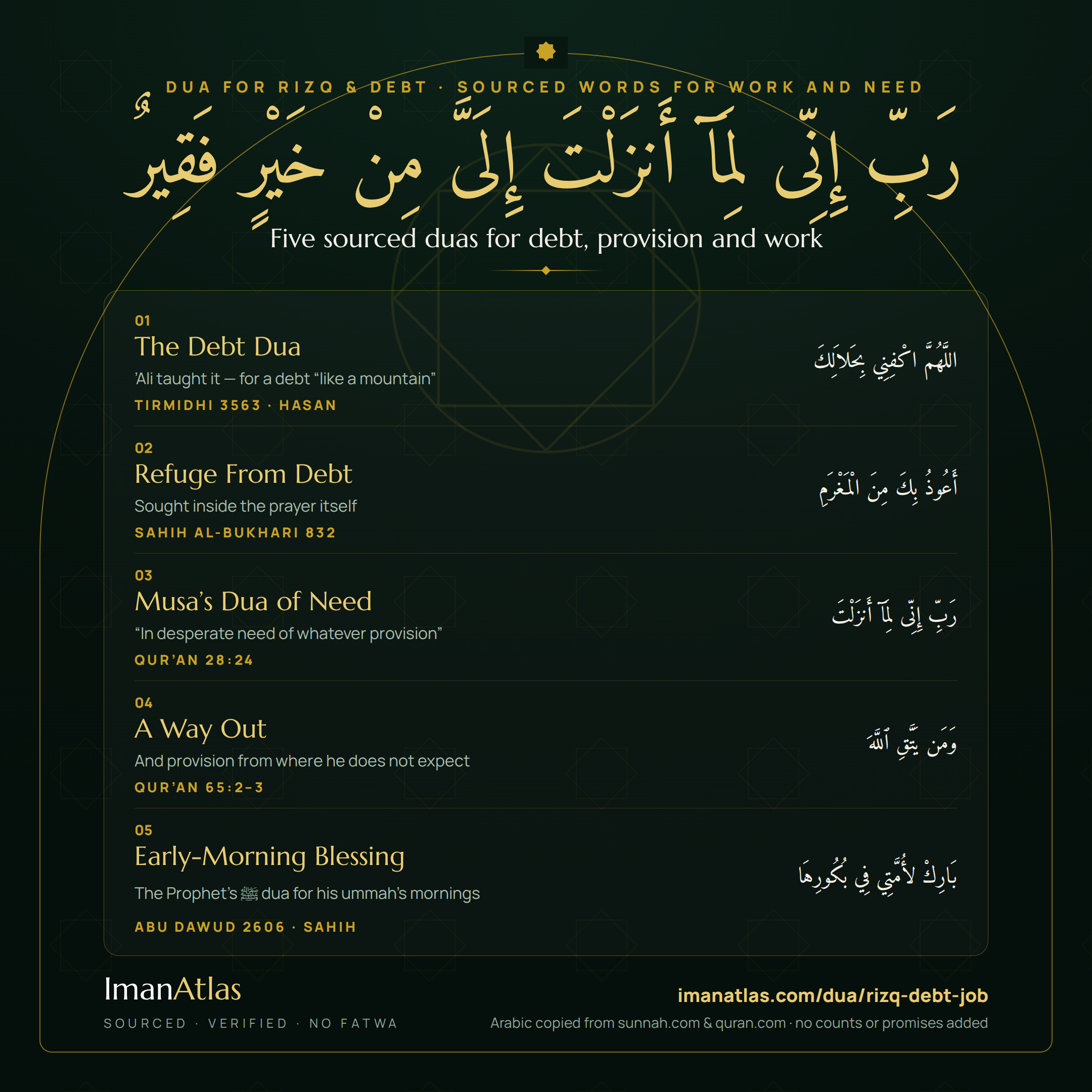
Words for debt, provision and work, exactly as narrated
Authentic duas for rizq, debt, jobs and business — Arabic, translation, reference and grade for every one, with no counts or promises added.
Short answer: For debt, the Prophet ﷺ taught words that ‘Ali passed on for a debt ‘like a mountain’ (Tirmidhi 3563), and he ﷺ sought refuge from debt inside his prayer (Bukhari 832). For provision and work, this page collects Musa’s dua of need (Qur’an 28:24), Nuh’s words on istighfar (71:10–12), and the Sunnah’s own framings, each with its source and grade.
Translations on this page: hadith — the translations printed at sunnah.com; Qur’an — Dr. Mustafa Khattab (via quran.com). Arabic is copied from those pages, never typed from memory. No repetition count is printed on this page, because none of its narrations states one, and no outcome is promised in this site’s voice — where a narration itself speaks of an outcome, it is quoted as the narration’s words. ImanAtlas presents sources, not fatwas.
The dua ‘Ali taught for a debt “like a mountain”
A mukatib — a slave who had contracted to buy his own freedom in instalments — came to ‘Ali ibn Abi Talib saying he could not meet his payments, and asked for help. ‘Ali taught him words instead: words, he said, that the Messenger of Allah ﷺ had taught him.
اللَّهُمَّ اكْفِنِي بِحَلاَلِكَ عَنْ حَرَامِكَ وَأَغْنِنِي بِفَضْلِكَ عَمَّنْ سِوَاكَ
Allāhummakfinī biḥalālika `an ḥarāmika, wa aghninī bi faḍlika `amman siwāka
“’Ali [may Allah be pleased with him] narrated: that a Mukatib came to him and said: ‘Indeed I am not capable of my Kitabah so aid me.’ He said: ‘Should I not teach you words that the Messenger of Allah (ﷺ) taught me? If you had a debt upon you similar to the mountain of Sir, Allah would fulfill it for you. He said: “Say: O Allah, suffice me with Your lawful against Your prohibited, and make me independent of all those besides You.”’”
Jami` at-Tirmidhi 3563 — sunnah.com/tirmidhi:3563 · Grade: Hasan (Darussalam), as printed at sunnah.com; at-Tirmidhi himself called the hadith hasan gharib
Its own page: The dua for debt — the words ‘Ali taught, with their source shown
The sentence about the mountain of debt is ‘Ali’s, inside the narration — it is quoted above as his words, not repeated as this site’s promise. The narration states no number of repetitions, no time of day and no deadline.
Refuge from debt inside the prayer itself
The Prophet ﷺ sought refuge from debt in the last part of his own prayer, before the salam — in the same breath as refuge from sin. When he was asked why he did it so often, his answer is printed in the narration itself.
اللَّهُمَّ إِنِّي أَعُوذُ بِكَ مِنْ عَذَابِ الْقَبْرِ وَأَعُوذُ بِكَ مِنْ فِتْنَةِ الْمَسِيحِ الدَّجَّالِ، وَأَعُوذُ بِكَ مِنْ فِتْنَةِ الْمَحْيَا وَفِتْنَةِ الْمَمَاتِ، اللَّهُمَّ إِنِّي أَعُوذُ بِكَ مِنَ الْمَأْثَمِ وَالْمَغْرَمِ
Allahumma inni a`udhu bika min `adhabi l-qabr, wa a`udhu bika min fitnati l-masihi d-dajjal, wa a`udhu bika min fitnati l-mahya wa fitnati l-mamat. Allahumma inni a`udhu bika mina l-ma’thami wa l-maghram.
“Narrated `Aisha: (the wife of the Prophet) Allah’s Messenger (ﷺ) used to invoke Allah in the prayer saying ‘Allahumma inni a`udhu bika min `adhabi l-qabr, wa a`udhu bika min fitnati l-masihi d-dajjal, wa a`udhu bika min fitnati l-mahya wa fitnati l-mamat. Allahumma inni a`udhu bika mina l-ma’thami wa l-maghram. (O Allah, I seek refuge with You from the punishment of the grave, from the afflictions of the imposter-Messiah, and from the afflictions of life and death. O Allah, I seek refuge with You from sins and from debt).’ Somebody said to him, ‘Why do you so frequently seek refuge with Allah from being in debt?’ The Prophet (ﷺ) replied, ‘A person in debt tells lies whenever he speaks, and breaks promises whenever he makes (them).’”
Sahih al-Bukhari 832 — sunnah.com/bukhari:832
Two more debt duas already live on this site in full: the Prophet’s ﷺ refuge dua whose clauses include “being heavily in debt and from being overpowered by (other) men” (Sahih al-Bukhari 6369) is the anchor of the Dua for Anxiety & Stress page, and the long bedtime dua that ends “Remove the burden of debt from us and relieve us from want” (Sahih Muslim 2713a) is on the Duas Before Sleeping page. A narration about Abu Umamah’s anxieties and debts (Sunan Abi Dawud 1555) is shown with its Da’if grade on the Anxiety page’s note section.
“…and provide me sustenance”
The shortest provision dua in the collections — one of the four things the Prophet ﷺ taught every person who embraced Islam to ask for.
اللَّهُمَّ اغْفِرْ لِي وَارْحَمْنِي وَاهْدِنِي وَارْزُقْنِي
Allahumma-ghfir li, warhamni, wahdini, warzuqni.
“Abu Malik Ashaja’i reported on the authority of his father that whenever a person embraced Islam, Allah’s Messenger (ﷺ) instructed him to recite: ‘O Allah, grant me pardon, have mercy upon me, direct me to the path of righteousness and provide me sustenance.’”
Sahih Muslim 2697a — sunnah.com/muslim:2697a
One more rizq dua belongs to the morning: after the Fajr prayer the Prophet ﷺ would ask for “beneficial knowledge, goodly provision and acceptable deeds” (Sunan Ibn Majah 925, Grade: Sahih (Darussalam)). Its full block, with its after-Fajr framing, is on the Morning Duas & Azkar page.
Musa’s dua when he arrived with nothing
Musa reached Madyan as a fugitive, with nothing. Before he prayed, he helped: he watered the herd of the two women who were holding back from the well. Only then did he withdraw to the shade and say these words. The verse’s own order — help given first, then the dua — is part of its text.
رَبِّ إِنِّى لِمَآ أَنزَلْتَ إِلَىَّ مِنْ خَيْرٍ فَقِيرٌ
rabbi innī limā anzalta ilayya min khayrin faqīrun
“So he watered ˹their herd˺ for them, then withdrew to the shade and prayed, ‘My Lord! I am truly in ˹desperate˺ need of whatever provision You may have in store for me.’”
Qur’an 28:24 — quran.com/28/24
Its own page: Rabbi Inni Lima Anzalta — Musa’s dua of need, and what the verse itself says
The dua names no job, no salary and no timeframe — it asks for “whatever provision” Allah sends down. It is printed here as the Qur’an’s words, in their context; readers looking for a “job dua” will find the honest answer in the questions below.
Musa’s dua before the task
When Allah sent Musa to Pharaoh — the most daunting assignment in the Qur’an — these were the words he asked with: an uplifted heart, an eased task, and speech that would be understood. They are printed in their Qur’an context, as a dua before a hard task and for clear speech.
قَالَ رَبِّ ٱشْرَحْ لِى صَدْرِى · وَيَسِّرْ لِىٓ أَمْرِى · وَٱحْلُلْ عُقْدَةً مِّن لِّسَانِى · يَفْقَهُوا۟ قَوْلِى
qāla rabbi ish’raḥ lī ṣadrī
wayassir lī amrī
wa-uḥ’lul ʿuq’datan min lisānī
yafqahū qawlī
“Moses prayed, ‘My Lord! Uplift my heart for me, and make my task easy, and remove the impediment from my tongue so people may understand my speech.’”
Qur’an 20:25–28 — quran.com/20/25
The dua for good in this world and the next
The most complete short dua in the Qur’an asks for both worlds in one breath — good here, good in the Hereafter, and protection from the Fire.
رَبَّنَآ ءَاتِنَا فِى ٱلدُّنْيَا حَسَنَةً وَفِى ٱلْـَٔاخِرَةِ حَسَنَةً وَقِنَا عَذَابَ ٱلنَّارِ
rabbanā ātinā fī l-dun’yā ḥasanatan wafī l-ākhirati ḥasanatan waqinā ʿadhāba l-nāri
“Yet there are others who say, ‘Our Lord! Grant us the good of this world and the Hereafter, and protect us from the torment of the Fire.’”
Qur’an 2:201 — quran.com/2/201
No count is attached to it in the Qur’an. (A figure of 434 repetitions circulates in wazifa documents online; it appears in no narration — see the checked-claims section below.)
Taqwa: “He will make a way out for them”
These verses are the Qur’an’s own framing around provision — quoted as its words, attributed to it, and not converted into a personal promise to any reader. (The quotation begins mid-verse: the opening of 65:2 concerns the waiting period after divorce; the provision sentence begins at “And whoever is mindful of Allah…”)
وَمَن يَتَّقِ ٱللَّهَ يَجْعَل لَّهُۥ مَخْرَجًا وَيَرْزُقْهُ مِنْ حَيْثُ لَا يَحْتَسِبُ وَمَن يَتَوَكَّلْ عَلَى ٱللَّهِ فَهُوَ حَسْبُهُۥٓ إِنَّ ٱللَّهَ بَٰلِغُ أَمْرِهِۦ قَدْ جَعَلَ ٱللَّهُ لِكُلِّ شَىْءٍ قَدْرًا
waman yattaqi l-laha yajʿal lahu makhrajan
wayarzuq’hu min ḥaythu lā yaḥtasibu waman yatawakkal ʿalā l-lahi fahuwa ḥasbuhu inna l-laha bālighu amrihi qad jaʿala l-lahu likulli shayin qadran
“…And whoever is mindful of Allah, He will make a way out for them, and provide for them from sources they could never imagine. And whoever puts their trust in Allah, then He ˹alone˺ is sufficient for them. Certainly Allah achieves His Will. Allah has already set a destiny for everything.”
Qur’an 65:2–3 — quran.com/65/2 · quran.com/65/3
Nuh’s words: istighfar, rain and provision
The Qur’an narrates what the Prophet Nuh said to his people — the words are printed as that narration, in his voice to them, not re-voiced as an offer made to the reader.
فَقُلْتُ ٱسْتَغْفِرُوا۟ رَبَّكُمْ إِنَّهُۥ كَانَ غَفَّارًا · يُرْسِلِ ٱلسَّمَآءَ عَلَيْكُم مِّدْرَارًا · وَيُمْدِدْكُم بِأَمْوَٰلٍ وَبَنِينَ وَيَجْعَل لَّكُمْ جَنَّٰتٍ وَيَجْعَل لَّكُمْ أَنْهَٰرًا
faqul’tu is’taghfirū rabbakum innahu kāna ghaffāran
yur’sili l-samāa ʿalaykum mid’rāran
wayum’did’kum bi-amwālin wabanīna wayajʿal lakum jannātin wayajʿal lakum anhāran
“…saying, ‘Seek your Lord’s forgiveness, ˹for˺ He is truly Most Forgiving. He will shower you with abundant rain, supply you with wealth and children, and give you gardens as well as rivers.’”
Qur’an 71:10–12 — quran.com/71/10
The verses state no number of istighfar — “seek forgiveness” is qualitative. A hadith about persisting in istighfar (Sunan Ibn Majah 3819) is graded Da’if and is shown with its grade on the Anxiety page.
Blessing in the early morning — work and trade
This dua is one the Prophet ﷺ made for his ummah — for their early mornings. At-Tirmidhi files its narration in his Book on Business, and Abu Dawud’s narration adds what Sakhr, a merchant Companion, did with it.
اللَّهُمَّ بَارِكْ لأُمَّتِي فِي بُكُورِهَا
Allahumma barik li-ummati fi bukuriha.
“Narrated Sakhr al-Ghamidi: The Prophet (ﷺ) said: ‘O Allah, bless my people in their early mornings.’ When he sent out a detachment or an army, he sent them at the beginning of the day. Sakhr was a merchant, and he would send off his merchandise at the beginning of the day; and he became rich and had much wealth. Abu Dawud said: He is Sakhr b. Wada’ah.” (Translation as printed at Sunan Abi Dawud 2606.)
Sunan Abi Dawud 2606 — sunnah.com/abudawud:2606 · Grade: Sahih (Al-Albani) · Jami` at-Tirmidhi 1212 — sunnah.com/tirmidhi:1212 · Grade: Hasan (Darussalam), both as printed at sunnah.com
Its own page: The dua for business — Sakhr’s narration, in the Book on Business itself
Sakhr’s wealth is the narration’s report about Sakhr — printed here as its words. The site does not turn it into a formula for anyone’s business.
What widens provision: keeping ties of kinship
This block is not a dua — it is the Prophet’s ﷺ words about an action, printed here because he himself connected the action to provision. It is labelled as what it is.
مَنْ أَحَبَّ أَنْ يُبْسَطَ لَهُ فِي رِزْقِهِ، وَيُنْسَأَ لَهُ فِي أَثَرِهِ، فَلْيَصِلْ رَحِمَهُ
Man ahabba an yubsata lahu fi rizqihi, wa yunsa’a lahu fi atharihi, fal-yasil rahimah.
“Narrated Anas bin Malik: Allah’s Apostle said, ‘Whoever loves that he be granted more wealth and that his lease of life be prolonged then he should keep good relations with his Kith and kin.’”
Sahih al-Bukhari 5986 — sunnah.com/bukhari:5986 — Bukhari’s own chapter title for it: “Whoever was made wealthy because of keeping good relations with his kith and kin”
Ibrahim’s dua for his family in a barren valley
Leaving his family by the Sacred House, in a valley with no crops, Ibrahim prayed for two things: that they would establish the prayer, and that they would be provided for. A dua for anyone providing for a family in a new and empty place.
رَّبَّنَآ إِنِّىٓ أَسْكَنتُ مِن ذُرِّيَّتِى بِوَادٍ غَيْرِ ذِى زَرْعٍ عِندَ بَيْتِكَ ٱلْمُحَرَّمِ رَبَّنَا لِيُقِيمُوا۟ ٱلصَّلَوٰةَ فَٱجْعَلْ أَفْـِٔدَةً مِّنَ ٱلنَّاسِ تَهْوِىٓ إِلَيْهِمْ وَٱرْزُقْهُم مِّنَ ٱلثَّمَرَٰتِ لَعَلَّهُمْ يَشْكُرُونَ
rabbanā innī askantu min dhurriyyatī biwādin ghayri dhī zarʿin ʿinda baytika l-muḥarami rabbanā liyuqīmū l-ṣalata fa-ij’ʿal afidatan mina l-nāsi tahwī ilayhim wa-ur’zuq’hum mina l-thamarāti laʿallahum yashkurūna
“Our Lord! I have settled some of my offspring in a barren valley, near Your Sacred House, our Lord, so that they may establish prayer. So make the hearts of ˹believing˺ people incline towards them and provide them with fruits, so perhaps they will be thankful.”
Qur’an 14:37 — quran.com/14/37
“Seek the bounty of Allah”
The set closes with the Qur’an’s own pairing — prayer first, then going out into the land to seek provision:
فَإِذَا قُضِيَتِ ٱلصَّلَوٰةُ فَٱنتَشِرُوا۟ فِى ٱلْأَرْضِ وَٱبْتَغُوا۟ مِن فَضْلِ ٱللَّهِ وَٱذْكُرُوا۟ ٱللَّهَ كَثِيرًا لَّعَلَّكُمْ تُفْلِحُونَ
fa-idhā quḍiyati l-ṣalatu fa-intashirū fī l-arḍi wa-ib’taghū min faḍli l-lahi wa-udh’kurū l-laha kathīran laʿallakum tuf’liḥūna
“Once the prayer is over, disperse throughout the land and seek the bounty of Allah. And remember Allah often so you may be successful.”
Qur’an 62:10 — quran.com/62/10
Widely shared claims, checked
Surah al-Waqiah every night “for wealth”
The narration “whoever recites Surah al-Waqiah every night will never be afflicted by poverty” is attributed to Ibn Mas’ud and recorded by al-Bayhaqi and others — it is in none of the six canonical collections, and it is not on sunnah.com. Al-Albani graded it Da’if (weak) in his Silsilat al-Ahadith ad-Da’ifah (no. 289), and the grading discussion quotes the chain’s defects as recorded by Ahmad, Abu Hatim, ad-Daraqutni and others; al-Manawi called the narration Munkar. A stronger sibling version of the claim is graded Mawdhu’ (fabricated) by al-Albani. The surah itself is Qur’an, and reading it is reading Qur’an — but this site does not present nightly al-Waqiah as an established provision practice, and attaches no promise to it. Its Arabic is not printed here, because the narration’s text was not captured from a primary hadith source.
Grading discussion: Islamweb fatwa 348835 — islamweb.net/en/fatwa/348835, quoting al-Albani’s Silsilah (ad-Da’ifah 289)
The counts attached to these duas online
The figures that travel with these duas — Musa’s dua 313 times for 21 days or 1,000 times a day, Rabbana atina 434 times, “Ya Razzaq 308 times”, even “twelve thousand times in one sitting” (a figure from an IslamQA questioner’s own words) — appear in none of the narrations on this page. Every narration above states no count at all. That is why this page, like the rest of this site, prints none.
The companion sets
Debt and provision sit beside two other sets on this site: the full refuge dua of Bukhari 6369 anchors the Dua for Anxiety, Stress, Sadness & Depression page, and the after-Fajr provision dua (Ibn Majah 925) lives on the Morning Duas & Azkar page. The whole collection is gathered on the Dua & Azkar hub.
The rizq, debt and work duas, one by one
Five of these duas now have a page of their own, with the narrations around them:
Dua for Debt — the words ‘Ali taught a man who could not meet his payments (Tirmidhi 3563).
Rabbi Inni Lima Anzalta — Musa’s dua of need, and what the verse itself says (Qur’an 28:24).
Dua for Protection from Poverty — the Prophet’s ﷺ own words of refuge from poverty itself (Abu Dawud 1544).
Dua for Wealth — the prayer the Prophet ﷺ made for Anas ibn Malik, printed whole with its story (Sahih al-Bukhari 6334).
Dua for Business — Sakhr’s narration, filed by at-Tirmidhi in the Book on Business itself (Abu Dawud 2606).
Frequently asked questions
What is the dua for paying off debt?
The dua ‘Ali taught for it is in Jami` at-Tirmidhi 3563, graded Hasan (Darussalam) as printed at sunnah.com: “O Allah, suffice me with Your lawful against Your prohibited, and make me independent of all those besides You.” ‘Ali introduced it with the words: “If you had a debt upon you similar to the mountain of Sir, Allah would fulfill it for you” — quoted here as his words inside the narration. The Prophet ﷺ also sought refuge from debt inside his prayer (Sahih al-Bukhari 832). Neither narration states a count, a time or a deadline.
Is there a dua for getting a job?
Honestly: no narration verified for this page is a “job dua” as such, and this site will not label one. What the sources do carry is Musa’s dua when he arrived in Madyan with nothing — “My Lord! I am truly in desperate need of whatever provision You may have in store for me” (Qur’an 28:24) — said after he had first helped the two women at the well; Musa’s dua before a daunting task (Qur’an 20:25–28); and the Qur’an’s instruction, after prayer, to “disperse throughout the land and seek the bounty of Allah” (62:10).
How many times should I recite these duas?
The narrations on this page state no number of repetitions — not one of them. The counts attached to these duas online (313 times for 21 days, 1,000 times a day, 434 times, “Ya Razzaq 308 times”) appear in no narration we could verify, so this page prints none.
Does reciting Surah al-Waqiah at night protect from poverty?
The narration behind that claim is graded Da’if (weak) by al-Albani (Silsilat al-Ahadith ad-Da’ifah 289); it is in none of the six canonical collections, and the chain’s defects are recorded by Ahmad, Abu Hatim, ad-Daraqutni and others, as quoted in Islamweb’s fatwa 348835. A stronger sibling version is graded Mawdhu’ (fabricated). Reading the surah is reading Qur’an; this site does not present it as an established provision practice or attach a promise to it.
Why did the Prophet ﷺ seek refuge from debt so often?
His own explanation is in the narration: “A person in debt tells lies whenever he speaks, and breaks promises whenever he makes (them)” (Sahih al-Bukhari 832). He ﷺ sought refuge from debt together with sin — “O Allah, I seek refuge with You from sins and from debt” — inside the prayer, before the salam.
What about the dua “Allahumma la sahla illa ma ja’altahu sahla”?
It is widely quoted from Sahih Ibn Hibban — a collection sunnah.com does not host, and the reference is cited with differing numbers in secondary sources. Our research could not verify its Arabic text and grade at the primary source, so it is named here honestly and not printed yet. The same note is carried on the Anxiety page.
What about the long dua “Allahumma inni ‘abduka” for debt and anxiety?
It is printed — on its own page, with the Anxiety duas, where it belongs. When this page was first built, the dua could not be verified at its source, so it was named here instead of printed unchecked. It has since been verified in sunnah.com’s printing of Hisn al-Muslim (entry 120), and the full text, with its translation and grading note, is here: Allahumma Inni Abduka.
Can I make these duas in my own language, and does dua replace effort?
Every block on this page prints the Arabic with a named translation — sunnah.com’s for the hadith, Dr. Mustafa Khattab’s for the Qur’an — so you can understand the words as you learn them. As for effort: the sources themselves pair the two. Musa helped at the well before he prayed (Qur’an 28:24), Sakhr sent out his merchandise in the early morning (Abu Dawud 2606), and the Qur’an sends the worshipper out after prayer to “seek the bounty of Allah” (62:10). This page describes the sources and leaves rulings to qualified scholars.
Sources
Hadith Arabic and translations: the pages printed at sunnah.com — Tirmidhi 3563 · Bukhari 832 · Muslim 2697a · Abu Dawud 2606 · Tirmidhi 1212 · Bukhari 5986 · pointers: Ibn Majah 925 · Bukhari 6369 · Muslim 2713a · Abu Dawud 1555. Qur’an Arabic: the Tanzil Uthmani text (tanzil.net); Qur’an translation: Dr. Mustafa Khattab, as printed at quran.com — 28:24 · 20:25–28 · 2:201 · 65:2 · 65:3 · 71:10–12 · 14:37 · 62:10. Waqiah grading: Islamweb fatwa 348835 (quoting al-Albani, Silsilat al-Ahadith ad-Da’ifah 289). Grades are exactly as printed at sunnah.com. Every claim on this page was checked against these pages on 28 November 2026.
Share this set