Duas for Protection — Evil Eye, Black Magic & Fear
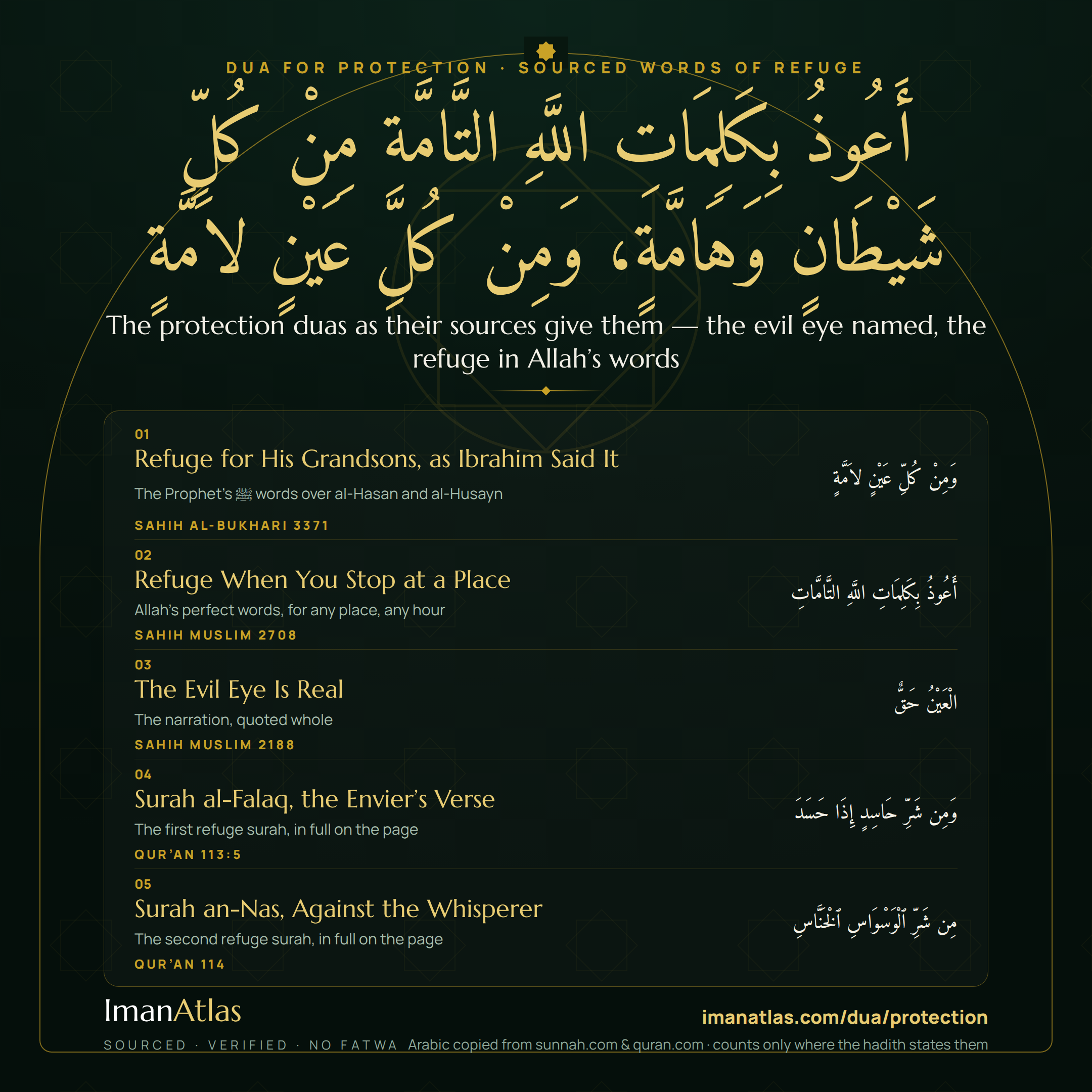
The protection duas as their sources give them — the evil eye named by its own narration, the refuge in Allah’s perfect words, and the two refuge surahs in full.
Short answer: The Qur’an and the Sunnah name the harms plainly — the evil eye is real (Muslim 2188), and the refuge is in Allah’s words: the dua the Prophet ﷺ said over his grandsons (Bukhari 3371), the words for one who stops at a place (Muslim 2708), and the two refuge surahs, al-Falaq and an-Nas, printed here in full.
ImanAtlas does not give fatwas. For your own situation, ask a qualified scholar you trust.
If fear or unease stays with you day after day, please reach out as well — to family, to a trusted friend, and to a doctor or counsellor. Accepting support from people is part of looking after yourself.
The eyes, and the Reminder
A framing passage, not a dua — the Qur’an’s own scene of hostile eyes at the hearing of the Reminder, and the passage’s own close. Both verses are printed whole:
وَإِن يَكَادُ ٱلَّذِينَ كَفَرُوا۟ لَيُزْلِقُونَكَ بِأَبْصَٰرِهِمْ لَمَّا سَمِعُوا۟ ٱلذِّكْرَ وَيَقُولُونَ إِنَّهُۥ لَمَجْنُونٌ
wa-in yakādu alladhīna kafarū layuz’liqūnaka bi-abṣārihim lammā samiʿū l-dhik’ra wayaqūlūna innahu lamajnūnun
“The disbelievers would almost cut you down with their eyes when they hear ˹you recite˺ the Reminder, and say, "He is certainly a madman."”
Qur’an 68:51
وَمَا هُوَ إِلَّا ذِكْرٌ لِّلْعَٰلَمِينَ
wamā huwa illā dhik’run lil’ʿālamīna
“But it is simply a reminder to the whole world.”
Qur’an 68:52
The evil eye is real
A statement narration, not a dua — the anchor text for this whole topic, printed whole. Its closing clause speaks of a bath when one is asked for it; that clause is the narration’s words, reported as narration — the narration itself gives no procedure, and this page builds none. And the narration carries its own limit inside itself: the eye is real, and nothing precedes the destiny:
الْعَيْنُ حَقٌّ وَلَوْ كَانَ شَىْءٌ سَابَقَ الْقَدَرَ سَبَقَتْهُ الْعَيْنُ وَإِذَا اسْتُغْسِلْتُمْ فَاغْسِلُوا
“Ibn ‘Abbas reported Allah’s Messenger (ﷺ) as saying: The influence of an evil eye is a fact; if anything would precede the destiny it would be the influence of an evil eye, and when you are asked to take bath (as a cure) from the influence of an evil eye, you should take bath.”
Sahih Muslim 2188
Refuge in Allah’s perfect words
The words taught for one who lands or stops at a place — any place, any hour. The narration states no repetition count, and none is printed with these words on this page. Its outcome clause stays inside the narration’s quote:
أَعُوذُ بِكَلِمَاتِ اللَّهِ التَّامَّاتِ مِنْ شَرِّ مَا خَلَقَ
“Khaula bint Hakim Sulamiyya reported: I heard Allah’s Messenger (ﷺ) as saying: When anyone lands at a place, and then says: "I seek refuge in the Perfect Word of Allah from the evil of what He has created," nothing would harm him until he marches from that stopping place.”
Sahih Muslim 2708
Its own page: The Dua When You Stop at a Place, where this narration and Malik’s route stand together.
The same words stand in an evening narration — Abu Huraira’s, with the scorpion — whose full block is on the Evening page; the two narrations are never merged.
The words he ﷺ said over his grandsons
The protection dua with the longest pedigree on this page — Ibrahim’s words for Ishmael and Isaac, the Prophet’s ﷺ words for al-Hasan and al-Husayn — printed whole, exactly as Bukhari prints them:
أَعُوذُ بِكَلِمَاتِ اللَّهِ التَّامَّةِ مِنْ كُلِّ شَيْطَانٍ وَهَامَّةٍ، وَمِنْ كُلِّ عَيْنٍ لاَمَّةٍ
“Narrated Ibn `Abbas: The Prophet (ﷺ) used to seek Refuge with Allah for Al-Hasan and Al-Husain and say: "Your forefather (i.e. Abraham) used to seek Refuge with Allah for Ishmael and Isaac by reciting the following: ‘O Allah! I seek Refuge with Your Perfect Words from every devil and from poisonous pests and from every evil, harmful, envious eye.’ "”
Sahih al-Bukhari 3371
Its own page: The Dua He ﷺ Said Over His Grandsons, where both routes of this dua stand side by side.
The two refuge surahs he ﷺ recited over himself
A practice narration, not a dua text — ‘Aisha reports the Prophet ﷺ turning to the two surahs over himself. Its details stay inside her narration; this page builds no technique from them. The two surahs — Al-Mu’awwidhat, the refuge pair — are printed in full beneath it, with their translation:
أَنَّ رَسُولَ اللَّهِ صلى الله عليه وسلم كَانَ إِذَا اشْتَكَى يَقْرَأُ عَلَى نَفْسِهِ بِالْمُعَوِّذَاتِ وَيَنْفُثُ، فَلَمَّا اشْتَدَّ وَجَعُهُ كُنْتُ أَقْرَأُ عَلَيْهِ وَأَمْسَحُ بِيَدِهِ رَجَاءَ بَرَكَتِهَا
“Narrated `Aisha: Whenever Allah’s Messenger (ﷺ) became sick, he would recite Mu’awwidhat (Surat Al-Falaq and Surat An-Nas) and then blow his breath over his body. When he became seriously ill, I used to recite (these two Suras) and rub his hands over his body hoping for its blessings.”
Sahih al-Bukhari 5016
Surah al-Falaq — Qur’an 113
قُلْ أَعُوذُ بِرَبِّ ٱلْفَلَقِ مِن شَرِّ مَا خَلَقَ وَمِن شَرِّ غَاسِقٍ إِذَا وَقَبَ وَمِن شَرِّ ٱلنَّفَّٰثَٰتِ فِى ٱلْعُقَدِ وَمِن شَرِّ حَاسِدٍ إِذَا حَسَدَ
qul aʿūdhu birabbi l-falaqi min sharri mā khalaqa wamin sharri ghāsiqin idhā waqaba wamin sharri l-nafāthāti fī l-ʿuqadi wamin sharri ḥāsidin idhā ḥasada
“Say, ˹O Prophet,˺ "I seek refuge in the Lord of the daybreak from the evil of whatever He has created, and from the evil of the night when it grows dark, and from the evil of those ˹witches casting spells by˺ blowing onto knots, and from the evil of an envier when they envy."”
Qur’an 113 — printed in full
Surah an-Nas — Qur’an 114
قُلْ أَعُوذُ بِرَبِّ ٱلنَّاسِ مَلِكِ ٱلنَّاسِ إِلَٰهِ ٱلنَّاسِ مِن شَرِّ ٱلْوَسْوَاسِ ٱلْخَنَّاسِ ٱلَّذِى يُوَسْوِسُ فِى صُدُورِ ٱلنَّاسِ مِنَ ٱلْجِنَّةِ وَٱلنَّاسِ
qul aʿūdhu birabbi l-nāsi maliki l-nāsi ilāhi l-nāsi min sharri l-waswāsi l-khanāsi alladhī yuwaswisu fī ṣudūri l-nāsi mina l-jinati wal-nāsi
“Say, ˹O Prophet,˺ "I seek refuge in the Lord of humankind, the Master of humankind, the God of humankind, from the evil of the lurking whisperer— who whispers into the hearts of humankind— from among jinn and humankind."”
Qur’an 114 — printed in full
Surah al-Baqarah in the house
A narration, not a dua — the Prophet’s ﷺ words about a house where al-Baqarah is recited, reported as narration. This page builds no house method from it — no schedule, no room-by-room practice:
لاَ تَجْعَلُوا بُيُوتَكُمْ مَقَابِرَ إِنَّ الشَّيْطَانَ يَنْفِرُ مِنَ الْبَيْتِ الَّذِي تُقْرَأُ فِيهِ سُورَةُ الْبَقَرَةِ
“Abu Huraira reported Allah’s Messenger (ﷺ) as saying: Do not make your houses as graveyards. Satan runs away from the house in which Surah Baqara is recited.”
Sahih Muslim 780
The surah itself — 286 verses — is listed and linked on the Surah hub.
The daily protection sets
The daily words of protection live in the morning and evening adhkar sets, with their narrations and the counts those narrations themselves state. Ayat al-Kursi (Qur’an 2:255) is printed in full on the Morning, Before Sleeping pages and the Dua hub. Bismillahil-ladhi la yadurru — “in the Name of Allah, who with His Name nothing in the earth or the heavens can cause harm”, three times, morning and evening — is printed in full on the Morning and Evening pages (Sunan Abi Dawud 5088, Sahih (Al-Albani); Jami` at-Tirmidhi 3388, Hasan (Darussalam)). Its Tirmidhi narration ends with a sentence the protection lists leave out, restored here: its own transmitter, Aban, stricken with semi-paralysis, answered the man staring at him — “Indeed the Hadith is as I reported it to you, but I did not say it one day, so Allah brought about His decree upon me.” The three Quls as adhkar, with their “sufficient” narration (Sunan Abi Dawud 5082), are on the Morning and Evening pages; the Mu’awwidhat at sleep (Sahih al-Bukhari 5017) on the Before Sleeping page, and in illness (Sahih al-Bukhari 5735) with “La ba’sa, tahurun in sha Allah” (Sahih al-Bukhari 5662) on the Health page. For fear itself, Hasbunallah wa ni’mal wakeel (Qur’an 3:173) is printed on the Anxiety page.
Diagnosis, methods and your own situation
These pages print the texts with their sources; they do not diagnose anyone, and they assemble no treatment. The questions this page routes rather than answers are the ruling questions: whether a practice is a permissible ruqyah, whether a person should see a raqi, whether an object is a taweez, and what a particular person’s condition is.
ImanAtlas does not give fatwas. For your own situation, ask a qualified scholar you trust.
If fear or unease stays with you day after day, please reach out as well — to family, to a trusted friend, and to a doctor or counsellor. Accepting support from people is part of looking after yourself.
Widely shared claims, checked
The counts and programmes attached to this topic online. Figures and protocols circulate with these duas: al-Fatiha seven times as a treatment, verse-lists presented as a removal protocol for sihr, ruqyah courses of 7 or 21 days, “recite until the reaction stops”. None of them appears in any source on this page. The “three times” attached in popular lists to Muslim’s kalimatillah words is not in Muslim’s text — the counts that do exist live inside other narrations, on the Morning and Evening pages; and one book’s English rendering circulates with “33 times” for the Bismillahilladhi dua against its own Arabic’s three — a rendering artifact, not a narration. The “Hasbiyallah seven times” narration is graded Mawdu’ (Fabricated) as printed at sunnah.com and stands treated, with its grade, on the Morning and Evening pages.
The diagnosis lists. Symptom checklists for sihr, the evil eye and jinn — onset-story sorting rules, reaction-under-recitation tests, folk tests with lemons, salt water and camphor — appear in no source on this page and in no narration this site prints. A person cannot be diagnosed from a list, and this page offers no list; what the sources give for the eye and for refuge is printed above, as texts.
The long “Jibril dua”. A long dua beginning “Allahumma dhas-sultanil-‘azim…” circulates online as the dua for the evil eye. It is traced by hadith-scholarship sites to material in Tafsir Ibn Kathir, from a Hadith Juz’ of Khaythamah ibn Sulayman; it stands in none of the sources this page prints from and was not captured at a primary source for this page, so its wording is not printed here. The duas the captured sources do give for the eye are Bukhari 3371 above and the two refuge surahs.
The protection duas, one by one
Four of these duas now have a page of their own, where their routes are set out in full. Each page keeps this page’s frame: no diagnosis, no promise, and no programme added.
The Dua He ﷺ Said Over His Grandsons — the refuge words for al-Hasan and al-Husayn in both of their routes (Bukhari 3371 · Abu Dawud 4737), each under its own number and grade.
The Dua When You Stop at a Place — Khaula’s narration (Muslim 2708) and Malik’s route beside it, with no count attached to words whose own text states none.
The Dua for Protection from Loss of Blessings — the refuge from a blessing withdrawn (Muslim 2739 · Abu Dawud 1545), its two routes differing by a single word, kept side by side.
The Dua When Fearing a People — Abu Musa’s narration (Abu Dawud 1537), the book’s own print (Hisn 126) and Anas’s expedition narration (Abu Dawud 2632), each as its source gives it.
Frequently asked questions
What is the dua for protection from the evil eye?
The captured sources give the Prophet’s ﷺ own words: the refuge he ﷺ said over al-Hasan and al-Husayn — “O Allah! I seek Refuge with Your Perfect Words from every devil and from poisonous pests and from every evil, harmful, envious eye” (Sahih al-Bukhari 3371) — the words for one who stops at a place (Sahih Muslim 2708), and the two refuge surahs, al-Falaq and an-Nas, printed in full on this page.
Is the evil eye real in Islam?
The narration’s own words, quoted whole: “The influence of an evil eye is a fact; if anything would precede the destiny it would be the influence of an evil eye, and when you are asked to take bath (as a cure) from the influence of an evil eye, you should take bath” (Sahih Muslim 2188). The Qur’an’s frame is at 68:51–52. Both are printed on this page; the narration’s destiny clause travels with its opening, never cropped off.
How do I know if I have sihr, black magic or the evil eye?
This site cannot tell you, and no source on this page contains a test or a symptom list by which anyone could. The lists and tests online go beyond every text printed here. A fatwa record states the scholarly caution plainly: “There is generally no way for the Muslim to be certain that he is affected with magic and the like, especially that the symptoms of diseases are often similar… it is better to look for the normal reasons that are apparent and to consult doctors who are specialised in physical or psychological diseases” (IslamWeb, fatwa 400183 — quoted as a record). Bodily or mental symptoms belong first with a doctor; the personal case belongs with a qualified scholar.
What should I recite every day for protection?
The daily sets live where their narrations put them: the Morning and Evening pages carry Ayat al-Kursi, the three Quls with their narration (Abu Dawud 5082), and Bismillahilladhi three times (Abu Dawud 5088; Tirmidhi 3388) — each with its Arabic, reference and grade. This page assembles no programme of its own; it prints the protection texts and points to the daily sets that carry them.
I have seen “A’udhu bi kalimatillah” printed with “three times” — does the hadith say that?
Muslim’s narrations of these words (2708, and the evening narration 2709) state no count — the “three times” printed against them in popular lists is an addition the lists make, not the narration’s text. The counts of three that the sources do state belong to other narrations — Bismillahilladhi (Abu Dawud 5088, Tirmidhi 3388) and the three Quls as adhkar (Abu Dawud 5082) — and are printed on the Morning and Evening pages, where those narrations live.
Someone offered me a taweez or amulet for protection — what do the sources say?
Honestly: the narration the genre cites about amulets stands in Musnad Ahmad, which is not hosted on sunnah.com and was not verified at a primary source for this page — so this page does not print its wording, because printing what it has not verified is exactly what this site refuses to do. Whether you may wear or must remove such an object is a ruling question: ImanAtlas does not give fatwas. For your own situation, ask a qualified scholar you trust.
Can I recite these words over my children?
That is exactly what the anchor narration describes: the Prophet ﷺ sought refuge for al-Hasan and al-Husayn with the words of Bukhari 3371, as Ibrahim had sought refuge for Ishmael and Isaac before him. The words are printed in full on this page, as Bukhari prints them.
What is ruqyah — and do you give a ruqyah programme or method?
In the narrations on this page, what the Prophet ﷺ recited over himself was the Qur’an — the two refuge surahs (Bukhari 5016, and 5735 in illness) — and the taught duas. This site prints those texts with their sources; it assembles no programme, no session structure, no water, oil or leaf methods, and offers no sessions. How ruqyah is conducted as a treatment is a ruling and practice question: ImanAtlas does not give fatwas. For your own situation, ask a qualified scholar you trust.
I feel afraid and uneasy all the time — is that a sign of sihr?
This page cannot diagnose anyone, and fear is named in no source printed here as a sign of anything. The duas for a heavy heart are on the Anxiety page — Yunus’s words from inside the distress, the Prophet’s ﷺ karb dua, and Hasbunallah (Qur’an 3:173). And if fear or unease stays with you day after day, please reach out as well — to family, to a trusted friend, and to a doctor or counsellor. Accepting support from people is part of looking after yourself.
Sources
Translations on this page: hadith — the translations printed at sunnah.com (its Muslim 2188 and 780 texts are the older USC-MSA renderings, printed as captured, never silently modernised); Qur’an — Dr. Mustafa Khattab (via quran.com). Arabic is copied from those sources, never typed from memory. No repetition count is printed unless the narration itself states it — and no text in this page’s main set states one.
- Qur’an 68:51–52 — quran.com · Sahih Muslim 2188 — sunnah.com
- Sahih Muslim 2708 — sunnah.com · Sahih al-Bukhari 3371 — sunnah.com
- Sahih al-Bukhari 5016 — sunnah.com · Surah al-Falaq (113) — quran.com · Surah an-Nas (114) — quran.com
- Sahih Muslim 780 — sunnah.com
- Pointers: Sunan Abi Dawud 5088 — sunnah.com · Jami` at-Tirmidhi 3388 — sunnah.com · Sunan Abi Dawud 5082 — sunnah.com · Sahih al-Bukhari 5017 — sunnah.com · Sahih al-Bukhari 5735 — sunnah.com · Sahih al-Bukhari 2311 — sunnah.com · Qur’an 2:255 — quran.com
- IslamWeb fatwa 400183 — the diagnosis caution (a fatwa record) · Tanzil — Qur’an text (Uthmani)
Share this set