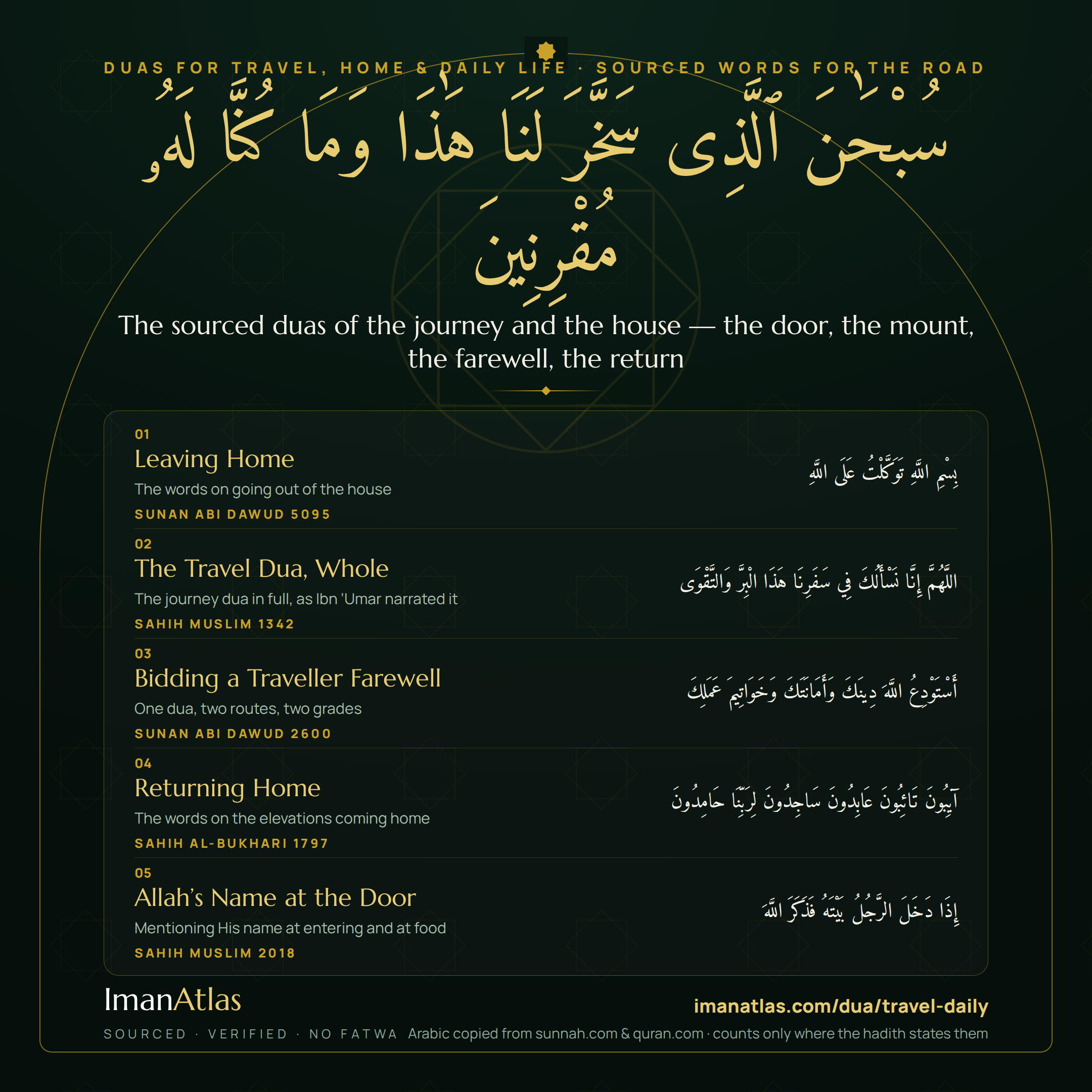
Duas for Travel, Home & Daily Life
The sourced words for the threshold and the road — leaving home, the mount verse, the travel dua whole, the farewells both ways, the return, and the house’s own small words.
Short answer: The journey is covered by words at every step: the dua for leaving home (Abu Dawud 5095), the mount verse (Qur’an 43:13–14), the Prophet’s ﷺ travel dua (Muslim 1342), the farewell duas, and the words for returning (Bukhari 1797) — and the house has its own: Allah’s name at the door (Muslim 2018), a garment dua, and the bathroom pair.
ImanAtlas does not give fatwas. For your own situation, ask a qualified scholar you trust.
Leaving home
The door dua, printed exactly as Abu Dawud prints it — لاَ حَوْلَ with no wa before it; the popular copy with an added wa is a later-copy variant, named in the note section below. What is said to the one who says these words stays inside the narration, where it belongs:
بِسْمِ اللَّهِ تَوَكَّلْتُ عَلَى اللَّهِ لاَ حَوْلَ وَلاَ قُوَّةَ إِلاَّ بِاللَّهِ
“Narrated Anas ibn Malik: The Prophet (ﷺ) said: When a man goes out of his house and says: "In the name of Allah, I trust in Allah; there is no might and no power but in Allah," the following will be said to him at that time: "You are guided, defended and protected." The devils will go far from him and another devil will say: How can you deal with a man who has been guided, defended and protected?”
Grade: Sahih (Al-Albani), as printed at sunnah.com.
Sunan Abi Dawud 5095
Its own page: The Dua for Leaving Home, where this dua and its second routes stand side by side.
The Prophet’s ﷺ own words at the door
The second leaving dua — the words Umm Salamah heard him ﷺ say every time he left her house, his eyes raised to the sky. Its pairs run in both directions: the harm I might do, and the harm that might be done to me:
اللَّهُمَّ إِنِّي أَعُوذُ بِكَ أَنْ أَضِلَّ أَوْ أُضَلَّ أَوْ أَزِلَّ أَوْ أُزَلَّ أَوْ أَظْلِمَ أَوْ أُظْلَمَ أَوْ أَجْهَلَ أَوْ يُجْهَلَ عَلَىَّ
“Narrated Umm Salamah, Ummul Mu’minin: The Messenger of Allah (ﷺ) never went out of my house without raising his eye to the sky and saying: "O Allah! I seek refuge in Thee lest I stray or be led astray, or slip or made to slip, or cause injustice, or suffer injustice, or do wrong, or have wrong done to me."”
Grade: Sahih (Al-Albani), as printed at sunnah.com.
Sunan Abi Dawud 5094
The mount words — the verse the journey opens with
This is the “safar ki dua” of the popular search. The verse first speaks of settling on the mount’s back and remembering the blessing — that frame rides in the translation line; the block prints the words the verse itself gives to say. The verse is the dua’s opening; the dua continues in the next block, where the Prophet ﷺ is narrated saying it:
سُبْحَٰنَ ٱلَّذِى سَخَّرَ لَنَا هَٰذَا وَمَا كُنَّا لَهُۥ مُقْرِنِينَ وَإِنَّآ إِلَىٰ رَبِّنَا لَمُنقَلِبُونَ
sub’ḥāna alladhī sakhara lanā hādhā wamā kunnā lahu muq’rinīna wa-innā ilā rabbinā lamunqalibūna
“…so that you may sit firmly on their backs, and remember your Lord’s blessings once you are settled on them, saying, ‘Glory be to the One Who has subjected these for us, for we could have never done so ˹on our own˺. And surely to our Lord we will ˹all˺ return.’”
Qur’an 43:13–14
The travel dua, whole
The anchor of this page — Ibn ‘Umar’s narration of the whole setting-out: the takbir three times on mounting, the mount words, the journey dua itself, and, at the narration’s end, the addition he ﷺ made when returning. Its requests stay inside its words:
سُبْحَانَ الَّذِي سَخَّرَ لَنَا هَذَا وَمَا كُنَّا لَهُ مُقْرِنِينَ وَإِنَّا إِلَى رَبِّنَا لَمُنْقَلِبُونَ اللَّهُمَّ إِنَّا نَسْأَلُكَ فِي سَفَرِنَا هَذَا الْبِرَّ وَالتَّقْوَى وَمِنَ الْعَمَلِ مَا تَرْضَى اللَّهُمَّ هَوِّنْ عَلَيْنَا سَفَرَنَا هَذَا وَاطْوِ عَنَّا بُعْدَهُ اللَّهُمَّ أَنْتَ الصَّاحِبُ فِي السَّفَرِ وَالْخَلِيفَةُ فِي الأَهْلِ اللَّهُمَّ إِنِّي أَعُوذُ بِكَ مِنْ وَعْثَاءِ السَّفَرِ وَكَآبَةِ الْمَنْظَرِ وَسُوءِ الْمُنْقَلَبِ فِي الْمَالِ وَالأَهْلِ
“Ibn Umar (Allah be pleased with them) reported that whenever Allah’s Messenger (ﷺ) mounted his camel while setting out on a journey, he glorified Allah (uttered Allah-o-Akbar) thrice, and then said: Hallowed is He Who subdued for us this (ride) and we were not ourselves powerful enough to use It as a ride, and we are going to return to our Lord. O Allah, we seek virtue and piety from Thee in this journey of ours and the act which pleaseth Thee. O Allah, lighten this journey of ours, and make its distance easy for us. O Allah, Thou art (our) companion during the journey, and guardian of (our) family. O Allah, I seek refuge with Thee from hardships of the journey, gloominess of the sights, and finding of evil changes in property and family on return. And he (the Holy Prophet) uttered (these words), and made this addition to them: We are returning, repentant, worshipping our Lord. and praising Him.”
And the return addition, in its place at the narration’s end:
آيِبُونَ تَائِبُونَ عَابِدُونَ لِرَبِّنَا حَامِدُونَ
Sahih Muslim 1342
Its own page: The Travel Dua, Whole, where the verse, the whole dua and the refuge list stand side by side.
‘Ali’s mounting, as the narration tells it
A different text from the block above, never blended with it: ‘Ali ibn Abi Talib mounting as he had seen the Prophet ﷺ mount — bismillah at the stirrup, the verse on the back, praise and takbir, and the forgiveness words that end it, with the narration’s own closing — his ﷺ laughter, and the reason he ﷺ gave for it:
بِسْمِ اللَّهِ ثَلاَثًا … سُبْحَانَ الَّذِي سَخَّرَ لَنَا هَذَا وَمَا كُنَّا لَهُ مُقْرِنِينَ وَإِنَّا إِلَى رَبِّنَا لَمُنْقَلِبُونَ … الْحَمْدُ لِلَّهِ ثَلاَثًا وَاللَّهُ أَكْبَرُ ثَلاَثًا سُبْحَانَكَ إِنِّي قَدْ ظَلَمْتُ نَفْسِي فَاغْفِرْ لِي فَإِنَّهُ لاَ يَغْفِرُ الذُّنُوبَ إِلاَّ أَنْتَ
“Ali bin Rabi’ah said: "I witnessed Ali having an animal brought to him to ride. When he placed his foot in the stirrup he said: ‘In the Name of Allah,’ (Bismillah) [three times]. So then, once he had ascended upon its back, he said: ‘All praise is due to Allah.’ (Al-hamdulillah) then he said: Glory is to Him Who has subjected this to us, and we were not able to do it. And, surely, to our Lord are we returning (Subhan alladhi sakh-khara lana hadha wa ma kunna lahu muqrinin. Wa inna ila rabbina lamunqalibun). Then he said: ‘All praise is due to Allah (Al-hamdulillah)’ – three times – and ‘Allah is the Greatest (Allahu Akbar)’ – three times – ‘Glory is to You, indeed I have wronged myself, so forgive me, for indeed none forgives sins except You (Subhanaka inni qad zalamtu nafsi faghfirli fa-innahu la yaghfirudh-dhunuba illa ant).’ Then he laughed. So I said: ‘O Commander of the Believer! What caused you to laugh?’ He said: ‘I saw the Messenger of Allah do as I did, then he (ﷺ) laughed, so I said, ‘What cause you to laugh?’ He said: ‘Indeed, your Lord is very pleased with His worshipper when he says: "O my Lord, forgive me my sins, indeed, no one other than You forgives sins.”
Grade: Sahih (Darussalam), as printed at sunnah.com. At-Tirmidhi’s own words on this narration: “This hadith is hasan sahih.”
Jami’ at-Tirmidhi 3446
Bidding a traveller farewell
One dua, two routes — and each route keeps its own grade and its own wording. The block’s text is at-Tirmidhi’s route, whose Arabic was captured whole; Ibn ‘Umar would call the traveller close and bid him farewell as the Prophet ﷺ used to bid them farewell:
أَسْتَوْدِعُ اللَّهَ دِينَكَ وَأَمَانَتَكَ وَخَوَاتِيمَ عَمَلِكَ
Astawdi`ullāha dīnaka wa amānataka wa khawātīma `amalik
“Salim narrated that: when he intended to undertake a journey, Ibn `Umar used to say to a person to "Come close to me so that I may bid you farewell as the Messenger of Allah (ﷺ) used to bid us farewell." Then he would say: "I entrust to Allah your religion, and your trusts, and the last of your deeds (Astawdi`ullaha dinaka wa amanataka wa khawatima `amalik).”
Grade: Hasan (Darussalam), as printed at sunnah.com; at-Tirmidhi’s own tail calls it hasan sahih gharib from this route.
The second route — Qaza’ah, from Ibn ‘Umar: “Qaza’ah said Ibn ‘Umar told me "Come, I see off you as the Apostle of Allaah(ﷺ) saw me off. I entrust to Allaah your religion what you are responsible for and your final deeds.""”
Grade: Sahih (Al-Albani), as printed at sunnah.com — Abu Dawud’s route, never attached to at-Tirmidhi’s line.
Jami’ at-Tirmidhi 3443 · Sunan Abi Dawud 2600
Its own page: The Farewell Duas, Both Ways, where the parting words stand in both directions.
“Give me provision for the journey”
A man asked the Prophet ﷺ for provision, and was given three sentences — asking twice for more, and given more each time. Printed as the dialogue it is:
زَوَّدَكَ اللَّهُ التَّقْوَى … وَغَفَرَ ذَنْبَكَ … وَيَسَّرَ لَكَ الْخَيْرَ حَيْثُمَا كُنْتَ
Zawwadak Allāhut-taqwā … Wa ghafara dhanbak … Wa yassara lakal-khaira ḥaithu mā kunt
“Anas said: "A man came to the Messenger of Allah (ﷺ) and said: ‘I intend to undertake a journey, so give me provision. He said: ‘May Allah grant you Taqwa as your provision (Zawwadak Allāhut-taqwā).’ He said: ‘Give me more.’ He said: ‘And may He forgive your sin (Wa ghafara dhanbak).’ He said: ‘Give me more, may my father be ransomed for you, and my mother.’ He said: ‘And may He make goodness easy for you wherever you are (Wa yassara lakal-khaira ḥaithu mā kunt).’”
Grade: Hasan (Darussalam), as printed at sunnah.com; at-Tirmidhi’s own tail: hasan gharib.
Jami’ at-Tirmidhi 3444
His ﷺ dua as the traveller turned away
The farewell’s second half: advice spoken to the man’s face — taqwa, and the takbir on every elevated place, an instruction inside a narration, printed as narration — and then a dua said for him as he turned away. The same “fold the distance” request stands inside Muslim 1342’s dua in the first person; the texts are echoed here, never merged:
اللَّهُمَّ اطْوِ لَهُ الأَرْضَ وَهَوِّنْ عَلَيْهِ السَّفَرَ
Allāhummaṭwi lahul-arḍa wa hawwin `alaihis-safar
“Abu Hurairah [may Allah be pleased with him] narrated that: a man said: "O Messenger of Allah (ﷺ), I intend to travel, so advise me." He said, "Hold fast to the Taqwa of Allah, and (say the) Takbir upon every elevated place." So when the man turned away he said: "O Allah make near for him the distance, and ease for him the journey (Allāhummaṭwi lahul-arḍa wa hawwin `alaihis-safar).”
The advice, as printed:
عَلَيْكَ بِتَقْوَى اللَّهِ وَالتَّكْبِيرِ عَلَى كُلِّ شَرَفٍ
Grade: Hasan (Darussalam), as printed at sunnah.com; at-Tirmidhi’s own tail: hasan.
Jami’ at-Tirmidhi 3445
The traveller entrusts those who stay
The farewell in the other direction — here the Prophet ﷺ himself speaks it, seeing Abu Hurairah off. One narration, one sentence, printed with its frame:
أَسْتَوْدِعُكَ اللَّهَ الَّذِي لاَ تَضِيعُ وَدَائِعُهُ
“It was narrated that Abu Hurairah said: "The Messenger of Allah (ﷺ) gave me a send-off and said: ‘I command you to Allah’s keeping, Whose trust is never lost.’”
Grade: Sahih (Darussalam), as printed at sunnah.com.
Sunan Ibn Majah 2825
Returning from a journey
The return words, in two collections with one wording — said on the elevations coming home, the takbir three times at each, a count inside the narrations. This is a different return text from Muslim 1342’s short addition in its block above; the two are printed in their own blocks and never spliced:
لاَ إِلَهَ إِلاَّ اللَّهُ وَحْدَهُ لاَ شَرِيكَ لَهُ لَهُ الْمُلْكُ وَلَهُ الْحَمْدُ وَهُوَ عَلَى كُلِّ شَىْءٍ قَدِيرٌ آيِبُونَ تَائِبُونَ عَابِدُونَ سَاجِدُونَ لِرَبِّنَا حَامِدُونَ صَدَقَ اللَّهُ وَعْدَهُ وَنَصَرَ عَبْدَهُ وَهَزَمَ الأَحْزَابَ وَحْدَهُ
“Abdullah b. ‘Umar reported that whenever Allah’s Messenger (ﷺ) came back from the battle or from expeditions or from Hajj or Umra and as he reached the top of the hillock or upon the elevated hard ground, he uttered Allah-o-Akbar thrice, and then said: There is no god but Allah. He is One, there is no partner with Him, His is the sovereignty and His is the praise and He is Potent over everything. (We are) returning, repenting, worshipping, prostrating before our Lord, and we praise Him Allah fulfilled His promise and helped His servant, and routed the confederates alone.”
Bukhari’s route: “Narrated `Abdullah bin `Umar: Whenever Allah’s Messenger (ﷺ) returned from a Ghazwa, Hajj or `Umra, he used to say Takbir thrice at every elevation of the ground and then would say, "None has the right to be worshipped but Allah; He is One and has no partner. All the kingdoms is for Him, and all the praises are for Him, and He is Omnipotent. We are returning with repentance, worshipping, prostrating, and praising our Lord. He has kept up His promise and made His slave victorious, and He Alone defeated all the clans of (nonbelievers).”
Sahih Muslim 1344 · Sahih al-Bukhari 1797
Its own page: The Words for Returning, where this longer form and Bukhari’s two printings stand side by side.
Entering home — the name of Allah
A narration, not a dua — the entering block the Sahih sources actually give. It teaches mentioning Allah’s name at entering and at food; it prescribes no formula, and this page invents none for it. The set formula the genre prints for this door stands in the note section below, wearing its grade:
إِذَا دَخَلَ الرَّجُلُ بَيْتَهُ فَذَكَرَ اللَّهَ عِنْدَ دُخُولِهِ وَعِنْدَ طَعَامِهِ قَالَ الشَّيْطَانُ لاَ مَبِيتَ لَكُمْ وَلاَ عَشَاءَ . وَإِذَا دَخَلَ فَلَمْ يَذْكُرِ اللَّهَ عِنْدَ دُخُولِهِ قَالَ الشَّيْطَانُ أَدْرَكْتُمُ الْمَبِيتَ . وَإِذَا لَمْ يَذْكُرِ اللَّهَ عِنْدَ طَعَامِهِ قَالَ الشَّيْطَانُ أَدْرَكْتُمُ الْمَبِيتَ وَالْعَشَاءَ
“Jabir b. ‘Abdullah reported Allah’s Messenger (ﷺ) as saying: When a person enters his house and mentions the name of Allah at the time of entering it and while eating the food, Satan says (addressing himself: You have no place to spend the night and no evening meal; but when he enters without mentioning the name of Allah, the Satan says: You have found a place to spend the night, and when he does not mention the name of Allah while eating food, he (the Satan) says: You have found a place to spend the night and evening meal.”
Sahih Muslim 2018
Its own page: The Dua for Entering Home, where this narration stands as the anchor beside the famous formula.
A new garment
He ﷺ named the garment — turban or shirt — and then said the words; that detail stays inside the narration, and the Companions’ answering words are printed as the narration’s second half, as Abu Nadrah reported them:
اللَّهُمَّ لَكَ الْحَمْدُ أَنْتَ كَسَوْتَنِيهِ أَسْأَلُكَ مِنْ خَيْرِهِ وَخَيْرِ مَا صُنِعَ لَهُ وَأَعُوذُ بِكَ مِنْ شَرِّهِ وَشَرِّ مَا صُنِعَ لَهُ
“Narrated AbuSa’id al-Khudri: When the Messenger of Allah (ﷺ) put on a new garment he mentioned it by name, turban or shirt, and would then say: O Allah, praise be to Thee! as Thou hast clothed me with it, I ask Thee for its good and the good of that for which it was made, and I seek refuge in Thee from its evil and the evil of that for which it was made. Abu Nadrah said: When any of the Companions of the Prophet (ﷺ) put on a new garment, he was told: May you wear it out and may Allah give you another in its place.”
The Companions’ words: تُبْلِي وَيُخْلِفُ اللَّهُ تَعَالَى
Grade: Sahih (Al-Albani), as printed at sunnah.com. A second route stands at Jami’ at-Tirmidhi 1767, cited here as a route with no grade attached.
Sunan Abi Dawud 4020
The bathroom pair
The smallest pair on the page — refuge words going in, one word of forgiveness coming out. Printed as the narrations give them, with no etiquette method built around them:
اللَّهُمَّ إِنِّي أَعُوذُ بِكَ مِنَ الْخُبُثِ وَالْخَبَائِثِ
Allah-umma inni a`udhu bika minal khubuthi wal khaba’ith
Going in — Anas narrated: “Narrated Anas: Whenever the Prophet (ﷺ) went to answer the call of nature, he used to say, "Allah-umma inni a`udhu bika minal khubuthi wal khaba’ith i.e. O Allah, I seek Refuge with You from all offensive and wicked things (evil deeds and evil spirits).""”
Coming out — ‘Aisha narrated: “Narrated Aisha, Ummul Mu’minin: When the Prophet (ﷺ) came out of the privy, he used to say: "Grant me Thy forgiveness.""”
غُفْرَانَكَ
Ghufranak
The exit word through at-Tirmidhi’s route: “When the Prophet would exit the toilet he would say: ‘Ghufranak.’” At-Tirmidhi’s own words: “This hadith is hasan gharib.” Abu Dawud’s route: Grade: Sahih (Al-Albani), as printed at sunnah.com.
Sahih al-Bukhari 142 · Sunan Abi Dawud 30 · Jami’ at-Tirmidhi 7
More of the road and the house
The words for one who stops at a place — “…nothing will harm him until he moves on from that stopping place” — are printed in full on the Protection page (Sahih Muslim 2708). Eating begins with the same name: the boy at the dish was told, “Mention the Name of Allah and eat with your right hand” (Sahih al-Bukhari 5376) — the food words belong with the Family pages. Sleeping and waking are the Before Sleeping page’s set; the day opens with the Morning page and closes with the Evening page; provision at work is the Rizq page’s subject, and illness the Health page’s.
Guarantees, rulings and your own journey
No text on this page is a promise that a journey ends safely — the narrations’ own words are quoted whole, and the site adds no assurance of its own. The questions this page routes rather than answers are the ruling questions: whether the mount words are said on every ride or only on journeys, the traveller’s prayer concessions, what may be said entering another person’s house or a new house, and any practice built on the weak or uncaptured items below.
Beyond what these texts themselves say, this page adds nothing — no guarantee, no benefit list, no method, and no formula the sources do not give.
ImanAtlas does not give fatwas. For your own situation, ask a qualified scholar you trust.
The travel and daily-life duas, one by one
Five of these duas now have a page of their own, where their prints stand side by side:
The Travel Dua, Whole — the verse as the opening it is, the whole dua from Muslim 1342, and the refuge list of Muslim 1343 beside it.
The Dua for Leaving Home — both door duas with their second routes, and the grade records shown whole.
The Farewell Duas, Both Ways — the parting words in both directions, every route under its own grade, with the plural form standing as its own narration.
The Words for Returning — the longer form whole, and Bukhari’s two printings of the return words side by side, one with “prostrating” and one without.
The Dua for Entering Home — the Sahih narration (Muslim 2018) as the anchor, with the famous formula in a labelled section under its printed grade.
Widely shared claims, checked
The famous entering-home dua, with its grade. The formula the whole genre prints for this door — “O Allah! I ask Thee for good both when entering and when going out; in the name of Allah we have entered, and in the name of Allah we have gone out, and in Allah our Lord do we trust” — then, the narration says, he should greet his family (Sunan Abi Dawud 5096). Its grade, as printed at sunnah.com, is Da’if (Al-Albani). That is why it stands here and not in the main set: the main set’s entering block is Muslim 2018, and the sites that print this formula do not tell you its status. The additions built on it in the genre — reciting Surah al-Ikhlas on entering, for blessings in sustenance and protection from domestic disputes — stand in no source on this page.
اللَّهُمَّ إِنِّي أَسْأَلُكَ خَيْرَ الْمَوْلِجِ وَخَيْرَ الْمَخْرَجِ بِسْمِ اللَّهِ وَلَجْنَا وَبِسْمِ اللَّهِ خَرَجْنَا وَعَلَى اللَّهِ رَبِّنَا تَوَكَّلْنَا
Sunan Abi Dawud 5096 — the dua, as printed
The market dua, with its status displayed. “Whoever enters the marketplace and says: ‘There is none worthy of worship except Allah, Alone, without partner, to Him belongs the dominion, and to Him is all the praise, He gives life and causes death, He is Living and does not die, in His Hand is the good, and He has power over all things’ — Allah shall record a million good deeds for him, wipe a million evil deeds away from him, and raise a million ranks for him” (Jami’ at-Tirmidhi 3428). At-Tirmidhi’s own words on it: “This hadith is gharib.” Its grade, as printed at sunnah.com, is Da’if (Darussalam) — which is why it stands here, in the checked-claims section, and not in the main set. The reward figures are the narration’s words, inside its quote; a reward of that size is precisely the kind of claim this page does not merchandise.
لاَ إِلَهَ إِلاَّ اللَّهُ وَحْدَهُ لاَ شَرِيكُ لَهُ لَهُ الْمُلْكُ وَلَهُ الْحَمْدُ يُحْيِي وَيُمِيتُ وَهُوَ حَىٌّ لاَ يَمُوتُ بِيَدِهِ الْخَيْرُ وَهُوَ عَلَى كُلِّ شَيْءٍ قَدِيرٌ
Lā ilāha illallāh, waḥdahu lā sharīka lahu, lahul-mulku wa lahul-ḥamdu, yuḥyī wa yumītu, wa huwa ḥayyun lā yamūtu, biyadihil-khairu, wa huwa `alā kulli shay’in qadīr
Jami’ at-Tirmidhi 3428 — the words, as printed
Counts and composites. No dua on this page carries a repetition count in its own narration — the counts that live here are the takbirs inside the narrations, reported, never turned into programmes. The genre’s additions stand in no captured source: the wa added before la hawla in popular copies of the leaving-home dua (the primary text captured here reads it without the wa); the two-rak’ah programme before leaving and on returning, with named surahs for each rak’ah (its narration stands in Musnad al-Bazzar, not in the six books captured here); the town dua’s “three times”; and the composite entering dua circulating with a greeting prefixed and a narrator it does not have — Abu Dawud 5096’s narrator is Abu Malik al-Ash’ari.
Frequently asked questions
What is the dua for travelling (safar ki dua)?
It opens with the mount verse — Qur’an 43:13–14, printed on this page — and the dua whole is the Prophet’s ﷺ own, narrated by Ibn ‘Umar: the takbir on mounting, the mount words, then “O Allah, we seek virtue and piety from Thee in this journey of ours…” (Sahih Muslim 1342). The verse alone is not the whole dua; both stand on this page in their places.
What do I say when I leave the house?
Two wordings stand in the sources: Anas’s narration — “In the name of Allah, I trust in Allah; there is no might and no power but in Allah” (Sunan Abi Dawud 5095, Sahih (Al-Albani)) — and the words Umm Salamah heard the Prophet ﷺ himself say at her door every time (Sunan Abi Dawud 5094, Sahih (Al-Albani)). Both are printed on this page.
Is there a different dua for a car or a plane?
No separate text for any vehicle stands in any source captured for this page — the mount words were said on a camel, and they are the words the sources give. Whether they are said on every ride or only on journeys is a question scholars have differed on; this page prints the texts and rules nothing. ImanAtlas does not give fatwas. For your own situation, ask a qualified scholar you trust.
What do I say when I arrive somewhere and stop?
The words for stopping at a place — “I seek refuge in the perfect words of Allah from the evil of what He has created” — are Sahih Muslim 2708, and they are printed in full on the Protection page, which is their home on this site. This page points there rather than printing the same block twice.
What should I say to someone who is leaving on a journey?
The farewell duas stand on this page with their grades: “I entrust to Allah your religion, and your trusts, and the last of your deeds” (Jami’ at-Tirmidhi 3443, Hasan (Darussalam); Sunan Abi Dawud 2600, Sahih (Al-Albani)); “May Allah grant you Taqwa as your provision…” (Jami’ at-Tirmidhi 3444, Hasan (Darussalam)); and his ﷺ dua as the traveller turned away (Jami’ at-Tirmidhi 3445, Hasan (Darussalam)).
What does the traveller say to the people staying behind?
The entrusting runs both ways: the Prophet ﷺ, seeing Abu Hurairah off, said “I command you to Allah’s keeping, Whose trust is never lost” (Sunan Ibn Majah 2825, Sahih (Darussalam)) — printed on this page.
What do I say when I return from a journey?
Two narrations, shown as two: the return words of Sahih Muslim 1344 and Sahih al-Bukhari 1797 — the takbir on the elevations, then “There is no god but Allah. He is One, there is no partner with Him…” — and Muslim 1342’s own shorter return addition, “We are returning, repentant, worshipping our Lord, and praising Him”, which stands at the end of its own block on this page. The two are never spliced into one text here.
What is the dua for entering home — and is it authentic?
Honestly: the Sahih narration for this door (Sahih Muslim 2018) teaches mentioning Allah’s name at entering and at food, and prescribes no set formula. The famous formula — “O Allah! I ask Thee for good both when entering and when going out…” — is Sunan Abi Dawud 5096, graded Da’if (Al-Albani) as printed at sunnah.com; on this page it stands in the checked-claims section with its grade shown, not in the main set. The sites that print it as simply “the dua” do not tell you that.
Is the market dua’s million-deeds reward authentic?
The text stands at Jami’ at-Tirmidhi 3428, and at-Tirmidhi’s own words on it are “This hadith is gharib” — both are shown in this page’s checked-claims section. Its grade at sunnah.com is Da’if (Darussalam), and it stands in the checked-claims section for that reason — not in the main set. The million-deed figures are the narration’s own words, inside its quote — never this site’s offer.
What are the daily duas for clothes and the bathroom?
For a new garment: “O Allah, praise be to Thee! as Thou hast clothed me with it, I ask Thee for its good…” (Sunan Abi Dawud 4020, Sahih (Al-Albani)). For the bathroom: refuge words going in (Sahih al-Bukhari 142) and one word coming out — “Ghufranaka”, “Grant me Thy forgiveness” (Sunan Abi Dawud 30, Sahih (Al-Albani); Jami’ at-Tirmidhi 7). All are printed on this page.
Is there a dua for entering a new town or city?
The famous town wording stands in an-Nasa’i’s al-Sunan al-Kubra, Sahih Ibn Hibban and al-Hakim’s Mustadrak — collections this site does not capture from, and it is not in the six books at its primary source, so its wording is not printed here; printing what it has not verified is what this site refuses to do. The words this site does print for arriving and stopping are Sahih Muslim 2708’s, on the Protection page.
Why does my copy of the leaving-home dua say “wa la hawla”?
Because the wording travels in two forms. The primary text captured for this page — Sunan Abi Dawud 5095 as printed at sunnah.com — reads “la hawla” without the wa; the wa entered through later copies behind An-Nawawi’s Adhkar. This page prints its source’s wording and names the difference; it does not tell you your memorised form is wrong.
Sources
Translations on this page: hadith — the translations printed at sunnah.com (its Muslim and Abu Dawud texts are the older USC-MSA renderings, printed as captured, artifacts included, never silently modernised); Qur’an — Dr. Mustafa Khattab, The Clear Quran (via quran.com). Arabic is copied from those sources, never typed from memory. No repetition count is printed unless the narration itself states it — and no dua text on this page is given one by its narration.
- Sunan Abi Dawud 5095 — sunnah.com · Sunan Abi Dawud 5094 — sunnah.com · Qur’an 43:13–14 — quran.com
- Sahih Muslim 1342 — sunnah.com · Jami’ at-Tirmidhi 3446 — sunnah.com
- Jami’ at-Tirmidhi 3443 — sunnah.com · Sunan Abi Dawud 2600 — sunnah.com · Jami’ at-Tirmidhi 3444 — sunnah.com · Jami’ at-Tirmidhi 3445 — sunnah.com
- Sunan Ibn Majah 2825 — sunnah.com · Sahih Muslim 1344 — sunnah.com · Sahih al-Bukhari 1797 — sunnah.com
- Sahih Muslim 2018 — sunnah.com · Sunan Abi Dawud 4020 — sunnah.com · Sahih al-Bukhari 142 — sunnah.com · Sunan Abi Dawud 30 — sunnah.com · Jami’ at-Tirmidhi 7 — sunnah.com
- Note section: Sunan Abi Dawud 5096 — sunnah.com · Jami’ at-Tirmidhi 3428 — sunnah.com
- Pointer: Sahih al-Bukhari 5376 — sunnah.com · Sahih Muslim 2022 — sunnah.com · Tanzil — Qur’an text (Uthmani)
Share this set